Carcharodontosaurus
Carcharodontosaurus saharicus
Image: Image sourced via web search (Fair use / Educational)
About Carcharodontosaurus
Carcharodontosaurus saharicus was a colossal carnivorous dinosaur that roamed North Africa during the Late Cretaceous period, approximately 100 to 94 million years ago. As one of the largest terrestrial predators ever discovered, its name, meaning 'shark-toothed lizard,' alludes to its formidable, blade-like teeth, which were remarkably similar to those of modern great white sharks. This apex predator played a crucial role in one of the most dangerous and diverse ecosystems of the Mesozoic Era, making it a subject of immense paleontological interest for understanding the upper limits of theropod size and the dynamics of ancient food webs.
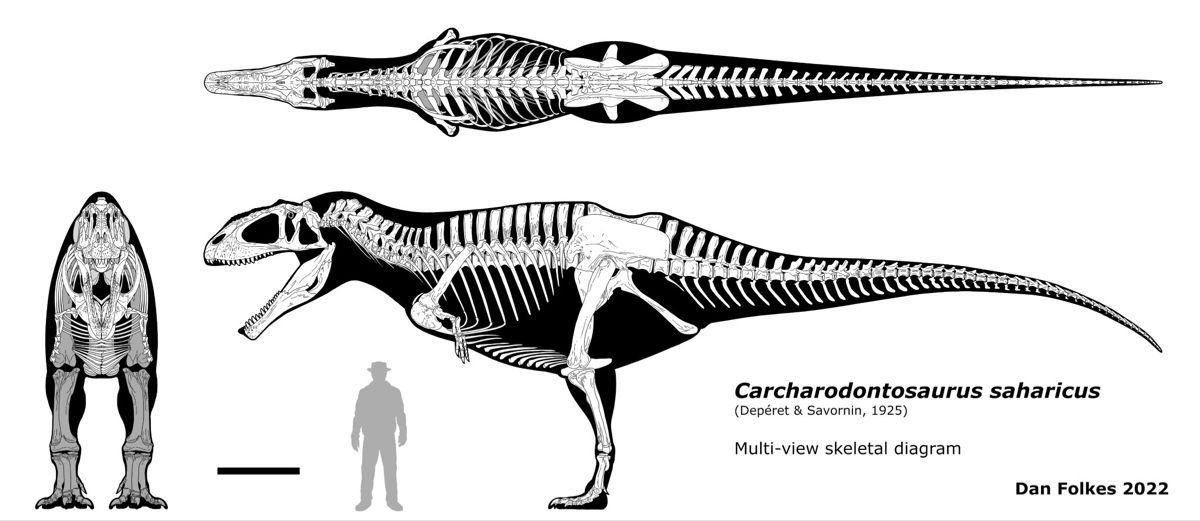
Carcharodontosaurus was a truly gigantic theropod, rivaling and possibly exceeding the size of the more famous Tyrannosaurus rex. Estimates based on fragmentary remains suggest a body length between 12 and 13.3 meters (39 to 44 feet) and a weight ranging from 6 to 15 metric tons. Its most defining feature was its enormous skull, which could reach up to 1.6 meters (5.2 feet) in length, making it one of the longest skulls of any theropod dinosaur. Unlike the robust, bone-crushing skull of Tyrannosaurus, the skull of Carcharodontosaurus was more elongated and lightly built, with large fenestrae (openings) that reduced its weight without compromising structural integrity. Its jaws were lined with dozens of serrated, laterally compressed teeth, each up to 20 centimeters (8 inches) long. These teeth were not designed for crushing bone but for slicing through flesh, inflicting deep, bleeding wounds on its prey. The rest of its skeleton was typical for a large theropod: a massive body balanced by a long, muscular tail, powerful hind limbs with three-toed feet, and proportionally small, three-fingered forelimbs. Its neck was short and S-shaped, providing the leverage needed to drive its massive head into prey. The overall build suggests an animal built for powerful, ambush-style attacks rather than prolonged chases.
As an apex predator, the paleobiology of Carcharodontosaurus was centered around hunting large prey. Its serrated, blade-like teeth indicate a feeding strategy focused on causing catastrophic blood loss. Instead of a bone-crushing bite like Tyrannosaurus, Carcharodontosaurus likely delivered rapid, slashing bites to the flanks and limbs of large sauropods and ornithopods, then waited for the animal to weaken from shock and exsanguination. This method would have been highly effective against the giant sauropods like Paralititan and Aegyptosaurus that shared its environment. Biomechanical studies of its skull suggest it could withstand significant stress from struggling prey. While direct evidence of social behavior is absent, some paleontologists speculate that Carcharodontosaurids may have hunted in groups to tackle the truly colossal sauropods that were otherwise too formidable for a single predator. Its powerful hind limbs suggest it was capable of moving with surprising speed for its size over short distances, though it was not a marathon runner. Like other large theropods, its metabolism was likely mesothermic, somewhere between that of a modern cold-blooded reptile and a warm-blooded mammal, allowing it to sustain the high energy levels required for an active predatory lifestyle while managing the thermal challenges of its immense body size.
The world Carcharodontosaurus inhabited was a vast, lush, river-delta and mangrove swamp system along the coast of the Tethys Sea, a stark contrast to the arid Sahara Desert that covers the region today. The climate was hot and humid, supporting a rich and diverse ecosystem teeming with life. Carcharodontosaurus stood at the pinnacle of this food web, a true 'hypercarnivore' in what has been dubbed the 'most dangerous place in Earth's history.' It shared this environment with a menagerie of other giant predators, creating a unique and highly competitive ecological niche. Its primary competition came from other massive carnivores like the spinosaurid Spinosaurus, a semi-aquatic predator that likely specialized in fish but would have competed for resources along the waterways, and the abelisaurid Rugops. The prey base was equally impressive, dominated by enormous sauropods such as the titanosaur Paralititan stromeri, which could reach over 25 meters in length, and the slightly smaller Aegyptosaurus. Other herbivores included the iguanodontian Ouranosaurus. The waterways were filled with giant fish like Onchopristis and Mawsonia, as well as massive crocodilians like Sarcosuchus, creating a complex and perilous environment where Carcharodontosaurus reigned as the dominant terrestrial predator.
The discovery history of Carcharodontosaurus is marked by loss and rediscovery. The first fossils, consisting of two teeth, were found in Algeria in 1925 by Charles Depéret and J. Savornin. They initially named the species Megalosaurus saharicus. Later, in 1927, more substantial remains, including a partial skull, femur, and vertebrae, were unearthed in the Bahariya Formation of Egypt by Ernst Stromer von Reichenbach's expedition. Recognizing the distinctiveness of the teeth, Stromer renamed the genus Carcharodontosaurus, meaning 'shark-toothed lizard,' in 1931. Tragically, this holotype specimen (IPHG 1922 X46) was housed in the Bavarian State Collection of Paleontology in Munich and was completely destroyed during an Allied bombing raid in April 1944. For over half a century, the 'shark-toothed lizard' was known only from Stromer's detailed descriptions and drawings. The genus was resurrected in 1995 when paleontologist Paul Sereno discovered a new, more complete skull (SGM-Din 1) in the Kem Kem Beds of Morocco, a geological formation equivalent in age to the Bahariya. This neotype specimen confirmed Stromer's observations and provided a wealth of new anatomical information, firmly re-establishing Carcharodontosaurus as one of the greatest predators of the Cretaceous.
Carcharodontosaurus is the namesake and a key member of the family Carcharodontosauridae, a group of giant allosauroid theropods that were the dominant apex predators in the southern continents (Gondwana) during the early to mid-Cretaceous period. This family includes other formidable carnivores like Giganotosaurus and Mapusaurus from South America and Acrocanthosaurus from North America. The Carcharodontosaurids represent a distinct evolutionary lineage of giant theropods that evolved separately from the tyrannosaurids, which dominated the northern continents (Laurasia) in the Late Cretaceous. The discovery of Carcharodontosaurus and its relatives revealed that the allosauroid lineage, thought to have dwindled after the Jurassic, actually flourished and produced some of the largest carnivores in Earth's history. They demonstrate a fascinating case of convergent evolution with tyrannosaurs, as both groups independently evolved massive body sizes and enormous skulls to fill the apex predator niche on their respective continents. The eventual extinction of the carcharodontosaurids around 90 million years ago, possibly due to environmental changes, paved the way for other predator groups, like the abelisaurids in Gondwana and the tyrannosaurids in Laurasia, to rise to dominance.
Despite the new material found by Sereno, several scientific debates surrounding Carcharodontosaurus persist. The primary issue is the precise upper limit of its size. Because all known specimens are incomplete, size estimates are extrapolations that vary between studies, leading to an ongoing debate about whether Carcharodontosaurus, Giganotosaurus, or Spinosaurus was truly the largest terrestrial carnivore. Another area of discussion involves its ecological relationship with Spinosaurus. While it is generally accepted that Spinosaurus was primarily piscivorous and Carcharodontosaurus was a terrestrial hunter, the degree of niche partitioning and potential conflict between these two giants in the same ecosystem is a topic of active research and speculation. The discovery of a second, closely related species, Carcharodontosaurus iguidensis, in Niger in 2007, distinguished by differences in its maxilla and braincase, has also raised questions about the diversity and geographic range of the genus across North Africa during the Cenomanian stage.
The fossil record of Carcharodontosaurus saharicus remains frustratingly sparse and fragmentary. The original holotype from Egypt was destroyed, and the neotype from Morocco, while including a significant portion of the skull, lacks the postcranial skeleton. Fossils attributed to this species are primarily found in the Cenomanian-aged deposits of North Africa, specifically the Bahariya Formation in Egypt and the Kem Kem Group in Morocco. Other fragmentary remains, mostly teeth, have been reported from Algeria, Tunisia, and Niger. The preservation quality of these fossils is generally poor to fair, often consisting of isolated bones and teeth rather than articulated skeletons. The harsh desert environments where these fossils are found contribute to their erosion and fragmentation. The Kem Kem beds are particularly famous for producing a high volume of isolated theropod teeth, many of which are assigned to Carcharodontosaurus, indicating it was a relatively common component of its faunal community, even if complete skeletons remain elusive.
Despite the scarcity of its fossil remains, Carcharodontosaurus has made a significant cultural impact, captivating the public imagination as a formidable rival to Tyrannosaurus rex. It has been featured prominently in television documentaries, including the BBC's 'Planet Dinosaur' and National Geographic's 'Bigger than T. rex,' which have showcased its immense size and its role in the unique North African ecosystem. Museums such as the University of Chicago and the National Geographic Museum have displayed casts of the neotype skull discovered by Paul Sereno, allowing the public to appreciate the sheer scale of this predator. Its evocative name and status as one of history's largest carnivores ensure its place in books, video games, and toy lines, making it a key figure in dinosaur education and popular science.
Classification
Time Period
Discovery
Location
Egypt
Formation
Bahariya Formation
Frequently Asked Questions
What is Carcharodontosaurus?
Carcharodontosaurus saharicus was a colossal carnivorous dinosaur that roamed North Africa during the Late Cretaceous period, approximately 100 to 94 million years ago. As one of the largest terrestrial predators ever discovered, its name, meaning 'shark-toothed lizard,' alludes to its formidable, b...
When did Carcharodontosaurus live?
Carcharodontosaurus lived during the cretaceous period of the mesozoic era approximately 100-94 million years ago.
Where was Carcharodontosaurus discovered?
Fossils of Carcharodontosaurus were discovered in Egypt in the Bahariya Formation.
What did Carcharodontosaurus eat?
Carcharodontosaurus was a carnivore. It lived in terrestrial habitats.
What type of fossil is Carcharodontosaurus?
Carcharodontosaurus is preserved as a body fossil. The preservation quality is poor.
Related Specimens
From the mesozoic era · body fossils