Big Al (MOR 693)
Allosaurus fragilis
Image: Image sourced via web search (Fair use / Educational)
About Big Al (MOR 693)
Big Al, officially designated by the specimen number MOR 693, is one of the most famous and exceptionally preserved dinosaur specimens ever discovered, representing a subadult Allosaurus fragilis. Living during the Late Jurassic period, approximately 155 to 150 million years ago, this remarkable apex predator roamed the vast, semi-arid floodplains of what is now the western United States. The specimen's unprecedented completeness and extensive record of healed injuries have provided paleontologists with an unparalleled window into the brutal reality of theropod life, making it a cornerstone in our understanding of dinosaur paleopathology, ontogeny, and paleoecology.
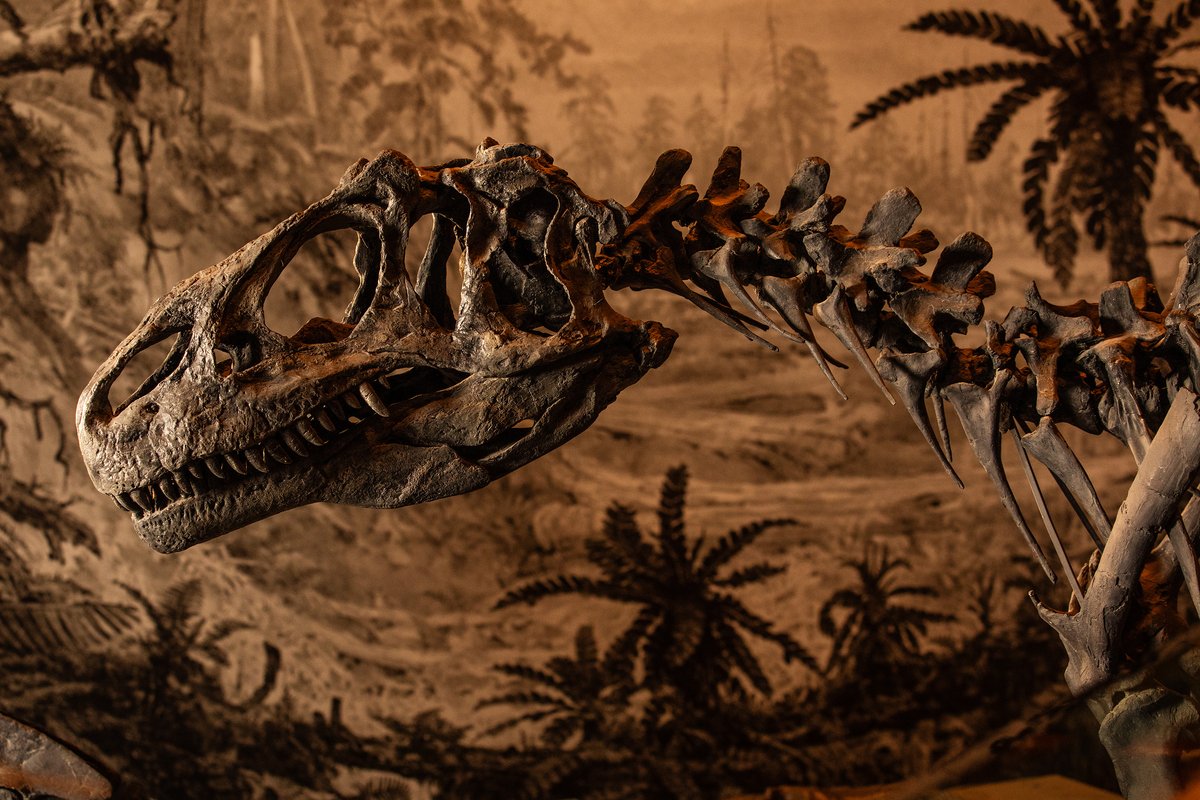
Big Al measured approximately 8 meters (about 26 feet) in length at the time of its death, which is slightly smaller than the 9.5 to 10 meters typically reached by fully mature Allosaurus fragilis individuals. Paleontologists estimate that this subadult weighed between 1,300 and 1,500 kilograms, comparable in mass to a modern adult rhinoceros, though distributed across a bipedal, elongated frame balanced by a long, muscular tail. The skull of Big Al is a marvel of predatory evolution, featuring the characteristic paired ridges or crests just above and in front of the eyes, which were likely covered in keratin and used for display or species recognition. Its jaws were lined with dozens of serrated, laterally compressed teeth designed for slicing through flesh rather than crushing bone. The forelimbs, though relatively short compared to the hindlimbs, were robust and heavily muscled, ending in three massive, recurved claws that were instrumental in grappling with struggling prey. What truly sets Big Al apart physically, however, is the staggering number of skeletal pathologies. The skeleton bears evidence of at least 19 distinct injuries and infections, including broken ribs, a fractured toe, and severe bone infections. The right foot exhibits a massive, swollen lesion on the middle toe, which would have caused excruciating pain and severely hampered the animal's ability to walk or hunt. These physical characteristics not only define the morphology of a Late Jurassic carnosaur but also vividly illustrate the immense physical toll exacted by an active predatory lifestyle.
The paleobiology of Allosaurus fragilis, as illuminated by Big Al, reveals a highly active, fast-growing, and aggressive apex predator. As an obligate carnivore, Big Al's diet consisted primarily of the abundant herbivorous dinosaurs of its ecosystem, including ornithopods, stegosaurs, and juvenile sauropods. Biomechanical studies of the Allosaurus skull suggest that it possessed a relatively weak bite force compared to later tyrannosaurids; however, it compensated for this with a specialized hunting technique. Paleontologists hypothesize that Allosaurus used its skull like a hatchet, driving its upper jaw downward into prey with the force of its powerful neck muscles, inflicting massive blood loss and shock. Big Al's extensive injuries provide profound insights into its behavior and life history. The sheer number of healed fractures and chronic infections indicates an incredibly resilient immune system and a rapid metabolic rate capable of sustaining extensive tissue repair. The severe infection in its right foot likely altered its locomotion, forcing a pronounced limp that may have ultimately contributed to its death by starvation or an inability to capture prey. Histological analysis of Big Al's bones indicates that it was still actively growing at the time of its demise, estimated to be around 15 years old. This suggests an avian-like growth trajectory, characterized by rapid juvenile growth spurts followed by a plateau upon reaching sexual maturity. The presence of multiple healed injuries also hints at frequent, violent encounters, either with formidable prey items like Stegosaurus, or in intraspecific combat with other Allosaurus individuals for territory or mating rights.
Big Al inhabited the vast, semi-arid floodplains of the Morrison Formation, a sprawling geological sequence that covered much of the western interior of North America during the Late Jurassic. The climate was characterized by distinct wet and dry seasons, creating a dynamic and sometimes harsh environment dominated by gallery forests of conifers, tree ferns, and ginkgoes along river channels, interspersed with expansive, fern-covered savannas. This ecosystem supported an astonishing diversity of megafauna, representing one of the most productive dinosaur habitats in Earth's history. Big Al shared its world with colossal sauropods such as Diplodocus, Apatosaurus, and Brachiosaurus, which browsed the high canopy and dominated the landscape through sheer size. The heavily armored Stegosaurus and the swift, bipedal Camptosaurus were also common, serving as primary prey targets for a hungry Allosaurus. In this complex food web, Allosaurus fragilis occupied the apex predator niche, though it was not the only carnivore. Big Al would have competed with other large theropods like the massive Torvosaurus and the agile Ceratosaurus. The seasonal droughts of the Morrison ecosystem likely forced these animals into intense competition around shrinking water holes, a scenario that may have led to the very injuries preserved in Big Al's skeleton. The ecological pressures of this environment demanded a combination of speed, strength, and adaptability, traits that Allosaurus possessed in abundance, allowing it to become the most successful and numerous large predator of its time and place.
The discovery of Big Al is a landmark event in the annals of North American paleontology. The specimen was unearthed in 1991 near Shell, Wyoming, in the renowned Howe Dinosaur Quarry area of the Morrison Formation. The discovery was made by a Swiss team led by Kirby Siber, who were initially prospecting for sauropod remains. Recognizing the significance of the articulated theropod skeleton, the team collaborated with the Museum of the Rockies (MOR) and the University of Wyoming Geological Museum to carefully excavate the site. The specimen was officially cataloged as MOR 693 but quickly acquired the affectionate nickname 'Big Al' due to its impressive size and exceptional state of preservation. The excavation process revealed a skeleton that was approximately 95 percent complete, an extreme rarity for large theropod dinosaurs, which are typically found as isolated bones or fragmentary skeletons. The bones were found in a state of near-perfect articulation, suggesting that the animal was buried relatively quickly after death, possibly in a dried riverbed that suddenly flooded. Following its excavation, Big Al was transported to the Museum of the Rockies in Bozeman, Montana, where it underwent years of meticulous preparation and study. The discovery of Big Al not only provided a nearly complete anatomical map of Allosaurus fragilis but also sparked a renewed wave of interest in dinosaur paleopathology, as researchers from around the world flocked to study its extensive catalog of prehistoric injuries.
Big Al holds immense evolutionary significance as a quintessential representative of the Allosauroidea, a major clade of large-bodied theropod dinosaurs that dominated terrestrial ecosystems globally from the Middle Jurassic to the Late Cretaceous. Within the broader theropod family tree, Allosaurus belongs to the Carnosauria, a group distinct from the Coelurosauria, which includes tyrannosaurs and modern birds. The anatomy of Big Al perfectly encapsulates the evolutionary pinnacle of the carnosaur body plan: a balance of size, speed, and lethal weaponry without the extreme cranial robusticity seen in later tyrannosaurs. By studying Big Al, paleontologists can trace the evolutionary trajectory of theropod forelimbs, noting how the three-fingered, highly functional grasping hands of Allosaurus represent an intermediate stage between the primitive, four- or five-fingered hands of early theropods and the highly reduced, two-fingered appendages of Late Cretaceous apex predators. Furthermore, the pneumaticity of Big Al's skeleton—the presence of air sacs within the vertebrae—provides crucial evidence for the evolution of the complex, bird-like respiratory system in non-avian dinosaurs. This anatomical feature suggests that Allosaurus possessed a highly efficient, unidirectional airflow system, which would have supported a high metabolic rate and active lifestyle. The evolutionary success of the Allosaurus lineage is evident in its wide geographic distribution and longevity, and Big Al serves as the ultimate anatomical reference point for understanding how these magnificent predators adapted and thrived over millions of years.
Despite the wealth of data provided by Big Al, the specimen and its species remain at the center of several ongoing scientific debates. One major area of contention involves the feeding behavior of Allosaurus. While traditionally viewed as an active apex predator, some researchers have argued that the relatively weak bite force of Allosaurus might indicate a greater reliance on scavenging than previously thought. However, the hatchet-jaw hypothesis, supported by the robust neck musculature and reinforced skull structure of specimens like Big Al, strongly counters this, suggesting a specialized, active hunting style. Another debate centers on the social behavior of Allosaurus. The discovery of multiple Allosaurus individuals of varying ages at sites like the Cleveland-Lloyd Dinosaur Quarry has led to speculation about pack-hunting behavior. Critics argue that these aggregations might simply represent predator traps or feeding frenzies around a carcass, rather than coordinated social groups. Big Al's numerous injuries are often cited in this debate; some argue that surviving such severe trauma would require support from a pack, while others maintain that the injuries simply demonstrate the incredible hardiness of a solitary survivor.
The fossil record of Allosaurus fragilis is arguably the best of any large theropod dinosaur, and Big Al represents its crown jewel. Fossils of this species are predominantly found throughout the Morrison Formation, spanning states such as Colorado, Utah, Wyoming, and New Mexico. To date, remains of dozens, if not hundreds, of individuals have been recovered, ranging from isolated teeth and fragmented bones to nearly complete skeletons. The Cleveland-Lloyd Dinosaur Quarry in Utah is particularly famous, having yielded the remains of at least 46 Allosaurus individuals, providing an unprecedented sample size for population studies. However, the preservation quality of Big Al (MOR 693) is truly exceptional, standing at roughly 95 percent complete. Typically, theropod fossils are found lacking delicate structures like the gastralia, the tip of the tail, or the complete skull. Big Al, remarkably, preserves almost all of these fragile elements in exquisite detail, allowing for advanced biomechanical modeling and pathological analysis.
Big Al has achieved a level of cultural prominence matched by very few individual dinosaur specimens, rivaling even the famous Tyrannosaurus rex named Sue. The specimen's dramatic life story, written in its scarred bones, captured the public imagination and became the focus of the acclaimed 2000 BBC documentary special, Walking with Dinosaurs: The Ballad of Big Al. This groundbreaking program utilized the specific pathologies found on MOR 693 to reconstruct a speculative but scientifically grounded narrative of the dinosaur's life, from hatching to its tragic, painful death. Today, the original fossilized bones of Big Al are carefully housed and studied at the Museum of the Rockies, while high-quality cast replicas are proudly displayed in major natural history museums around the world, continuing to inspire future generations of paleontologists.
Classification
Time Period
Discovery
Location
Wyoming, United States
Formation
Morrison Formation
Frequently Asked Questions
What is Big Al (MOR 693)?
Big Al, officially designated by the specimen number MOR 693, is one of the most famous and exceptionally preserved dinosaur specimens ever discovered, representing a subadult Allosaurus fragilis. Living during the Late Jurassic period, approximately 155 to 150 million years ago, this remarkable ape...
When did Big Al (MOR 693) live?
Big Al (MOR 693) lived during the jurassic period of the mesozoic era approximately 155-150 million years ago.
Where was Big Al (MOR 693) discovered?
Fossils of Big Al (MOR 693) were discovered in Wyoming, United States in the Morrison Formation.
What did Big Al (MOR 693) eat?
Big Al (MOR 693) was a carnivore. It lived in terrestrial habitats.
What type of fossil is Big Al (MOR 693)?
Big Al (MOR 693) is preserved as a body fossil. The preservation quality is exceptional.
Related Specimens
From the mesozoic era · body fossils