Bothriolepis
Bothriolepis canadensis
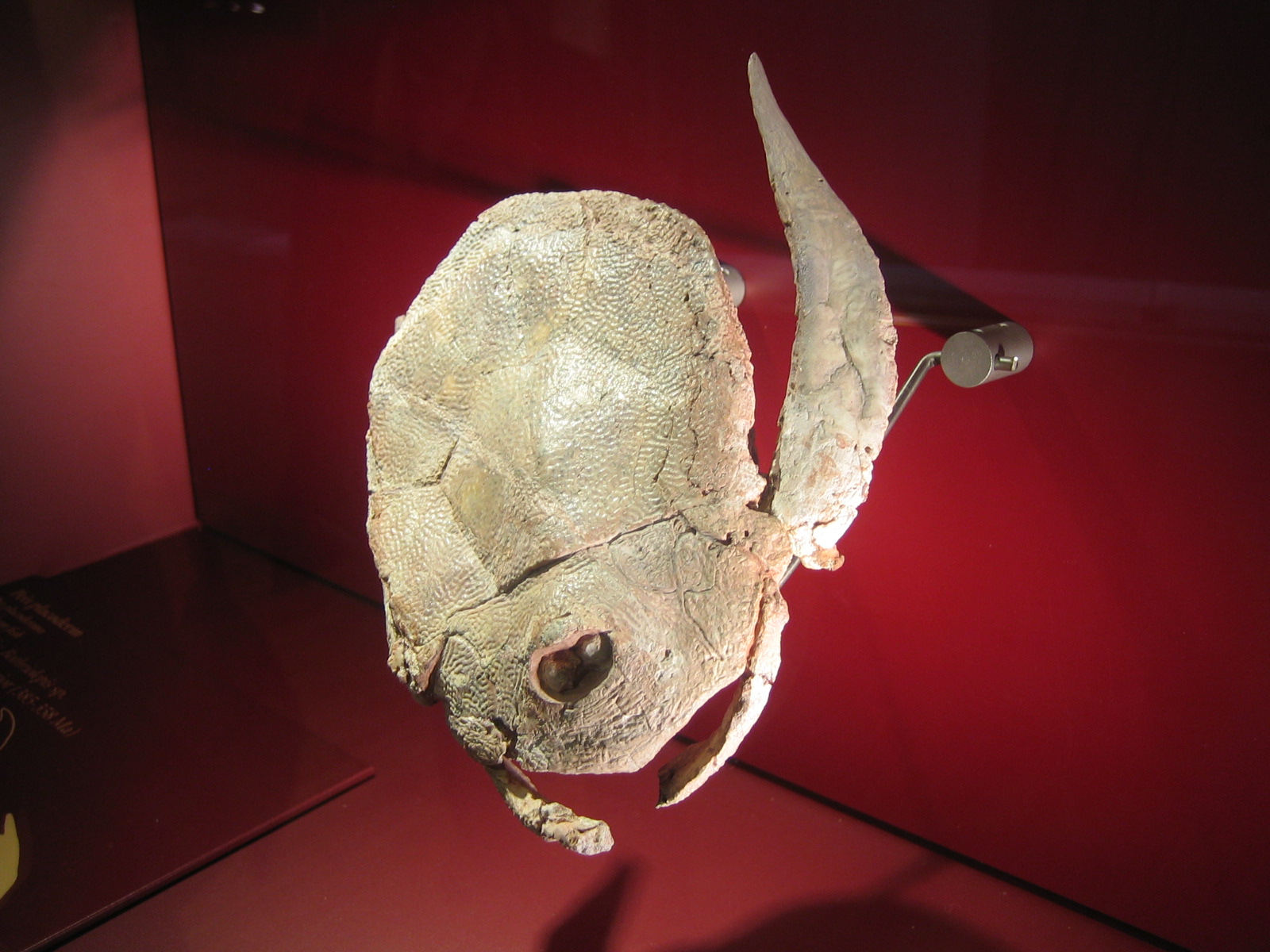
Image: File:Bothriolepis fossil.jpg - Wikimedia Commons (CC BY-SA)
About Bothriolepis
Bothriolepis canadensis is one of the most abundant and widely recognized placoderms, a group of extinct armored fishes that dominated the aquatic environments of the Devonian period. This remarkable creature, which lived approximately 382 to 370 million years ago, represents a pinnacle of success for the antiarch placoderms, a specialized subgroup known for their unique body plan. Found in astonishing numbers in the Escuminac Formation of Miguasha, Quebec, Canada, Bothriolepis provides an unparalleled window into the life and times of early jawed vertebrates during a critical phase of their evolution.
The physical appearance of Bothriolepis canadensis was both bizarre and highly specialized, a testament to its adaptation for a benthic, or bottom-dwelling, lifestyle. Typically measuring between 30 to 40 centimeters in length, though some individuals could reach up to a meter, it possessed a distinct two-part body. The anterior portion, comprising the head and thorax, was encased in a heavy, box-like armor made of thick, interlocking bony plates. This rigid shield provided substantial protection from predators like the lobe-finned fish Eusthenopteron or early sharks that shared its habitat. The head shield was flattened dorsally, featuring small, closely set eyes positioned on the top of the head, granting it a periscopic view of its surroundings while remaining concealed on the substrate. A single nostril opening was located between the eyes. The most striking feature was its pair of long, jointed pectoral appendages, which were also covered in articulated bony plates. These appendages, often compared to the limbs of arthropods, were not fins in the traditional sense but rather rigid, spine-like structures that could be moved at a complex joint connecting them to the thoracic shield. The posterior half of the body, in stark contrast, was unarmored, covered in small scales, and highly flexible, terminating in a whiplash-like heterocercal tail where the vertebral column extended into the larger upper lobe. This combination of a heavily armored front and a nimble, muscular tail created a unique "armored tadpole" silhouette unlike any fish alive today.
The paleobiology of Bothriolepis was intrinsically linked to its unusual anatomy. Its flattened ventral surface, dorsally placed eyes, and ventrally oriented mouth strongly indicate a life spent on the muddy or sandy bottoms of rivers, lakes, and estuaries. It was a detritivore, a bottom-feeder that subsisted on organic matter in the sediment. Its mouth was small and lacked the powerful, shearing jaw plates seen in predatory placoderms like Dunkleosteus. Instead, it possessed small, weak gnathal plates that were likely used to scoop or shovel mud and detritus. The animal would have ingested large amounts of substrate, with its digestive system extracting nutrients from decaying plant and animal matter, algae, and microorganisms. Locomotion was likely a combination of tail propulsion and appendage use. The flexible, muscular tail would have provided the primary thrust for swimming in short bursts. The unique, jointed pectoral appendages were multi-functional tools. They could have been used to prop the animal up on the substrate, to "walk" or punt along the bottom in a manner similar to modern frogfishes, or to dig into the sediment to search for food or conceal itself from predators. Growth patterns, studied from the vast fossil collections at Miguasha, show that Bothriolepis experienced determinate growth, reaching a maximum size after which growth slowed or ceased, a pattern seen in many modern vertebrates.
The ecological context of Bothriolepis canadensis is exceptionally well-documented thanks to the Escuminac Formation, which preserves an entire ancient ecosystem. During the Late Devonian, the Miguasha region was a vast, subtropical estuary or bay, fed by freshwater rivers and connected to the sea. The climate was warm and likely subject to seasonal variations, including periods of heavy rainfall and potential drought, which may have led to anoxic (low-oxygen) conditions in the water. Bothriolepis was the most numerous vertebrate in this environment, occupying the niche of a primary consumer or decomposer at the base of the vertebrate food web. It shared this habitat with a diverse array of other organisms. Its primary predators were likely the large lobe-finned fishes, such as the 2-meter-long Eusthenopteron, and the early sarcopterygian Platycephalichthys. Other contemporaries included the primitive lungfish Scaumenacia, the early ray-finned fish Cheirolepis, and the enigmatic, jawless anaspid fish Endeiolepis. The sheer abundance of Bothriolepis suggests it was a crucial food source for the larger predators of the Escuminac ecosystem, forming a vital link between the detrital base and the higher trophic levels.
The discovery history of Bothriolepis is deeply intertwined with the development of paleontology in Canada. While fossils of the genus were found in Europe earlier, the species Bothriolepis canadensis was first scientifically described by Joseph Frederick Whiteaves in 1880, based on specimens collected from the cliffs along the Scaumenac Bay (now Miguasha) in Quebec. These initial discoveries were made by local collectors and geologists surveying the region for the Geological Survey of Canada. However, it was the work of later paleontologists, such as the Swedish researcher Erik Stensiö in the 1930s and 1940s, that truly revolutionized our understanding of the genus. Stensiö employed a meticulous serial grinding technique, where he would grind away a fossil millimeter by millimeter, drawing each exposed layer to create a three-dimensional reconstruction of the internal anatomy, including the braincase, nerves, and blood vessels. This painstaking work revealed the intricate internal structures of placoderms in unprecedented detail. Later expeditions to Miguasha, led by figures like Erik Jarvik and later Richard Cloutier, unearthed thousands of specimens, making the Escuminac Formation the world's premier locality for studying this animal and its Devonian ecosystem.
Bothriolepis holds a significant position in the evolutionary history of vertebrates. As a member of the Placodermi, it belongs to one of the earliest successful radiations of jawed vertebrates (gnathostomes). The placoderms were a diverse and globally dominant group during the Devonian, but they went extinct at the end of the period, leaving no direct descendants. Bothriolepis itself represents a highly specialized branch within the placoderms known as the antiarchs. The evolutionary origin of their unique, arthropod-like pectoral appendages remains a topic of study, but they represent a remarkable example of convergent evolution for benthic locomotion. One of the most profound discoveries related to Bothriolepis is the evidence of air-breathing capabilities. Exceptionally preserved fossils from Australia have revealed traces of what appear to be paired, sac-like structures connected to the pharynx, interpreted as primitive lungs. This suggests that Bothriolepis, living in potentially oxygen-poor estuarine environments, may have been able to gulp air from the surface to supplement its gill-based respiration. This feature provides crucial insight into the early evolution of lungs, a key adaptation that would later allow vertebrates to transition to terrestrial life.
Despite being one of the best-known fossil fishes, Bothriolepis is still the subject of scientific debate. The precise function of its peculiar pectoral appendages continues to be discussed. While the consensus points to a role in benthic locomotion and digging, the exact range of motion and the mechanics of how they were used are still being modeled and refined. Some early hypotheses suggested they could have been used for defense, locking into a forward position to deter predators, though this is now considered less likely than their primary role in movement and substrate interaction. Another area of ongoing research is the taxonomy within the genus Bothriolepis itself, which contains over one hundred named species worldwide. Distinguishing between genuine species and variations due to age, sex, or local environment (ecophenotypic variation) is a significant challenge for paleontologists and has led to ongoing revisions of the group's classification. The discovery of potential lung structures has also fueled discussion about its physiology and whether it could have survived for short periods out of water, perhaps moving between pools during droughts.
The fossil record of Bothriolepis is nothing short of extraordinary, making it one of the most completely understood of all extinct vertebrates. Fossils of the genus have been found on every continent, including Antarctica, attesting to its global distribution and success during the Late Devonian. However, the Escuminac Formation in Miguasha National Park, a UNESCO World Heritage Site, is unparalleled in both the quantity and quality of its Bothriolepis canadensis specimens. Tens of thousands of complete, articulated individuals have been recovered from this single locality. The fine-grained sediment of the ancient estuary led to exceptional preservation, capturing not only the bony armor but also, in rare cases, impressions of soft tissues, gut contents, and internal organs. This fossil bonanza allows for detailed studies of its entire life cycle, from juveniles just a few centimeters long to large adults, providing a unique dataset for analyzing population dynamics, growth rates, and ontogeny in an animal that lived over 370 million years ago. Its incredible abundance and wide geographic range make Bothriolepis an important index fossil, helping paleontologists date and correlate rock layers from the Frasnian age of the Late Devonian around the world.
Due to its bizarre appearance and exceptional fossil record, Bothriolepis canadensis has earned a notable place in museums and educational materials worldwide. It is a signature fossil of the Devonian Period, often called the "Age of Fishes," and features prominently in exhibits at the Miguasha National Park's museum, the Canadian Museum of Nature, and many other natural history institutions. Its well-preserved remains serve as a perfect educational tool for explaining concepts like adaptation, extinction, and the diversity of ancient life. While it may not have the same celebrity status as dinosaurs, for anyone interested in the history of vertebrate life, Bothriolepis is an iconic and unforgettable representative of a lost world.
Classification
Time Period
Discovery
Location
Miguasha, Quebec, Canada
Formation
Escuminac Formation
Frequently Asked Questions
What is Bothriolepis?
Bothriolepis canadensis is one of the most abundant and widely recognized placoderms, a group of extinct armored fishes that dominated the aquatic environments of the Devonian period. This remarkable creature, which lived approximately 382 to 370 million years ago, represents a pinnacle of success f...
When did Bothriolepis live?
Bothriolepis lived during the devonian period of the paleozoic era approximately 382-370 million years ago.
Where was Bothriolepis discovered?
Fossils of Bothriolepis were discovered in Miguasha, Quebec, Canada in the Escuminac Formation.
What did Bothriolepis eat?
Bothriolepis was a detritivore. It lived in freshwater and estuarine habitats.
What type of fossil is Bothriolepis?
Bothriolepis is preserved as a body fossil. The preservation quality is exceptional.
Related Specimens
From the paleozoic era · body fossils