Kronosaurus
Kronosaurus queenslandicus
Image: Image sourced via web search (Fair use / Educational)
About Kronosaurus
Kronosaurus queenslandicus was a colossal marine reptile that patrolled the shallow inland seas of ancient Australia during the Early Cretaceous period, approximately 125 to 100 million years ago. As one of the largest members of the Pliosauridae family, this apex predator represents a pinnacle of marine reptilian evolution, renowned for its immense size, powerful bite, and formidable hunting capabilities. Its discovery has provided crucial insights into the structure of Cretaceous marine ecosystems and the sheer scale that life could achieve in the Mesozoic oceans.
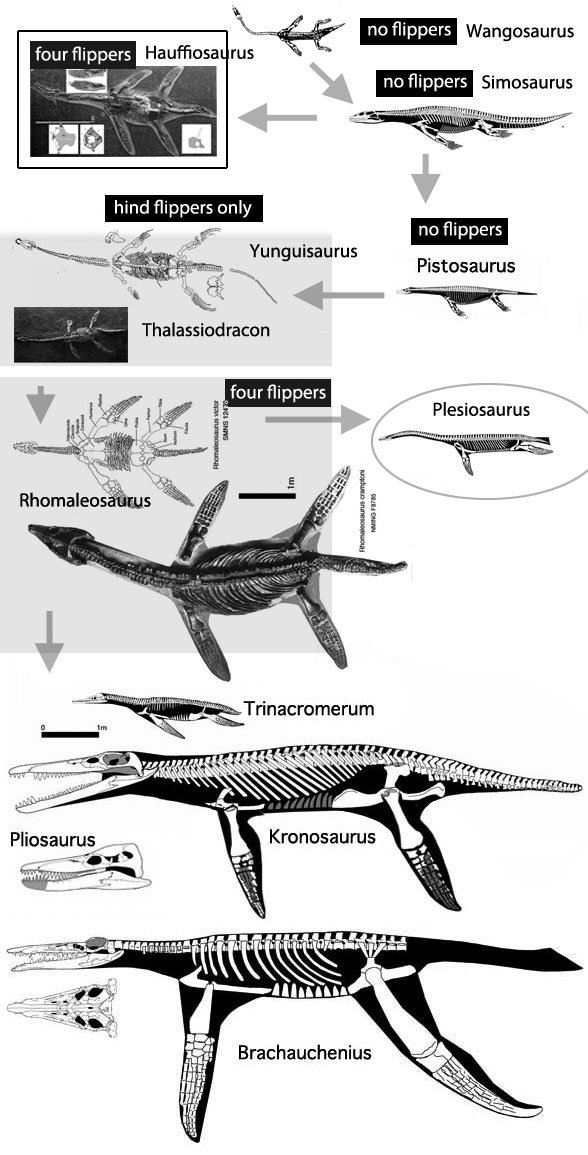
Kronosaurus was a truly gigantic animal, with modern estimates placing its total body length between 9 and 10.5 meters (approximately 30 to 34 feet). Earlier, more sensationalized reconstructions suggested lengths of up to 12.8 meters, but these have been revised downward based on more rigorous anatomical analysis. Its weight is estimated to have been in the range of 10 to 12 metric tons, making it comparable in mass to a modern orca or a large bus. The most striking feature of Kronosaurus was its enormous, robust skull, which could reach lengths of 2.2 to 2.7 meters (7 to 9 feet), accounting for nearly a quarter of its total body length. This massive head was armed with a formidable array of large, conical, and deeply rooted teeth, some exceeding 7 centimeters in length beyond the gum line, with total lengths including the root reaching up to 30 centimeters. These teeth were not designed for shearing but for puncturing and crushing, ideal for dispatching large prey. The skull was relatively short and wide compared to other pliosaurs, giving it a powerful, bulldog-like appearance. Its body was teardrop-shaped and streamlined, propelled by four enormous, wing-like flippers. The front flippers were slightly larger than the rear ones, providing the primary thrust for locomotion. Its neck was short and muscular, a characteristic trait of pliosaurs, allowing for powerful head movements to capture struggling prey. The tail was relatively short and likely served more for steering and stability than for propulsion.
The paleobiology of Kronosaurus paints a picture of a fearsome apex predator. Its diet consisted of a wide range of marine fauna, including large fish, ammonites, sea turtles like Notochelone, and even other marine reptiles. Direct evidence for its diet comes from fossil stomach contents, which have included the remains of turtles and other plesiosaurs, such as Eromangasaurus. The powerful jaws and robust, conical teeth suggest a hunting strategy based on ambush and overwhelming force. Kronosaurus likely used its massive flippers to generate powerful bursts of speed from a standstill, surprising prey from below. Its bite force would have been immense, capable of crushing the shells of turtles and the bones of other large reptiles. Locomotion was achieved through a form of underwater flight, with the four large flippers beating in a coordinated pattern, likely with the front pair providing the main propulsive force and the rear pair assisting with power and steering. This method of swimming would have been highly efficient for cruising through the shallow Eromanga Sea that covered much of inland Australia at the time. There is no direct evidence for social behavior, but like many modern large marine predators, it may have been a solitary hunter. Its metabolism was likely higher than that of modern reptiles, a condition known as mesothermy, which would have been necessary to sustain an active predatory lifestyle in the relatively cool epicontinental seas.
During the Early Cretaceous, Kronosaurus inhabited the Eromanga Sea, a vast, shallow epicontinental sea that covered large parts of eastern Australia. The climate was temperate to warm, and the sea was teeming with life. As the apex predator, Kronosaurus occupied the highest trophic level in this marine ecosystem. Its prey included a diverse array of animals. Giant ammonites, cephalopods with coiled shells, were abundant. Large bony fish also formed part of its diet. Critically, it preyed upon other marine reptiles. The long-necked plesiosaur Woolungasaurus and the ichthyosaur Platypterygius were potential prey items. The presence of remains from the plesiosaur Eromangasaurus within a Kronosaurus specimen confirms this predator-prey relationship. This indicates that Kronosaurus was capable of hunting and killing other large, powerful marine reptiles, cementing its status at the top of the food web. The only potential competitors or threats to a fully grown Kronosaurus would have been other large Kronosaurus individuals. This ecological dominance highlights the role of pliosaurs as the super-predators of the Cretaceous seas, filling a niche similar to that of modern great white sharks and orcas, but on a significantly larger scale.
The discovery history of Kronosaurus is rooted in the fossil-rich landscapes of Queensland, Australia. The first fragment, a piece of jawbone containing six teeth, was found in 1899 by Andrew Crombie near the town of Hughenden. This specimen was sent to the Queensland Museum and formally described by Heber Longman in 1924, who named it Kronosaurus queenslandicus in honor of the Titan Kronos from Greek mythology, a fitting name for such a gigantic predator. However, the true scale of the animal was not realized until 1932, when a team from Harvard University, led by William E. Schevill, discovered a remarkably complete skeleton in an army camp near Richmond, Queensland. This specimen, now housed at the Harvard Museum of Comparative Zoology (MCZ 1285), became the most famous and complete Kronosaurus fossil ever found. The excavation was a monumental effort, requiring the use of explosives to break up the surrounding limestone. The subsequent reconstruction at Harvard in the 1950s, however, was fraught with inaccuracies, including the use of too many vertebrae which artificially lengthened the animal, leading to the exaggerated size estimates that persisted for decades. This iconic but flawed mount shaped public perception of the animal for over half a century until it was re-evaluated and corrected.
Kronosaurus belongs to the family Pliosauridae, a group of short-necked plesiosaurs that were dominant marine predators for much of the Jurassic and Cretaceous periods. Within the Plesiosauria order, pliosaurs represent a distinct evolutionary lineage characterized by massive skulls, short necks, and powerful, streamlined bodies. Kronosaurus is considered one of the most derived and largest members of this family. Its evolutionary history demonstrates the trend towards gigantism seen in several marine reptile lineages during the Mesozoic. The development of such large body sizes and powerful feeding apparatuses allowed pliosaurs to exploit a wide range of prey, including other large marine vertebrates. While plesiosaurs as a whole have no direct modern descendants, having gone extinct at the end of the Cretaceous period, their position as diapsid reptiles places them broadly within the same group that includes modern lizards, snakes, and birds. Studying the anatomy and biomechanics of Kronosaurus provides invaluable data on the functional morphology of large-bodied marine predators and the evolutionary pathways that lead to the development of such specialized and powerful forms. It serves as a prime example of convergent evolution, with its body plan and ecological role paralleling those of later marine predators like the mosasaurs and, much later, cetaceans like the orca.
Despite its fame, Kronosaurus has been the subject of significant scientific debate, primarily concerning its true size and taxonomy. The original Harvard reconstruction of MCZ 1285 included too many vertebrae, leading to an inflated length estimate of 12.8 meters. In 2003, paleontologist Colin McHenry conducted a thorough re-examination, concluding that the true length was closer to 9-10.5 meters. This revision has been widely accepted, correcting a long-standing misconception. Another major debate revolves around the classification of a similarly large pliosaur from Colombia, initially named Kronosaurus boyacensis. This specimen, a nearly complete skeleton, is even larger than the Australian material. However, detailed anatomical studies published in 2021 by Noè and Gómez-Pérez revealed significant differences in skull and postcranial anatomy, leading to the erection of a new genus for the Colombian specimen, Monquirasaurus boyacensis. This reclassification restricts the genus Kronosaurus to the Australian species, K. queenslandicus, and highlights the diversity of giant pliosaurs during the Cretaceous. These debates underscore the dynamic nature of paleontology, where new analyses and discoveries continually refine our understanding of prehistoric life.
The fossil record of Kronosaurus is geographically restricted to the Early Cretaceous marine deposits of Queensland, Australia, primarily within the Toolebuc and Wallumbilla Formations. These formations represent the sediments of the ancient Eromanga Sea. While fossils are rare, the specimens that have been found are often of good quality, though typically disarticulated. The most significant specimen remains MCZ 1285, the nearly complete skeleton at Harvard, which includes a well-preserved skull and much of the postcranial skeleton. Other important fossils are housed in Australian museums, including the Queensland Museum and the Kronosaurus Korner museum in Richmond, Queensland. This regional museum holds several key specimens, including a nearly complete skull and mandible, providing crucial anatomical data. The preservation often occurs in limestone nodules, which can protect the bones from crushing and distortion, allowing for detailed study. The rarity of complete, articulated skeletons means that each new discovery is of immense scientific importance, offering the potential to further clarify the anatomy, growth, and behavior of this ancient sea monster.
Kronosaurus has made a significant impact on popular culture, frequently depicted as the ultimate sea monster of the dinosaur age. Its immense size and terrifying appearance have made it a staple in books, television documentaries, and video games about prehistoric life. The iconic, albeit oversized, skeleton mounted at the Harvard Museum of Comparative Zoology has captivated generations of visitors and served as a powerful visual representation of the scale of Mesozoic marine predators. The Kronosaurus Korner museum in Richmond, Queensland, has become a major tourist and educational center, built around the region's rich fossil heritage and featuring impressive displays of Kronosaurus and other local marine reptiles. This public fascination makes Kronosaurus an important ambassador for paleontology, inspiring interest in Earth's deep past and the incredible creatures that once inhabited its oceans.
Classification
Time Period
Discovery
Location
Australia
Formation
Toolebuc Formation, Wallumbilla Formation
Frequently Asked Questions
What is Kronosaurus?
Kronosaurus queenslandicus was a colossal marine reptile that patrolled the shallow inland seas of ancient Australia during the Early Cretaceous period, approximately 125 to 100 million years ago. As one of the largest members of the Pliosauridae family, this apex predator represents a pinnacle of m...
When did Kronosaurus live?
Kronosaurus lived during the cretaceous period of the mesozoic era approximately 125-100 million years ago.
Where was Kronosaurus discovered?
Fossils of Kronosaurus were discovered in Australia in the Toolebuc Formation, Wallumbilla Formation.
What did Kronosaurus eat?
Kronosaurus was a carnivore. It lived in marine, shallow-sea habitats.
What type of fossil is Kronosaurus?
Kronosaurus is preserved as a body fossil. The preservation quality is good.
Related Specimens
From the mesozoic era · body fossils