Pachycephalosaurus
Pachycephalosaurus wyomingensis
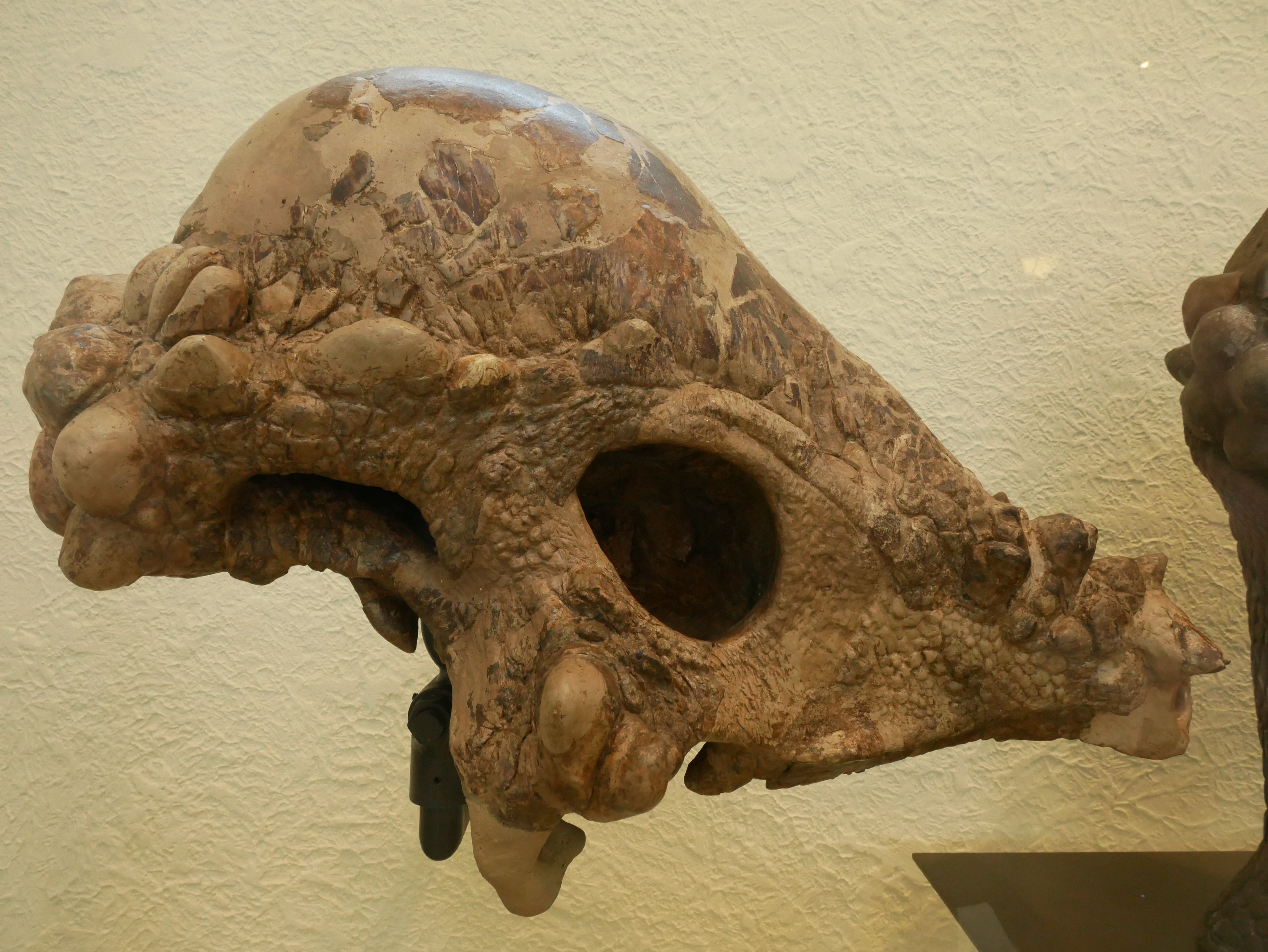
Image: File:AMNH 1696 Pachycephalosaurus.jpg - Wikimedia Commons (CC BY-SA)
About Pachycephalosaurus
Pachycephalosaurus wyomingensis, the "thick-headed lizard from Wyoming," stands as one of the most iconic and enigmatic dinosaurs of the Late Cretaceous Period. This bipedal herbivore roamed the floodplains of western North America between 70 and 66 million years ago, making it one of the last non-avian dinosaurs to witness the twilight of the Mesozoic Era before the cataclysmic Cretaceous-Paleogene extinction event. Its fame stems almost entirely from its extraordinary skull, a massive, dome-shaped helmet of solid bone that has fueled decades of scientific debate and captured the public imagination.
Pachycephalosaurus was a moderately sized dinosaur, with adult individuals reaching an estimated length of 4.5 meters (approximately 15 feet) from snout to tail and weighing around 450 kilograms (nearly 1,000 pounds), comparable in size to a modern-day pony or a small cow. It possessed a classic bipedal ornithischian body plan, characterized by a bulky torso, a relatively short and thick S-shaped neck, and a long, stiffened tail held aloft for balance. Its forelimbs were notably short and slender, likely used for grasping low-lying vegetation rather than for locomotion or defense. In stark contrast, its hindlimbs were long, robust, and powerfully muscled, indicating it was a capable and potentially swift runner, an essential trait for evading predators like Tyrannosaurus rex. The most spectacular feature, however, was its cranium. The skull roof formed a solid, thickened dome of bone that could reach an astonishing 25 centimeters (10 inches) in thickness. This dome was not smooth but was adorned with a fringe of bony knobs and small, blunt spikes along its posterior and lateral edges, with additional clusters of pointed tubercles on the snout. This unique cranial morphology, unparalleled in its extreme development, has made Pachycephalosaurus a subject of intense paleontological interest and speculation.
The paleobiology of Pachycephalosaurus is largely inferred from its distinctive anatomy and the environment it inhabited. Its small, leaf-shaped teeth with serrated crowns were not suited for processing tough, fibrous plant matter. Instead, they suggest a selective diet consisting of softer vegetation, such as leaves, fruit, seeds, and possibly even insects. This feeding strategy implies it was a low-level browser, using its narrow beak to pluck food items before processing them with its cheek teeth. Its powerful hindlimbs suggest a dynamic lifestyle; it was likely agile enough to navigate the complex forest and floodplain environments of its habitat and could probably achieve significant bursts of speed to escape danger. The most debated aspect of its biology is the function of its cranial dome. The prevailing hypothesis, championed by paleontologists like Peter Galton and Hans-Dieter Sues, posits that the dome was used for intraspecific combat, particularly head-butting or flank-butting contests between males competing for mates or territory, analogous to the behavior of modern bighorn sheep. Histological studies of the dome's internal structure reveal a dense arrangement of bone fibers well-suited to absorb and dissipate impact forces. Furthermore, analysis of fossil skulls has revealed pathologies, such as lesions and fractures, consistent with high-impact trauma. Growth studies, notably by Jack Horner and Mark Goodwin, have shown that the dome developed significantly with age, starting as a flat, ornamented structure in juveniles and progressively inflating into the massive dome of adults, suggesting it was a feature linked to social signaling and sexual maturity.
Pachycephalosaurus lived in the lush, subtropical coastal plain environment represented by the Hell Creek Formation of the western United States. During the Late Cretaceous, this region was a vast, low-lying floodplain crisscrossed by rivers and streams, bordering the Western Interior Seaway. The climate was warm and humid, supporting a rich ecosystem of dense forests dominated by conifers, cycads, and early flowering plants, interspersed with fern-covered wetlands. This vibrant landscape was home to a diverse and famous dinosaurian fauna. Pachycephalosaurus shared its habitat with other herbivores, including the giant horned dinosaur Triceratops, the armored Ankylosaurus, and the duck-billed hadrosaur Edmontosaurus. As a medium-sized herbivore, it likely occupied a specific ecological niche, feeding on understory vegetation that was inaccessible to the larger grazers. Its primary predator would have been the formidable apex carnivore Tyrannosaurus rex, whose immense size and power would have made even an adult Pachycephalosaurus a potential target. Smaller theropods, such as dromaeosaurs like Acheroraptor, may have preyed on younger or smaller individuals. Pachycephalosaurus was thus an integral part of one of the last complex dinosaur-dominated food webs on Earth.
The history of Pachycephalosaurus discovery is complex and intertwined with that of other related dinosaurs. The first fossil evidence attributable to the genus was a single squamosal bone fragment collected in the 1850s by Ferdinand Vandeveer Hayden from the Lance Formation in Montana. In 1859, Joseph Leidy identified this fragment, believing it came from an armored reptile or armadillo, and named it Tylosteus. However, the name was largely forgotten. The official type specimen of Pachycephalosaurus wyomingensis, a nearly complete skull (AMNH 1696), was discovered in the Lance Formation of Wyoming and described in 1931 by paleontologist Charles W. Gilmore. It was not until 1943 that Barnum Brown and Erich Maren Schlaikjer, after studying new and more complete material from the Hell Creek Formation, formally erected the genus Pachycephalosaurus and designated P. wyomingensis as the type species. In the process, they also named the genera Stygimoloch and Dracorex based on skulls with more pronounced spikes and less developed domes. This naming history set the stage for later taxonomic debates regarding the validity of these related genera and the true diversity of North American pachycephalosaurs.
Pachycephalosaurus holds a significant position within the dinosaur evolutionary tree. It is the type genus of the family Pachycephalosauridae and the larger clade Pachycephalosauria, a group of bipedal, dome-headed ornithischian dinosaurs primarily known from the Late Cretaceous of North America and Asia. As one of the last and largest members of this lineage, it represents the culmination of an evolutionary trend towards extreme cranial thickening and ornamentation. Pachycephalosauria is nested within the larger clade Marginocephalia, which also includes the Ceratopsia (horned dinosaurs like Triceratops). Both groups share a distinctive feature: a bony shelf or frill extending from the back of the skull. This shared characteristic highlights a close evolutionary relationship, suggesting they diverged from a common ancestor during the Jurassic or Early Cretaceous. Pachycephalosaurus provides crucial insight into the diversity and specialization of ornithischian dinosaurs just prior to their extinction. The unique adaptations of its skull offer a case study in the evolution of structures for social interaction and display, demonstrating that complex behaviors seen in modern animals, such as ritualized combat, likely had deep roots in the Mesozoic.
The most significant scientific debate surrounding Pachycephalosaurus centers on its taxonomy and the function of its dome. The "head-butting hypothesis" remains the most widely accepted theory for the dome's purpose, but it is not without its critics. Some researchers have argued that the dome's spongy, vascularized bone structure was ill-suited for direct, high-impact collisions and may have been used primarily for visual display or species recognition. Another major controversy involves the status of the genera Dracorex and Stygimoloch. A highly influential 2009 study by Jack Horner and Mark Goodwin proposed that these two dinosaurs are not distinct species but represent juvenile and subadult growth stages of Pachycephalosaurus. According to this "ontogenetic" model, the flat, spiky skull of "Dracorex" would have developed into the spiky, partially domed skull of "Stygimoloch," which in turn would have matured into the fully domed, less spiky skull of an adult Pachycephalosaurus as the dome expanded and reabsorbed the spikes. While this hypothesis is widely supported, some paleontologists maintain that the differences are significant enough to warrant separate generic status, and the debate continues pending further fossil discoveries.
The fossil record of Pachycephalosaurus is notoriously incomplete, a fact that complicates a full understanding of its anatomy and behavior. Fossils are primarily known from the Hell Creek Formation of Montana, South Dakota, and Wyoming, as well as the contemporaneous Lance Formation of Wyoming and the Scollard Formation of Alberta, Canada. By far the most commonly found remains are the incredibly robust and durable skull domes, which were well-suited to withstand the rigors of fossilization. Postcranial skeletons are exceptionally rare, with only a handful of partial specimens known. This scarcity means that reconstructions of its body, limbs, and overall proportions are largely based on extrapolations from more complete skeletons of smaller, related pachycephalosaurs like Stegoceras. The disproportionate preservation of skulls over other skeletal elements presents a classic example of taphonomic bias, where the durability of a particular bone leads to its overrepresentation in the fossil record. Famous paleontological sites within the Hell Creek Formation continue to be the primary source of new Pachycephalosaurus material, offering the potential to resolve long-standing questions about its life history and anatomy.
Despite the scientific uncertainties, Pachycephalosaurus has cemented a firm place in popular culture. Its distinctive appearance and the dramatic imagery of head-butting dinosaurs have made it a favorite among the public and a staple in dinosaur-themed media. It is prominently featured in museums around the world, where its bizarre and formidable skull never fails to attract attention. Its role in films, most notably the Jurassic Park franchise, has further elevated its status, portraying it as a powerful and sometimes aggressive animal. This cultural visibility makes Pachycephalosaurus an excellent educational tool, serving as a gateway for introducing concepts like animal behavior, sexual selection, and the incredible diversity of life in the Late Cretaceous.
Classification
Time Period
Discovery
Location
Wyoming, USA
Formation
Hell Creek Formation
Frequently Asked Questions
What is Pachycephalosaurus?
Pachycephalosaurus wyomingensis, the "thick-headed lizard from Wyoming," stands as one of the most iconic and enigmatic dinosaurs of the Late Cretaceous Period. This bipedal herbivore roamed the floodplains of western North America between 70 and 66 million years ago, making it one of the last non-a...
When did Pachycephalosaurus live?
Pachycephalosaurus lived during the cretaceous period of the mesozoic era approximately 70-66 million years ago.
Where was Pachycephalosaurus discovered?
Fossils of Pachycephalosaurus were discovered in Wyoming, USA in the Hell Creek Formation.
What did Pachycephalosaurus eat?
Pachycephalosaurus was a herbivore. It lived in terrestrial habitats.
What type of fossil is Pachycephalosaurus?
Pachycephalosaurus is preserved as a body fossil. The preservation quality is fair.
Related Specimens
From the mesozoic era · body fossils