Tiktaalik
Tiktaalik roseae
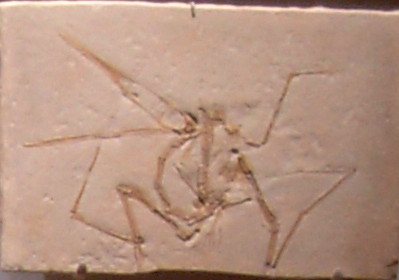
Image: File:Tiktaalik fossil.JPG - Wikimedia Commons (CC BY-SA)
About Tiktaalik
Tiktaalik roseae, a pivotal transitional fossil from the Late Devonian period approximately 375 million years ago, represents one of the most significant evolutionary milestones in the history of life on Earth. Discovered in the Fram Formation of Ellesmere Island, Nunavut, Canada, this semi-aquatic carnivore provides an unprecedented anatomical window into the monumental transition of vertebrates from aquatic environments to terrestrial ecosystems. Often celebrated as the quintessential fishapod, it perfectly bridges the morphological gap between advanced lobe-finned fishes and the earliest four-limbed tetrapods, illustrating the gradual adaptation of marine life to the physical demands of land.
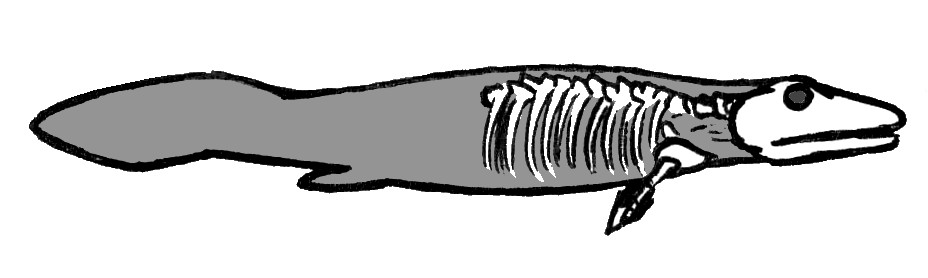
The physical anatomy of Tiktaalik roseae presents a fascinating mosaic of primitive aquatic traits and derived terrestrial adaptations, making it a spectacular subject of paleontological study. Measuring between 120 and 275 centimeters in length, this robust creature possessed a body plan that superficially resembled a cross between a large modern lungfish and a crocodile. Its wide, flattened skull was distinctly crocodilian, featuring eyes positioned on the dorsal surface rather than the sides, which strongly indicates a life spent navigating the shallowest margins of water bodies. Unlike any fish that preceded it, Tiktaalik possessed a mobile neck; the loss of the bony opercular plates that typically connect the skull to the shoulder girdle in fishes allowed it to move its head independently of its torso, a crucial adaptation for snapping at prey in shallow water or on muddy banks. Its body was covered in overlapping, diamond-shaped rhombic scales typical of lobe-finned fishes, and it retained both gills and lungs for respiration. However, the most revolutionary aspect of its physical description lies in its pectoral appendages. The fins of Tiktaalik encased a robust, highly derived skeletal architecture homologous to the tetrapod limb, complete with a humerus, radius, ulna, and a primitive array of wrist bones. These bones were surrounded by extensive muscle attachment sites and supported by massive, overlapping ribs that protected the animal's internal organs from the crushing force of gravity when it ventured out of the buoyancy of water. While it lacked true digits, the distal fin rays were arranged in a way that allowed the appendage to bear weight, effectively functioning as a primitive limb capable of propping the animal up against the substrate.
In terms of paleobiology, Tiktaalik roseae was a formidable carnivore perfectly adapted to the transitional zones between deep water and dry land. Its feeding strategies likely mirrored those of modern ambush predators like alligators or giant salamanders. Positioned in the shallows with its dorsally located eyes breaking the water's surface, Tiktaalik could monitor both aquatic and terrestrial environments for potential prey, which likely included smaller fishes, aquatic invertebrates, and perhaps early terrestrial arthropods venturing near the water's edge. Its robust jaws and sharp, conical teeth were well-suited for grasping and holding struggling prey. Locomotion for Tiktaalik was a complex affair, blending aquatic swimming with a novel form of benthic walking. The structure of its pectoral fins, combined with a highly flexible wrist joint, allowed the animal to plant its fins flat on the riverbed and push its upper body upward. This propping behavior was not just for movement; it may have been essential for breathing air. The presence of large spiracles on the top of its head suggests it relied heavily on atmospheric oxygen, particularly in warm, oxygen-poor shallow waters. By propping itself up, Tiktaalik could elevate its spiracles above the water line to gulp air. Growth patterns analyzed from the fossilized bones indicate that Tiktaalik grew relatively slowly and continuously throughout its life, a trait common among large, long-lived aquatic vertebrates. The dense nature of its limb bones suggests a need for ballast, helping the animal remain anchored to the bottom of fast-flowing streams rather than floating aimlessly.
The ecological context of the Late Devonian period, specifically the Frasnian stage around 375 million years ago, provided the perfect evolutionary crucible for a creature like Tiktaalik. During this era, the landmass that is now the frozen Arctic of Ellesmere Island was situated near the equator, forming part of the supercontinent Euramerica. The climate was tropical, warm, and humid, characterized by extensive, meandering river systems, sprawling floodplains, and dense, swampy wetlands. This period witnessed the rapid expansion of early terrestrial forests, dominated by early trees like Archaeopteris, whose extensive root systems stabilized riverbanks and created complex, debris-filled aquatic habitats. These shallow, choked waterways were difficult for large, traditional predatory fish to navigate, creating a unique ecological niche. Tiktaalik thrived in these marginal environments, occupying the role of an apex predator in the shallow-water food web. It co-existed with a variety of other organisms, including smaller lobe-finned fishes, heavily armored placoderms, early ray-finned fishes, and a burgeoning diversity of terrestrial and semi-aquatic arthropods such as early millipedes and arachnids. The dense vegetation dropping into the water created anoxic conditions in the shallows, which heavily favored organisms like Tiktaalik that could utilize atmospheric oxygen and navigate the tangled, shallow root systems using their robust, limb-like fins. This environment essentially rewarded the exact anatomical innovations that Tiktaalik possessed, driving the evolutionary push toward terrestriality.
The discovery history of Tiktaalik roseae is a testament to the predictive power of evolutionary biology and the perseverance of modern paleontologists. The fossil was discovered in 2004 by a team of researchers led by Neil Shubin of the University of Chicago, Edward Daeschler of the Academy of Natural Sciences in Philadelphia, and the late Farish A. Jenkins Jr. of Harvard University. The team did not stumble upon the fossil by accident; they specifically targeted the Fram Formation on Ellesmere Island because geological maps indicated it contained sedimentary rocks of the exact age, environment, and type necessary to preserve a transitional fossil between the known lobe-finned fish Panderichthys and the early tetrapod Acanthostega. After five years of grueling expeditions in the harsh, freezing conditions of the Canadian Arctic, their targeted search yielded spectacular results. They uncovered multiple beautifully preserved specimens, with the most complete fossil featuring an intact skull and forelimbs protruding from the rock. Recognizing the profound importance of the discovery, the researchers sought a name that honored the region and its indigenous people. They consulted with the Inuit elders of the Nunavut Territory, who suggested the Inuktitut word Tiktaalik, which translates to a large freshwater fish seen in the shallows. The specific epithet, roseae, was chosen to honor an anonymous donor who helped fund the costly Arctic expeditions. The formal description of the species was published in the journal Nature in April 2006, immediately capturing global attention and securing its place as one of the most important fossil discoveries of the 21st century.
The evolutionary significance of Tiktaalik roseae cannot be overstated, as it occupies a crucial node in the vertebrate tree of life, specifically within the clade Elpistostegalia. Before its discovery, there was a frustrating morphological gap in the fossil record between fully aquatic lobe-finned fishes, such as Eusthenopteron and Panderichthys, and the earliest known tetrapods, such as Acanthostega and Ichthyostega, which already possessed fully formed digits. Tiktaalik perfectly bridges this gap, providing tangible, irrefutable evidence of how the transition occurred. It demonstrates that many of the features previously thought to have evolved on land, such as a mobile neck, robust ribs, and weight-bearing limbs, actually evolved in water as adaptations for navigating shallow, complex aquatic environments. The homologous structures in Tiktaalik's pectoral fins clearly show the evolutionary origins of the humerus, radius, ulna, and wrist bones found in all modern tetrapods, from amphibians and reptiles to birds and mammals, including humans. By showing that major evolutionary innovations arise through the gradual modification of existing structures for new functions, a concept known as exaptation, Tiktaalik serves as a textbook validation of Darwinian evolutionary theory. It fundamentally shifted the scientific understanding of the water-to-land transition, proving that the conquest of land was not a sudden leap, but a gradual ecological shift driven by the exploitation of shallow-water niches.
Despite its clear transitional status, Tiktaalik roseae has been the subject of ongoing scientific debates and continuous study, particularly regarding its behavior and the exact nature of its locomotion. Initially, much of the focus was on its front-wheel drive anatomy, as the earliest discoveries primarily featured the front half of the animal, leading to the assumption that early tetrapod locomotion was heavily reliant on the forelimbs while the hindlimbs remained small and fish-like. However, this view was significantly revised in 2014 when Shubin and his team published descriptions of Tiktaalik's pelvic girdle and hind fins, which had been meticulously prepared from blocks of rock collected during the original expeditions. The newly revealed pelvis was surprisingly large and robust, comparable in size to the shoulder girdle, and featured a massive hip joint. This discovery sparked debates about the origins of terrestrial walking, suggesting that the shift toward hind-limb-driven locomotion, a hallmark of modern tetrapods, began much earlier in the evolutionary timeline, while these animals were still primarily aquatic. Furthermore, debates continue regarding exactly how much time Tiktaalik spent out of the water; while its anatomy allowed for terrestrial excursions, many paleontologists argue its heavy body and lack of true digits meant it was primarily an aquatic ambush predator that only dragged itself onto mudflats to escape larger predators or move between drying pools.
The fossil record of Tiktaalik roseae is exceptionally rich for a transitional fossil of its age, providing researchers with a wealth of data. All known specimens have been recovered from the Fram Formation on Ellesmere Island, a site that has proven to be a paleontological goldmine for Late Devonian fauna. The initial 2004 discovery yielded three primary specimens, but subsequent expeditions have uncovered the remains of at least ten additional individuals, ranging from juveniles to massive adults. The preservation quality of these fossils is extraordinary; the bones are preserved in three dimensions rather than being flattened by geological pressure, allowing for incredibly detailed anatomical reconstructions. The entombment of these creatures in fine-grained siltstone, likely the result of sudden flood events in the ancient river system, protected the delicate structures of the skull and fins. In recent years, researchers have utilized advanced high-resolution micro-CT scanning techniques to peer inside the fossilized blocks without destroying the surrounding rock. This non-destructive technology has revealed hidden internal structures, such as the intricate details of the braincase, the inner ear, and the internal architecture of the fin rays, further enriching our understanding of its sensory capabilities and biomechanics.
The cultural impact of Tiktaalik roseae extends far beyond the confines of academic paleontology, having permeated popular culture and science education worldwide. It became an instant icon of evolution, frequently cited in textbooks and public discourse as the ultimate missing link that creationists long claimed did not exist. The fossil gained widespread fame through Neil Shubin's bestselling popular science book, Your Inner Fish, which was later adapted into an Emmy Award-winning PBS documentary series. The creature has inspired countless museum exhibits, artistic reconstructions, and even internet memes celebrating its fateful decision to crawl out of the water. By providing a charismatic and easily understandable example of our deep evolutionary history, Tiktaalik has played a monumental role in public science literacy, helping millions visualize the ancient, unbroken chain of life that connects modern humans to the muddy swamps of the Devonian period.
Classification
Time Period
Discovery
Location
Ellesmere Island, Nunavut, Canada
Formation
Fram Formation
Frequently Asked Questions
What is Tiktaalik?
Tiktaalik roseae, a pivotal transitional fossil from the Late Devonian period approximately 375 million years ago, represents one of the most significant evolutionary milestones in the history of life on Earth. Discovered in the Fram Formation of Ellesmere Island, Nunavut, Canada, this semi-aquatic ...
When did Tiktaalik live?
Tiktaalik lived during the devonian period of the paleozoic era approximately 375 million years ago.
Where was Tiktaalik discovered?
Fossils of Tiktaalik were discovered in Ellesmere Island, Nunavut, Canada in the Fram Formation.
What did Tiktaalik eat?
Tiktaalik was a carnivore. It lived in freshwater, semi-aquatic habitats.
What type of fossil is Tiktaalik?
Tiktaalik is preserved as a body fossil. The preservation quality is excellent.
Related Specimens
From the paleozoic era · body fossils