Camptosaurus
Camptosaurus dispar
Image: Image sourced via web search (Fair use / Educational)
About Camptosaurus
Camptosaurus dispar was a medium-to-large herbivorous dinosaur that roamed the floodplains of western North America during the Late Jurassic Period, approximately 157 to 152 million years ago. As a member of the Ornithopoda, the 'bird-footed' dinosaurs, it represents a crucial stage in the evolution of the highly successful iguanodontians and their later descendants, the hadrosaurs or 'duck-billed' dinosaurs. Its fossils, primarily found within the famed Morrison Formation, provide paleontologists with a detailed window into the ecology of one of the most iconic dinosaur-bearing geological units in the world, painting a picture of a robust, adaptable plant-eater navigating a world of giants.
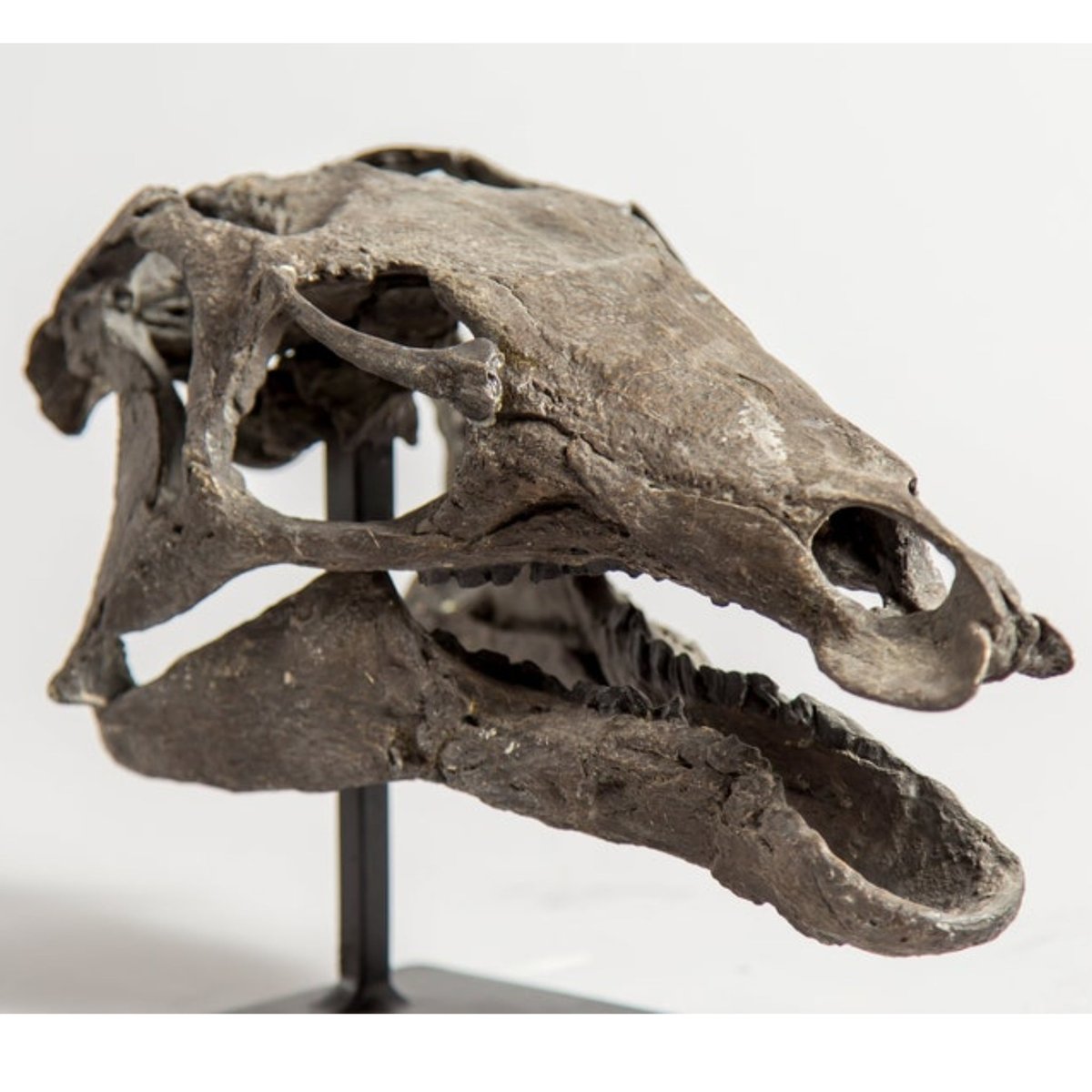
Camptosaurus was a solidly built dinosaur, typically measuring between 5 and 8 meters (16 to 26 feet) in length and standing about 2 meters (6.5 feet) tall at the hips. Weight estimates for an average adult range from 785 to 1,000 kilograms (1,730 to 2,200 pounds), making it comparable in size to a modern bison or a small rhinoceros. Its most distinctive feature was its robust skeletal structure, indicative of a powerful, muscular animal. The skull was relatively long and low, ending in a keratinous beak used for cropping vegetation. Inside its mouth, rows of leaf-shaped teeth were arranged in dental batteries, designed for efficiently grinding tough plant material. Unlike its later relatives, its skull was less specialized, lacking the complex chewing mechanisms of the hadrosaurs. The forelimbs were stout and strong, ending in five-fingered hands, with the central three digits being broad and hoof-like, suggesting they were used for weight support. The thumb, or pollex, was a simple spike, less developed than the formidable thumb-spike of its relative Iguanodon. Its hind limbs were significantly larger and more powerful than its forelimbs, terminating in three-toed feet, clearly built for bearing the animal's substantial weight. The tail was long, deep, and stiffened by ossified tendons, acting as a crucial counterbalance for the body, especially when moving or rearing up.
As an ornithopod, Camptosaurus was a dedicated herbivore. The structure of its beak and teeth suggests a diet focused on low-to-medium-height vegetation. It likely browsed on ferns, cycads, and conifers, using its horny beak to snip off plant parts and its dental batteries to process them. Its posture has been a subject of study; while traditionally depicted as bipedal, the robust nature of its forelimbs and hoof-like hands strongly suggests it was a facultative quadruped, spending much of its time on all fours while foraging, but capable of rearing up or running on its hind legs to reach higher vegetation or escape predators. This versatility in locomotion would have been a significant advantage. There is little direct evidence for social behavior, but like many herbivorous dinosaurs, it is plausible that Camptosaurus lived in small groups or herds for protection and foraging efficiency. Growth studies based on bone histology indicate a relatively slow and steady growth rate compared to some other dinosaurs, reaching maturity over several years. Its metabolism was likely intermediate between that of a modern cold-blooded reptile and a warm-blooded mammal, a condition termed mesothermy, allowing for sustained activity without the extremely high energy demands of full endothermy.
Camptosaurus lived in the vast, semi-arid environment of the Morrison Formation ecosystem, a landscape characterized by extensive river floodplains, seasonal rivers, and open woodlands of conifers, ginkgoes, and tree ferns. The climate was monsoonal, with distinct wet and dry seasons. This was a world populated by some of the most famous dinosaurs known. Camptosaurus shared its habitat with colossal sauropods like Diplodocus, Apatosaurus, and Brachiosaurus, which were high browsers, likely reducing competition for food resources. It also coexisted with other ornithischians, most notably the heavily armored Stegosaurus. As a mid-sized herbivore, Camptosaurus occupied a middle-tier position in the food web. It was a primary consumer, and in turn, it was prey for the formidable predators of the Jurassic. Its primary threats would have been large theropods such as the fearsome Allosaurus, the apex predator of the Morrison, and the slightly smaller but still dangerous Ceratosaurus. The ability of Camptosaurus to switch between quadrupedal and bipedal locomotion may have been a key defensive strategy, allowing it to graze low to the ground while retaining the ability to make a swift, bipedal escape when threatened.
The history of Camptosaurus is deeply intertwined with the 'Bone Wars' of the late 19th century, the fierce rivalry between paleontologists Othniel Charles Marsh and Edward Drinker Cope. The first remains were discovered in 1879 by William Harlow Reed, one of Marsh's collectors, at Como Bluff, Wyoming. Marsh initially named the new dinosaur Camptonotus, meaning 'flexible back,' referring to the flexible nature of its sacral vertebrae. However, this name was already in use for a species of cricket, so in 1885, Marsh renamed it Camptosaurus, 'bent lizard,' a name that has stuck. One of the most significant specimens is the holotype, YPM 1879, a partial skeleton that formed the basis of the original description. Over the years, numerous other specimens have been unearthed, including a nearly complete and articulated skeleton (USNM 2210) found by Marshall P. Felch at Garden Park, Colorado, which provided a much clearer picture of the animal's anatomy. The sheer number of fossils collected during this period, though often hastily excavated, established Camptosaurus as a cornerstone of our understanding of Late Jurassic fauna in North America.
Camptosaurus holds a pivotal position in the evolutionary history of ornithopod dinosaurs. It is classified within the group Ankylopollexia, which includes Iguanodon and the hadrosaurs, characterized by a stiffened thumb spike. Camptosaurus itself represents a more basal, or primitive, member of this lineage compared to its Cretaceous relatives. It showcases an intermediate anatomy between earlier, smaller bipedal ornithopods like Dryosaurus and the later, larger, and more specialized iguanodontians. For instance, its skull is more robust than that of Dryosaurus but lacks the sophisticated dental batteries and pleurokinetic hinge (a flexible upper jaw) that allowed hadrosaurs to chew so effectively. Its hands, with their weight-bearing central digits and simple thumb spike, are a clear precursor to the more derived hands of Iguanodon, which featured a larger spike and more specialized fingers. By studying Camptosaurus, paleontologists can trace the gradual evolutionary trends within Ornithopoda, such as the increase in body size, the shift towards facultative quadrupedalism, and the refinement of feeding mechanisms that ultimately led to the extraordinary success of the duck-billed dinosaurs in the Cretaceous Period.
Despite being known for over a century, Camptosaurus has been at the center of several scientific debates, primarily concerning its taxonomy. For many years, the genus became a 'wastebasket taxon,' with various ornithopod fossils from around the world, including Europe, being assigned to it. Paleontologists Kenneth Carpenter and Peter Galton undertook a major revision in 2007, re-examining all material assigned to Camptosaurus. They concluded that only the original species, Camptosaurus dispar from the North American Morrison Formation, was valid. European species previously named 'Camptosaurus' were reassigned to new genera, such as Cumnoria and Owenodon. This taxonomic cleanup has provided a much clearer definition of what Camptosaurus was and has refined our understanding of ornithopod diversity and distribution during the Late Jurassic. There is also ongoing discussion about its exact posture and locomotion, with recent analyses increasingly favoring the view of it as a primary quadruped that could become bipedal when needed, rather than the other way around, challenging older, more bipedal-centric reconstructions.
The fossil record of Camptosaurus is quite robust, though complete, perfectly articulated skeletons are rare. Its remains are found almost exclusively in the Upper Jurassic Morrison Formation of the western United States, with significant discoveries in Wyoming, Colorado, and Utah. Dozens of partial skeletons and isolated bones have been recovered, providing a comprehensive view of its osteology. The preservation quality is generally good, with bones often found disarticulated but not heavily damaged, allowing for detailed anatomical study. Famous fossil sites that have yielded Camptosaurus material include Como Bluff and Bone Cabin Quarry in Wyoming, and Dinosaur National Monument on the Utah-Colorado border. The abundance of fossils relative to some other Morrison herbivores suggests it was a reasonably common component of its ecosystem, though not as numerous as sauropods or Stegosaurus. The fossils typically preserved are robust limb bones, vertebrae, and pelvic elements, while delicate skull material is found less frequently.
In popular culture, Camptosaurus has often been overshadowed by its larger or more bizarre contemporaries like Stegosaurus and Allosaurus, or its more famous relative, Iguanodon. However, it is a staple in museum exhibits focusing on the Morrison Formation. Skeletons and casts of Camptosaurus are displayed in major institutions worldwide, including the American Museum of Natural History in New York, the National Museum of Natural History (Smithsonian) in Washington, D.C., and the Yale Peabody Museum. These displays are crucial for public education, illustrating the diversity of herbivorous dinosaurs and showcasing a key transitional form in ornithopod evolution. While it may not be a household name, Camptosaurus is a familiar sight to museum-goers and an essential character in telling the complete story of the Age of Dinosaurs.
Classification
Time Period
Discovery
Location
Wyoming, USA
Formation
Morrison Formation
Frequently Asked Questions
What is Camptosaurus?
Camptosaurus dispar was a medium-to-large herbivorous dinosaur that roamed the floodplains of western North America during the Late Jurassic Period, approximately 157 to 152 million years ago. As a member of the Ornithopoda, the 'bird-footed' dinosaurs, it represents a crucial stage in the evolution...
When did Camptosaurus live?
Camptosaurus lived during the jurassic period of the mesozoic era approximately 157-152 million years ago.
Where was Camptosaurus discovered?
Fossils of Camptosaurus were discovered in Wyoming, USA in the Morrison Formation.
What did Camptosaurus eat?
Camptosaurus was a herbivore. It lived in terrestrial habitats.
What type of fossil is Camptosaurus?
Camptosaurus is preserved as a body fossil. The preservation quality is good.
Related Specimens
From the mesozoic era · body fossils
/12d285016704.png)