Titanis
Titanis walleri
Image: Image sourced via web search (Fair use / Educational)
About Titanis
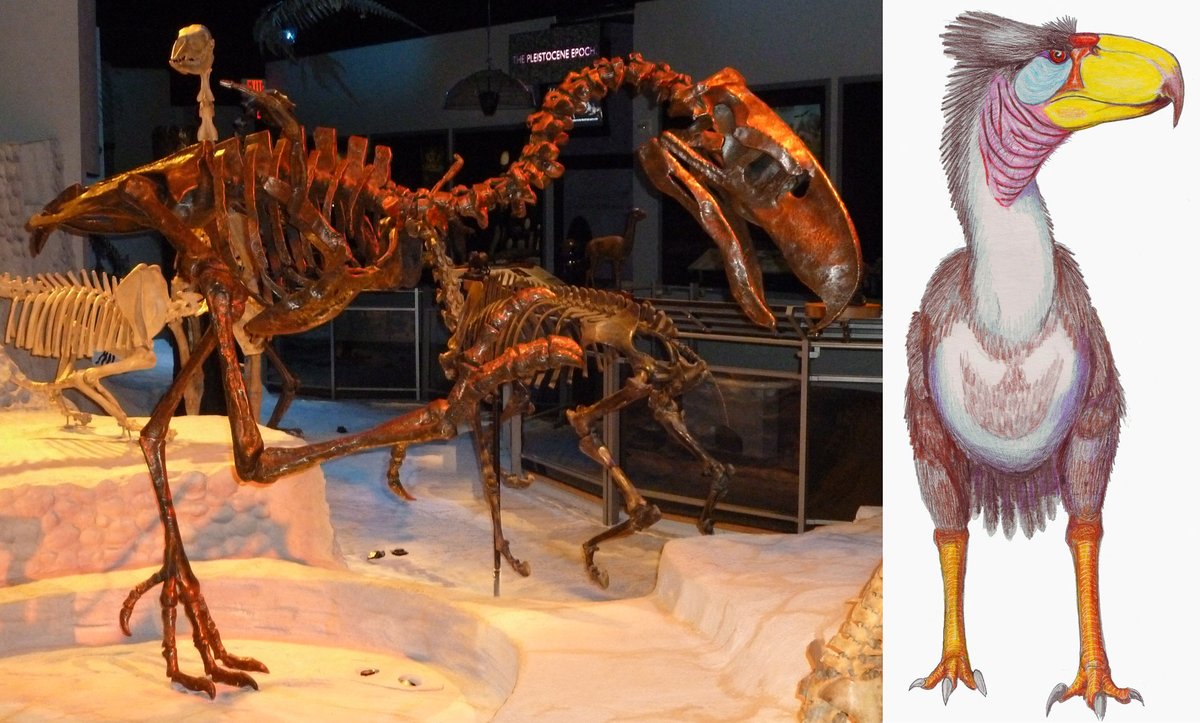
Titanis walleri, commonly referred to as a terror bird, was a formidable, large flightless predatory bird that inhabited North America during the Pliocene and early Pleistocene epochs, approximately 4.9 to 1.8 million years ago. As a member of the extinct family Phorusrhacidae, Titanis represents a spectacular and highly unusual chapter in the evolutionary history of the Americas. It is of immense significance in paleontology because it is the only known member of the terror bird family to have successfully migrated out of South America and established a population in North America. This migration occurred during the early stages of the Great American Biotic Interchange, a monumental event in Earth's history when the volcanic Isthmus of Panama rose from the seafloor, bridging the two continents and allowing a massive exchange of fauna. The presence of Titanis in North America challenges the traditional narrative that South American predators were entirely outcompeted by their northern counterparts, proving instead that at least one lineage of giant avian carnivores could hold its own alongside advanced placental mammals.
In terms of physical description, Titanis walleri was an imposing creature that would have dominated its local landscape. Estimates suggest that an adult Titanis stood approximately 2.5 meters (about 8 feet 2 inches) tall and weighed anywhere from 150 to 200 kilograms (330 to 440 pounds). Its anatomy was heavily specialized for a terrestrial predatory lifestyle. The skull was massive, equipped with a huge, laterally compressed beak that ended in a sharp, downward-curving hook, much like that of a modern eagle but scaled up to terrifying proportions. This beak was designed for delivering devastating, hatchet-like downward strikes to prey. The neck was thick and heavily muscled to support the weight of the massive head and to power these lethal strikes. Its wings were highly reduced and entirely useless for flight, but they possessed a unique, robust joint structure that once led scientists to mistakenly believe they bore a clawed, dinosaur-like hand. The legs of Titanis were long, incredibly thick, and built for immense power and speed, ending in large feet with sharp talons. Compared to modern ostriches, Titanis was much more robustly built, trading some running endurance for sheer physical power and the ability to grapple with large prey.
The paleobiology of Titanis reveals a highly specialized apex predator adapted to the open and semi-open environments of prehistoric North America. As an obligate carnivore, its diet likely consisted of a wide variety of small to medium-sized mammals, including early horses, camelids, and perhaps the young of larger megafauna. Its hunting strategy is thought to have relied on a combination of ambush and short, explosive bursts of speed. Biomechanical studies of its leg bones suggest it could run at impressive speeds, potentially reaching up to 65 kilometers per hour (40 mph) in short sprints. Once it caught its prey, Titanis would have used its powerful legs to kick and pin the animal down, while delivering fatal blows with its massive, axe-like beak. It is unlikely that Titanis chewed its food; instead, it probably tore off large chunks of flesh or swallowed smaller prey whole, later regurgitating indigestible bones and fur as pellets, similar to modern owls and raptors. Socially, it is unknown whether they were solitary hunters or lived in small family groups, though the energetic requirements of such a large predator suggest they required vast, exclusive territories to sustain their high metabolism.
The ecological context in which Titanis lived was a dynamic and changing world. During the Pliocene and early Pleistocene, the regions of Florida and Texas where Titanis fossils have been found were characterized by a mosaic of environments, including expansive grasslands, savannas, and mixed scrub woodlands. The climate was generally warmer and more equable than today, supporting a rich diversity of megafauna. Titanis shared its habitat with an incredible array of animals, including early members of the horse family like Equus, giant ground sloths, glyptodonts, capybaras, and proboscideans such as gomphotheres and early mammoths. In this complex food web, Titanis occupied the role of an apex predator, but it was not without competition. It had to contend with formidable mammalian carnivores that had also evolved in or migrated to North America, including saber-toothed cats like Smilodon gracilis, bone-crushing dogs (Borophaginae), and early dire wolves. The interactions between this giant avian predator and the advanced placental carnivores of the north would have been intense, representing a unique ecological overlap of entirely different predatory lineages.
The discovery history of Titanis walleri is rooted in the rich fossil beds of the American South. The first fossils were discovered in the winter of 1961-1962 by Benjamin I. Waller, an underwater archaeologist and avid fossil diver, who found fragmentary remains in the Santa Fe River in Gilchrist County, Florida. Waller brought these unusual bones to the attention of paleontologist Pierce Brodkorb at the University of Florida. In 1963, Brodkorb formally described the species, naming the genus Titanis (after the Titans of Greek mythology, reflecting its immense size) and the species walleri in honor of its discoverer. The holotype specimen consists of a partial distal tarsometatarsus (a lower leg bone). Since that initial discovery, additional fragmentary remains have been found in other Florida sites, such as the Inglis 1A quarry, and later in the Nueces River in Texas. Despite decades of searching, no complete skeleton of Titanis has ever been found; the species is known entirely from isolated, often water-worn bones, which makes every new fragment a crucial piece of the puzzle.
The evolutionary significance of Titanis cannot be overstated, as it provides a critical data point in understanding the Great American Biotic Interchange. The Phorusrhacidae evolved in South America during its long period of isolation as an island continent, filling the apex predator niches left vacant by the absence of large placental carnivores. For millions of years, these terror birds were the undisputed rulers of the South American plains. When the Isthmus of Panama formed, a massive wave of North American mammals moved south, leading to the extinction of many native South American lineages. However, Titanis represents a rare counter-migration. Its ability to spread northward into Texas and Florida demonstrates that phorusrhacids were highly adaptable and capable of competing with advanced northern carnivores for hundreds of thousands of years. Taxonomically, Titanis is placed within the subfamily Phorusrhacinae, making it closely related to other giant terror birds like Phorusrhacos and Devincenzia. Its closest living relatives are the much smaller seriemas (family Cariamidae) of South America, which still retain some of the predatory behaviors of their giant extinct cousins.
Scientific debates surrounding Titanis have been lively and have significantly shaped our understanding of the species. One of the most famous controversies involved the structure of its wings. In the late 1990s, paleontologist Robert Chandler proposed that the unique joint structure of the Titanis wing indicated it had a flexible, clawed hand, similar to a theropod dinosaur, which it used to grapple with prey. This sensational idea captured the public imagination but was heavily scrutinized by the scientific community. Subsequent re-evaluations by other paleontologists concluded that the joint was simply a highly rigid structure, likely an adaptation to prevent wing damage during the violent struggles with prey, and that there was no evidence for a functional, clawed hand. Another major debate concerns the exact timing of its extinction. Initial dating of some Florida fossils suggested Titanis might have survived until as recently as 15,000 years ago, meaning it would have coexisted with early humans. However, rigorous radiometric dating and rare earth element analysis conducted in 2007 definitively proved that all known Titanis fossils are at least 1.8 million years old, placing its extinction firmly in the early Pleistocene.
The fossil record of Titanis is notoriously sparse and fragmentary, which presents ongoing challenges for paleontologists. Geographically, its remains are restricted to the Gulf Coast of the United States, specifically various river deposits and sinkholes in Florida, and a single submerged site in the Nueces River of Texas. The total number of known specimens is quite small, numbering only a few dozen isolated bones. The preservation quality is generally fair to poor; because many of the fossils are found in riverine environments, they have often been subjected to significant water transport, resulting in heavy abrasion and the loss of delicate features. The parts of the skeleton most typically preserved are the dense, robust bones of the legs and feet (such as the tarsometatarsus and phalanges), as well as fragments of the massive beak and cervical vertebrae. Famous fossil sites include the Santa Fe River and the Inglis 1A sinkhole in Citrus County, Florida, which have yielded the majority of the known material. The lack of a complete skull or articulated skeleton means that much of our understanding of its overall proportions relies on scaling up from its better-preserved South American relatives.
In terms of cultural impact, Titanis has achieved a legendary status among prehistoric animals, often serving as the quintessential representation of the 'terror bird' in popular media. It has been featured prominently in numerous paleontology documentaries, books, and television series, where its terrifying appearance and formidable predatory skills are frequently highlighted. Museums, such as the Florida Museum of Natural History, feature impressive skeletal reconstructions and life-sized models of Titanis, drawing significant public fascination. Educationally, Titanis serves as a powerful and accessible example of the Great American Biotic Interchange, helping to illustrate complex concepts of biogeography, evolution, and extinction to the general public. Its dramatic form and the sheer novelty of a giant, flightless, carnivorous bird roaming the ancient American South continue to capture the imagination of both scientists and enthusiasts alike.
Classification
Time Period
Discovery
Location
Florida, USA
Formation
Santa Fe River deposits
Frequently Asked Questions
What is Titanis?
Titanis walleri, commonly referred to as a terror bird, was a formidable, large flightless predatory bird that inhabited North America during the Pliocene and early Pleistocene epochs, approximately 4.9 to 1.8 million years ago. As a member of the extinct family Phorusrhacidae, Titanis represents a ...
When did Titanis live?
Titanis lived during the quaternary period of the cenozoic era approximately 4.9-1.8 million years ago.
Where was Titanis discovered?
Fossils of Titanis were discovered in Florida, USA in the Santa Fe River deposits.
What did Titanis eat?
Titanis was a carnivore. It lived in terrestrial habitats.
What type of fossil is Titanis?
Titanis is preserved as a body fossil. The preservation quality is fair.
Related Specimens
From the cenozoic era · body fossils