Gigantspinosaurus
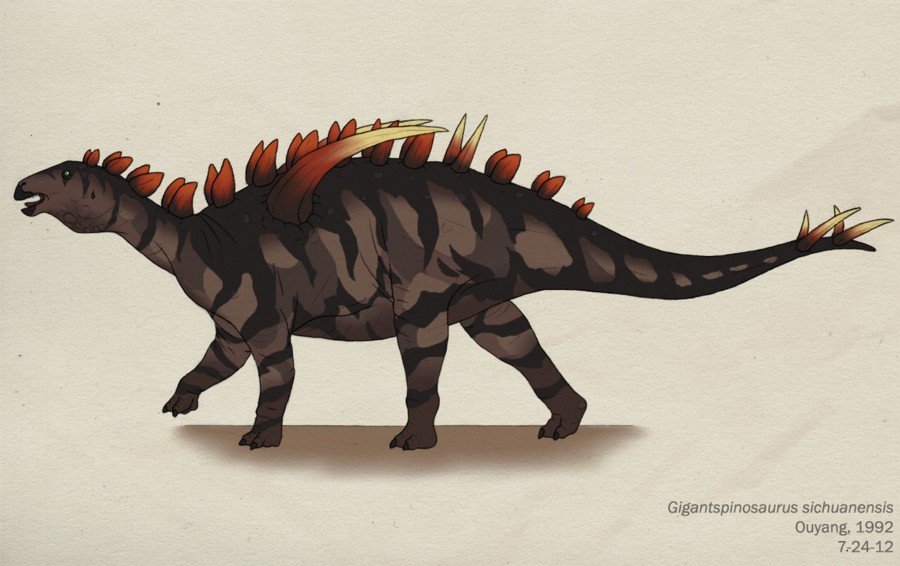
Gigantspinosaurus sichuanensis
Image: Image sourced via web search (Fair use / Educational)
About Gigantspinosaurus
Gigantspinosaurus sichuanensis is a fascinating and highly distinctive genus of herbivorous ornithischian dinosaur that roamed the earth during the Late Jurassic period, approximately 163 to 155 million years ago. Found primarily in what is now the Sichuan Province of China, this remarkable creature is a member of the Stegosauria clade, a group of armored dinosaurs famous for the plates and spikes adorning their backs and tails. Gigantspinosaurus holds a unique and highly significant place in the annals of paleontology due to its bizarre anatomical proportions, most notably the enormously elongated parascapular spines that protruded from its shoulder region. These spines were so massive that they rivaled the length of the animal's entire forelimbs, presenting a striking visual profile that sets it apart from more familiar relatives like the North American Stegosaurus. As a relatively early and basal member of the stegosaur lineage, Gigantspinosaurus provides crucial insights into the evolutionary development of thyreophoran (armor-bearing) dinosaurs in Asia. Its discovery has helped paleontologists piece together the complex biogeography of the Late Jurassic world, demonstrating that the isolated ecosystems of East Asia fostered the evolution of highly specialized and anatomically extreme dinosaur forms that differed significantly from their contemporaries in other parts of the globe.
In terms of physical description, Gigantspinosaurus was a medium-sized stegosaur, measuring approximately 4.2 meters (about 14 feet) in length and weighing an estimated 700 kilograms (roughly 1,500 pounds). While this makes it considerably smaller than the massive Stegosaurus, which could reach lengths of up to 9 meters, Gigantspinosaurus was nonetheless a robust and heavily built animal. Its most defining and spectacular anatomical feature was undoubtedly the pair of gigantic parascapular spines that extended outward and backward from its shoulder blades. These solid bone spikes were exceptionally long, thick, and slightly curved, functioning as formidable defensive weapons and highly visible display structures. In addition to these shoulder spikes, Gigantspinosaurus possessed a series of relatively small, thick, and somewhat triangular bony plates running down the midline of its back, which transitioned into sharp spikes along the tail, forming a defensive weapon known as a thagomizer. The animal's skull was small, narrow, and elongated, equipped with a toothless beak at the front for cropping vegetation and rows of small, leaf-shaped teeth further back in the jaw for processing plant matter. Its forelimbs were notably robust but shorter than its hind limbs, giving the dinosaur a characteristic hunched posture with its head held low to the ground. Soft tissue inferences suggest that the bony plates and spikes were likely covered in a sheath of keratin, which would have made them even longer and sharper in life than the fossilized bone indicates, and possibly brightly colored for intraspecific display.
From a paleobiological perspective, Gigantspinosaurus was an obligate herbivore, uniquely adapted to feeding on the low-growing vegetation of its Late Jurassic environment. Given its hunched posture, short neck, and low-slung head, it was restricted to browsing on ferns, cycads, bennettitales, and low-hanging coniferous foliage that grew within a meter or two of the ground. Its narrow snout suggests it was a selective feeder, capable of carefully picking out the most nutritious leaves and shoots rather than bulk-feeding like the wider-mouthed ankylosaurs. The small, leaf-shaped teeth were not designed for extensive chewing; instead, Gigantspinosaurus likely sliced plant material into smaller pieces before swallowing it whole, relying on a large, fermenting gut chamber—and possibly swallowed stones known as gastroliths—to break down the tough, fibrous plant matter. Locomotion in Gigantspinosaurus was quadrupedal and relatively slow. Its robust limb bones and the biomechanics of its hips and shoulders indicate it was not built for speed, relying instead on its formidable armor and massive shoulder spines to deter predators rather than fleeing from them. Social behavior in Gigantspinosaurus is a subject of ongoing study, but the extravagant nature of its shoulder spines strongly suggests they played a role in visual communication, species recognition, and possibly sexual dimorphism or mating displays, implying that these animals may have lived in loose herds or aggregations where such visual signals would be advantageous.
The ecological context of Gigantspinosaurus is rooted in the rich and diverse paleoenvironment of the Upper Shaximiao Formation in the Sichuan Basin. During the Oxfordian stage of the Late Jurassic, this region was characterized by a warm, humid, and highly seasonal subtropical climate. The landscape was dominated by vast floodplains, meandering river systems, and dense gallery forests interspersed with open, fern-covered plains. This lush environment supported a staggering diversity of dinosaurian life, making it one of the most vibrant ecosystems of the Mesozoic era. Gigantspinosaurus shared its habitat with a variety of other spectacular dinosaurs, including the long-necked mamenchisaurid sauropods like Mamenchisaurus and Omeisaurus, which browsed the high forest canopies, leaving the low-level vegetation to smaller herbivores like Gigantspinosaurus and the early ornithopod Agilisaurus. The presence of such massive herbivores inevitably attracted formidable predators. The apex predators of the Shaximiao ecosystem were large metriacanthosaurid theropods such as Yangchuanosaurus and Sinraptor. These massive, bipedal carnivores, armed with serrated teeth and powerful jaws, were more than capable of taking down a medium-sized herbivore. It was against these terrifying predators that the massive shoulder spines and tail spikes of Gigantspinosaurus evolved, serving as a critical evolutionary arms race between predator and prey in the dense Jurassic underbrush.
The discovery history of Gigantspinosaurus is a testament to the rich paleontological heritage of China's Sichuan Province. The first and most significant fossils of this dinosaur were unearthed in 1985 by the renowned Chinese paleontologist Ouyang Hui. The discovery took place during extensive excavations at the famous Dashanpu dinosaur quarry near the city of Zigong, a site that has yielded an unprecedented number of exceptionally preserved Jurassic dinosaur skeletons. The holotype specimen, designated ZDM 0019, consists of a remarkably complete and articulated partial skeleton, including the lower jaws, elements of the vertebral column, the pelvic girdle, limbs, and, crucially, the spectacular shoulder spines and dermal plates. Initially, the fossils were somewhat confusing due to the unprecedented size of the shoulder spines, which led to early speculation about the animal's classification. Ouyang Hui first coined the name Gigantspinosaurus in 1992 in a preliminary report, though it was initially considered a nomen nudum (a naked name) because it lacked a formal, detailed scientific description. It wasn't until 2006 that a comprehensive osteological description was finally published by Tracy Ford and later expanded upon by Chinese paleontologists, formally validating the name Gigantspinosaurus sichuanensis. The generic name translates to 'giant-spined lizard,' a direct reference to its most prominent feature, while the specific epithet honors the Sichuan Province where it was discovered.
The evolutionary significance of Gigantspinosaurus cannot be overstated, as it occupies a critical and somewhat complex position near the base of the stegosaurian family tree. For many years, the evolution of stegosaurs was primarily understood through the lens of North American and European taxa. However, the discovery of Gigantspinosaurus, along with other Chinese stegosaurs like Huayangosaurus and Tuojiangosaurus, revealed that East Asia was a major center of diversification for early thyreophorans. Gigantspinosaurus exhibits a fascinating mosaic of primitive (basal) and derived (advanced) anatomical traits. Its relatively small dorsal plates and robust limbs are reminiscent of earlier, more primitive armored dinosaurs, while the development of a true thagomizer and specific modifications in its pelvic structure align it more closely with advanced stegosaurids. Phylogenetic analyses have frequently placed Gigantspinosaurus as the most basal known member of the Stegosauridae family, or sometimes just outside it as a sister taxon to the entire clade. This transitional status helps paleontologists map the sequence of anatomical changes that occurred as early armored dinosaurs evolved into the highly specialized, plate-backed giants of the Late Jurassic. Furthermore, the extreme development of its shoulder spines highlights the incredible morphological plasticity of the thyreophoran dermal armor, showing that different lineages experimented with wildly different defensive and display structures.
Scientific debates surrounding Gigantspinosaurus have primarily centered on its precise taxonomic placement and the functional morphology of its bizarre armor. Early in its discovery history, there was considerable debate over whether the massive shoulder spines actually belonged on the shoulders at all, with some researchers suggesting they might be misplaced tail spikes or pelvic armor. However, the articulation of the holotype specimen eventually confirmed their parascapular position. More recently, the debate has shifted to its phylogenetic relationships. While most modern cladistic analyses agree that it is a basal stegosaur, its exact relationship to the slightly older and more primitive Huayangosaurus remains a topic of active discussion. Some researchers have proposed that Gigantspinosaurus might represent a distinct, endemic lineage of Asian stegosaurs that evolved parallel to the main Stegosauridae line. Another area of ongoing debate involves the biomechanics and primary function of the giant spines. While defense against predators like Yangchuanosaurus is the most obvious function, some paleontologists argue that the spines were too unwieldy for active combat and may have functioned primarily as visual deterrents or sexual display structures, similar to the exaggerated horns and antlers seen in some modern ungulates.
The fossil record of Gigantspinosaurus is currently limited but of exceptionally high quality. To date, the genus is known almost exclusively from the holotype specimen (ZDM 0019) recovered from the Dashanpu quarry in the Upper Shaximiao Formation. Despite the lack of multiple individuals, the preservation quality of this single specimen is considered good to excellent. The fossilized bones are highly mineralized and have suffered relatively little crushing or distortion from geological pressure. The typical parts preserved include the robust limb bones, the pelvic girdle, significant portions of the vertebral column, the lower jaws, and the all-important dermal armor, including the plates, tail spikes, and the signature shoulder spines. The skull, unfortunately, is largely missing, which is a common issue with stegosaur fossils due to the fragile nature of their cranial bones. The Dashanpu quarry itself is one of the most famous and productive Middle-to-Late Jurassic fossil sites in the world, representing a mass mortality event—likely a catastrophic flood—that buried hundreds of dinosaurs rapidly in fine-grained sediments, ensuring their remarkable preservation for millions of years.
In terms of cultural impact, Gigantspinosaurus has captured the imagination of dinosaur enthusiasts and the general public, primarily due to its extreme and almost fantastical anatomical proportions. The holotype skeleton is a centerpiece exhibit at the world-renowned Zigong Dinosaur Museum in Sichuan, China, where it draws hundreds of thousands of visitors annually. The mounted skeleton, with its massive shoulder spines jutting out aggressively, provides a dramatic and unforgettable visual representation of Jurassic life. Beyond the museum, Gigantspinosaurus has made notable appearances in popular culture, most prominently in dinosaur-themed video games and simulation software. It is a featured and highly popular animal in the hit video game 'Jurassic World Evolution' and its sequel, where players can bioengineer and care for the dinosaur in a virtual theme park. These appearances have significantly elevated its profile, transforming it from an obscure Asian fossil into a widely recognized and beloved species among paleontology fans, serving as an excellent educational tool to highlight the incredible diversity and evolutionary experimentation of the dinosaurian world.
Classification
Time Period
Discovery
Location
Sichuan, China
Formation
Upper Shaximiao Formation
Frequently Asked Questions
What is Gigantspinosaurus?
Gigantspinosaurus sichuanensis is a fascinating and highly distinctive genus of herbivorous ornithischian dinosaur that roamed the earth during the Late Jurassic period, approximately 163 to 155 million years ago. Found primarily in what is now the Sichuan Province of China, this remarkable creature...
When did Gigantspinosaurus live?
Gigantspinosaurus lived during the jurassic period of the mesozoic era approximately 163-155 million years ago.
Where was Gigantspinosaurus discovered?
Fossils of Gigantspinosaurus were discovered in Sichuan, China in the Upper Shaximiao Formation.
What did Gigantspinosaurus eat?
Gigantspinosaurus was a herbivore. It lived in terrestrial habitats.
What type of fossil is Gigantspinosaurus?
Gigantspinosaurus is preserved as a body fossil. The preservation quality is good.
Related Specimens
From the mesozoic era · body fossils