Coelophysis
Coelophysis bauri
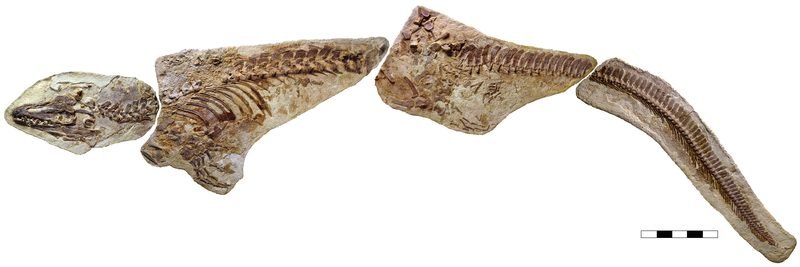
Image: File:Coelophysis fossilized position 038.JPG - Wikimedia Commons (CC BY-SA)
About Coelophysis
Coelophysis bauri was a pivotal early theropod dinosaur that roamed the terrestrial landscapes of North America during the Late Triassic period, approximately 221 to 190 million years ago. This agile, bipedal carnivore holds immense significance in paleontology as one of the earliest and most completely understood dinosaurs, offering unparalleled insights into the initial diversification of the theropod lineage that would eventually give rise to all predatory dinosaurs, including the formidable Tyrannosaurus rex, and ultimately, modern birds. Its name, derived from Greek, translates to 'hollow form,' a direct reference to its lightweight, pneumatized bones, a characteristic anatomical feature shared with avian descendants. The exceptional fossil record of Coelophysis, particularly from the renowned Ghost Ranch site in New Mexico, has cemented its status as a foundational species for understanding early dinosaur anatomy, ecology, and behavior.
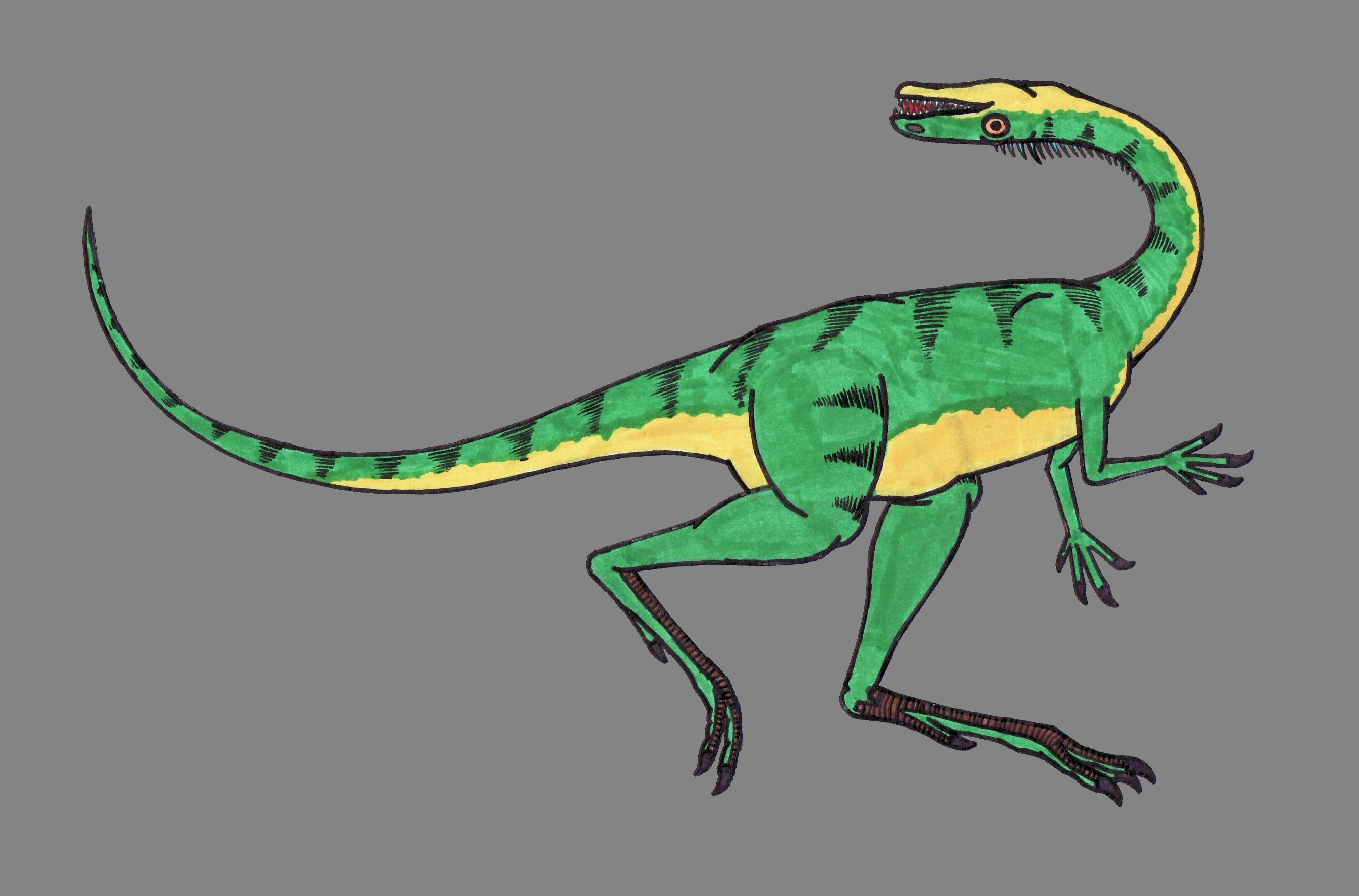
Physically, Coelophysis bauri was a slender and remarkably agile creature, perfectly adapted for a predatory lifestyle. Adults typically measured around 3 meters (approximately 9.8 feet) in length from snout to tail tip, with some larger individuals potentially reaching up to 3.5 meters. Despite its length, its gracile build meant it was relatively lightweight, estimated to weigh between 15 and 25 kilograms (33-55 pounds), comparable to a modern-day coyote or a large domestic dog. Its most striking features included a long, narrow, and low-slung skull, approximately 25-30 centimeters (10-12 inches) in length, which housed numerous small, serrated, and recurved teeth. These teeth, numbering around 50-60 in total, were ideal for grasping and tearing the flesh of small, struggling prey rather than crushing bone. The neck was notably long and flexible, forming a distinct S-curve, providing an excellent range of motion for spotting and snatching prey. Its body was supported by a lightweight, S-shaped vertebral column, leading to a very long, whip-like tail that comprised more than half of its total body length. This tail served as a crucial counterbalance, aiding in rapid turns and maintaining stability during high-speed pursuits. The forelimbs were relatively short but robust, equipped with three functional digits ending in sharp, recurved claws, well-suited for grasping and manipulating prey. The hind limbs were long and powerfully muscled, terminating in three forward-pointing toes and a smaller, elevated dewclaw, indicative of its bipedal locomotion and capacity for swift running. The hollow nature of its bones, a key diagnostic feature, contributed significantly to its overall lightness and agility, a trait that would prove highly successful in later theropod evolution.
The paleobiology of Coelophysis paints a picture of an active and opportunistic carnivore. Its diet, inferred from its dentition and occasional stomach contents found in exceptional specimens, primarily consisted of small vertebrates and invertebrates. Evidence suggests it preyed upon insects, lizards, early crocodylomorphs, and possibly even fish, given its presence in environments near water bodies. The discovery of juvenile Coelophysis remains within the abdominal cavity of an adult specimen initially led to speculation of cannibalism, though this is now widely reinterpreted as the adult having scavenged a carcass or the juvenile being a different species. Its long, powerful hind limbs and balancing tail indicate it was a swift runner, capable of chasing down agile prey. The structure of its hands, with grasping claws, suggests it could effectively seize and hold onto its victims. Locomotion was obligately bipedal, with its center of gravity positioned over its hips, allowing for efficient movement. The remarkable bone beds at Ghost Ranch, where hundreds of individuals were found together, strongly suggest gregarious behavior, possibly living and hunting in groups or at least congregating in large numbers. This social aspect, if confirmed, would represent one of the earliest examples of complex social behavior in dinosaurs. Growth patterns, studied from the extensive fossil record, indicate a relatively rapid growth rate, with individuals reaching sexual maturity within a few years.
Coelophysis thrived in the Late Triassic period, a time of significant global change and the dawn of the dinosaurian age. The world then was dominated by the supercontinent Pangea, and the region now known as New Mexico would have been situated closer to the equator. The climate was generally warm and semi-arid, characterized by seasonal monsoons that led to periods of intense rainfall followed by dry spells. The Chinle Formation, where Coelophysis fossils are predominantly found, represents a diverse ancient ecosystem of floodplains, rivers, and lakes, interspersed with upland regions. The flora consisted of conifers, cycads, ferns, and horsetails, providing a varied landscape. Coelophysis shared its habitat with a diverse array of other Triassic fauna. Its primary competitors and potential predators included larger, more heavily armored pseudosuchians (early crocodilian relatives) like Postosuchus, which were apex predators of the time. Other co-existing species included various rhynchosaurs, aetosaurs (armored reptiles), phytosaurs (crocodile-like reptiles), and early amphibians. As a mesopredator, Coelophysis occupied a crucial niche in the food web, preying on smaller animals and in turn being preyed upon by larger carnivores, contributing to the complex ecological dynamics of the Triassic. Its agility and speed would have been key to its survival in an environment shared with formidable rivals.
The discovery history of Coelophysis is as fascinating as the dinosaur itself, deeply intertwined with the early days of American paleontology. The first fragmentary remains were unearthed in 1881 by David Baldwin, a fossil collector working for the renowned paleontologist Edward Drinker Cope, in the Petrified Forest region of northern New Mexico. Cope formally described and named the genus Coelophysis in 1889, based on these incomplete specimens, assigning the type species Coelophysis bauri in honor of paleontologist Georg Baur. However, the true significance and abundance of Coelophysis were not fully realized until 1947, with the monumental discovery of the "Coelophysis Quarry" or "Ghost Ranch Coelophysis bone bed" near Abiquiu, New Mexico. This extraordinary site, located within the Chinle Formation, was initially found by George Whitaker, a preparator for the American Museum of Natural History (AMNH), under the direction of Edwin H. Colbert. The quarry yielded hundreds of exquisitely preserved, nearly complete, and articulated skeletons of Coelophysis bauri, ranging from juveniles to fully grown adults, all buried together in a mass death assemblage. This unparalleled discovery provided an unprecedented wealth of material, allowing paleontologists to reconstruct the anatomy, growth, and population structure of an early dinosaur with remarkable accuracy. The Ghost Ranch specimens, particularly AMNH 7223, became the definitive reference for the species and are among the most iconic dinosaur fossils ever found.
Coelophysis holds immense evolutionary significance, representing a critical early branch in the dinosaurian family tree. It is classified within the Neotheropoda, a group that includes all more advanced theropods, placing it as one of the most basal members of this diverse clade. Its skeletal structure exhibits a mosaic of primitive and advanced features, making it a crucial transitional form. Primitive traits include the relatively small braincase and the retention of certain ancestral reptilian skull elements. More advanced features, characteristic of later theropods, include its bipedal stance, hollow bones (pneumatization), a three-fingered hand with grasping ability, and a specialized ankle joint (mesotarsal ankle) that allowed for efficient forward-backward movement while running. The presence of these features in such an early dinosaur highlights the rapid evolutionary innovations occurring during the Triassic that set the stage for the Mesozoic Era's dinosaurian dominance. Coelophysis is a direct ancestor to the vast array of theropods that would follow, from the massive tyrannosaurids and allosaurids to the swift ornithomimids and ultimately, the avian dinosaurs that survive today as birds. Its success in the Late Triassic suggests that the theropod body plan, characterized by agility, bipedalism, and predatory adaptations, was highly effective from its inception, providing a foundational blueprint for subsequent predatory dinosaur evolution.
Despite its well-established status, Coelophysis has been at the center of several scientific debates and taxonomic revisions over the years. One of the most significant controversies revolved around its taxonomy, particularly the relationship between Coelophysis bauri and another similar early theropod, Syntarsus rhodesiensis (now known as Megapnosaurus rhodesiensis). For a period, some paleontologists suggested that the two genera were synonymous, or that Syntarsus was a junior synonym of Coelophysis, leading to considerable confusion. However, detailed comparative studies have largely affirmed their distinctiveness, though they remain closely related. Another long-standing debate concerned the interpretation of the mass burial at Ghost Ranch. While the initial interpretation favored a catastrophic flash flood event, the precise taphonomic details and the possibility of other environmental factors contributing to the mass death are still discussed. The question of cannibalism, based on the juvenile remains found within an adult, was also a subject of intense debate, with current consensus leaning towards scavenging rather than active predation of its own young. More recently, detailed analyses of growth rings in bones (histology) have refined our understanding of its growth rates and lifespan, contributing to ongoing discussions about dinosaur physiology.
The fossil record of Coelophysis is exceptionally rich, particularly for a dinosaur of its antiquity. While the most famous and prolific site is the Ghost Ranch quarry in New Mexico, where hundreds of individuals were preserved, fragmentary remains and isolated teeth have also been found in other localities within the Chinle Formation across the southwestern United States, including Arizona, Utah, and possibly Texas. This widespread distribution suggests that Coelophysis, or closely related forms, were successful and relatively common across a significant portion of western Pangea during the Late Triassic. The quality of preservation at Ghost Ranch is unparalleled, with many skeletons found in articulation, providing complete anatomical information. This contrasts with many other early dinosaur finds, which are often fragmentary and disarticulated. The sheer number of specimens from Ghost Ranch has allowed for population-level studies, examining variations in size, age, and morphology within the species. This extensive fossil evidence makes Coelophysis one of the most thoroughly understood early dinosaurs, providing a robust dataset for paleontological research into Triassic ecosystems and early dinosaur evolution.
Coelophysis has achieved a notable cultural impact, serving as an iconic representation of early dinosaurs and the Triassic period. Its distinctive slender form and historical significance make it a popular exhibit in natural history museums worldwide, with the American Museum of Natural History in New York City housing some of the most famous and complete specimens from Ghost Ranch. It has appeared in numerous documentaries, books, and educational materials, often highlighted as a prime example of dinosaur diversification and the evolutionary link to birds. In popular culture, Coelophysis has been featured in the "Walking with Dinosaurs" series and various video games, solidifying its image as an agile and opportunistic predator. In 1981, Coelophysis bauri was officially designated the State Fossil of New Mexico, a testament to its profound scientific importance and the spectacular discoveries made within the state. Its accessible name, striking appearance, and the compelling story of its mass burial continue to captivate the public imagination, making Coelophysis a powerful ambassador for paleontology and the wonders of prehistoric life.
Classification
Time Period
Discovery
Location
Ghost Ranch, New Mexico, USA
Formation
Chinle Formation
Frequently Asked Questions
What is Coelophysis?
Coelophysis bauri was a pivotal early theropod dinosaur that roamed the terrestrial landscapes of North America during the Late Triassic period, approximately 221 to 190 million years ago. This agile, bipedal carnivore holds immense significance in paleontology as one of the earliest and most comple...
When did Coelophysis live?
Coelophysis lived during the triassic period of the mesozoic era approximately 221-190 million years ago.
Where was Coelophysis discovered?
Fossils of Coelophysis were discovered in Ghost Ranch, New Mexico, USA in the Chinle Formation.
What did Coelophysis eat?
Coelophysis was a carnivore. It lived in terrestrial habitats.
What type of fossil is Coelophysis?
Coelophysis is preserved as a body fossil. The preservation quality is excellent.
Related Specimens
From the mesozoic era · body fossils