Mononykus
Mononykus olecranus
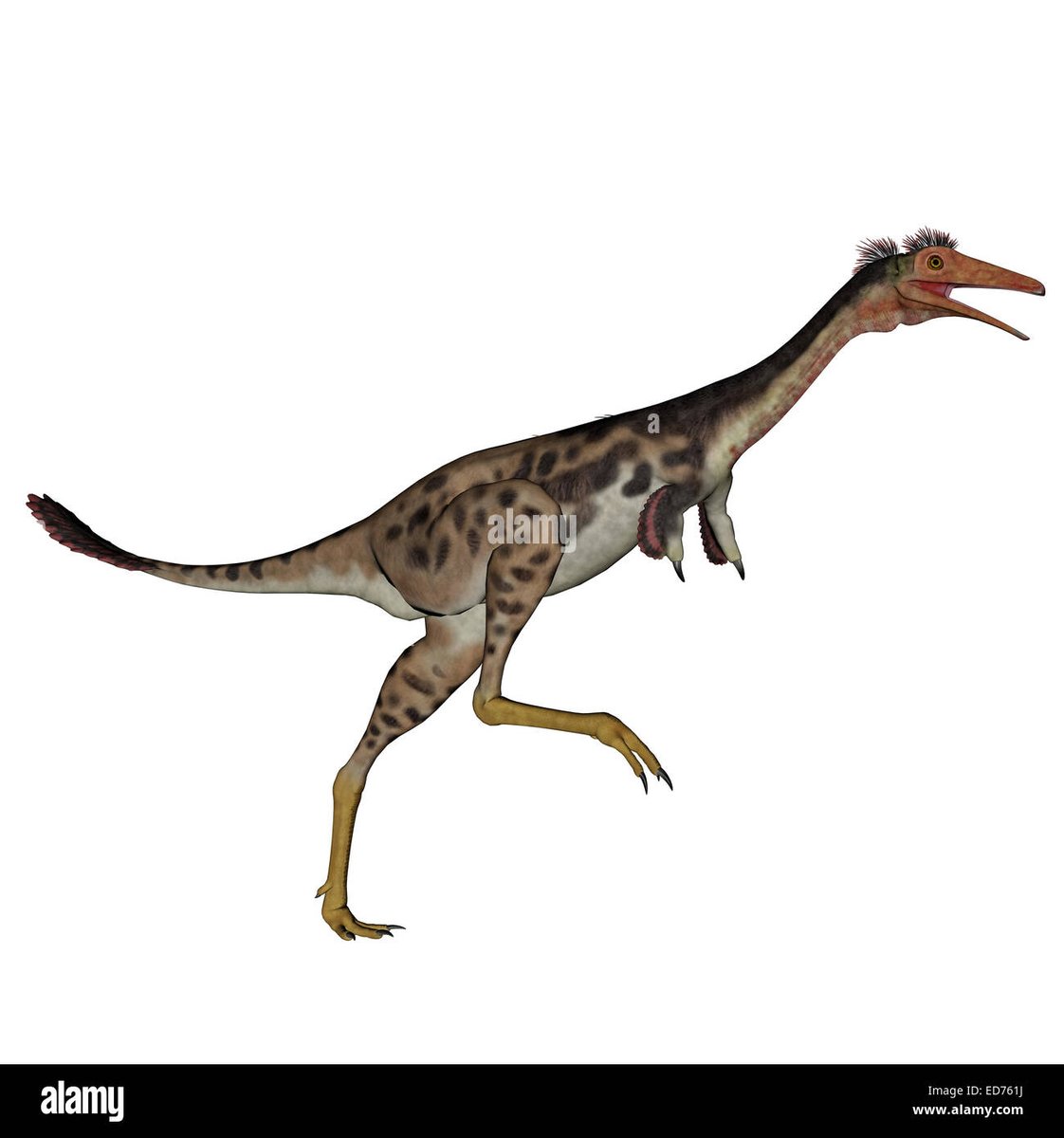
Image: Image sourced via web search (Fair use / Educational)
About Mononykus
Mononykus olecranus was a small, bird-like theropod dinosaur that inhabited the arid landscapes of what is now Mongolia during the Late Cretaceous period, approximately 70 to 66 million years ago. Its name, meaning 'one claw', alludes to its most distinctive and enigmatic feature: a single, large claw on each of its diminutive forelimbs. As a highly specialized member of the family Alvarezsauridae, Mononykus provides paleontologists with a fascinating case study in evolutionary adaptation, convergence, and the complex relationships between non-avian dinosaurs and the origins of modern birds.
Mononykus was a lightly built, bipedal dinosaur, measuring approximately 1 meter (about 3.3 feet) in length from snout to tail tip and standing roughly hip-high to a human adult. Weight estimates for this creature are modest, typically ranging from 3 to 5 kilograms (6.6 to 11 pounds), comparable in size to a large domestic turkey or a small fox. Its overall body plan was gracile and cursorial, suggesting an animal built for speed and agility. The skeleton reveals long, slender hindlimbs with a fused ankle structure known as an arctometatarsus, a feature common in fast-running dinosaurs like tyrannosaurids and ornithomimids, which enhanced its ability to run efficiently across open terrain. The tail was long and thin, likely acting as a counterbalance during rapid locomotion. Its skull was small and delicate, with tiny, peg-like teeth that were not suited for tearing flesh, hinting at a specialized diet. Perhaps the most striking and debated feature of Mononykus was its forelimbs. The arms were incredibly short and stout, with the humerus being particularly robust. Most of the hand bones were fused together, and the arm terminated in a single, prominent digit tipped with a large, sharp claw, while the other two digits were vestigial or entirely absent. This bizarre anatomy, a powerful arm with a single functional claw, is unique among dinosaurs and has been the subject of intense scientific inquiry.
The paleobiology of Mononykus is largely inferred from its unique anatomical features. Its small, weak teeth suggest it did not prey on large vertebrates. Instead, the prevailing hypothesis is that Mononykus was a specialized insectivore. Its powerful, single-clawed forelimbs may have been used as digging tools, perfectly suited for breaking open termite mounds, ripping apart rotting logs, or excavating insect nests in the arid soil. The robust construction of the arm, particularly the enlarged olecranon process on the ulna (the feature for which the species 'olecranus' is named), provided a strong attachment point for powerful triceps muscles, enabling forceful backward strokes ideal for excavation. This lifestyle is analogous to modern insectivorous mammals like anteaters or aardvarks, which possess similarly powerful forelimbs for accessing colonial insects. Its long, slender legs would have allowed it to cover large distances efficiently in search of food patches. Its large eye sockets suggest it may have had good vision, possibly being nocturnal or crepuscular to avoid the heat of the day and larger predators. There is no direct fossil evidence for social behavior, but it is plausible that they lived solitarily or in small groups, similar to many modern insectivores. Its metabolism was likely high, consistent with its bird-like anatomy and active lifestyle, and fossil evidence of feathers on related alvarezsaurids like Shuvuuia strongly implies Mononykus was also covered in a downy, insulating coat.
The world Mononykus inhabited was the ecosystem preserved in the Nemegt Formation of Mongolia's Gobi Desert. During the Late Cretaceous, this region was not the hyper-arid desert it is today but a semi-arid environment characterized by seasonal rivers, floodplains, and dune fields, similar to modern-day savanna or scrubland environments in Africa or Australia. This habitat supported a diverse and famous dinosaur fauna. Mononykus occupied a specific ecological niche as a small, ground-dwelling insectivore. It shared its environment with a host of other dinosaurs, creating a complex food web. Herbivores included large hadrosaurs like Saurolophus, armored ankylosaurs such as Tarchia, and the massive titanosaurs Nemegtosaurus and Opisthocoelicaudia. Predators were abundant and formidable; Mononykus would have been potential prey for the giant apex predator Tarbosaurus bataar, a close relative of Tyrannosaurus rex. Other theropods included the swift-running ornithomimids like Gallimimus and Deinocheirus, and various dromaeosaurids ('raptors') such as Adasaurus. Mononykus's speed and agility would have been its primary defense against these larger carnivores, allowing it to navigate the open landscape and quickly escape threats. Its position in the food web was that of a secondary consumer, feeding on insects and other small invertebrates, and in turn, being a food source for the ecosystem's larger predators.
The discovery of Mononykus is tied to the rich paleontological expeditions in Mongolia that have yielded some of the world's best-preserved dinosaur fossils. The holotype specimen, cataloged as IGM N107/6, was discovered during a joint Mongolian Academy of Sciences-American Museum of Natural History expedition to the Gobi Desert in 1992. The fossil was found in the Bugin Tsav locality of the Nemegt Formation. The scientific description was published in 1993 by a team of paleontologists including Mark Norell, Luis Chiappe, and James Clark. The name 'Mononykus olecranus' was chosen to highlight its two most prominent features: 'Mononykus' (from Greek 'monos' for single and 'onyx' for claw) refers to its single-clawed hand, and 'olecranus' refers to the large, bony prominence on its ulna, which anchored powerful arm muscles. The initial specimen was remarkably complete, though it lacked a skull. The discovery was significant because its highly bird-like features, including a keeled sternum (breastbone), initially led its discoverers to classify it as a primitive, flightless bird, more advanced than Archaeopteryx. This classification sparked considerable debate and helped to fuel the ongoing discussion about the dinosaur-bird evolutionary link. Subsequent discoveries of related alvarezsaurids, some with skulls and feather impressions, have since clarified its position and provided a more complete picture of this unusual dinosaur group.
Mononykus holds a crucial position in our understanding of theropod dinosaur evolution, particularly the lineage leading to birds (Avialae). It belongs to the family Alvarezsauridae, a bizarre and highly specialized clade of coelurosaurian theropods. When first described, its mosaic of primitive dinosaurian and advanced avian traits was puzzling. Features like the keeled sternum, fused wrist bones (carpometacarpus), and pygostyle-like tail end are strongly bird-like, suggesting a close relationship. However, its skull (known from related genera like Shuvuuia) is distinctly more reptilian, and its bizarre forelimbs are unlike those of any known bird, flying or flightless. This combination of features makes Mononykus a textbook example of mosaic evolution, where different parts of an organism evolve at different rates. It demonstrates that many 'bird-like' characteristics evolved multiple times and in various combinations among different theropod groups. While it is not a direct ancestor of modern birds, Mononykus and its relatives represent a fascinating side-branch of the maniraptoran family tree that experimented with a unique ecological niche. Its existence underscores the incredible diversity and evolutionary plasticity of dinosaurs in the Late Cretaceous, showing how they adapted to fill roles now occupied by specialized mammals.
The classification and biology of Mononykus have been subjects of ongoing scientific debate since its discovery. Initially, its discoverers placed it within Avialae, suggesting it was a true bird that had secondarily lost the ability to fly. This was based on features like its keeled sternum, which in modern birds anchors flight muscles. Other paleontologists, such as Alan Feduccia, argued against this, suggesting alvarezsaurids were a case of convergent evolution, where unrelated animals independently evolve similar traits. The discovery of more complete alvarezsaurid fossils, including skulls and specimens with preserved feathers, has largely resolved this debate. Most paleontologists now agree that Alvarezsauridae is a family of non-avian maniraptoran dinosaurs, placing them as a sister group to the Ornithomimosauria or within the Ornithomimosauria itself, rather than being closer to birds than dromaeosaurs are. The precise function of its single claw also remains a topic of discussion. While the insectivory hypothesis is widely accepted, other suggestions have included defense, intraspecific combat, or gripping onto surfaces, though these are considered less likely given the arm's limited range of motion.
The fossil record of Mononykus is currently restricted to the Nemegt Formation in the Gobi Desert of Mongolia. This formation is renowned for its exceptional preservation of Late Cretaceous vertebrate fossils, often found as articulated or semi-articulated skeletons in floodplain and channel deposits. The holotype specimen of Mononykus olecranus is the most significant known fossil, providing most of the postcranial skeleton. While only a few specimens are definitively assigned to Mononykus, the broader family Alvarezsauridae is known from a growing number of fossils found across Asia, North America, and South America, indicating a wider geographic distribution for the group. Fossils of its close relative, Shuvuuia deserti, also from Mongolia, are particularly important as they include well-preserved skulls and even traces of feather-like filaments, confirming that these animals were feathered. The quality of preservation in the Nemegt Formation is generally good, allowing for detailed anatomical studies that have been crucial in deciphering the paleobiology and evolutionary relationships of these strange dinosaurs.
Despite its scientific importance, Mononykus has maintained a relatively low profile in popular culture compared to dinosaurs like Tyrannosaurus or Velociraptor. However, it has gained recognition among dinosaur enthusiasts for its unique appearance. It was featured prominently in the 1999 television documentary series 'Walking with Dinosaurs' in the episode 'Spirits of the Ice Forest,' although the program depicted it in North America rather than Asia. It also appeared in the television special 'Chased by Dinosaurs', where it was shown correctly in its Mongolian habitat. Museum displays featuring Mononykus or its relatives can be found at major institutions like the American Museum of Natural History in New York, which holds the original specimen. Its bizarre, almost alien-like anatomy makes it a compelling subject for educational purposes, perfectly illustrating the concepts of specialized adaptation and the surprising diversity of the dinosaur world just before their extinction.
Classification
Time Period
Discovery
Location
Mongolia
Formation
Nemegt Formation
Frequently Asked Questions
What is Mononykus?
Mononykus olecranus was a small, bird-like theropod dinosaur that inhabited the arid landscapes of what is now Mongolia during the Late Cretaceous period, approximately 70 to 66 million years ago. Its name, meaning 'one claw', alludes to its most distinctive and enigmatic feature: a single, large cl...
When did Mononykus live?
Mononykus lived during the cretaceous period of the mesozoic era approximately 70-66 million years ago.
Where was Mononykus discovered?
Fossils of Mononykus were discovered in Mongolia in the Nemegt Formation.
What did Mononykus eat?
Mononykus was a insectivore. It lived in terrestrial habitats.
What type of fossil is Mononykus?
Mononykus is preserved as a body fossil. The preservation quality is good.
Related Specimens
From the mesozoic era · body fossils