Cave Bear
Ursus spelaeus
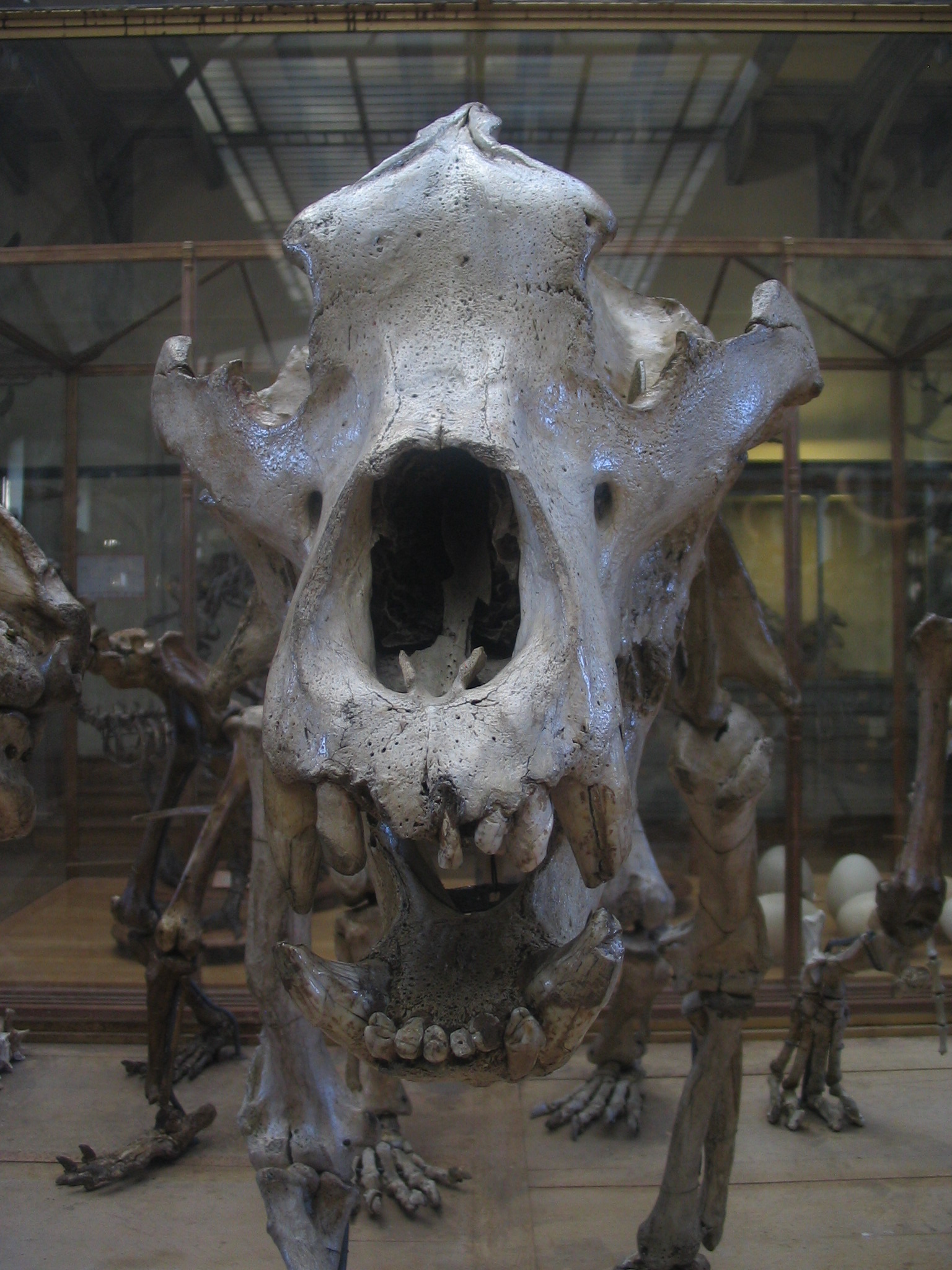
Image: Category:Ursus spelaeus fossils - Wikimedia Commons (CC BY-SA)
About Cave Bear
The Cave Bear, scientifically known as Ursus spelaeus, was a formidable and massive species of bear that dominated the landscapes of Europe and Asia during the Pleistocene epoch, specifically living from approximately 250,000 to 24,000 years ago. As one of the most iconic representatives of Ice Age megafauna, this remarkable creature holds immense significance in the field of paleontology, offering profound insights into Pleistocene ecology, mammalian adaptation, and the complex dynamics of extinction during the Last Glacial Maximum. Thriving in a variety of terrestrial habitats across the Eurasian continent, the cave bear left behind an astonishingly rich fossil record, primarily due to its deep behavioral association with limestone cave systems where countless generations sought refuge and ultimately perished.
In terms of physical anatomy, Ursus spelaeus was an incredibly robust and imposing animal, significantly larger and more heavily built than most modern bear species, including the contemporary grizzly bear. Adult males were particularly massive due to pronounced sexual dimorphism, capable of weighing up to 1,000 kilograms and measuring nearly 300 centimeters in length when fully grown. Even the smaller females were formidable, possessing a stout, barrel-shaped torso supported by incredibly powerful, thick-boned limbs that were adapted more for strength and endurance than for high-speed pursuit. The most distinctive anatomical feature of the cave bear was its skull, which was broad and highly domed, featuring a steep, almost vertical forehead that sharply distinguished it from the sloping facial profiles of modern brown bears. This unique cranial architecture housed massive jaw muscles, which were necessary to process its specific diet. Furthermore, the dentition of Ursus spelaeus was highly specialized; it had largely lost the anterior premolars typically found in other ursids, while its molars were exceptionally large, flat, and elongated, perfectly evolved for grinding tough, fibrous materials rather than shearing meat.
The paleobiology of the cave bear presents a fascinating evolutionary paradox, as isotopic analysis and dental microwear patterns strongly suggest that despite belonging to the order Carnivora, Ursus spelaeus was primarily herbivorous. Scientific studies analyzing the ratios of nitrogen-15 and carbon-13 isotopes in cave bear bone collagen have consistently indicated a diet that relied heavily on tough vegetation, roots, tubers, and seasonal berries. However, as an opportunistic omnivore, it likely supplemented its diet with insects, small vertebrates, or scavenged carrion when plant resources were scarce, particularly during the harsh climatic fluctuations of the Pleistocene. Behaviorally, these bears are most famous for their profound reliance on deep limestone caves for hibernation. Unlike modern bears that may dig temporary dens, cave bears returned to the exact same subterranean networks year after year to survive the brutal Ice Age winters. This prolonged hibernation strategy was fraught with risk, and paleodemographic studies of fossil assemblages reveal high mortality rates among cubs, elderly individuals, and diseased bears who failed to accumulate sufficient fat reserves to survive the long winter sleep. Their locomotion was plantigrade, walking flat on their feet, and their heavily reinforced skeletal structure suggests they were slow-moving but immensely powerful foragers.
The ecological context in which Ursus spelaeus lived was defined by the dramatic and shifting climates of the Pleistocene epoch, characterized by alternating glacial and interglacial periods. The Eurasian landscape was a mosaic of mammoth steppes, boreal forests, and alpine meadows, providing a diverse array of plant life to sustain such massive herbivores. In this dynamic ecosystem, the cave bear shared its habitat with a spectacular array of megafauna, including woolly mammoths, woolly rhinoceroses, giant deer, and steppe bison. However, the cave bear also faced significant pressures from formidable apex predators and competitors. Cave lions and cave hyenas frequently roamed the same territories and are known to have occasionally preyed upon vulnerable cave bear cubs or scavenged the carcasses of adults that died during hibernation. Furthermore, the cave bear found itself in direct competition for vital cave shelters with early hominins, including Neanderthals and anatomically modern humans. This intense competition for limited, secure hibernation sites likely placed immense stress on cave bear populations, forcing them into complex and sometimes fatal ecological interactions with early human hunter-gatherers.
The discovery history of the cave bear is deeply intertwined with European folklore and the very birth of modern paleontology. For centuries during the Middle Ages, the massive bones found in deep cavern systems, such as the famous Zoolithen Cave in Germany, were completely misunderstood by local populations. They were widely believed to be the remains of mythical dragons, unicorns, or ancient giants, and the crushed bones were frequently sold in apothecaries as magical medicines and elixirs. It was not until the late eighteenth century that scientific inquiry began to unravel the truth behind these mysterious remains. In 1774, the German clergyman and naturalist Johann Friedrich Esper published a detailed study of the bones from the Zoolithen Cave, correctly identifying them as belonging to a bear, though he initially speculated they might be related to polar bears. Two decades later, in 1794, the anatomist Johann Christian Rosenmuller formally described the species, giving it the scientific name Ursus spelaeus, meaning bear of the cave. Since then, the Zoolithen Cave and numerous other sites have yielded thousands of key specimens, transforming the cave bear from a creature of myth into a cornerstone of vertebrate paleontology.
The evolutionary significance of Ursus spelaeus cannot be overstated, as it occupies a crucial branch in the evolutionary tree of the family Ursidae. The lineage of the cave bear diverged from the ancestors of the modern brown bear roughly 1.2 to 1.4 million years ago. The direct evolutionary predecessor to Ursus spelaeus is widely considered to be Ursus deningeri, a slightly smaller and less specialized bear that lived during the Middle Pleistocene. Through a process of gradual anagenetic evolution, the lineage developed the massive size, domed skull, and highly specialized herbivorous dentition characteristic of the classic Late Pleistocene cave bear. Today, the cave bear holds immense importance in the rapidly advancing field of paleogenetics. Because cave environments offer incredibly stable temperatures and protection from the elements, the preservation quality of cave bear fossils is often exceptional. This has allowed scientists like Svante Paabo and his colleagues to successfully extract and sequence ancient mitochondrial and nuclear DNA. These groundbreaking genetic studies have provided unprecedented insights into Pleistocene population dynamics, revealing complex genetic diversity, regional population turnovers, and the intricate evolutionary relationships between extinct megafauna and their surviving modern relatives.
Despite the wealth of fossil evidence, several scientific debates continue to surround the cave bear, driving ongoing research and re-evaluation. One major area of contention involves the true extent of their herbivory. While isotopic signatures from many Central European populations point to a strictly vegetarian diet, recent studies of cave bear remains from regions like the Romanian Carpathian Mountains suggest that some localized populations may have consumed higher amounts of animal protein, indicating a more flexible, omnivorous diet than previously assumed. Taxonomy also remains a fiercely debated topic. Some paleontologists argue that the vast morphological and genetic variations seen across Eurasia represent distinct species, such as Ursus ingressus, while others maintain they are merely regional subspecies of a single, highly variable Ursus spelaeus complex. Furthermore, the exact cause of their extinction around 24,000 years ago remains controversial. While some researchers emphasize the devastating impact of climate change and habitat loss during the Last Glacial Maximum, others argue that relentless hunting and competitive exclusion from crucial hibernation caves by expanding populations of early modern humans were the primary drivers of their demise.
The fossil record of the cave bear is arguably one of the most abundant and well-documented of any extinct Pleistocene mammal. The geographic distribution of Ursus spelaeus fossils spans from the Iberian Peninsula and the British Isles in the west, across Central Europe and the Balkans, all the way to the Ural Mountains and the Altai region of Siberia in the east. Because these animals congregated and died in caves over tens of thousands of years, their remains accumulated in staggering numbers. Some individual European cave systems, such as the Goyet Cave in Belgium, the Chauvet Cave in France, and the Mixnitz Cave in Austria, contain the disarticulated bones of thousands, if not tens of thousands, of individual bears. The preservation quality in these subterranean bone beds is highly variable; while many bones are fragmented or scavenged by ancient hyenas, a vast number of complete skulls, articulated limbs, and even delicate juvenile skeletons have been recovered in pristine condition, allowing for exhaustive morphological and taphonomic studies.
The cultural impact of the cave bear extends far beyond the confines of academic paleontology, capturing the imagination of the public and playing a vital role in education. In prehistoric times, the cave bear profoundly influenced early human culture, as evidenced by the stunning Paleolithic cave art found in sites like the Chauvet Cave, where dynamic, incredibly accurate charcoal portraits of cave bears adorn the walls. Today, articulated skeletons of Ursus spelaeus are dramatic centerpieces in natural history museums around the world, serving as powerful educational tools to teach the public about Ice Age ecosystems, the reality of extinction, and the impacts of climate change. From ancient myths of dragons to modern genetic sequencing, the cave bear remains a profound symbol of the lost megafaunal world of the Pleistocene.
Classification
Time Period
Discovery
Location
Zoolithen Cave, Germany
Frequently Asked Questions
What is Cave Bear?
The Cave Bear, scientifically known as Ursus spelaeus, was a formidable and massive species of bear that dominated the landscapes of Europe and Asia during the Pleistocene epoch, specifically living from approximately 250,000 to 24,000 years ago. As one of the most iconic representatives of Ice Age ...
When did Cave Bear live?
Cave Bear lived during the quaternary period of the cenozoic era approximately 0.25-0.024 million years ago.
Where was Cave Bear discovered?
Fossils of Cave Bear were discovered in Zoolithen Cave, Germany.
What did Cave Bear eat?
Cave Bear was a omnivore. It lived in terrestrial habitats.
What type of fossil is Cave Bear?
Cave Bear is preserved as a body fossil. The preservation quality is excellent.
Related Specimens
From the cenozoic era · body fossils