Endoceras
Endoceras proteiforme
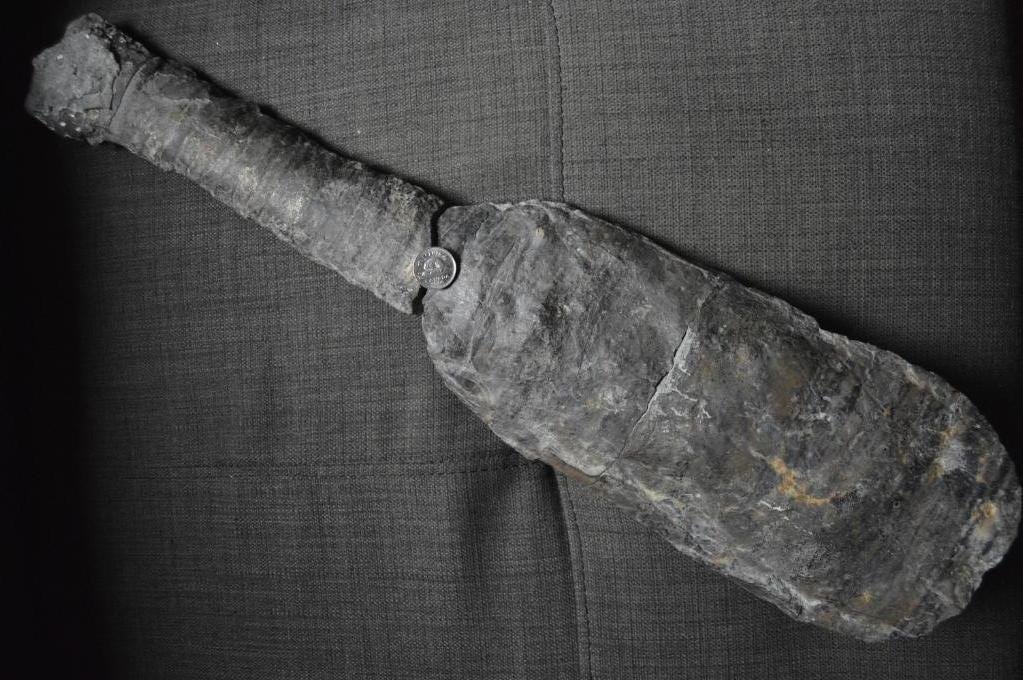
Image: Image sourced via web search (Fair use / Educational)
About Endoceras
Endoceras proteiforme was a colossal, straight-shelled cephalopod that dominated the shallow epicontinental seas of the Middle to Late Ordovician period, approximately 470 to 443 million years ago. As one of the earliest truly gigantic animals to appear on Earth, this magnificent invertebrate represents a pivotal moment in the evolutionary history of marine life, marking the rise of macroscopic apex predators in the world's oceans. Found primarily in the fossil-rich limestone deposits of North America and Europe, Endoceras stands as a testament to the incredible biological diversification known as the Great Ordovician Biodiversification Event. Its significance in paleontology cannot be overstated, as it provides crucial insights into the early evolution of cephalopods, the mechanics of buoyancy in shelled marine organisms, and the complex predator-prey dynamics that shaped Paleozoic marine ecosystems. The sheer scale and predatory adaptations of Endoceras highlight a period when invertebrates were the undisputed rulers of the marine realm, long before jawed fishes evolved to challenge their supremacy.
The physical anatomy of Endoceras proteiforme is defined by its massive, elongated, cone-shaped shell, known as an orthocone, which could reach astonishing lengths of three to five meters, with some fragmentary estimates suggesting even larger dimensions. To put this into perspective, a fully grown Endoceras was comparable in length to a modern great white shark or a large adult crocodile, making it an absolute titan of the Ordovician seas. The shell was divided into two main sections: the body chamber at the wide, open end where the animal's soft tissues resided, and the phragmocone, a series of gas-filled chambers (camerae) separated by walls called septa. Running through the center of these chambers was the siphuncle, a remarkably wide tube that is the defining characteristic of the order Endocerida. In Endoceras, this siphuncle was disproportionately large, sometimes taking up to half the diameter of the shell, and was filled with complex, cone-in-cone calcareous deposits known as endocones. These heavy endocones served as crucial counterweights to the buoyant gas in the chambers, allowing the animal to maintain a horizontal orientation in the water column. While the soft tissues of Endoceras have never been preserved, paleontologists infer its appearance based on modern cephalopods like the nautilus and squid. It likely possessed a formidable cluster of grasping tentacles surrounding a powerful, parrot-like chitinous beak and a rasping radula, perfectly adapted for crushing the hard shells of its prey. Its eyes were likely highly developed, providing acute vision necessary for an apex predator, while a muscular mantle and hyponome (funnel) would have facilitated jet propulsion.
In terms of paleobiology, Endoceras proteiforme was undoubtedly an apex carnivore, sitting at the very top of the Ordovician food web. Its hunting and feeding strategies were largely dictated by its massive size and the physical constraints of its long, rigid shell. Unlike modern, highly agile squids, Endoceras was likely not a fast, pursuit predator. Instead, it is believed to have been a formidable ambush predator, utilizing its neutral buoyancy to hover silently near the sea floor or within the water column. When unsuspecting prey—such as trilobites, brachiopods, early jawless fishes, or smaller cephalopods—wandered too close, Endoceras would propel itself forward with a sudden burst of water expelled from its hyponome, seizing the victim with its tentacles. The heavy endocones in its siphuncle were critical for this lifestyle; without them, the gas-filled apex of the shell would have floated upward, forcing the animal into an awkward, head-down position. By carefully regulating the fluid and gas within its camerae via the siphuncular tissue, Endoceras could adjust its buoyancy to move vertically through the water column with minimal energetic cost. Growth patterns inferred from fossilized shells indicate that these animals grew continuously throughout their lives, adding new, larger chambers to the front of the shell as their soft bodies expanded. The metabolism of Endoceras was likely lower than that of modern coleoid cephalopods, suited to a life of energy conservation punctuated by brief, explosive bursts of predatory action.
The ecological context of the Middle to Late Ordovician period was one of profound biological and geological transformation. During this time, the Earth's landmasses were largely barren, but the oceans were teeming with an unprecedented variety of life. Endoceras lived primarily in the shallow, warm, sunlit epicontinental seas that flooded the ancient continent of Laurentia, which roughly corresponds to modern-day North America. The climate was generally warm and equitable, fostering the growth of extensive reef systems built not by modern corals, but by sponges, bryozoans, and stromatoporoids. In these vibrant underwater landscapes, Endoceras shared its habitat with a diverse array of organisms. The sea floor was carpeted with brachiopods, crinoids (sea lilies), and gastropods, while the water column was filled with graptolites and early, heavily armored jawless fishes known as ostracoderms. Trilobites, such as Isotelus, were incredibly abundant and likely formed a significant portion of the Endoceras diet. As the apex predator, Endoceras played a crucial top-down regulatory role in this ecosystem, controlling the populations of secondary consumers and driving evolutionary arms races. The presence of such a massive predator likely exerted strong selective pressures on its prey, leading to the development of thicker armor, burrowing behaviors, and enhanced sensory organs among the benthic and pelagic fauna of the Ordovician seas.
The discovery history of Endoceras proteiforme is deeply intertwined with the foundational years of North American paleontology. The species was first formally described and named in 1847 by James Hall, a towering figure in 19th-century geology and paleontology, in his monumental work 'Paleontology of New York.' The initial, and most significant, fossils were discovered in the Trenton Limestone formations of New York State, a geological unit that has yielded some of the most spectacular Ordovician fossils in the world. The circumstances of these early discoveries were often tied to the expansion of infrastructure, such as the digging of the Erie Canal and the quarrying of limestone for building materials, which exposed vast swaths of fossiliferous rock. Hall chose the genus name Endoceras, meaning 'inner horn,' to highlight the distinctive, heavy endocones found within the siphuncle, while the specific epithet 'proteiforme' refers to the highly variable, or protean, nature of the fossil fragments he encountered. Because the fragile outer shell (phragmocone) often broke away after death, leaving only the massive, solid siphuncle, early paleontologists frequently misidentified these isolated parts as entirely different organisms. It took decades of careful comparative anatomy and the discovery of more complete specimens to fully understand the true morphology of Endoceras. Today, key specimens are housed in major institutions like the American Museum of Natural History and the Smithsonian National Museum of Natural History, serving as vital holotypes for ongoing research.
The evolutionary significance of Endoceras proteiforme lies in its position as a highly specialized, early offshoot of the cephalopod family tree. The order Endocerida represents one of the first major radiations of cephalopods, diverging from earlier, smaller nautiloids during the Early Ordovician. Endoceras and its kin demonstrate an extreme evolutionary experiment in gigantism and buoyancy control. The development of the wide siphuncle and complex endocones was a unique evolutionary solution to the problem of stabilizing a massive, straight shell in the water column. While this adaptation was highly successful during the Ordovician, allowing endocerids to dominate global oceans, it ultimately proved to be an evolutionary dead end. The heavy, rigid shells made them relatively slow and cumbersome compared to the more agile, coiled nautiloids and the later, shell-less coleoids (squids and octopuses) that would eventually evolve. When the Late Ordovician mass extinction event occurred—driven by severe glaciation, dropping sea levels, and ocean anoxia—the specialized, shallow-water habitats of Endoceras were decimated. The endocerids suffered catastrophic losses and eventually went completely extinct during the Silurian period, leaving no direct modern descendants. However, their fossils remain crucial for understanding the early morphological plasticity of cephalopods and the evolutionary pathways that led to the diverse array of mollusks we see today.
Scientific debates surrounding Endoceras have persisted since its discovery, particularly regarding its maximum size and its taxonomic relationship to other giant orthocones. For many years, fragmentary fossils of massive siphuncles led to wild extrapolations, with some mid-20th-century texts suggesting lengths of up to nine or ten meters. Modern paleontologists, utilizing more rigorous allometric scaling based on complete specimens, have revised these estimates down to a more realistic three to five meters. Furthermore, there is ongoing taxonomic confusion between Endoceras and the closely related genus Cameroceras. Many fossils historically assigned to Cameroceras are now considered by some experts to be synonymous with or closely related to Endoceras, leading to debates over which generic name holds priority. Additionally, the exact orientation and swimming capabilities of Endoceras remain a topic of biomechanical modeling. While the consensus supports a horizontal, neutrally buoyant posture, some researchers argue that the massive weight of the apical endocones might have forced the animal into a slightly tilted or even benthic resting position, challenging the traditional view of it as an active, mid-water cruiser.
The fossil record of Endoceras proteiforme is both abundant and frustratingly incomplete. Fossils are predominantly found in the Middle to Upper Ordovician marine deposits of North America, particularly in the Trenton Group of New York, Ontario, and Quebec, as well as in equivalent strata in Northern Europe. Because the outer shell (phragmocone) was relatively thin and fragile, it was frequently destroyed by wave action, scavenging, or geological compression before fossilization could occur. Consequently, the vast majority of Endoceras fossils consist solely of the robust, heavily calcified siphuncle and its internal endocones, which are incredibly resistant to taphonomic destruction. These isolated siphuncles are sometimes so common in certain limestone beds that they form distinct geological markers. Exceptionally preserved specimens, where the entire shell, septa, and body chamber are intact, are exceedingly rare but provide the critical data needed to reconstruct the animal's full dimensions. Famous fossil sites, such as the Walcott-Rust Quarry in New York, have yielded some of the most complete and scientifically valuable specimens of Endoceras, offering a rare window into the anatomy of these ancient giants.
The cultural impact of Endoceras, while perhaps not as ubiquitous as that of dinosaurs, is significant within the realm of paleontology and natural history education. In museums around the world, the massive, spear-like fossils of Endoceras are frequently displayed to illustrate the bizarre and alien nature of Paleozoic marine life. These exhibits capture the public's imagination, serving as tangible proof that 'sea monsters' once truly existed. In popular culture, giant orthocones often feature in documentaries and media focused on prehistoric oceans, such as the BBC's 'Sea Monsters' series, where they are depicted as terrifying apex predators. Educationally, Endoceras is a classic textbook example used to teach students about buoyancy, evolutionary arms races, and the concept of deep time, ensuring its legacy endures long after its extinction.
Classification
Time Period
Discovery
Location
New York, United States
Formation
Trenton Limestone
Frequently Asked Questions
What is Endoceras?
Endoceras proteiforme was a colossal, straight-shelled cephalopod that dominated the shallow epicontinental seas of the Middle to Late Ordovician period, approximately 470 to 443 million years ago. As one of the earliest truly gigantic animals to appear on Earth, this magnificent invertebrate repres...
When did Endoceras live?
Endoceras lived during the ordovician period of the paleozoic era approximately 470-443 million years ago.
Where was Endoceras discovered?
Fossils of Endoceras were discovered in New York, United States in the Trenton Limestone.
What did Endoceras eat?
Endoceras was a carnivore. It lived in marine habitats.
What type of fossil is Endoceras?
Endoceras is preserved as a body fossil. The preservation quality is good.
Related Specimens
From the paleozoic era · body fossils