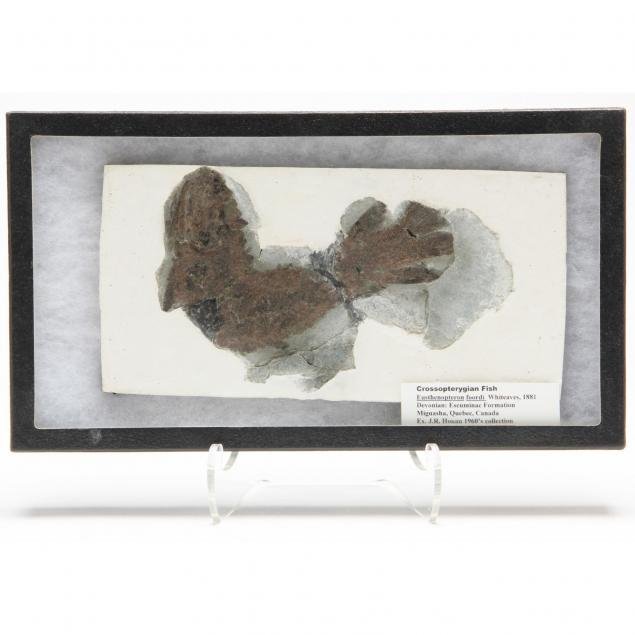
Eusthenopteron
Eusthenopteron foordi
Image: Image sourced via web search (Fair use / Educational)
About Eusthenopteron
Eusthenopteron foordi is a genus of prehistoric lobe-finned fish that lived during the Late Devonian period, approximately 385 to 374 million years ago. Its remarkably well-preserved fossils, primarily from the Escuminac Formation in Quebec, Canada, have made it one of the most thoroughly studied fossil vertebrates, providing profound insights into the anatomy of the ancestors of tetrapods—the four-limbed vertebrates that include amphibians, reptiles, birds, and mammals. For decades, Eusthenopteron was held as a textbook example of a direct fish ancestor to terrestrial animals, a 'fish with legs' in the popular imagination, although its precise role in this transition is now understood with greater nuance.
Eusthenopteron was a formidable predator, reaching lengths of up to 1.8 meters (nearly 6 feet), though most specimens are closer to 1 meter. Its body was torpedo-shaped, streamlined for powerful, ambush-style hunting in the water. The skull was broad and flattened, composed of numerous dermal bones that formed a complex, mosaic-like pattern. A key feature was its intracranial joint, a hinge within the skull roof that allowed the front part of the cranium to flex upwards relative to the cheek region, likely increasing the gape of its mouth for capturing prey. Its jaws were lined with large, conical fangs on the palate and smaller, sharp teeth along the jaw margins, indicating a carnivorous diet. The most significant anatomical features were its paired pectoral and pelvic fins. Unlike the ray fins of most modern fish, these were fleshy, muscular lobes supported by a robust internal skeleton. This endoskeleton contained bones homologous to the humerus, radius, and ulna in the forelimb, and the femur, tibia, and fibula in the hindlimb of tetrapods. While it lacked wrists, ankles, and digits, this foundational limb structure represents a clear precursor to the limbs of land-dwelling vertebrates. Its tail was diphycercal, with the vertebral column extending straight to the tip, flanked by a three-lobed fin, providing powerful propulsion.
As an apex predator in its ecosystem, Eusthenopteron likely employed an ambush hunting strategy. Its streamlined body and powerful tail fin would have enabled rapid bursts of speed to catch smaller fish and other aquatic organisms. The intracranial joint would have facilitated a wide gape and a powerful bite, allowing it to consume substantial prey. Its locomotion was entirely aquatic; despite the tetrapod-like bones in its fins, there is no evidence to suggest it could walk on land. The fins were more likely used for maneuvering in complex, shallow-water environments, perhaps navigating through submerged vegetation or propping itself up on the substrate while waiting for prey. Studies of growth rings on its scales and bones suggest a life history similar to that of modern large predatory fish, with individuals growing throughout their lives, although at a decreasing rate after reaching maturity. Its metabolism was likely ectothermic, or 'cold-blooded,' consistent with other fish of the period, relying on the ambient water temperature to regulate its body functions. There is no direct fossil evidence for social behavior, but like many modern predatory fish, it was probably a solitary hunter.
The world of the Late Devonian was a 'greenhouse' world, characterized by warm global temperatures and high sea levels. Eusthenopteron inhabited subtropical, brackish, and freshwater ecosystems, specifically the large, semi-enclosed estuary represented by the Escuminac Formation. This environment was a rich and complex food web. The water column teemed with other fish, including the armored placoderm Bothriolepis, the primitive ray-finned fish Cheirolepis, and the lungfish Scaumenacia. Eusthenopteron, as one of the largest predators in this habitat, would have occupied a high trophic level, preying on these smaller fish. It, in turn, may have been prey for even larger, though rarer, tristichopterids or other apex predators that are less well-represented in the fossil record. The surrounding terrestrial landscape was newly colonized by forests of early trees like Archaeopteris, which shed organic matter into the water, fueling the aquatic ecosystem. This period, known as the 'Age of Fishes,' saw an incredible diversification of aquatic life, but it was also the crucible in which the vertebrate transition to land was beginning, with organisms like Eusthenopteron representing a critical stage in this evolutionary saga.
The history of Eusthenopteron's discovery is intrinsically linked to the famous fossil beds of Miguasha National Park in Quebec, Canada. Fossils were first noted in the region in the 1840s, but it was the Canadian geologist Joseph Frederick Whiteaves who first scientifically described the fish in 1881. He named the genus Eusthenopteron, meaning 'strong fin,' and the species foordi in honor of the paleontologist Arthur H. Foord. However, the true scientific potential of Eusthenopteron was unlocked through the meticulous work of Swedish paleontologist Erik Jarvik in the mid-20th century. Beginning in the 1930s, Jarvik undertook an exhaustive study of the exceptionally preserved Miguasha specimens. Using a painstaking serial grinding technique, where a fossil is ground down millimeter by millimeter and each new surface is drawn or photographed, he was able to reconstruct the entire three-dimensional anatomy of the skull and skeleton in unprecedented detail. His resulting monographs, published over several decades, became foundational texts in vertebrate paleontology and cemented Eusthenopteron's status as a key transitional fossil. The sheer abundance and quality of specimens from the Escuminac Formation, numbering in the thousands, have made it one of the most completely known fossil vertebrates.
Eusthenopteron's evolutionary significance lies in its position as a member of the Sarcopterygii, or lobe-finned fishes, the group that gave rise to all tetrapods. For much of the 20th century, based on Jarvik's detailed work, it was considered the archetypal 'ancestor' of land vertebrates. Its fin endoskeleton, with its clear one-bone, two-bone pattern, was seen as the perfect precursor to a walking limb. Furthermore, its skull bone pattern closely matched that of the earliest known tetrapods like Ichthyostega and Acanthostega. While its direct ancestral role has been revised, its importance has not diminished. We now understand that Eusthenopteron belongs to the family Tristichopteridae, which is considered a sister group to the elpistostegalians (like Panderichthys and Tiktaalik), the group now recognized as being even more closely related to tetrapods. Therefore, Eusthenopteron is not a direct ancestor but rather a very close 'cousin,' providing an exceptionally detailed anatomical blueprint of the body plan from which tetrapods evolved. It showcases the suite of pre-adaptations—robust fins, a flattened skull, and air-breathing potential (inferred from its relatives)—that were present in this fish lineage long before the move onto land was completed.
Despite being one of the most studied fossil fish, Eusthenopteron is not without scientific debate. For many years, Erik Jarvik's reconstructions were the unquestioned standard. However, with the advent of modern technologies like CT scanning, paleontologists have been able to re-examine his work and the original fossils non-destructively. These new analyses have largely confirmed the brilliance and accuracy of Jarvik's anatomical work but have also led to some revisions. For example, the precise arrangement and mobility of certain skull bones have been reinterpreted. The most significant shift in understanding has been its phylogenetic placement. The discovery of more tetrapod-like fish such as Panderichthys in the 1980s and, most famously, Tiktaalik in 2004, demonstrated that Eusthenopteron was not on the direct line to tetrapods. These newer finds possess even more derived features, such as a further flattened skull, a loss of the dorsal fin, and in the case of Tiktaalik, a mobile neck and a primitive wrist-like structure in its fin. This has repositioned Eusthenopteron as a slightly more basal but still critically important relative, illustrating a slightly earlier stage of sarcopterygian evolution.
The fossil record of Eusthenopteron is extraordinary, almost exclusively concentrated in the Escuminac Formation of Miguasha, Quebec, a UNESCO World Heritage Site. This site represents a 380-million-year-old estuary and has yielded over 2,000 specimens of Eusthenopteron alone, making it a remarkably common fossil in this specific locality. The preservation is often exceptional, with many fossils being three-dimensionally preserved within nodules of sediment, rather than being flattened. This has allowed for the detailed study of not just the bones, but also impressions of blood vessels, nerve canals within the skull, and even, in some rare cases, soft tissue traces. Complete skeletons are known, from small juveniles to large adults, providing a comprehensive view of its entire life cycle. While Eusthenopteron-like tristichopterids are known from other Late Devonian sites around the world (in what was the supercontinent of Euramerica), the genus Eusthenopteron foordi itself is defined by the Miguasha material, which remains the global standard for this animal.
Due to its historical importance as a 'missing link,' Eusthenopteron has had a significant cultural impact, particularly in education. For decades, it was the go-to illustration in biology and paleontology textbooks to depict the fish-to-tetrapod transition. Although now often shown alongside Tiktaalik to present a more complete story, its legacy endures. Models and fossil casts of Eusthenopteron are prominent features in major natural history museums worldwide, including the Canadian Museum of Nature and the Miguasha National Park's own museum. Its detailed, accessible anatomy makes it an excellent teaching tool for demonstrating homologous structures and the stepwise nature of major evolutionary transitions, securing its place as a celebrated icon of vertebrate evolution.
Classification
Time Period
Discovery
Location
Canada
Formation
Escuminac Formation
Frequently Asked Questions
What is Eusthenopteron?
Eusthenopteron foordi is a genus of prehistoric lobe-finned fish that lived during the Late Devonian period, approximately 385 to 374 million years ago. Its remarkably well-preserved fossils, primarily from the Escuminac Formation in Quebec, Canada, have made it one of the most thoroughly studied fo...
When did Eusthenopteron live?
Eusthenopteron lived during the devonian period of the paleozoic era approximately 385-374 million years ago.
Where was Eusthenopteron discovered?
Fossils of Eusthenopteron were discovered in Canada in the Escuminac Formation.
What did Eusthenopteron eat?
Eusthenopteron was a carnivore. It lived in freshwater, brackish habitats.
What type of fossil is Eusthenopteron?
Eusthenopteron is preserved as a body fossil. The preservation quality is exceptional.
Related Specimens
From the paleozoic era · body fossils