Conularia
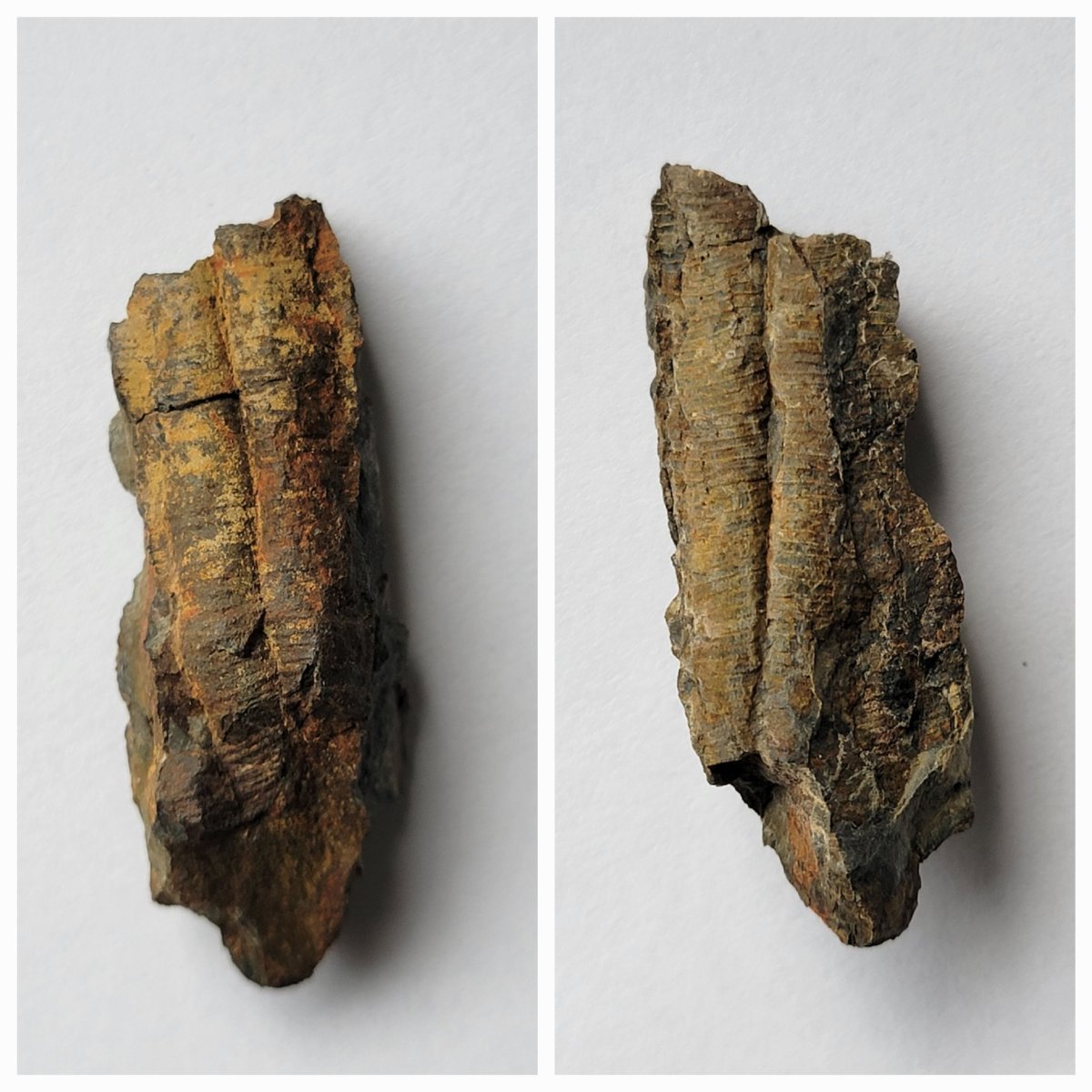
Conularia quadrisulcata
Image: Image sourced via web search (Fair use / Educational)
About Conularia
Conularia is an extinct genus of enigmatic marine invertebrates that thrived during the Paleozoic Era, with the species Conularia quadrisulcata being a prominent representative from the Devonian Period. These organisms, known as conulariids, are characterized by their distinctive four-sided, pyramidal exoskeletons and are found in marine fossil deposits worldwide. Their unique morphology and uncertain evolutionary relationships have made them a subject of considerable paleontological interest, representing a successful but ultimately failed evolutionary experiment within the early history of animal life.
Conularia quadrisulcata possessed an elongate, four-sided pyramidal exoskeleton, or periderm, composed of chitinophosphate, a material similar to the shells of some brachiopods. This structure, which could range from 5 to over 30 centimeters in length, tapered from a wide aperture at one end to a pointed apex at the other. For comparison, a large specimen could be the length of a human forearm. The name 'quadrisulcata' refers to the four prominent grooves, or sulci, that ran longitudinally along the corners of the pyramid, dividing the periderm into four flat or slightly convex faces. Each face was ornamented with fine, transverse ribs or ridges that often bent sharply as they crossed the midline, creating a distinctive chevron-like pattern. The aperture, or opening, was likely covered by four triangular lappets or flaps that could close to protect the soft-bodied animal within. At the apex, some specimens show evidence of a small holdfast structure, suggesting a sessile, or attached, juvenile stage. The internal anatomy is poorly known, but inferences from their cnidarian classification suggest a simple, sac-like body with a central mouth surrounded by tentacles for feeding, all housed within the protective periderm.
The paleobiology of Conularia remains a topic of active research, but a consensus is emerging that they were likely active predators. Their cnidarian affinity suggests they possessed stinging cells, or cnidocytes, on tentacles that extended from the aperture, much like modern jellyfish or sea anemones. These tentacles would have been used to capture small prey such as trilobite larvae, small crustaceans, and other planktonic organisms drifting in the water column. While some paleontologists once proposed a benthic, filter-feeding lifestyle, with the apex anchored to the seafloor, the hydrodynamic shape of the periderm and the global distribution of fossils in various marine environments suggest a more mobile existence. It is now widely believed that many conulariids, including Conularia, were pelagic, living as free-swimming or floating predators in the open ocean. They may have used a form of jet propulsion by rhythmically contracting their bodies to expel water from the aperture, similar to modern jellyfish. Growth occurred by adding new layers of periderm at the apertural margin, resulting in the characteristic transverse ridges that represent daily or periodic growth lines, providing a record of the organism's life history.
During the Devonian Period, often called the 'Age of Fishes', Conularia quadrisulcata inhabited a world of warm, shallow epicontinental seas teeming with life. The continents were arranged differently, with the supercontinent of Gondwana dominating the Southern Hemisphere and the smaller continents of Laurussia and Siberia located near the equator. These seas supported the first great coral-stromatoporoid reefs, creating complex ecosystems. Conularia shared these habitats with a diverse array of organisms. It would have floated above the seafloor, which was populated by brachiopods, crinoids, trilobites like Phacops, and rugose and tabulate corals. In the water column, it competed with and likely preyed upon early ammonoids, nautiloids, and various arthropods. The primary predators of Conularia were likely the rapidly diversifying jawed fishes, including the formidable placoderms like Dunkleosteus, and early sharks. The tough but flexible periderm of Conularia would have offered some defense against these new, powerful predators. As a mid-level carnivore, Conularia played an important role in the pelagic food web, transferring energy from smaller planktonic life to larger marine vertebrates.
The discovery and study of Conularia have a long history, dating back to the early days of paleontology. The species Conularia quadrisulcata was first described by the English naturalist and paleontologist John Sowerby in his seminal work, 'Mineral Conchology of Great Britain', published in parts between 1812 and 1846. Sowerby's initial descriptions were based on fossils found in Devonian-aged rocks in England. For many years, the biological affinity of these strange, four-sided fossils was a complete mystery. They were variously classified as mollusks related to pteropods or cephalopods, worms, or even plants. It was not until the mid-20th century that detailed microstructural analysis of the periderm and comparisons with other fossil groups began to point towards a cnidarian relationship. Key work by researchers like R. Kozłowski in the 1960s, who studied exceptionally preserved material, helped solidify this interpretation. No single 'famous' specimen of Conularia exists in the way that 'Lucy' does for hominids, but numerous well-preserved examples in museum collections, such as those at the Natural History Museum in London and the Smithsonian National Museum of Natural History, have been crucial for scientific understanding.
The evolutionary significance of Conularia lies in its unique position within the phylum Cnidaria. For decades, their classification was highly contentious, but the current consensus places them within the class Scyphozoa, which includes modern true jellyfish. This makes conulariids a highly specialized, extinct order that demonstrates the remarkable evolutionary plasticity of the cnidarian body plan. They represent an early experiment in developing a hard, mineralized exoskeleton within a phylum that is otherwise overwhelmingly soft-bodied. This evolutionary path, which involved creating a durable, chitinophosphatic skeleton, was a major deviation from the typical gelatinous form of their scyphozoan relatives. The presence of a four-fold (tetrameral) symmetry in Conularia is a key feature linking them to scyphozoans, which also exhibit this body plan. They are not direct ancestors to any modern group but are considered a successful side-branch of the jellyfish lineage that flourished for over 300 million years before succumbing to the Permian-Triassic extinction event, which wiped out an estimated 96% of all marine species.
Despite the general consensus placing conulariids within Scyphozoa, scientific debates continue, particularly regarding their precise mode of life and the function of certain anatomical features. The debate over a benthic (bottom-dwelling) versus pelagic (free-swimming) lifestyle is a primary example. While the pelagic hypothesis is currently favored for many species, evidence of apical holdfasts in some specimens suggests that at least some conulariids were sessile for part or all of their lives, or that different species occupied different ecological niches. Another area of discussion involves the periderm's internal structures and their function. The exact mechanism for closing the apertural lappets and the nature of the soft-part attachment within the skeleton are still not fully understood. Recent discoveries of exceptionally preserved fossils, sometimes showing traces of soft tissues or organisms attached to the conulariid shell, continue to refine our understanding and challenge long-held assumptions about their biology and ecological interactions.
The fossil record of Conularia is robust and geographically widespread, a testament to their success as a group. Their fossils are found on every continent, including Antarctica, in marine sedimentary rocks ranging from the late Ediacaran to the end of the Permian period. Conularia quadrisulcata itself is a common index fossil for the Devonian Period. The periderm, being made of a durable chitinophosphatic material, fossilized readily. Fossils are most often found as flattened compressions in shales or as three-dimensional internal or external molds in sandstones and limestones. Famous fossil sites yielding well-preserved Conularia include the Hunsrück Slate in Germany, the Silica Shale of Ohio and Michigan in the USA, and various Devonian formations in Bohemia (Czech Republic). While the periderm is commonly preserved, fossils showing the delicate apertural lappets or any trace of soft tissue are exceptionally rare and scientifically valuable.
While not a household name like Tyrannosaurus or Triceratops, Conularia holds a certain fascination for fossil collectors and paleontologists due to its unusual and geometric shape. Its fossils are prized by amateur collectors for their aesthetic, symmetrical appearance. Major natural history museums around the world, including the Field Museum in Chicago and the American Museum of Natural History in New York, feature specimens of Conularia in their Paleozoic marine life displays. They serve as excellent educational tools to illustrate the diversity of ancient life, the concept of extinct evolutionary lineages, and the challenges of classifying enigmatic organisms from the distant past. Their strange, almost alien form captures the imagination and highlights the vast and often bizarre history of life on Earth.
Classification
Time Period
Discovery
Location
Global, with early significant finds in Europe (e.g., England, Bohemia)
Formation
Various Devonian marine shales and limestones worldwide (e.g., Hunsrück Slate, Ohio Shale)
Frequently Asked Questions
What is Conularia?
Conularia is an extinct genus of enigmatic marine invertebrates that thrived during the Paleozoic Era, with the species Conularia quadrisulcata being a prominent representative from the Devonian Period. These organisms, known as conulariids, are characterized by their distinctive four-sided, pyramid...
When did Conularia live?
Conularia lived during the devonian period of the paleozoic era approximately 419-359 million years ago.
Where was Conularia discovered?
Fossils of Conularia were discovered in Global, with early significant finds in Europe (e.g., England, Bohemia) in the Various Devonian marine shales and limestones worldwide (e.g., Hunsrück Slate, Ohio Shale).
What did Conularia eat?
Conularia was a carnivore. It lived in marine, benthic, pelagic habitats.
What type of fossil is Conularia?
Conularia is preserved as a body fossil. The preservation quality is good.
Related Specimens
From the paleozoic era · body fossils