Hipparion
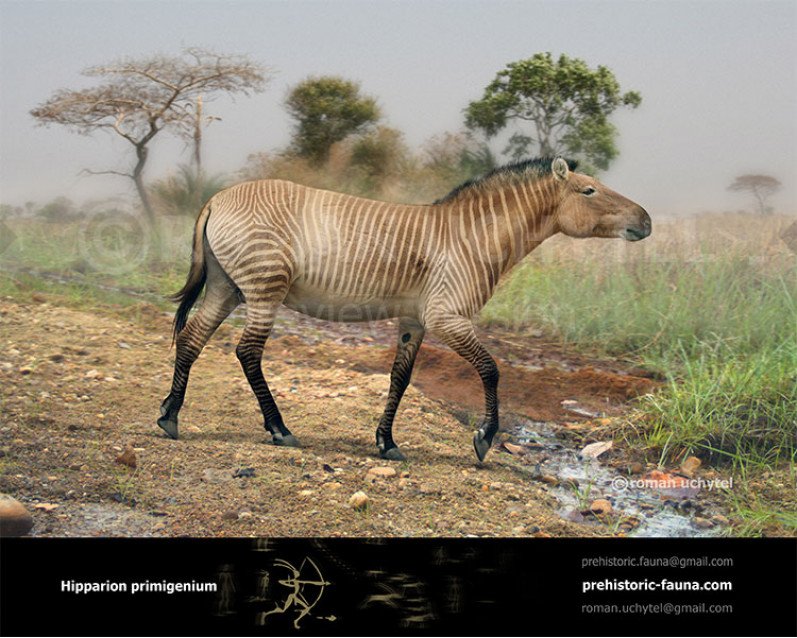
Hipparion primigenium
Image: Image sourced via web search (Fair use / Educational)
About Hipparion
Hipparion is an extinct genus of three-toed horse that roamed vast expanses of North America, Eurasia, and Africa during the Neogene Period, from the Middle Miocene to the Pleistocene, approximately 16 to 2 million years ago. Its remarkable success and widespread distribution make it a key index fossil, helping paleontologists date geological strata across continents. The story of Hipparion is not just about a single animal, but about a major evolutionary radiation that signifies a critical transition in equine history and the global expansion of grassland ecosystems.
Physically, Hipparion was a medium-sized equid, comparable in stature to a modern pony or a large zebra, standing approximately 1.4 meters (4.6 feet) tall at the shoulder. Its body length was around 1.4 meters (4.6 feet) and weight estimates range from 115 to 200 kilograms (250 to 450 pounds), depending on the species and individual. The most defining characteristic of Hipparion was its tridactyl (three-toed) foot structure. While it possessed a large central toe (the third digit) that bore the majority of its weight, it retained two smaller, non-functional side toes (the second and fourth digits) that did not typically touch the ground during normal locomotion. This is a crucial distinction from modern horses (genus Equus), which are monodactyl, having only the central toe remaining. The skull of Hipparion was elongated and horse-like, but with a notable feature: a deep, preorbital facial fossa, a pronounced depression in the skull in front of the eye sockets. The function of this fossa is debated, but theories suggest it may have housed a scent gland for communication, similar to those in modern duikers or deer, or perhaps a resonating chamber for vocalizations. Its dentition featured high-crowned (hypsodont) molars with complex enamel patterns, an adaptation for grinding tough, abrasive grasses.
As a dedicated herbivore, Hipparion's paleobiology was intricately linked to the expanding grasslands of the Miocene. The hypsodont teeth were perfectly suited for a grazing diet, allowing it to efficiently process silica-rich grasses that would quickly wear down the teeth of browsing animals. Isotopic analysis of tooth enamel from various Hipparion species confirms a diet dominated by C4 grasses, which were becoming ecologically dominant during this period. Its locomotion was well-adapted for life on open plains. While the side toes were vestigial, they may have provided extra traction on softer ground or during sharp turns at high speed, acting as a form of natural 'cleat'. This tridactyl arrangement represents an intermediate stage between earlier, more flat-footed browsing horses and the single-toed, highly cursorial modern grazers. Fossil trackways and the sheer abundance of remains suggest Hipparion lived in large herds, a social structure that would have offered protection against predators through collective vigilance. This herding behavior is a common strategy for ungulates in open environments, facilitating both defense and efficient foraging across wide territories. Growth patterns, inferred from bone histology, suggest a relatively rapid maturation rate, enabling young to quickly join the herd and fend for themselves.
Hipparion emerged into a world undergoing significant environmental transformation. The Miocene epoch, often called the 'Age of Mammals,' saw a global cooling and drying trend that spurred the retreat of forests and the vast expansion of savannas and grasslands. This new biome created immense ecological opportunities for grazing animals. Hipparion was a dominant herbivore in these ecosystems, sharing its habitat with a diverse megafauna. In North America, it coexisted with early camels, pronghorns, rhinos, and gomphotheres (elephant relatives). Its primary predators would have included saber-toothed cats like Machairodus, bear-dogs (Amphicyonidae), and large canids. In Eurasia and Africa, the faunal assemblages were even more diverse, including giraffids, bovids, and proboscideans. Hipparion's position in the food web was that of a primary consumer, a crucial link converting the energy from grasses into a food source for a wide array of carnivores. Its success and dispersal across continents, known as the 'Hipparion Event,' fundamentally reshaped terrestrial ecosystems, marking the establishment of modern-style savanna biomes globally.
The discovery history of Hipparion dates back to the early days of paleontology. The genus was first described in 1832 by the French paleontologist Christol, based on fossils unearthed from the rich Miocene deposits near Cucuron, France. However, the most significant early finds came from the Sansan Formation in southwestern France, which yielded numerous well-preserved specimens that allowed for a detailed anatomical understanding. The name 'Hipparion' is derived from Greek, meaning 'little horse' or 'pony.' The initial discovery and subsequent finds across Europe were pivotal, but the story expanded dramatically with discoveries in North America. Paleontologist Joseph Leidy was among the first to recognize Hipparion fossils in the United States during the mid-19th century, revealing the genus's intercontinental range. The 'Hipparion Datum' or 'Hipparion Event' refers to the first appearance of Hipparion fossils in the Old World around 11.6 million years ago, a key biostratigraphic marker indicating its migration from its North American origin. This event is so significant that it is used by geologists and paleontologists to correlate the age of terrestrial fossil sites across Eurasia and Africa, making Hipparion a cornerstone of Neogene chronostratigraphy.
Hipparion's evolutionary significance is profound, as it represents a major, successful branch of the equine family tree that thrived for over 14 million years. It is not a direct ancestor of the modern horse, genus Equus, but rather a member of a parallel, highly successful lineage that diverged from the line leading to modern horses. The evolution of equids is a classic textbook example of macroevolution, and Hipparion illustrates a key transitional phase. It showcases the adaptation from forest-dwelling, browsing ancestors with multiple toes to grassland-dwelling, grazing specialists. The retention of its side toes, combined with its advanced grazing dentition, perfectly encapsulates this intermediate stage. The genus underwent a massive adaptive radiation, with over 50 recognized species, each adapted to slightly different ecological niches. This diversification highlights the evolutionary plasticity of the equine body plan in response to the new opportunities presented by the spread of grasslands. Ultimately, the Hipparion lineage was outcompeted by the more advanced, single-toed horses of the genus Equus, which were even better adapted for rapid, efficient locomotion on open terrain, leading to Hipparion's extinction by the mid-Pleistocene.
Despite its long history of study, Hipparion remains a subject of scientific debate. The primary controversy revolves around its taxonomy; the sheer number of described species has led some paleontologists to argue that the genus is a 'wastebasket taxon,' containing multiple, not-so-closely-related lineages that should be split into separate genera. The precise function of the preorbital facial fossa is another area of active discussion, with no definitive consensus reached. Furthermore, the exact reasons for its extinction are debated. While competition from the more advanced Equus is the leading theory, a combination of factors, including climate change during the Pleistocene ice ages and shifts in vegetation, likely played a significant role. New analytical techniques, such as stable isotope analysis and microwear studies on teeth, continue to refine our understanding of the specific diets and ecological niches of different Hipparion species, challenging older, more generalized interpretations of its behavior.
The fossil record of Hipparion is exceptionally rich and geographically widespread, making it one of the most common large mammal fossils of the Neogene. Its remains have been found in abundance across North America (from Florida to California), Europe (especially Spain, Greece, and France), Asia (including China and India), and Africa (from Ethiopia to South Africa). Famous fossil sites yielding spectacular Hipparion material include the Ashfall Fossil Beds in Nebraska, where entire herds were preserved after being buried by volcanic ash, and the Pikermi fossil site in Greece. The fossils are typically well-preserved, with complete skeletons, skulls, and vast collections of isolated teeth and limb bones being relatively common. This abundance allows for detailed studies of population structure, variation, and paleoecology that are impossible for rarer organisms. The quality and quantity of its fossil record are what make Hipparion such a vital index fossil for its time period.
In terms of cultural impact, Hipparion is a staple in museum exhibits on evolution and prehistoric life worldwide. Its skeleton, often displayed alongside earlier and later horses, serves as a powerful visual aid to explain the concept of evolutionary transitions and adaptive radiation. The American Museum of Natural History in New York and the Field Museum in Chicago feature prominent displays illustrating the classic equine evolutionary sequence, with Hipparion representing a crucial chapter. While it may not have the same celebrity status as a Tyrannosaurus or a mammoth, Hipparion is fundamental to science education, providing a clear and compelling example of how life adapts to a changing world. Its story is a testament to a highly successful group that dominated global ecosystems for millions of years before giving way to its more famous modern relatives.
Classification
Time Period
Discovery
Location
France
Formation
Sansan Formation
Frequently Asked Questions
What is Hipparion?
Hipparion is an extinct genus of three-toed horse that roamed vast expanses of North America, Eurasia, and Africa during the Neogene Period, from the Middle Miocene to the Pleistocene, approximately 16 to 2 million years ago. Its remarkable success and widespread distribution make it a key index fos...
When did Hipparion live?
Hipparion lived during the neogene period of the cenozoic era approximately 16-2 million years ago.
Where was Hipparion discovered?
Fossils of Hipparion were discovered in France in the Sansan Formation.
What did Hipparion eat?
Hipparion was a herbivore. It lived in terrestrial habitats.
What type of fossil is Hipparion?
Hipparion is preserved as a body fossil. The preservation quality is good.
Related Specimens
From the cenozoic era · body fossils