Lambeosaurus
Lambeosaurus lambei
Image: Image sourced via web search (Fair use / Educational)
About Lambeosaurus
Lambeosaurus is a genus of hadrosaurid, or 'duck-billed' dinosaur, that inhabited the coastal plains of what is now North America during the Late Cretaceous period, approximately 76 to 75 million years ago. As a prominent member of the Lambeosaurinae subfamily, it is distinguished by its unique and hollow cranial crest, making it one of the most recognizable dinosaurs from its time. Its abundant fossil remains have provided paleontologists with a wealth of information about hadrosaur anatomy, behavior, and evolution, cementing its significance in the study of Late Cretaceous ecosystems.
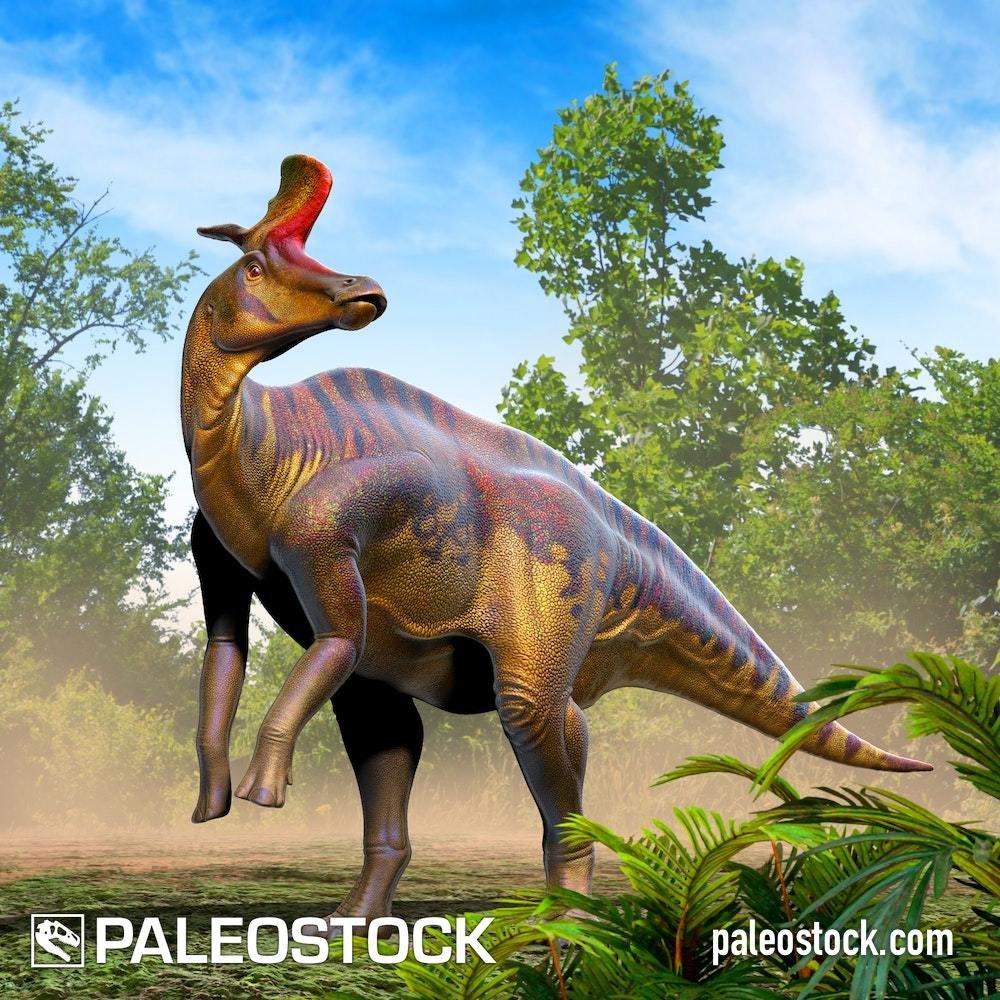
Lambeosaurus was a large, bipedal and quadrupedal herbivore, with adults of the type species, Lambeosaurus lambei, reaching lengths of 9 to 10 meters (approximately 30 to 33 feet) and weighing an estimated 4 to 5.5 metric tons. This size is comparable to a large modern African elephant, though with a very different body plan. Its most striking feature was its complex cranial crest. In L. lambei, this crest was shaped like a hatchet or a forward-pointing glove, with a prominent forward-pointing 'blade' and a smaller, solid rearward-pointing 'thumb' or spine. This hollow structure was formed by the premaxillary and nasal bones and contained elaborate nasal passages that looped through it before reaching the airway. The function of this crest is a subject of ongoing study, with leading theories suggesting it was used for species recognition, sexual display, and as a resonating chamber to produce loud, distinctive calls. The rest of its skeleton was typical for a hadrosaurid, featuring a long, stiffened tail counterbalancing a bulky torso, powerful hind limbs, and shorter forelimbs. The hands were adapted for both weight-bearing and grasping vegetation, while the feet were robust and three-toed. Its 'duck-bill' was a broad, toothless beak used for cropping vegetation, with complex dental batteries containing hundreds of continuously replaced teeth located further back in the jaws, designed for efficiently grinding tough plant material. Skin impressions from related hadrosaurs show a covering of non-overlapping, polygonal scales of various sizes.
As a large herbivore, Lambeosaurus's paleobiology was centered on the efficient processing of vast quantities of plant matter. Its sophisticated dental batteries, composed of interlocking columns of teeth, created a continuous grinding surface that could pulverize fibrous material like conifers, ferns, and early flowering plants. Wear patterns on the teeth indicate a complex chewing motion that was highly effective. Lambeosaurus was a facultative biped, meaning it likely spent much of its time on all fours while foraging but could rise and run on its powerful hind legs to escape predators. Its stiff tail, reinforced by ossified tendons, would have acted as a dynamic stabilizer during locomotion. Evidence from bonebeds of other hadrosaur species suggests they were highly social animals, living in large herds. This social structure would have offered protection from predators and facilitated mating and raising young. The cranial crest likely played a crucial role in this social dynamic, with differences in crest size and shape potentially signaling age, sex, and species identity. The hollow passages within the crest, connected to the respiratory system, would have allowed Lambeosaurus to produce a range of low-frequency sounds, perhaps for long-distance communication with other herd members, similar to the calls of modern cassowaries or some birds. Growth studies on related hadrosaurs indicate a rapid growth rate, reaching near-adult size in less than a decade, a strategy to quickly outgrow the most vulnerable juvenile stage.
Lambeosaurus lived in a warm, humid, subtropical environment along the western margin of the Western Interior Seaway, an immense inland sea that divided North America. Its fossils are found in the Dinosaur Park Formation of Alberta, Canada, which preserves a lush coastal floodplain ecosystem crisscrossed by rivers and dotted with swamps and forests. This environment supported an incredibly diverse and abundant dinosaur fauna, one of the richest known from the Mesozoic Era. Lambeosaurus shared this habitat with numerous other herbivores, creating a complex system of niche partitioning. Fellow hadrosaurs included Corythosaurus, Parasaurolophus, and Gryposaurus. The landscape was also populated by heavily armored ankylosaurs like Euoplocephalus and horned ceratopsians such as Centrosaurus and Styracosaurus. This abundance of large herbivores supported a formidable array of predators. The apex predator was the massive tyrannosaurid Gorgosaurus, a close relative of Tyrannosaurus rex, which undoubtedly preyed on adult and juvenile Lambeosaurus. Smaller predators included troodontids and dromaeosaurs ('raptors'), which likely targeted the young and vulnerable. Lambeosaurus, as a common, large-bodied herbivore, would have been a foundational species in this food web, converting vast amounts of primary plant production into a crucial food source for the ecosystem's top carnivores. Its herding behavior and keen senses would have been its primary defense against the constant threat of predation.
The discovery history of Lambeosaurus is intertwined with the early 'bone wars' of Canadian paleontology. The first fossils attributable to the genus were collected in 1902 by Lawrence Lambe from the Red Deer River in Alberta. These initial remains, consisting of partial skulls and skeletons, were initially assigned to other genera. In 1914, Lambe described two new hadrosaur skulls from the same region, naming them Stephanosaurus marginatus. However, it was later determined that these and other fragmentary remains belonged to a distinct type of crested hadrosaur. In 1923, paleontologist William Parks revisited the material collected by Lambe and others. Recognizing that these fossils represented a new genus, he named it Lambeosaurus ('Lambe's lizard') in honor of Lawrence Lambe's pioneering work in the region. The type species was named Lambeosaurus lambei. A second well-known species, Lambeosaurus magnicristatus, named by C.M. Sternberg in 1935, is distinguished by its much larger, more rounded crest. The holotype specimen for L. lambei is NMC 2869, a skull and partial skeleton, which remains a key reference for the genus. Over the decades, numerous skulls and skeletons of Lambeosaurus have been unearthed from the Dinosaur Park Formation, making it one of the best-represented hadrosaurs in the fossil record and providing a robust basis for anatomical and life history studies.
Lambeosaurus holds a significant position within the evolutionary tree of dinosaurs. It is the type genus for the Lambeosaurinae, a major subfamily of the Hadrosauridae family, which is characterized by the presence of hollow cranial crests. This group stands in contrast to the Saurolophinae (or Hadrosaurinae), the other major hadrosaur subfamily, which either lacked crests or had solid bone crests. The evolution of these elaborate hollow crests is a hallmark of the lambeosaurine lineage and represents a spectacular example of sexual selection and species recognition signals in the fossil record. By studying the diversity of crest shapes within Lambeosaurus and its close relatives like Corythosaurus, Hypacrosaurus, and Parasaurolophus, paleontologists can trace the evolutionary pathways of these display structures. The internal anatomy of the crest, with its complex nasal passages, provides a clear link between skeletal morphology and inferred behavior (vocalization), offering a rare window into the sensory world of dinosaurs. As part of the Ornithopoda, a major group of herbivorous dinosaurs, Lambeosaurus represents a highly successful and specialized radiation of large-bodied herbivores that dominated many Late Cretaceous ecosystems worldwide. Its advanced chewing apparatus and social behaviors were key adaptations that allowed hadrosaurs to thrive until the mass extinction event 66 million years ago.
Despite being a well-known dinosaur, Lambeosaurus has been at the center of several scientific debates, primarily concerning taxonomy and the function of its crest. For many years, a number of different species were assigned to the genus based on variations in crest size and shape. However, detailed studies, particularly by David Evans and Robert Reisz, have suggested that some of this variation may be attributable to ontogeny (growth stages) and sexual dimorphism rather than distinct species. For example, it was proposed that the smaller, less elaborate crests belonged to females or juveniles, while the larger, more pronounced crests belonged to adult males. This has led to the synonymization of some previously named species, such as Procheneosaurus, with juvenile Lambeosaurus. The debate over the primary function of the crest also continues. While a combination of visual display and sound resonance is widely accepted, the relative importance of each function is still discussed. Some researchers emphasize its role as a 'snorkel' for breathing in water, a theory now largely discredited, while others focus on its potential role in thermoregulation, though evidence for this is limited.
The fossil record of Lambeosaurus is geographically concentrated but scientifically rich. The vast majority of specimens have been recovered from the Dinosaur Park Formation in Alberta, Canada, a UNESCO World Heritage site renowned for its prolific dinosaur fossils. Dozens of skulls, many with associated skeletons, are known for L. lambei and L. magnicristatus, providing a comprehensive view of the animal's anatomy and variation. Preservation quality is generally good to excellent, with many skulls being complete and uncrushed, allowing for detailed study of the delicate internal crest structures using CT scans. While complete, articulated skeletons are less common than isolated skulls, enough postcranial material has been found to reconstruct the entire animal with high confidence. The abundance of Lambeosaurus fossils in a single, well-studied geological formation allows for robust population-level analyses of growth, variation, and paleoecology that are impossible for rarer dinosaurs. This makes the Dinosaur Park Formation the definitive and most famous fossil site for the genus.
As one of the classic crested 'duck-billed' dinosaurs, Lambeosaurus has made a notable impact on popular culture and public education. Its distinctive hatchet-like crest makes it easily recognizable in books, toys, and documentaries about the Age of Dinosaurs. While perhaps not as famous as its relative Parasaurolophus, Lambeosaurus is a staple in museum exhibits worldwide. The Royal Tyrrell Museum of Palaeontology in Alberta and the Canadian Museum of Nature in Ottawa feature particularly impressive displays of original Lambeosaurus fossil material, including stunning skulls and skeletons that showcase its unique anatomy. These exhibits serve as powerful educational tools, introducing the public to the diversity of the dinosaur world and the fascinating science of paleontology.
Classification
Time Period
Discovery
Location
Alberta, Canada
Formation
Dinosaur Park Formation
Frequently Asked Questions
What is Lambeosaurus?
Lambeosaurus is a genus of hadrosaurid, or 'duck-billed' dinosaur, that inhabited the coastal plains of what is now North America during the Late Cretaceous period, approximately 76 to 75 million years ago. As a prominent member of the Lambeosaurinae subfamily, it is distinguished by its unique and ...
When did Lambeosaurus live?
Lambeosaurus lived during the cretaceous period of the mesozoic era approximately 76-75 million years ago.
Where was Lambeosaurus discovered?
Fossils of Lambeosaurus were discovered in Alberta, Canada in the Dinosaur Park Formation.
What did Lambeosaurus eat?
Lambeosaurus was a herbivore. It lived in terrestrial (coastal floodplain) habitats.
What type of fossil is Lambeosaurus?
Lambeosaurus is preserved as a body fossil. The preservation quality is good.
Related Specimens
From the mesozoic era · body fossils