Coryphodon
Coryphodon eocaenus
Image: Image sourced via web search (Fair use / Educational)
About Coryphodon
Coryphodon was a large, semi-aquatic herbivorous mammal that roamed the Northern Hemisphere during the late Paleocene and early Eocene epochs, approximately 59 to 51 million years ago. As one of the first large-bodied mammalian herbivores to evolve after the extinction of the non-avian dinosaurs, it represents a crucial stage in the diversification of mammals and the establishment of modern-style ecosystems. Its widespread distribution and abundant fossil record make it a key index fossil for its time, providing invaluable insights into the warm, swampy environments of the early Cenozoic.
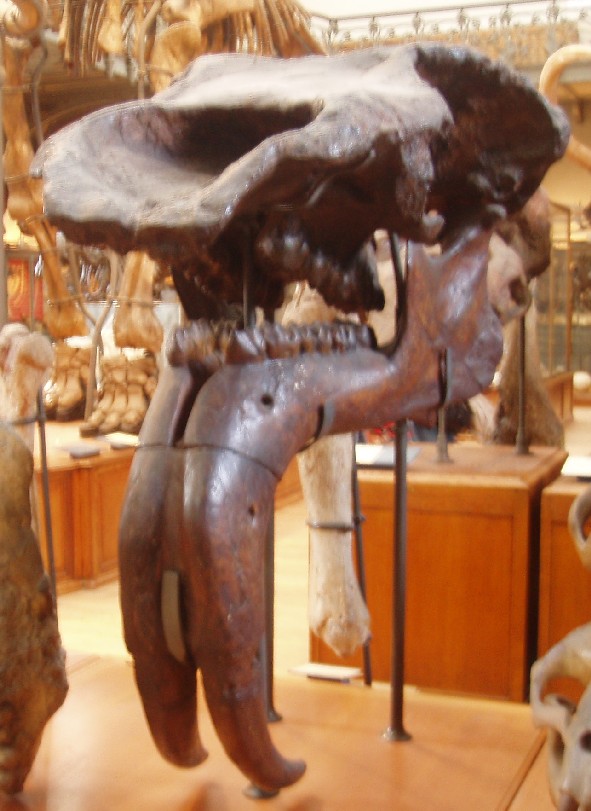
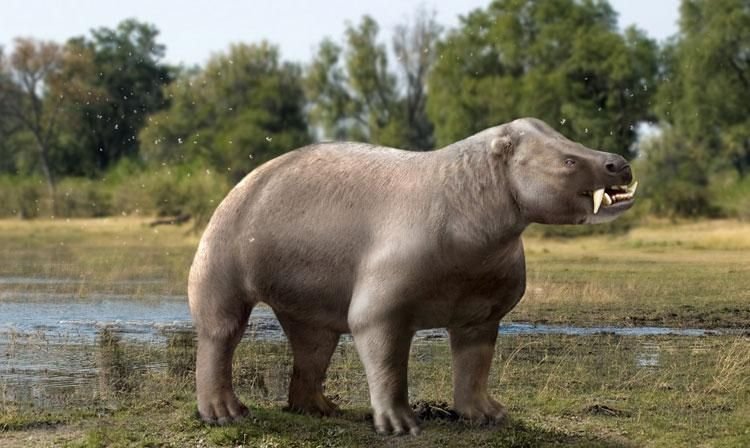
Coryphodon was a robustly built animal, superficially resembling a modern hippopotamus or a hornless rhinoceros in its general body plan and size. It typically measured around 2.5 meters (8.2 feet) in length and stood about 1 meter (3.3 feet) tall at the shoulder, with weight estimates ranging from 340 to 500 kilograms (750 to 1,100 pounds), making it one of the largest land mammals of its time. Its skeleton was stout and graviportal, adapted for supporting a heavy body. The limbs were short and pillar-like, ending in five-toed, broadly splayed feet, which would have been effective at distributing its weight on soft, muddy ground. The skull was massive and broad, with a relatively small braincase compared to its overall size, indicating a lower encephalization quotient than modern mammals. One of its most distinctive features was its dentition. Coryphodon possessed a pair of prominent, tusk-like upper canines, which were larger in males, suggesting they may have been used for display, defense, or intraspecific combat. Its cheek teeth (molars and premolars) were lophodont, characterized by ridges of enamel connecting the cusps, an adaptation for grinding tough plant material. Isotopic analysis of its tooth enamel suggests a diet of soft, aquatic vegetation, leaves, and possibly roots, which it would have processed with these specialized teeth. The overall anatomy points to a slow-moving, powerful creature well-suited to a life in and around water.
Analyses of Coryphodon's paleobiology reveal a creature adapted to a semi-aquatic, herbivorous lifestyle. Its postcranial skeleton, particularly the short, stout limbs and broad feet, strongly suggests it was not a fast runner but was well-adapted for navigating the soft, swampy terrain of its environment, much like a modern tapir or hippo. Isotopic studies of oxygen in its bones and teeth further support this semi-aquatic niche, indicating it spent a significant amount of time in or near freshwater bodies. Its diet consisted primarily of soft vegetation; wear patterns on its molars and isotopic data confirm a preference for leaves, aquatic plants, and possibly tubers dug from the mud. The prominent canine tusks, which show sexual dimorphism, were likely not for predation but for social signaling, defense against predators like early creodonts, or for contests between males for mates or territory. Growth patterns inferred from bone histology show that Coryphodon grew relatively quickly, reaching adult size in a few years, but had a shorter lifespan compared to modern mammals of similar size. This rapid life history strategy may have been an adaptation to the highly seasonal environments of the early Eocene. Its small brain-to-body mass ratio suggests it likely had simpler behaviors compared to later, more derived herbivores.
Coryphodon lived during the Paleocene-Eocene Thermal Maximum (PETM), a period of intense global warming characterized by lush, subtropical forests extending to the polar regions. The world was a greenhouse, with no permanent ice caps and high sea levels. Its habitat consisted of warm, humid, swampy forests, floodplains, and wetlands that dominated North America, Europe, and Asia. This environment supported a rich and diverse flora, including ferns, cycads, and early flowering plants, which formed the base of Coryphodon's diet. It shared this ecosystem with a variety of other early mammals. Co-existing herbivores included early primates like Cantius, perissodactyls such as the dawn horse Hyracotherium, and various condylarths. The primary predators that would have preyed upon Coryphodon, especially the young or infirm, were large creodonts like Patriofelis and Oxyaena, which were apex carnivores of the time. Coryphodon's large size as an adult would have offered significant protection. As one of the first large-bodied browsers, it played a crucial ecological role as a primary consumer, shaping the vegetation structure of these early Cenozoic forests and converting vast amounts of plant biomass, thereby occupying a niche similar to that of large ungulates today.
Coryphodon was first described by the renowned paleontologist Sir Richard Owen in 1845, based on fragmentary fossils, including a jaw fragment, discovered in the London Clay of England. The name 'Coryphodon' means "peaked tooth," referring to the distinctive shape of its molar cusps. However, the most significant and complete discoveries that truly defined the genus were made in North America. In the latter half of the 19th century, American paleontologists Edward Drinker Cope and Othniel Charles Marsh, during their famous "Bone Wars," unearthed numerous Coryphodon fossils from the Eocene badlands of Wyoming and New Mexico, particularly from the Willwood and Wasatch Formations. Cope, in particular, named several species, many of which are now considered synonyms of Coryphodon eocaenus. These extensive North American collections provided nearly complete skeletons, allowing for a comprehensive understanding of its anatomy and lifestyle. One of the most important localities is the Bighorn Basin in Wyoming, which has yielded hundreds of specimens, making Coryphodon one of the best-represented large mammals of the early Eocene. No single specimen has achieved a popular nickname like 'Sue,' but the sheer volume of material has made the genus a cornerstone of Paleogene vertebrate paleontology.
Coryphodon holds a pivotal position in the evolutionary history of mammals. It belongs to the extinct order Pantodonta, a group of early, archaic placental mammals that were among the first to achieve large body sizes following the Cretaceous-Paleogene extinction event. Pantodonts are considered part of the grand radiation of laurasiatherian mammals, the large clade that includes modern ungulates, carnivorans, and bats. Coryphodon itself is not a direct ancestor of any living mammal group; it represents a successful but ultimately terminal evolutionary experiment in large-scale herbivory. Its significance lies in demonstrating how quickly mammals could evolve to fill the ecological voids left by the dinosaurs. Within just a few million years of the extinction event, Coryphodon had become a dominant, widespread megaherbivore. Its semi-aquatic adaptations and specialized dentition illustrate an early pathway for herbivorous mammals, one that was later supplanted by the more efficient digestive systems and locomotor adaptations of true ungulates like perissodactyls (horses, rhinos) and artiodactyls (deer, cattle), which rose to prominence later in the Cenozoic. Coryphodon serves as a classic example of an archaic mammal group that thrived before being outcompeted by more modern, derived lineages.
Despite its well-established fossil record, Coryphodon remains a subject of scientific inquiry and some debate. A primary area of discussion has been its precise lifestyle and diet. While the semi-aquatic, hippo-like model is widely accepted, based on skeletal morphology and isotopic evidence, some researchers have proposed a more terrestrial, forest-dwelling existence, similar to a tapir or a large pig, arguing that its limb structure was not exclusively adapted for an aquatic environment. The exact function of its tusks is also debated, with theories ranging from defense and display to rooting for tubers. Furthermore, the taxonomy within the genus has been historically complex. Early paleontologists, particularly Cope, named numerous species based on minor variations, leading to a confusing proliferation of names. Modern revisions, such as the work by Uhen and Gingerich, have synonymized most of these into a few valid species, primarily C. eocaenus, suggesting that the observed variations represent individual, sexual, or age-related differences rather than distinct species. Ongoing research using advanced techniques like stable isotope analysis and CT scanning of skulls continues to refine our understanding of its biology and behavior.
The fossil record of Coryphodon is exceptionally rich and geographically widespread, making it one of the most common large mammal fossils from the early Eocene. Its remains are found across the Northern Hemisphere in what was then the supercontinent of Laurasia. Abundant fossils have been recovered from western North America, particularly in the Bighorn, Piceance, and Wind River basins of Wyoming, Colorado, and Utah. Important European sites include the London Clay in England and localities in France and Belgium. Fossils have also been found in Asia, for instance on Ellesmere Island in the Canadian Arctic, which was then located at a much warmer high latitude, and in China, demonstrating its impressive dispersal capability. The fossils are typically found in fluvial (river) and lacustrine (lake) deposits, consistent with its proposed habitat. The preservation quality is often good, with numerous complete or partially articulated skeletons known, in addition to thousands of isolated teeth and bones. This abundance makes Coryphodon a crucial biostratigraphic marker, helping paleontologists date and correlate rock layers from the late Paleocene and early Eocene across different continents.
Although not a household name like the woolly mammoth or saber-toothed cat, Coryphodon holds a significant place in paleontological education and museum displays. Its status as one of the first mammalian megafauna after the dinosaurs makes it a compelling example of evolutionary recovery and adaptation. Major natural history museums, including the American Museum of Natural History in New York, the Smithsonian National Museum of Natural History in Washington D.C., and the Yale Peabody Museum, feature impressive skeletal mounts of Coryphodon. These displays serve to illustrate the strange and unfamiliar world of the early 'Age of Mammals,' showcasing a creature that combines familiar features with an archaic body plan. It occasionally appears in documentary series about prehistoric life, representing the initial wave of large herbivores that set the stage for the later, more familiar Cenozoic fauna. Its story is a vital chapter in the rise of mammals to ecological dominance.
Classification
Time Period
Discovery
Location
France (initially), with significant early finds in North America (Wyoming, USA)
Formation
Willwood Formation, Fort Union Formation, Wasatch Formation
Frequently Asked Questions
What is Coryphodon?
Coryphodon was a large, semi-aquatic herbivorous mammal that roamed the Northern Hemisphere during the late Paleocene and early Eocene epochs, approximately 59 to 51 million years ago. As one of the first large-bodied mammalian herbivores to evolve after the extinction of the non-avian dinosaurs, it...
When did Coryphodon live?
Coryphodon lived during the paleogene period of the cenozoic era approximately 59-51 million years ago.
Where was Coryphodon discovered?
Fossils of Coryphodon were discovered in France (initially), with significant early finds in North America (Wyoming, USA) in the Willwood Formation, Fort Union Formation, Wasatch Formation.
What did Coryphodon eat?
Coryphodon was a herbivore. It lived in terrestrial, semi-aquatic habitats.
What type of fossil is Coryphodon?
Coryphodon is preserved as a body fossil. The preservation quality is good.
Related Specimens
From the cenozoic era · body fossils