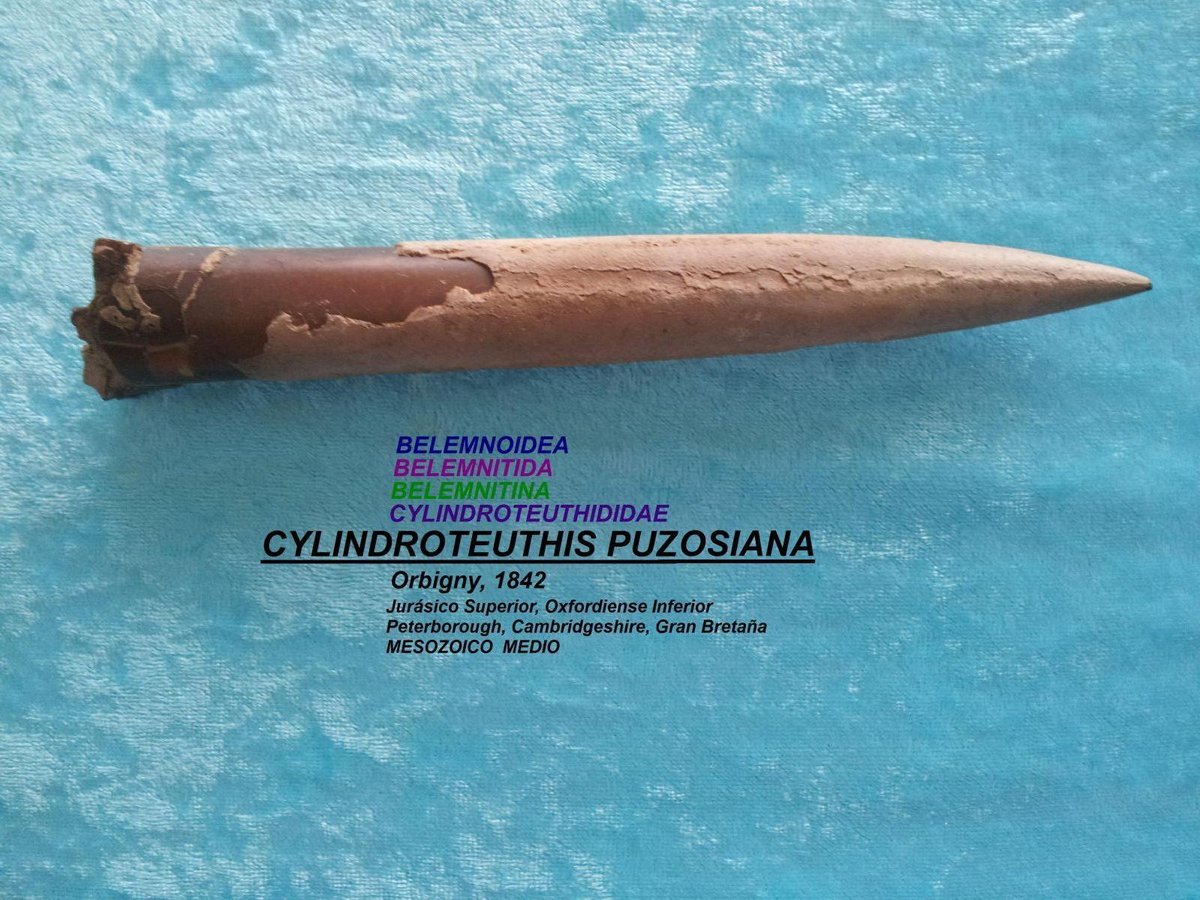
Cylindroteuthis
Cylindroteuthis puzosiana
Image: Image sourced via web search (Fair use / Educational)
About Cylindroteuthis
Cylindroteuthis puzosiana was a species of belemnite, an extinct group of marine cephalopods that flourished during the Mesozoic Era. This particular species inhabited the epicontinental seas of Europe during the Middle to Late Jurassic Period, approximately 163 to 155 million years ago. As a common and widespread member of the belemnite order, Cylindroteuthis provides paleontologists with crucial insights into the structure of Jurassic marine ecosystems and the evolutionary history of cephalopods, the group that today includes squids, octopuses, and cuttlefish.
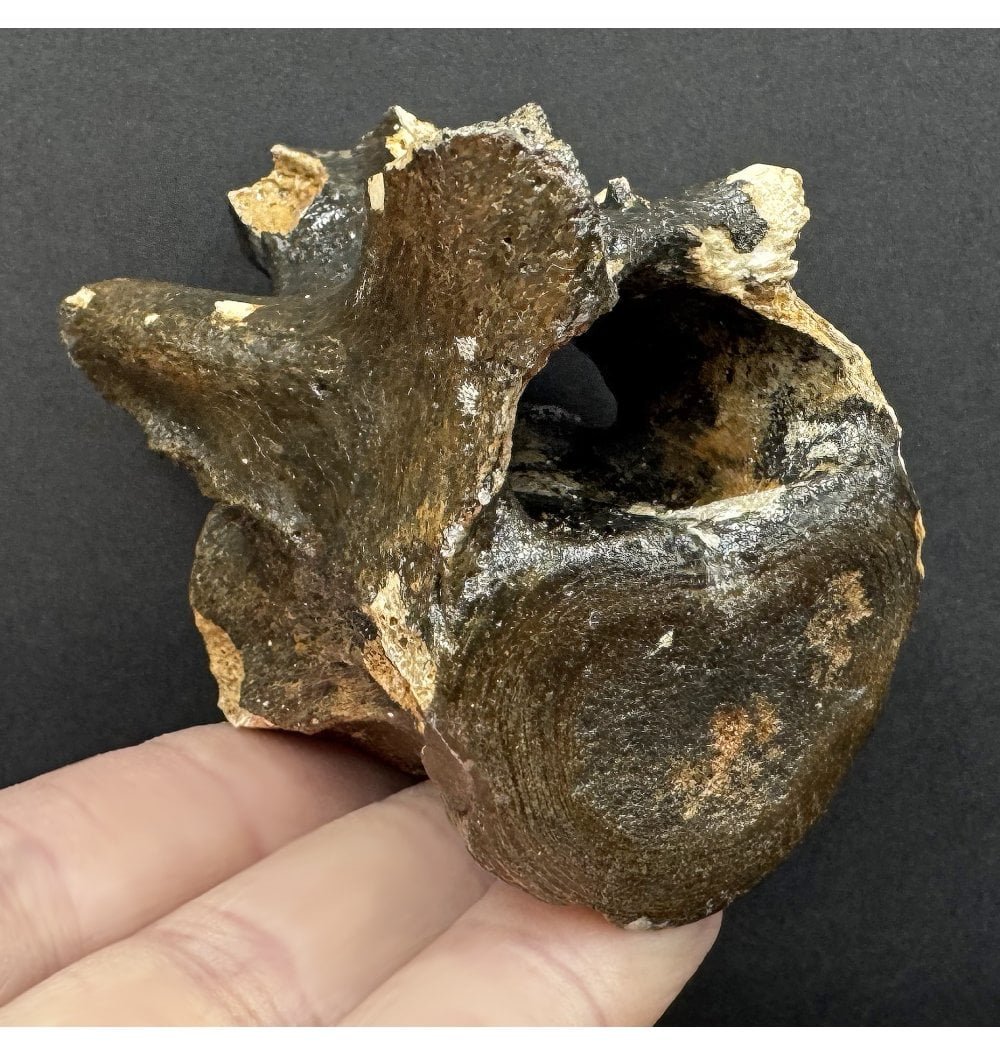
Cylindroteuthis puzosiana possessed a streamlined, torpedo-shaped body well-suited for a predatory, free-swimming lifestyle. The total body length, including the soft tissues, is estimated to have been between 15 and 30 centimeters, comparable in size to many modern-day squid species. The most commonly fossilized part of this animal is its internal shell, known as the guard or rostrum. This structure, composed of solid, dense calcite, was bullet-shaped and elongated, giving the genus its name, which translates to 'cylinder squid'. The guard of C. puzosiana was particularly robust and cylindrical, tapering to a pointed end. It acted as a counterbalance to the buoyant, chambered phragmocone located further forward in the body, allowing the animal to maintain a horizontal orientation in the water column. The phragmocone itself, a conical structure divided by septa into gas-filled chambers, was used for buoyancy control, much like the shell of a modern nautilus. Surrounding these internal hard parts was a muscular mantle. At the front of the animal was a well-developed head with large eyes, a sharp, parrot-like beak for tearing prey, and ten arms equipped with small, chitinous hooks for grasping, a feature distinguishing belemnites from modern squids which typically have suckers. Soft tissue preservation, though rare, confirms these features and the presence of an ink sac for defense.
As an active carnivore, Cylindroteuthis was a formidable mid-level predator in the Jurassic seas. Its diet likely consisted of small fish, crustaceans, and other marine invertebrates. Paleobiological analysis suggests it was a swift and agile swimmer, using jet propulsion for rapid bursts of speed to catch prey and evade predators. This was achieved by forcefully expelling water from its mantle cavity through a flexible funnel, or siphon. The robust guard and streamlined body shape would have provided stability during high-speed pursuit. The ten hooked arms would have been highly effective at snaring and immobilizing struggling prey, which was then dispatched by the powerful beak. Like modern cephalopods, Cylindroteuthis likely possessed excellent vision, with large, complex eyes capable of detecting movement and forming images, a critical adaptation for a visual predator in the well-lit upper layers of the ocean. Evidence from growth rings within the calcite guard suggests a rapid life cycle, with individuals potentially reaching maturity and reproducing within a single year, a strategy common among modern coleoids. Its metabolism was likely high to support its active, predatory lifestyle, placing it among the more energetic invertebrates of its time.
Cylindroteuthis puzosiana lived during the Oxfordian and Kimmeridgian stages of the Late Jurassic, a time when warm, shallow epicontinental seas covered much of Europe. The climate was generally warm and humid, with no polar ice caps, leading to high sea levels. These seas, such as the Sundance Sea in North America and the Tethys Ocean seaway across Europe, were teeming with life. Cylindroteuthis shared its pelagic habitat with a diverse array of marine organisms. It would have been prey for larger marine reptiles like the plesiosaurs (e.g., Cryptoclidus) and ichthyosaurs (e.g., Ophthalmosaurus), as well as large predatory fish like Hypsocormus. As a predator itself, it occupied a crucial intermediate position in the food web, controlling populations of smaller fish and invertebrates. The seafloor below was home to bivalves, gastropods, ammonites, and echinoderms, while the water column was filled with plankton, forming the base of this complex marine ecosystem. The widespread distribution of Cylindroteuthis fossils across formations like the Oxford Clay indicates it was a successful and adaptable organism, capable of thriving in these dynamic and competitive Jurassic marine environments.
The discovery and classification of Cylindroteuthis have a history rooted in 19th-century European paleontology. The species Cylindroteuthis puzosiana was first described by the French naturalist Alcide d'Orbigny in 1842. D'Orbigny was a prolific paleontologist who made monumental contributions to the study of cephalopods and other invertebrates, and his work established the foundation for much of our modern understanding of belemnites. The genus name, Cylindroteuthis, was later established by the French paleontologist Claude-Émile Bayle in 1878, who recognized the distinct cylindrical shape of the guard as a key characteristic warranting a separate genus. The initial fossils were discovered in the rich Jurassic marine deposits of France. Since then, numerous specimens, primarily the distinctive guards, have been unearthed across Europe, from the United Kingdom's Jurassic Coast to quarries in Germany and Russia. There are no single 'famous' individual specimens akin to vertebrate fossils like 'Sue' the T. rex; rather, the significance of Cylindroteuthis lies in its abundance, which has allowed for detailed statistical and morphological studies of its populations and evolutionary trends over millions of years. These countless fossils serve as invaluable index fossils for dating Jurassic strata.
Cylindroteuthis holds a significant position in the evolutionary history of cephalopods. It belongs to the order Belemnitida, an extinct group within the cohort Coleoidea, which includes all modern soft-bodied cephalopods (squids, cuttlefish, and octopuses). Belemnites are considered to be closely related to the ancestors of modern squids and cuttlefish. They represent a key evolutionary stage where the external shell of earlier cephalopods, like ammonites and nautiloids, became fully internalized. This internalization of the shell, with the guard acting as a counterweight and the phragmocone for buoyancy, freed the animal from the constraints of a bulky external shell, paving the way for the evolution of faster, more agile, and more actively predatory forms. The presence of ten hooked arms is another important feature, linking them more closely to modern ten-limbed decapods (squids and cuttlefish) than to eight-limbed octopuses. Studying Cylindroteuthis and its relatives helps paleontologists trace the reduction and modification of the cephalopod shell and understand the origins of the anatomical blueprint that has made modern coleoids so successful in today's oceans.
While the general classification of Cylindroteuthis within the belemnites is well-established, scientific debate continues regarding the finer points of its taxonomy and paleoecology. The family Cylindroteuthidae, to which it belongs, has undergone several revisions as new fossil evidence emerges and analytical techniques improve. The exact phylogenetic relationships between different belemnite families and their precise connection to the origin of modern squids and cuttlefish remain areas of active research. Some paleontologists debate the specific function of certain guard morphologies; for instance, whether subtle variations in shape relate to different swimming styles, sexual dimorphism, or adaptations to specific water depths. Furthermore, interpretations of its behavior are based on analogies with modern squids, and while these are well-supported, direct evidence is scarce. Recent discoveries of exceptionally preserved belemnite fossils with soft tissues, including ink sacs and arm hooks, have provided invaluable data, but such finds are rare and can sometimes challenge long-held assumptions about their anatomy and lifestyle, leading to ongoing refinement of our understanding of these ancient cephalopods.
The fossil record of Cylindroteuthis puzosiana is extensive, making it one of the more common and well-studied belemnites of the Jurassic period. Its fossils are found primarily in marine sedimentary rocks across Europe, with notable occurrences in the United Kingdom (especially the Oxford Clay and Kimmeridge Clay formations of the Jurassic Coast), France, Germany (including the famous Solnhofen Limestone), Poland, and Russia. The most commonly preserved part is the dense, calcite guard, which is highly resistant to decay and diagenesis. These bullet-shaped fossils are often found in large numbers, sometimes forming 'belemnite battlefields'—dense accumulations interpreted as mass mortality events, possibly following spawning. The phragmocone is more delicate and less frequently preserved, and impressions or carbonized remains of the soft body parts are exceptionally rare, typically found only in Konservat-Lagerstätten like the Solnhofen Limestone, which offer extraordinary conditions for preservation. The abundance of the guards makes them excellent index fossils, helping geologists to correlate and date Jurassic rock layers across different regions.
Despite being an invertebrate, Cylindroteuthis and belemnites in general have captured a degree of public interest, largely due to the distinctive and easily recognizable shape of their fossilized guards. These fossils are often referred to by folkloric names such as 'thunderbolts' or 'St. Peter's fingers' in England. They are common finds for amateur fossil hunters along coastlines like the Jurassic Coast World Heritage Site in Dorset, UK, making them an accessible entry point into the world of paleontology for the general public. Major natural history museums, including the Natural History Museum in London and the Muséum National d'Histoire Naturelle in Paris, feature displays of Cylindroteuthis and other belemnites, showcasing them as key components of Mesozoic marine ecosystems and important ancestors of modern squid and cuttlefish. Their story is a vital part of educational outreach on marine life's evolution.
Classification
Time Period
Discovery
Location
France
Formation
Oxford Clay, Solnhofen Limestone, Kimmeridge Clay
Frequently Asked Questions
What is Cylindroteuthis?
Cylindroteuthis puzosiana was a species of belemnite, an extinct group of marine cephalopods that flourished during the Mesozoic Era. This particular species inhabited the epicontinental seas of Europe during the Middle to Late Jurassic Period, approximately 163 to 155 million years ago. As a common...
When did Cylindroteuthis live?
Cylindroteuthis lived during the jurassic period of the mesozoic era approximately 163-155 million years ago.
Where was Cylindroteuthis discovered?
Fossils of Cylindroteuthis were discovered in France in the Oxford Clay, Solnhofen Limestone, Kimmeridge Clay.
What did Cylindroteuthis eat?
Cylindroteuthis was a carnivore. It lived in marine, pelagic habitats.
What type of fossil is Cylindroteuthis?
Cylindroteuthis is preserved as a body fossil. The preservation quality is good.
Related Specimens
From the mesozoic era · body fossils
/929f881473a0.jpg)