Elephant Bird
Aepyornis maximus
Image: Image sourced via web search (Fair use / Educational)
About Elephant Bird
Aepyornis maximus, universally recognized by its evocative common name, the Elephant Bird, was an enormous, flightless ratite that roamed the isolated island of Madagascar during the Late Pleistocene and Holocene epochs. Existing from approximately 60,000 years ago until its tragic extinction roughly 1,000 years ago, this colossal avian holds a monumental and revered place in the annals of paleontology and zoology. It stands as one of the heaviest and most massive birds to have ever evolved on Earth, offering profound scientific insights into the phenomena of island gigantism, avian evolution, and the devastating, irreversible impacts of human colonization on endemic megafauna. The Elephant Bird is not merely a scientific curiosity; it is a profound symbol of the lost world of Late Quaternary megafauna, representing a time when giants walked the earth and ecosystems functioned in ways we can now only reconstruct through subfossil remains.
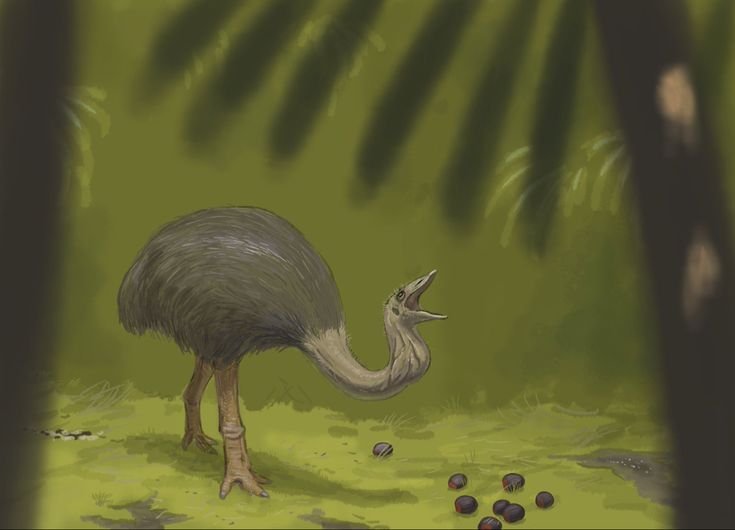
Standing up to an astonishing 3 meters (nearly 10 feet) tall and weighing between 400 and 500 kilograms (880 to 1,100 pounds), Aepyornis maximus was a true titan of the avian world, dwarfing nearly all other known birds, with the possible exception of its recently reclassified relative, Vorombe titan, and the extinct moas of New Zealand. Its skeletal structure was a marvel of biomechanical engineering, characterized by massive, pillar-like hind limbs designed specifically to support its immense, graviportal bulk. These legs featured incredibly thick femora and robust tibiotarsi that indicate a slow, deliberate, and ponderous walking pace, rather than the high-speed cursorial adaptations seen in modern ostriches or emus. The bird possessed a highly reduced, vestigial wing structure, rendering it completely flightless, with pectoral girdles that entirely lacked the pronounced keel (carina) found on the sternum of flying birds, which is necessary for the attachment of flight muscles. Its neck was long, thick, and highly muscular, supporting a relatively small head equipped with a broad, conical beak perfectly suited for processing tough, fibrous vegetation. Soft tissue inferences, drawn from its closest living relatives and the specific environments it inhabited, suggest it was covered in hair-like, shaggy plumage, likely brownish or grey, which would have helped it blend into the scrublands and dense forests of its island home. The eggs of Aepyornis maximus are perhaps its most famous and awe-inspiring physical attribute; they are the largest single cells known in the entire animal kingdom, measuring up to 34 centimeters in length and 1 meter in circumference. With a volume of around 8 to 9 liters, a single Elephant Bird egg is equivalent to roughly 150 standard chicken eggs, or seven ostrich eggs, showcasing the extreme reproductive biology of this magnificent creature.
As a dominant megaherbivore in its isolated ecosystem, Aepyornis maximus primarily consumed a diet consisting of tough, fibrous plant material, including leaves, seeds, fruits, and possibly the low-hanging branches of endemic Malagasy flora. Its robust beak and powerful gastric mill, which was almost certainly aided by the ingestion of large gastroliths (stomach stones) found alongside its skeletal remains, allowed it to process heavily defended or nutrient-poor vegetation that smaller herbivores could not utilize. Locomotion was strictly terrestrial and graviportal; the bird's massive weight precluded running or jumping, meaning it moved at a measured, walking pace through the diverse forests and savannas of Madagascar. Socially, it is theorized by paleontologists that Elephant Birds may have been solitary creatures or lived in very small family groups, given the incredibly high resource requirements necessary to sustain such massive bodies in an environment prone to seasonal fluctuations. Growth patterns, analyzed through detailed bone histology and cross-sectional imaging, indicate a prolonged period of development compared to smaller birds, with a slow metabolism adapted to the unpredictable resource availability of Madagascar's climate. This lower metabolic rate would have been highly advantageous in surviving seasonal droughts and famines, but it ultimately made the species highly vulnerable to rapid environmental changes, novel predators, and the slow reproductive replacement rate that characterizes many extinct megafaunal species.
During the Late Pleistocene and Holocene, Madagascar was a world of stark ecological contrasts and unparalleled biodiversity, featuring lush rainforests in the east, dry deciduous forests in the west, and expansive, otherworldly spiny thickets in the south. Aepyornis maximus inhabited various biomes across the island, acting as a crucial megaherbivore and an essential seed disperser for large-fruited endemic plants, many of which may have co-evolved specifically to be eaten and dispersed by these giant birds. It shared its habitat with an extraordinary array of endemic megafauna, including giant, sloth-like lemurs such as Megaladapis and the gorilla-sized Archaeoindris, the bizarre, badger-like Plesiorycteropus, and the dwarf Malagasy hippopotamus. The apex predators of this unique ecosystem were the giant fossa (Cryptoprocta spelea) and the massive Malagasy crowned eagle (Stephanoaetus mahery). While adult Elephant Birds were likely completely immune to predation due to their sheer, intimidating size and powerful kicks, their massive eggs and vulnerable chicks would have been highly prized targets for these predators, as well as for opportunistic scavengers. The arrival of humans—initially the Vazimba and later Austronesian and Bantu settlers—around 2,500 to 1,500 years ago introduced a novel, highly efficient apex predator to the island. This arrival fundamentally disrupted the delicate ecological balance, initiating a rapid wave of megafaunal extinctions that ultimately claimed the Elephant Bird, forever altering the landscape of Madagascar.
The history of the Elephant Bird's discovery is deeply steeped in myth, legend, and early global exploration. Legends of a terrifying giant bird capable of carrying off elephants, known as the Roc or Rukh, circulated widely in Middle Eastern and Asian folklore, famously recounted by Marco Polo in the 13th century. While these tales were highly exaggerated, they were likely based on actual sightings of massive Aepyornis eggs brought to the mainland by early Indian Ocean traders. The first documented Western encounter with the physical remains of the bird occurred in the 17th century when Étienne de Flacourt, the French governor of Madagascar, wrote of a giant, ostrich-like bird called the 'Vouron patra' by local Malagasy people, who claimed it still inhabited the most remote regions of the island. However, it was not until the mid-19th century that verifiable scientific specimens reached Europe. In 1851, the eminent French zoologist Isidore Geoffroy Saint-Hilaire formally described and named the species Aepyornis maximus based on enormous skeletal fragments and intact eggs brought to Paris by a merchant named Abadie. Subsequent scientific expeditions in the late 19th and early 20th centuries, particularly those led by researchers Charles Lamberton and Guillaume Grandidier, unearthed extensive subfossil remains from ancient swamps and coastal dunes, firmly cementing the Elephant Bird's place in the scientific annals and sparking a global fascination with Madagascar's lost giants.
Aepyornis maximus occupies a fascinating, complex, and somewhat unexpected position in the avian tree of life. For decades, scientists assumed that the Elephant Birds were most closely related to the ostriches of Africa, given their geographical proximity and obvious morphological similarities as giant, flightless ratites. However, groundbreaking paleogenomic research in the 21st century, which successfully extracted and sequenced ancient DNA from subfossil eggshells and bone fragments, completely revolutionized our understanding of their phylogeny. The genetic data revealed that the closest living relatives of the colossal Elephant Birds are, astonishingly, the diminutive, chicken-sized kiwis of New Zealand. This monumental discovery profoundly altered theories of ratite evolution, suggesting that flightlessness and gigantism evolved independently multiple times across different landmasses, rather than being inherited from a single, giant flightless common ancestor that walked across the breaking supercontinent of Gondwana. Instead, the ancestors of Aepyornis likely flew to Madagascar during the Cenozoic era and subsequently evolved into giants in the absence of large mammalian herbivores, providing a classic, textbook example of convergent evolution and island gigantism that continues to inform evolutionary biology today.
The taxonomy of the Aepyornithidae family has been a subject of intense, ongoing scientific debate for over a century. Historically, up to 15 different species of Elephant Birds were named by eager paleontologists based on minor variations in bone size, robustness, and geographic location. However, modern morphometric analyses and genomic studies have significantly streamlined this classification, suggesting that many of these supposed 'species' were actually representing sexual dimorphism or individual variation within a few distinct lineages. In 2018, researchers identified a new genus, Vorombe, reclassifying the absolute largest Aepyornis specimens as Vorombe titan, which now officially holds the title of the largest bird ever to have lived. Another major, highly contested controversy surrounds the exact cause and timing of their extinction. While climate change and shifting vegetation patterns at the end of the Holocene undoubtedly played a role in stressing the population, the scientific consensus increasingly points to human activity as the primary, driving factor. Fierce debates continue over whether direct hunting of adult birds, overharvesting of their massive eggs for food and water containers, or human-induced habitat destruction through slash-and-burn agriculture was the definitive death blow to the species.
The fossil record of Aepyornis maximus is remarkably rich and well-preserved for a recently extinct megafaunal species, primarily consisting of subfossilized remains rather than fully permineralized stones. These remains are predominantly found in the southern and southwestern regions of Madagascar, perfectly preserved in Holocene coastal dunes, ancient lake beds, and anoxic peat bogs. Sites like the swamps of Ampasambazimba and the coastal dunes of Lavanono have yielded thousands of bones, offering excellent preservation quality that has allowed for the successful extraction of ancient DNA, proteins, and stable isotopes. The most iconic and abundant elements of the Aepyornis fossil record are its eggs. Intact eggs are occasionally found buried deep in sandy dunes, having miraculously survived millennia, while fragmented eggshells are incredibly common, sometimes literally littering the beaches of southern Madagascar. These durable eggshells are invaluable to modern paleontologists, as they provide a continuous source of biomolecules and isotopic data used to meticulously reconstruct the bird's diet, local environment, and evolutionary history.
The Elephant Bird has left an indelible, lasting mark on human culture, literature, and imagination. It is widely believed by historians to be the primary, real-world inspiration for the mythical Roc in the legendary tales of the Arabian Nights and the epic voyages of Sinbad the Sailor. Today, Aepyornis maximus remains a subject of immense public fascination, serving as a powerful, melancholy emblem of extinction and the extreme fragility of isolated island ecosystems. Complete, towering skeletons and perfectly reconstructed eggs are highly prized, centerpiece exhibits in major natural history museums worldwide, including the Muséum national d'Histoire naturelle in Paris and the American Museum of Natural History in New York. Educationally, the Elephant Bird is frequently and effectively used to illustrate complex biological concepts of convergent evolution, island gigantism, and the profound, often tragic impacts of human expansion on global biodiversity.
Classification
Time Period
Discovery
Location
Madagascar
Formation
Various Holocene subfossil deposits
Frequently Asked Questions
What is Elephant Bird?
Aepyornis maximus, universally recognized by its evocative common name, the Elephant Bird, was an enormous, flightless ratite that roamed the isolated island of Madagascar during the Late Pleistocene and Holocene epochs. Existing from approximately 60,000 years ago until its tragic extinction roughl...
When did Elephant Bird live?
Elephant Bird lived during the quaternary period of the cenozoic era approximately 0.06-0.001 million years ago.
Where was Elephant Bird discovered?
Fossils of Elephant Bird were discovered in Madagascar in the Various Holocene subfossil deposits.
What did Elephant Bird eat?
Elephant Bird was a herbivore. It lived in terrestrial habitats.
What type of fossil is Elephant Bird?
Elephant Bird is preserved as a body fossil. The preservation quality is excellent.
Related Specimens
From the cenozoic era · body fossils
/09c845a0ecb7.png)