Cloudina
Cloudina hartmannae
Image: Image sourced via web search (Fair use / Educational)
About Cloudina
Cloudina is a pivotal genus of small, tube-dwelling organisms that lived during the terminal Ediacaran Period, approximately 550 to 541 million years ago. As one of the earliest and most widespread organisms to produce a mineralized skeleton, its appearance in the fossil record marks a profound evolutionary milestone: the dawn of biomineralization in animals. The fossils of Cloudina provide critical evidence of the ecological and evolutionary dynamics, including the emergence of predation, that preceded the Cambrian Explosion.
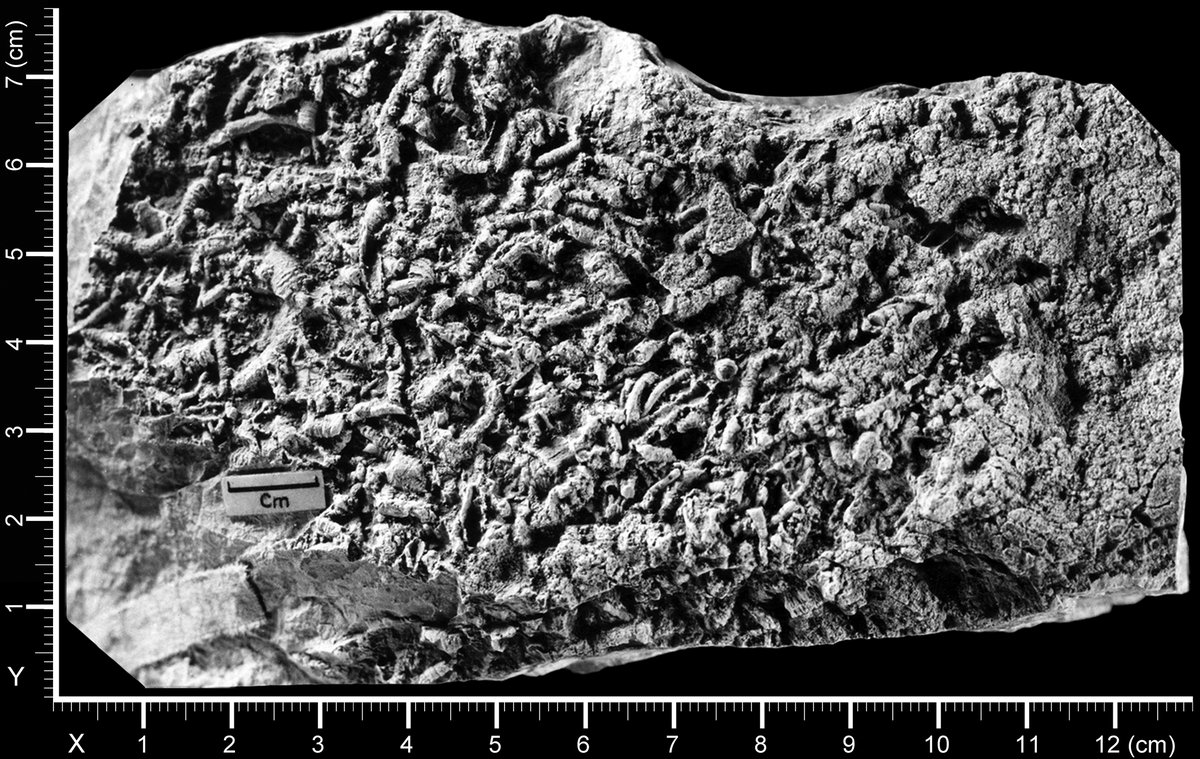
Cloudina was a small, sessile organism characterized by its distinctive, calcified tube-like skeleton. Individual fossils typically range from 0.3 to 6.5 centimeters in length, with a diameter of 0.5 to 7.5 millimeters. The skeleton is composed of a series of nested, funnel-shaped cones or trumpets stacked one inside the other, creating a structure reminiscent of a stack of ice cream cones. This modular construction allowed the organism to grow by adding new, larger cones to the open end of the tube. The walls of these cones were thin, generally between 8 and 75 micrometers thick, and composed of calcium carbonate, likely in the form of calcite. The external surface of the tube was often marked by transverse wrinkles or flanges, while the internal structure was relatively smooth. The organism itself, a soft-bodied animal presumed to be worm-like, would have resided within this protective tube, extending a portion of its body from the aperture to feed. While no soft tissues have ever been found, it is inferred that the animal was bilaterally symmetrical. The overall structure is simple, lacking complex features like septa or internal partitions seen in later shelled organisms like corals or cephalopods. Compared to modern animals, an individual Cloudina fossil might be comparable in length to a small earthworm or a segment of a drinking straw, but its significance lies in its pioneering skeletal architecture, not its size.
The paleobiology of Cloudina is inferred from its fossil structure and its association with other organisms. As a sessile creature, it was permanently attached to the substrate, likely microbial mats that covered the shallow seafloor. Its tubular morphology and fixed position strongly suggest a filter-feeding or suspension-feeding lifestyle. The animal would have extended soft feeding tentacles or a similar apparatus from the open end of its tube to capture organic particles and plankton drifting in the water column. The nested cone structure indicates a pattern of episodic growth; the animal would periodically secrete a new, larger cone at the aperture, extending its tube upward and outward. This growth pattern allowed it to keep its feeding apparatus above the accumulating sediment on the seafloor. Some fossils show evidence of asexual reproduction through budding, where a new, smaller tube branches off from the side of the parent tube. This resulted in the formation of colonial aggregations or reef-like bioconstructions, the first such structures built by animals in Earth's history. These aggregations suggest a degree of social or gregarious behavior, where individuals lived in close proximity, potentially for mutual protection or to enhance feeding efficiency by altering local water currents. Its metabolism was likely slow, typical of simple, sessile invertebrates in low-oxygen environments.
Cloudina lived in the shallow, warm marine environments of the late Ediacaran Period. The world at this time was vastly different from today; the continents were coalescing into the supercontinent of Pannotia, and the atmosphere and oceans were still relatively low in oxygen compared to modern levels. Cloudina fossils are predominantly found in carbonate platform settings, indicating a preference for clear, shallow seas. It was a key component of the Nama-type fossil assemblage, coexisting with other early mineralized organisms like Namacalathus and Sinotubulites, as well as soft-bodied Ediacaran biota such as Dickinsonia and Swartpuntia. Cloudina played a foundational role in these ecosystems as a reef-builder, creating complex, three-dimensional habitats on the seafloor. These reefs, the earliest known metazoan-built reefs, would have provided niches for other organisms, increasing local biodiversity. A crucial aspect of its ecological context is the evidence for predation. A significant percentage of Cloudina fossils, up to 15% in some locations, exhibit small, circular boreholes in their tubes. These holes are thought to be the work of predators that drilled through the shell to consume the soft-bodied animal inside. This is among the earliest direct fossil evidence of predation in the animal kingdom, signaling the beginning of the 'evolutionary arms race' between predators and prey that would drive much of the diversification seen in the subsequent Cambrian Explosion.
The discovery of Cloudina is credited to German paleontologist Gerard Germs, who first described the fossils in 1972. The fossils were found in the Nama Group of Namibia, a thick sequence of sedimentary rocks that preserves a remarkable window into the end of the Precambrian. Germs named the genus Cloudina in honor of Preston Cloud, a prominent American paleontologist who made significant contributions to the understanding of Precambrian life and the Cambrian Explosion. The specific name of the type species, Cloudina hartmannae, honors Mrs. H. Hartmann, who assisted Germs during his fieldwork in Namibia. The initial discovery was monumental because it provided definitive proof of skeletonized animals in the Precambrian, a concept that was highly debated at the time. Prior to this, the Ediacaran was known almost exclusively for its enigmatic, soft-bodied impressions. The discovery of Cloudina's mineralized tube demonstrated that the evolutionary 'invention' of hard parts occurred before the Cambrian Period began. The holotype specimen and other key materials are housed in geological collections in Namibia and Germany, and subsequent discoveries have since been made on every continent except Australia and Antarctica, establishing Cloudina as a globally significant index fossil for the terminal Ediacaran.
Cloudina's evolutionary significance is immense. It represents one of the first successful experiments in animal biomineralization, the biological process of forming hard, mineralized tissues. This innovation provided numerous advantages, including structural support, protection from predators, and a means of anchoring to the substrate. The appearance of skeletons like Cloudina's marks a fundamental shift in the evolutionary landscape, setting the stage for the rapid diversification of animal body plans during the Cambrian Explosion. Its exact phylogenetic placement, however, remains a subject of debate. Its simple, tubular form has led to comparisons with various groups. Some researchers propose it was an early annelid worm, similar to modern serpulids that also build calcareous tubes. Others suggest it was a cnidarian, related to the ancestors of sea anemones and corals, citing its sessile nature and potential for budding. Regardless of its precise lineage, Cloudina is a stem-group animal, meaning it belongs to the lineage leading to one of these major phyla but predates the last common ancestor of the modern 'crown group'. It provides a crucial snapshot of an early stage in animal evolution when fundamental traits like skeletons were first being acquired, profoundly altering the trajectory of life on Earth.
The primary scientific debate surrounding Cloudina concerns its taxonomic affinity. While it is definitively an animal (Metazoa), its placement within the animal kingdom is uncertain. The annelid hypothesis is supported by the tube's flexible, organic-rich layers, but it lacks the distinct segmentation (septa) characteristic of annelid tubes. The cnidarian hypothesis is supported by its simple, vase-like shape and asexual budding, but it lacks the key diagnostic features of cnidarians, such as tentacles or stinging cells, which are not preserved. Another area of debate involves the function of its skeleton. While protection from predation seems a primary driver, especially given the evidence of boreholes, the skeleton may also have served metabolic functions, such as a repository for calcium carbonate, a waste product in an Ediacaran ocean with different chemistry than today's. Recent studies using advanced imaging techniques like micro-CT scanning have revealed more about its internal structure and budding processes, but have not yet resolved the phylogenetic puzzle. The nature of the predator responsible for the boreholes is also unknown, representing another mystery from this ancient ecosystem.
The fossil record of Cloudina is extensive and globally distributed, making it a key index fossil for the terminal Ediacaran (approximately 550-541 million years ago). Fossils are found in carbonate rocks on nearly every continent, with major sites in Namibia (Nama Group), Oman (Ara Group), Spain, Brazil (Corumbá Group), Argentina, Uruguay, Mexico, and China (Dengying Formation). The sheer abundance of specimens in some locations is staggering, where they form dense aggregations or biostromes that can be meters thick and extend for kilometers. Preservation quality is generally good, although it is only the calcified tube that fossilizes; no soft parts have ever been discovered. The fossils are typically preserved as mineralized tubes within limestone or dolomite, often replaced by silica during diagenesis. The famous fossil sites in Namibia and the Three Gorges area of China offer the best-preserved and most abundant examples, providing invaluable data on their morphology, growth, and paleoecology.
Despite its ancient and simple nature, Cloudina has a notable cultural and scientific impact. It is a staple organism in university paleontology courses and museum exhibits detailing the origin of animal life. Displays featuring Cloudina fossils can be found in major natural history museums worldwide, including the Smithsonian National Museum of Natural History and the Natural History Museum, London. These exhibits use Cloudina to illustrate the critical evolutionary step of biomineralization and the onset of complex ecological interactions like predation. While it has not achieved the celebrity status of dinosaurs, for paleontologists and students of deep time, Cloudina is an iconic fossil representing a revolutionary moment in the history of life—the point at which animals first built their own armor.
Classification
Time Period
Discovery
Location
Namibia
Formation
Nama Group (specifically Kuibis and Schwarzrand Subgroups)
Frequently Asked Questions
What is Cloudina?
Cloudina is a pivotal genus of small, tube-dwelling organisms that lived during the terminal Ediacaran Period, approximately 550 to 541 million years ago. As one of the earliest and most widespread organisms to produce a mineralized skeleton, its appearance in the fossil record marks a profound evol...
When did Cloudina live?
Cloudina lived during the ediacaran period of the precambrian era approximately 550-541 million years ago.
Where was Cloudina discovered?
Fossils of Cloudina were discovered in Namibia in the Nama Group (specifically Kuibis and Schwarzrand Subgroups).
What did Cloudina eat?
Cloudina was a filter-feeder. It lived in marine reef habitats.
What type of fossil is Cloudina?
Cloudina is preserved as a body fossil. The preservation quality is good.
Related Specimens
From the precambrian era · body fossils