Leanchoilia
Leanchoilia superlata
Image: Image sourced via web search (Fair use / Educational)
About Leanchoilia
Leanchoilia superlata is an extinct species of megacheiran arthropod that thrived during the Middle Cambrian period, approximately 508 to 505 million years ago. Discovered in the world-renowned Burgess Shale deposits of British Columbia, Canada, this remarkable marine organism is celebrated for its bizarre, highly specialized frontal appendages and its critical role in unraveling the early evolutionary history of arthropods. As a prominent member of the "great appendage" arthropods, Leanchoilia represents a crucial transitional form in the Cambrian explosion, a period characterized by the rapid diversification of complex multicellular life. Its exceptionally preserved fossils, which capture intricate details of soft tissues, have provided paleontologists with an unprecedented window into the anatomy, ecology, and evolutionary dynamics of early Paleozoic marine ecosystems, cementing its status as one of the most significant and extensively studied organisms of its era.
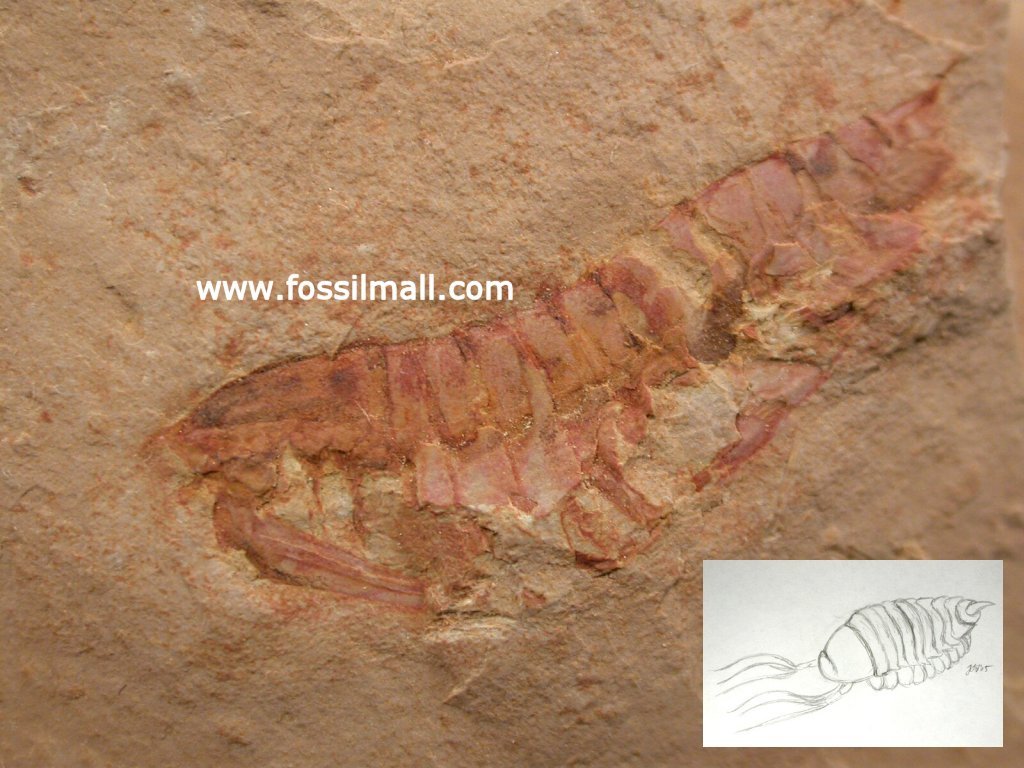
In terms of physical description, Leanchoilia superlata was a relatively small, elongated arthropod, typically measuring about 5 centimeters in length, making it roughly comparable in size to a modern-day ghost shrimp. Its body was distinctly segmented, comprising a head shield (cephalon), a trunk of eleven articulating segments, and a short, fringed tail piece known as a telson. The most striking and defining anatomical feature of Leanchoilia was its pair of massive, modified frontal appendages. These "great appendages" were robust, multi-segmented structures that terminated in three long, whip-like extensions or flagella, which could extend forward or sweep backward over the animal's body. Unlike many of its Cambrian contemporaries, Leanchoilia lacked obvious, well-developed eyes, suggesting a reliance on these elongated flagella for sensory input. The trunk segments housed biramous (two-branched) limbs, a hallmark of early marine arthropods. The inner branch (endopod) functioned as a walking leg, while the outer branch (exopod) was a broad, flap-like structure fringed with setae, likely used for swimming and respiration. The preservation of these delicate structures in the Burgess Shale is so exquisite that researchers can observe the fine details of the gut tract, muscle bands, and even the microscopic hairs on the gills, painting a vivid picture of a highly specialized, agile benthic organism.
The paleobiology of Leanchoilia superlata suggests a complex and active lifestyle adapted to the murky, nutrient-rich waters of the Cambrian seafloor. Given its apparent blindness or highly reduced visual capabilities, Leanchoilia is thought to have relied heavily on its specialized great appendages to navigate its environment and locate food. The long, flexible flagella were likely packed with chemosensory and mechanosensory receptors, allowing the animal to probe the soft, muddy substrate for organic detritus, small soft-bodied prey, or the carcasses of other Cambrian organisms. This makes Leanchoilia a likely scavenger or opportunistic predator. Its biramous limbs indicate a highly versatile mode of locomotion; the animal could walk along the ocean floor using its endopods or swim gracefully through the water column by undulating its flap-like exopods. The presence of a well-defined gut tract often filled with sediment in fossil specimens supports the hypothesis that it was a deposit feeder or a benthic scavenger. Growth patterns inferred from various fossil sizes indicate that Leanchoilia, like modern arthropods, grew through a series of molts (ecdysis), shedding its exoskeleton to accommodate an increasing body size. Its metabolism was likely well-adapted to the relatively low-oxygen environments of the deep Cambrian shelf, utilizing its extensive gill flaps to maximize oxygen extraction.
The ecological context of the Middle Cambrian world in which Leanchoilia lived was one of profound evolutionary experimentation and ecological restructuring. The Burgess Shale environment was situated along a submerged tropical carbonate reef escarpment, characterized by a steep drop-off into deeper, anoxic waters. This marine ecosystem was teeming with a bizarre array of early life forms, including the apex predator Anomalocaris, the five-eyed Opabinia, heavily armored trilobites like Olenoides, and early chordates such as Pikaia. Leanchoilia occupied a mid-level position in this complex food web. As a benthic scavenger and predator of small, soft-bodied meiofauna, it played a crucial role in nutrient cycling, breaking down organic matter that rained down from the photic zone above. In turn, Leanchoilia would have been a prime food source for larger, visually acute predators like Anomalocaris, which patrolled the waters above. The constant threat of predation likely drove the evolution of its agile swimming capabilities and its reliance on tactile and chemical sensing in the darker, deeper waters where visual predators were less effective. The periodic underwater mudslides that characterized the Burgess Shale environment frequently buried these communities alive, instantly freezing these intricate ecological interactions in the geological record.
Charles Doolittle Walcott, the legendary American paleontologist and Secretary of the Smithsonian Institution, first discovered Leanchoilia during his pioneering expeditions to the Burgess Shale in 1911. Walcott named the genus after Leanchoil, a railway station in British Columbia near the fossil site, and designated the type species as Leanchoilia superlata. During his initial assessments, Walcott classified Leanchoilia alongside modern branchiopod crustaceans, a common practice at the time when the bizarre nature of Cambrian fauna was not fully appreciated. It was not until the late 20th century, during the comprehensive reinvestigation of the Burgess Shale fauna led by Harry Whittington, Derek Briggs, and Simon Conway Morris, that the true uniqueness of Leanchoilia was recognized. In 1987, Derek Briggs published a meticulous redescription of Leanchoilia, utilizing advanced preparation techniques and camera lucida drawings to reveal the intricate details of its great appendages and biramous limbs. This modern analysis firmly removed Leanchoilia from the crustacean crown group, establishing it as a distinct and highly specialized early arthropod. Today, thousands of specimens of Leanchoilia superlata are housed in major institutions, with the Royal Ontario Museum and the Smithsonian National Museum of Natural History holding the most significant collections.
The evolutionary significance of Leanchoilia superlata cannot be overstated, as it sits at the heart of one of the most intensely studied transitions in the history of life: the origin and early radiation of arthropods. Leanchoilia is a quintessential member of the Megacheira, an extinct class of "great appendage" arthropods. For decades, paleontologists have debated the phylogenetic position of megacheirans. Current scientific consensus, supported by detailed neuroanatomical studies of related Cambrian arthropods, suggests that the great appendages of Leanchoilia are homologous to the chelicerae of modern spiders, scorpions, and horseshoe crabs. This makes Leanchoilia and its megacheiran relatives crucial stem-group chelicerates, providing a morphological bridge between the primitive, undifferentiated appendages of early Cambrian lobopodians and the highly specialized mouthparts of modern arachnids. By studying the segmentation of Leanchoilia's head and the structure of its nervous system (inferred from exceptionally preserved relatives like Alalcomenaeus), scientists have been able to map the evolutionary trajectory of the arthropod brain and head shield, demonstrating how ancient sensory structures were repurposed over millions of years into the diverse feeding and sensory organs seen in the largest animal phylum on Earth today.
Despite decades of intense study, Leanchoilia remains the subject of ongoing scientific debates and controversies. The primary debate centers on the exact homology of its great appendages. While the prevailing view links them to the chelicerae of arachnids, some researchers argue that they might be homologous to the antennae of crustaceans and insects, or perhaps represent an entirely unique, dead-end evolutionary experiment. Furthermore, the visual capabilities of Leanchoilia are highly contested. While early descriptions assumed the animal was completely blind due to the lack of obvious eye structures, recent examinations using advanced imaging techniques like micro-CT scanning and fluorescence microscopy have suggested the possible presence of small, simple ocelli (eyespots) hidden beneath the frontal margin of the head shield. If true, this would fundamentally alter our understanding of its paleoecology, suggesting it was not entirely reliant on its flagella for navigation. Additionally, the taxonomy within the genus Leanchoilia has seen revisions, with debates over whether variations in appendage morphology represent sexual dimorphism, ontogenetic (growth) stages, or distinct species such as Leanchoilia persephone.
The fossil record of Leanchoilia superlata is exceptionally rich, with over a thousand individual specimens recovered from the Burgess Shale in British Columbia. The vast majority of these fossils are found in the Walcott Quarry and the Raymond Quarry, where they are preserved as flattened, carbonaceous films on the dark shale matrix. This "Burgess Shale-type preservation" is famous for capturing soft tissues that normally decay rapidly, such as the delicate gill branches, the gut tract, and the fine sensory hairs on the flagella. Because the fossils are compressed, paleontologists must often study multiple specimens preserved at different angles—dorsal, lateral, and oblique—to reconstruct the animal in three dimensions. Beyond the Burgess Shale, related megacheirans and possible Leanchoilia species have been discovered in other Cambrian Lagerstätten, such as the Chengjiang biota in China and the Sirius Passet in Greenland, indicating that this group of great appendage arthropods had a global distribution and was highly successful during the early Paleozoic era.
In terms of cultural impact, Leanchoilia has become an emblematic figure of the Cambrian explosion, frequently featured in documentaries, textbooks, and popular science literature alongside Anomalocaris and Hallucigenia. Its bizarre, alien-like appearance—characterized by its sweeping, whip-like appendages—captures the public's imagination, serving as a powerful visual representation of the deep time and the strange evolutionary pathways life has taken. Major natural history museums, including the Royal Ontario Museum in Toronto and the Smithsonian in Washington, D.C., feature Leanchoilia prominently in their early life exhibits. It is often used in educational settings to teach students about fossil preservation, evolutionary homology, and the dynamic nature of scientific discovery, proving that even a small, blind, mud-sweeping arthropod from 500 million years ago can profoundly shape our understanding of the natural world.
Classification
Time Period
Discovery
Location
British Columbia, Canada
Formation
Burgess Shale
Frequently Asked Questions
What is Leanchoilia?
Leanchoilia superlata is an extinct species of megacheiran arthropod that thrived during the Middle Cambrian period, approximately 508 to 505 million years ago. Discovered in the world-renowned Burgess Shale deposits of British Columbia, Canada, this remarkable marine organism is celebrated for its ...
When did Leanchoilia live?
Leanchoilia lived during the cambrian period of the paleozoic era approximately 508-505 million years ago.
Where was Leanchoilia discovered?
Fossils of Leanchoilia were discovered in British Columbia, Canada in the Burgess Shale.
What did Leanchoilia eat?
Leanchoilia was a carnivore/scavenger. It lived in marine habitats.
What type of fossil is Leanchoilia?
Leanchoilia is preserved as a body fossil. The preservation quality is exceptional.
Related Specimens
From the paleozoic era · body fossils