About Cymbospondylus
Cymbospondylus was a large, basal ichthyosaur that patrolled the oceans of the Middle Triassic period, approximately 247 to 237 million years ago. As one of the earliest truly giant marine reptiles to evolve, its fossil remains provide crucial insights into the rapid diversification and adaptation of life in the seas following the devastating Permian-Triassic extinction event. Found in what are now North America and Europe, this formidable predator represents a key stage in the evolution of ichthyosaurs, showcasing a transitional anatomy between their terrestrial ancestors and the more specialized, fish-like forms that would dominate the later Mesozoic.
The physical form of Cymbospondylus was a fascinating blend of primitive and advanced traits, reflecting its early position in the ichthyosaur lineage. Unlike the later, more famous ichthyosaurs like Ichthyosaurus or Ophthalmosaurus, which possessed a dolphin-like body plan, Cymbospondylus had a more elongated, serpentine, or eel-like build. Its body was long and relatively narrow, lacking the deep, tuna-like torso of its descendants. Estimates of its size vary between species, but most individuals likely ranged from 6 to 10 meters (20 to 33 feet) in length, making it one of the largest marine animals of its time. Its weight would have been substantial, likely several tons, comparable to a modern orca but distributed over a longer frame. The skull was particularly distinctive, being long and narrow, equipped with a formidable array of conical, sharp teeth set in individual sockets, a feature known as thecodont dentition. These teeth were well-suited for grasping slippery prey. A key feature distinguishing it from later ichthyosaurs was the absence of a prominent dorsal fin and a less developed, more heterocercal tail fluke, where the vertebral column extended into the lower lobe of a crescent-shaped tail, providing propulsion through lateral, eel-like undulations rather than the powerful, fish-like oscillations of later forms. Its limbs had evolved into paddle-like flippers, but they were not as hydrodynamically refined as those of its Jurassic relatives.
The paleobiology of Cymbospondylus reveals a successful apex predator perfectly adapted to the Triassic seas. Its diet, as inferred from its sharp, conical teeth and jaw structure, consisted primarily of fish (piscivory) and cephalopods like belemnites and ammonites (teuthophagy). The teeth were not designed for shearing or crushing but for seizing and holding fast-moving, soft-bodied prey, which would have been swallowed whole. Its long, flexible body suggests a mode of locomotion known as anguilliform (eel-like) swimming, where waves of motion passed down the length of its body and tail. This method is efficient for cruising but less so for rapid acceleration compared to the carangiform (tuna-like) swimming of later ichthyosaurs. This indicates Cymbospondylus was likely an ambush or pursuit predator that stalked its prey in the open waters of the Panthalassic Ocean rather than a high-speed chase hunter. There is no direct evidence for viviparity (live birth) in Cymbospondylus itself, but it is a hallmark of all later ichthyosaurs, and it is widely assumed that Cymbospondylus also gave birth to live young at sea, as its body plan was entirely unsuited for returning to land to lay eggs.
Cymbospondylus thrived in the warm, shallow epicontinental seas that covered parts of the supercontinent Pangea during the Middle Triassic. The climate was generally hot and arid, and the oceans were recovering from the end-Permian mass extinction, leading to new ecological opportunities. These marine ecosystems were rich and diverse, populated by a host of other creatures. Cymbospondylus shared its habitat with early sauropterygian reptiles like Nothosaurus and the bizarre, long-necked Tanystropheus. The waters teemed with a variety of fish, including early neopterygians, and vast shoals of ammonites and belemnites, which formed the base of its food web. As one of the largest carnivores in its environment, an adult Cymbospondylus would have occupied a high trophic level, likely facing little competition or threat from other predators. Its presence indicates the establishment of complex marine food webs relatively quickly after the extinction event, with large-bodied predators evolving to exploit the burgeoning populations of smaller marine life. The specific fossil beds in Nevada, such as the Favret Formation, represent a deep-water, off-shelf environment, suggesting Cymbospondylus was a pelagic animal, comfortable in the open ocean far from shore.
The discovery and scientific recognition of Cymbospondylus date back to the late 19th and early 20th centuries, a period of intense paleontological exploration in the American West. The genus was formally named and described by the renowned American paleontologist Joseph Leidy in 1868, based on fragmentary vertebral remains found in the Humboldt Range of Nevada. The name Cymbospondylus means "boat vertebra," a reference to the distinctive concave, boat-like shape of its vertebral centra. For decades, knowledge of the animal remained piecemeal. The most significant discoveries came later, through the work of John C. Merriam and his student Annie Alexander from the University of California, Berkeley, in the early 1900s. Their expeditions to the West Humboldt Range in Nevada unearthed numerous, more complete specimens from what is now known as Berlin-Ichthyosaur State Park. These fossils, particularly those of the species *Cymbospondylus petrinus*, provided the first clear picture of the animal's complete anatomy, including its long skull and serpentine body. These well-preserved skeletons, embedded within the limestone of the Favret Formation, remain some of the most important ichthyosaur fossils ever found and form the basis of our modern understanding of this early marine reptile.
Cymbospondylus holds a pivotal position in the evolutionary history of the Ichthyosauria. As a basal ichthyosauromorph, it represents a crucial transitional form, illustrating the evolutionary steps between the earliest, more lizard-like ichthyosaur ancestors and the highly derived, dolphin-like forms of the Jurassic and Cretaceous. Its anatomy showcases a mosaic of primitive and advanced features. For instance, its elongated body and anguilliform swimming style are considered ancestral traits, harking back to a not-yet-fully-aquatic ancestor. In contrast, its large size, paddle-like limbs, and powerful jaws were clear adaptations for a fully marine, predatory lifestyle. It lacks the over-specialized features of later ichthyosaurs, such as the extremely large eyes of Ophthalmosaurus or the deeply forked tail of Stenopterygius, placing it firmly at the base of the ichthyosaur family tree. The study of Cymbospondylus and its relatives helps scientists trace the remarkable speed of marine reptile evolution in the early Mesozoic, demonstrating how quickly life could radiate into new ecological niches and develop sophisticated adaptations for aquatic life. It serves as a textbook example of an early, successful experiment in the evolution of large-scale marine predation.
Despite being known for over 150 years, Cymbospondylus is still the subject of scientific debate and revision. The taxonomy within the genus has been a point of contention, with numerous species named over the years, some of which have since been reclassified or deemed invalid. The validity and relationships between species like *C. petrinus*, *C. buchseri*, and *C. piscosus* are periodically reassessed as new fossil material comes to light. For a long time, Cymbospondylus was considered the largest ichthyosaur of its time, but the 2021 description of a new, closely related genus, *Cymbospondylus youngorum*, also from Nevada, revealed an animal estimated at over 17 meters (55 feet) long. This discovery not only reset the scale for early ichthyosaur gigantism but also sparked debate about the pace of their evolution, suggesting that ichthyosaurs reached colossal sizes much earlier and faster than whales did in their own evolutionary history. These findings continue to refine our understanding of the ecological dynamics and evolutionary potential of Triassic marine ecosystems.
The fossil record of Cymbospondylus is geographically concentrated but locally abundant. The most significant and complete specimens have been unearthed from the Middle Triassic marine deposits of the American West, particularly within the Favret and Prida Formations of the Shoshone Group in Nevada. The limestone quarries in this region have yielded dozens of skeletons, some of which are remarkably complete and articulated, providing unparalleled anatomical detail. Berlin-Ichthyosaur State Park in Nevada is world-famous for its in-situ display of giant ichthyosaur fossils, including specimens initially attributed to Cymbospondylus and its larger relatives. In Europe, more fragmentary remains, including vertebrae and jaw sections, have been found in Germany and Switzerland, confirming the genus had a wide distribution across the northern shores of the Tethys Sea and the eastern Panthalassic Ocean. The quality of preservation in the Nevada sites is exceptional, allowing for detailed studies of skull morphology, vertebral column structure, and limb anatomy, making it one of the best-understood of all Triassic marine reptiles.
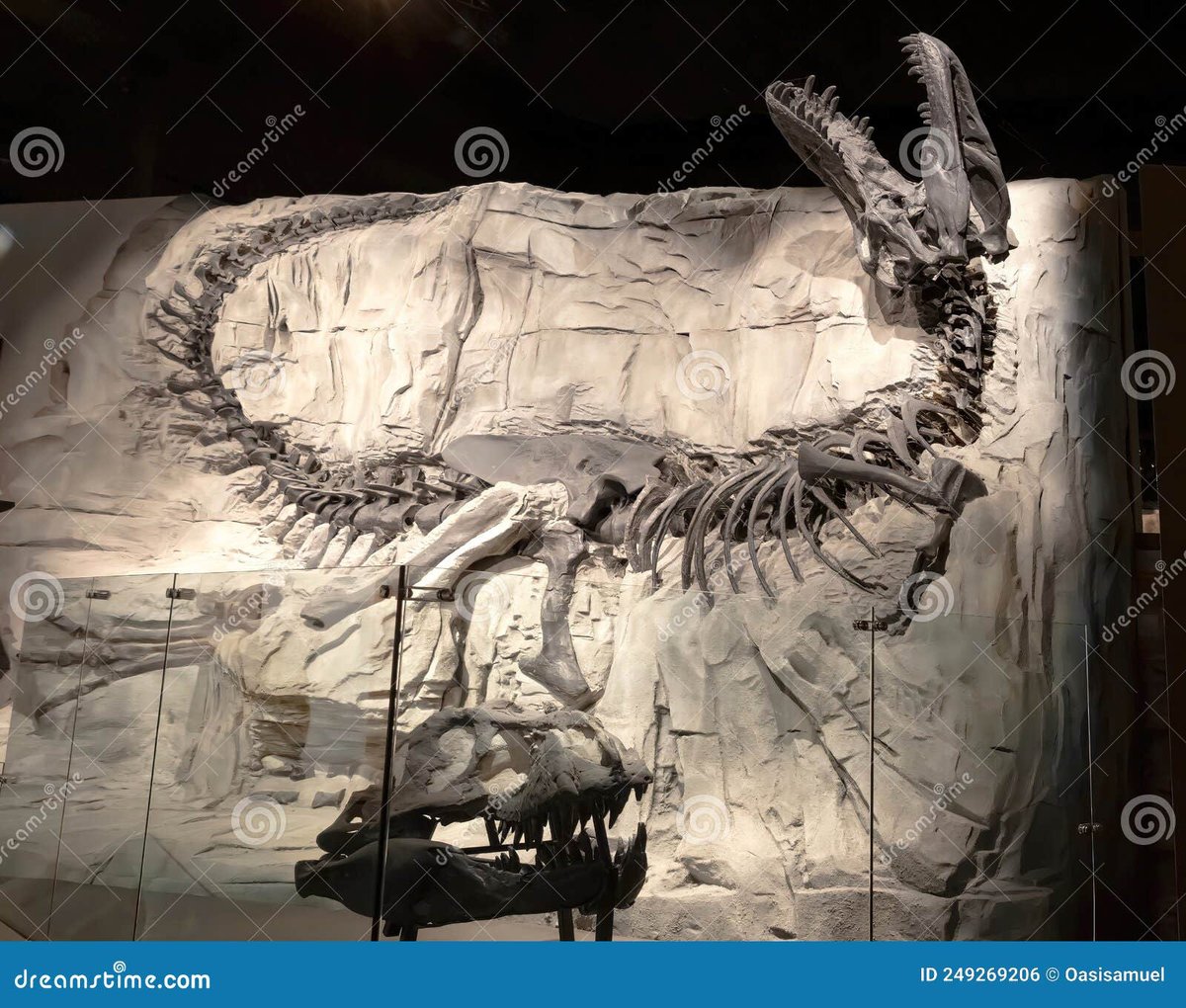
While not as famous as Jurassic Park's Mosasaurus or the iconic Ichthyosaurus, Cymbospondylus holds a significant place in paleontological education and museum collections. Skeletons and casts of this giant are displayed in major institutions, including the Natural History Museum of Los Angeles County and the University of California Museum of Paleontology, Berkeley. Its most prominent public presence is at Berlin-Ichthyosaur State Park, where visitors can see massive skeletons weathering out of the rock face, offering a dramatic glimpse into a prehistoric seabed. As one of the first giant predators of the Mesozoic, it serves as a powerful educational tool for illustrating the concept of adaptive radiation and the recovery of life after mass extinction events.
Time Period
Discovery
Location
North America (e.g., Nevada, USA), Europe (e.g., Germany)
Formation
Shoshone Group (e.g., Favret Formation)
Frequently Asked Questions
What is Cymbospondylus?
Cymbospondylus was a large, basal ichthyosaur that patrolled the oceans of the Middle Triassic period, approximately 247 to 237 million years ago. As one of the earliest truly giant marine reptiles to evolve, its fossil remains provide crucial insights into the rapid diversification and adaptation o...
When did Cymbospondylus live?
Cymbospondylus lived during the triassic period of the mesozoic era approximately 247-237 million years ago.
Where was Cymbospondylus discovered?
Fossils of Cymbospondylus were discovered in North America (e.g., Nevada, USA), Europe (e.g., Germany) in the Shoshone Group (e.g., Favret Formation).
What did Cymbospondylus eat?
Cymbospondylus was a carnivore (piscivore/teuthophage). It lived in marine habitats.
Related Specimens
From the mesozoic era
/09c845a0ecb7.png)