Belemnitella
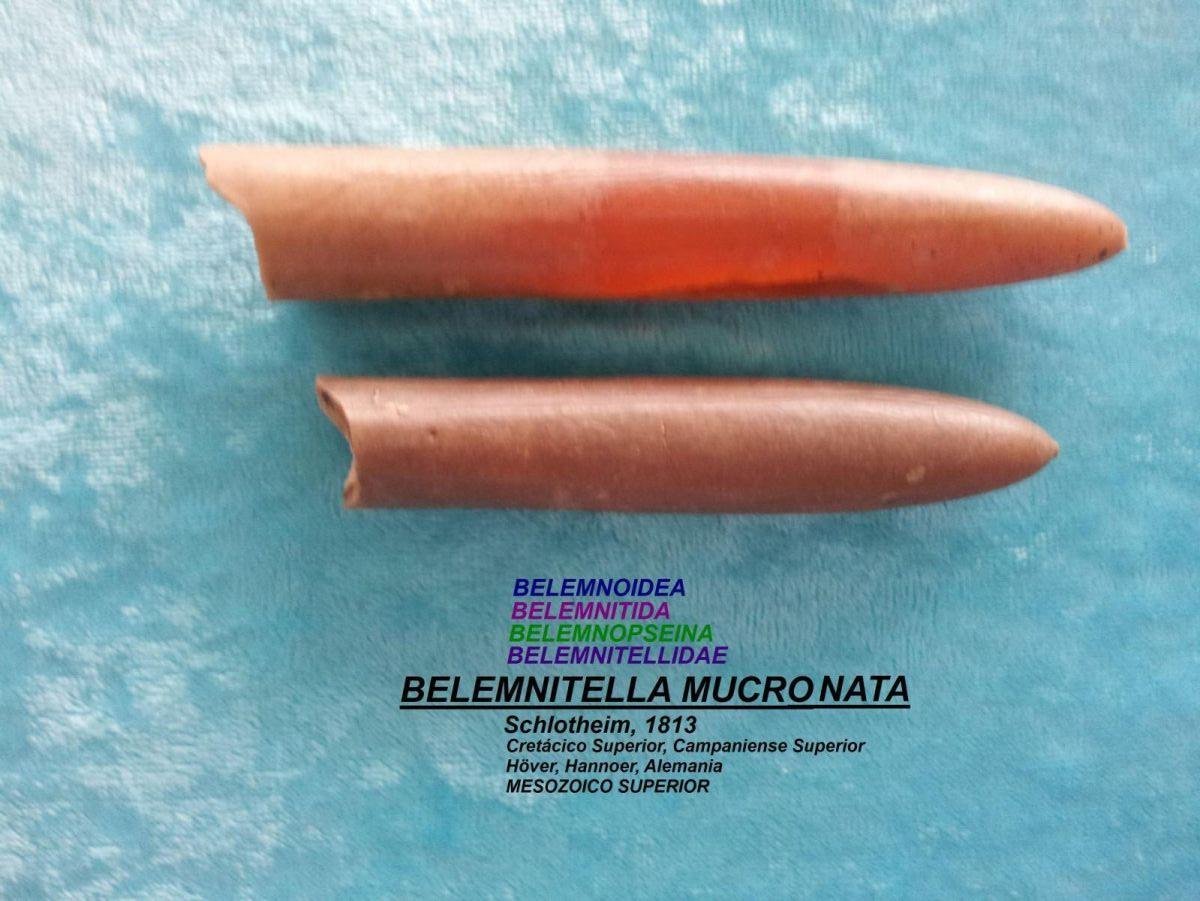
Belemnitella mucronata
Image: Image sourced via web search (Fair use / Educational)
About Belemnitella
Belemnitella mucronata was a genus of squid-like cephalopod that thrived in the epicontinental seas of the Late Cretaceous period, approximately 84 to 66 million years ago. As a member of the extinct order Belemnitida, it is an important index fossil, helping paleontologists and geologists date the rock layers in which its distinctive, bullet-shaped internal shells are found. Its widespread distribution and rapid evolution make it a cornerstone for biostratigraphy, particularly for the Campanian and Maastrichtian stages of the Cretaceous.
Belemnitella mucronata was a moderately sized cephalopod, with an estimated total body length, including tentacles, ranging from 60 to 100 centimeters, comparable to a modern Humboldt squid. The most commonly fossilized part of the animal is its internal shell, or guard, a dense, cigar-shaped structure made of calcite. These guards typically measure between 10 and 15 centimeters in length. The guard served as a counterweight to the phragmocone, a chambered, conical part of the shell used for buoyancy control, similar to the shell of a modern nautilus. The guard itself was solid and heavy, located at the posterior end of the animal, providing stability and protection. At the anterior end of the guard was a conical cavity called the alveolus, which housed the phragmocone. A distinctive feature of Belemnitella mucronata is the small, sharp point, or mucron, at the very tip of the guard, from which its species name is derived. Surrounding this internal shell was a muscular mantle, from which a head with large, complex eyes and ten arms protruded. Like modern squid, these arms were likely equipped with hooks or suckers for capturing prey. Inferred soft tissues, based on exceptionally preserved fossils of related belemnites, suggest a streamlined, torpedo-shaped body adapted for swift, jet-propelled movement.
As an active predator, Belemnitella mucronata played a significant role in the Late Cretaceous marine food web. Its diet likely consisted of small fish, crustaceans, and other cephalopods. Its large eyes would have provided excellent vision for spotting prey in the well-lit upper waters of the shallow seas it inhabited. Hunting was likely an active pursuit; using its powerful siphon for jet propulsion, it could rapidly accelerate to ambush or chase down its victims. Once caught, prey would be secured by its ten arms and dispatched with a sharp, parrot-like beak located at the center of the arm crown. The robust internal guard suggests a nektonic, or free-swimming, lifestyle in the open water column rather than a bottom-dwelling existence. There is little direct evidence for social behavior, but like many modern cephalopods, they may have formed shoals for hunting, mating, or defense. Growth patterns, studied through isotopic analysis of the concentric layers of the guard, indicate a relatively short lifespan, likely only one to two years, characterized by rapid growth to maturity, a common trait among modern coleoids.
Belemnitella lived during a time of global high sea levels, when vast, shallow epicontinental seas covered much of what is now Europe and North America. The climate was warmer than today, with no polar ice caps. These seas, such as the Western Interior Seaway in North America and the Chalk Sea of Europe, were highly productive ecosystems. Belemnitella shared these waters with a diverse array of marine life. It would have been a mid-trophic level predator, preying on smaller organisms while itself being a food source for larger marine reptiles like mosasaurs (e.g., Mosasaurus, Tylosaurus) and large predatory fish such as Xiphactinus. The seafloor below was composed of a fine-grained carbonate ooze, formed from the microscopic skeletons of coccolithophores, which would later become the famous chalk deposits where Belemnitella fossils are so abundant. This chalk environment also preserved a rich community of invertebrates, including ammonites (like Hoploscaphites), inoceramid bivalves, sea urchins, and sponges, all forming part of the complex ecosystem in which Belemnitella was a key player. Its abundance suggests it was a successful and integral part of this Late Cretaceous marine world, right up until the Cretaceous-Paleogene extinction event that wiped it out along with the dinosaurs and mosasaurs.
Fossils of Belemnitella, specifically the guards, have been known for centuries, long before the formal establishment of paleontology. In European folklore, they were often referred to as 'thunderbolts' or 'thunderstones', believed to be physical manifestations of lightning strikes. The scientific study began in the late 18th and early 19th centuries with the rise of geology and paleontology. The species Belemnitella mucronata was formally described by the German naturalist Johann Friedrich von Schlotheim in 1813. His work was part of a broader European effort to classify and understand the fossils being systematically excavated from chalk and limestone quarries. One of the key figures in establishing the biostratigraphic importance of belemnites was Alcide d'Orbigny, a French naturalist who, in the 1840s, meticulously documented the succession of fossil species, including various Belemnitella, through geological time. No single 'type' specimen holds the iconic status of a 'Sue' or 'Lucy', as the species is defined by a vast number of well-preserved guards found across Northern Europe, making it a classic example of an abundant and widespread index fossil rather than a creature known from a singular, spectacular find.
Belemnitella belongs to the Coleoidea, the subclass of cephalopods that includes modern squid, cuttlefish, and octopuses. Its order, the Belemnitida, represents a major extinct branch of this lineage that flourished throughout the Mesozoic Era. Belemnites are crucial for understanding the evolution of modern coleoids, as they showcase the progressive internalization and reduction of the ancestral external cephalopod shell. The belemnite's three-part shell—the pro-ostracum (a thin dorsal shield), the chambered phragmocone (for buoyancy), and the solid guard (for counterweight and protection)—represents a key transitional stage. While the phragmocone is homologous to the chambered shell of a nautilus or ammonite, the guard is a novel evolutionary structure. In modern squid, the shell is further reduced to a thin, chitinous pen or gladius, while in cuttlefish it is the porous cuttlebone. Octopuses have lost the shell almost entirely. Belemnitella and its relatives therefore provide a clear snapshot of this evolutionary trend, demonstrating a highly successful body plan that dominated predator guilds in Mesozoic seas before giving way to the more derived coleoids that populate our oceans today.
While the general classification of Belemnitella within the Belemnitida is stable, paleontological debate continues regarding the finer points of its biology and taxonomy. One area of discussion involves the precise function of the guard. While its role as a counterweight is widely accepted, other proposed functions include a defensive weapon, a tool for rooting in sediment (less likely for a pelagic species), or a structure involved in mating displays. Another debate centers on the specific boundaries and relationships between different species of Belemnitella and related genera like Belemnella. Distinguishing species often relies on subtle morphological variations in the guard, such as the shape of the alveolus, the nature of the vascular markings on its surface, and the presence or absence of a ventral slit. Recent research using advanced imaging techniques and geochemical analysis of the calcite guard is providing new insights into their life history, migration patterns, and the paleotemperature of the seas they inhabited, helping to refine our understanding of these ancient cephalopods and their environment.
The fossil record of Belemnitella mucronata is exceptionally rich and widespread, making it one of the most common fossils from the Late Cretaceous of the Northern Hemisphere. Its guards are found in vast numbers in the Upper Cretaceous chalk deposits of Northern Europe, including the White Cliffs of Dover in England, the chalk quarries of the Maastricht region in the Netherlands (from which the Maastrichtian stage gets its name), northern Germany, Denmark, and Sweden. They are also found in the Niobrara Formation and other contemporaneous deposits in North America. The part most commonly preserved is the dense, calcite guard, which is highly resistant to diagenesis and weathering. These guards are often found isolated but can occur in dense accumulations known as 'belemnite battlefields', which may represent mass mortality events after spawning. While the guard is common, preservation of the delicate phragmocone is much rarer, and impressions or carbonized remains of the soft body are exceptionally rare, known only from a handful of lagerstätten localities for other belemnite species.
Due to their abundance, distinctive shape, and historical association with folklore, belemnite guards are among the most widely recognized and collected fossils, especially by amateurs and students. They are a staple in museum collections worldwide, often used in educational displays to illustrate the concepts of index fossils, extinction, and cephalopod evolution. The term 'thunderstone' persists in some local dialects, a testament to their long history in the human imagination. While Belemnitella itself has not achieved the celebrity status of a Tyrannosaurus rex in popular media, it is a workhorse of paleontology, a silent but crucial tool that has allowed scientists to piece together the history of the Late Cretaceous world with remarkable precision. Its presence in the chalk cliffs that define coastlines like those of southern England gives it a tangible connection to a lost world of ancient seas.
Classification
Time Period
Discovery
Location
Northern Europe (specifically, the chalk deposits of England, Germany, and the Netherlands)
Formation
Chalk Group (including formations like the Maastricht Formation, Niobrara Formation)
Frequently Asked Questions
What is Belemnitella?
Belemnitella mucronata was a genus of squid-like cephalopod that thrived in the epicontinental seas of the Late Cretaceous period, approximately 84 to 66 million years ago. As a member of the extinct order Belemnitida, it is an important index fossil, helping paleontologists and geologists date the ...
When did Belemnitella live?
Belemnitella lived during the cretaceous period of the mesozoic era approximately 84-66 million years ago.
Where was Belemnitella discovered?
Fossils of Belemnitella were discovered in Northern Europe (specifically, the chalk deposits of England, Germany, and the Netherlands) in the Chalk Group (including formations like the Maastricht Formation, Niobrara Formation).
What did Belemnitella eat?
Belemnitella was a carnivore. It lived in marine, pelagic, epicontinental seas habitats.
What type of fossil is Belemnitella?
Belemnitella is preserved as a body fossil. The preservation quality is excellent.
Related Specimens
From the mesozoic era · body fossils