Daspletosaurus
Daspletosaurus torosus
Image: Image sourced via web search (Fair use / Educational)
About Daspletosaurus
Daspletosaurus torosus, whose name translates to the frightful lizard, was a massive apex predator that roamed the terrestrial landscapes of western North America during the Late Cretaceous period, specifically within the Campanian stage approximately 77 to 74 million years ago. As a prominent member of the family Tyrannosauridae, this formidable theropod dinosaur represents a crucial evolutionary link in the lineage that would eventually culminate in the famous Tyrannosaurus rex. Living primarily in the region known as Laramidia, an island continent formed by the Western Interior Seaway dividing North America, Daspletosaurus occupied a distinct ecological niche alongside other large carnivores. Its significance in paleontology is profound, as it provides critical insights into the morphological diversity, niche partitioning, and evolutionary trajectories of advanced tyrannosaurids prior to the end-Cretaceous mass extinction event. The discovery and subsequent study of Daspletosaurus have fundamentally reshaped our understanding of predator dynamics in Late Cretaceous ecosystems, proving that multiple giant theropods could coexist in the same environment by adapting to different prey types and hunting strategies.
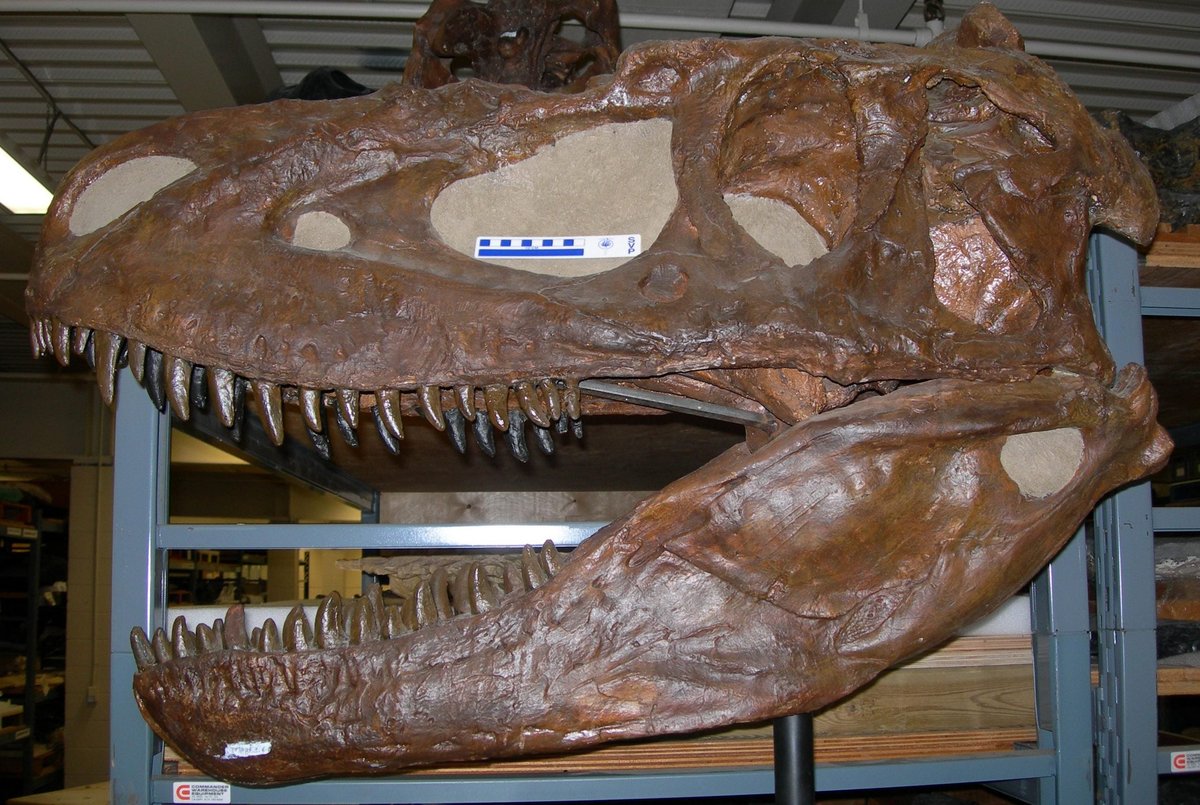
In terms of physical description, Daspletosaurus was a heavily built, robust carnivore that reached impressive dimensions, though it was slightly smaller than its later relative, Tyrannosaurus rex. Adult individuals are estimated to have measured between 8 and 9 meters in length, which is roughly 26 to 30 feet, and they stood about 2.5 to 3 meters tall at the hips. Weight estimates for fully grown adults range from 2.5 to 3.8 metric tons, making it a remarkably massive animal for its size, possessing a stockier build compared to the more gracile albertosaurines like Gorgosaurus. The skull of Daspletosaurus was particularly massive, reaching over a meter in length, and was heavily constructed with thick bone structures, particularly around the snout and the orbital fenestrae. Its jaws were lined with dozens of large, thick, and deeply rooted teeth that were oval in cross-section rather than blade-like, an adaptation specifically designed for crushing bone and gripping struggling prey. The neck was short and heavily muscled in an S-curve to support the massive head, while the forelimbs were disproportionately small, featuring only two functional digits, a hallmark of advanced tyrannosaurids. Despite their small size, the arms were relatively longer and more robust than those of T. rex. The hind limbs were powerful and built for bearing immense weight, ending in four-toed feet, though only three toes contacted the ground. A long, heavy tail served as a counterbalance to the massive head and torso, allowing the animal to maintain its bipedal stance. Soft tissue inferences suggest the presence of tough, scaly skin, and recent debates have considered the possibility of sparse filamentous feathers, though direct evidence in Daspletosaurus is lacking.
Turning to its paleobiology, Daspletosaurus was an obligate carnivore and an apex predator, utilizing its immense bite force to overpower and consume large herbivorous dinosaurs. Its robust skull and thick teeth indicate a hunting strategy that relied on brute force and bone-crushing bites, allowing it to tackle heavily armored prey such as ceratopsians like Chasmosaurus and ankylosaurs, which were abundant in its habitat. This contrasts with the likely hunting strategy of the contemporaneous Gorgosaurus, which may have pursued faster, unarmored hadrosaurs. Biomechanical studies suggest that Daspletosaurus was not built for sustained high-speed pursuits; instead, it likely relied on ambush tactics, utilizing the dense vegetation of its environment to get close to prey before launching a devastating attack. There is compelling evidence to suggest that Daspletosaurus may have exhibited complex social behaviors, including gregariousness or pack hunting. A notable bonebed in Montana contains the remains of multiple Daspletosaurus individuals of varying ages buried together, which some paleontologists interpret as evidence of a family group or hunting pack that perished simultaneously. Growth patterns derived from bone histology indicate that, like other tyrannosaurids, Daspletosaurus underwent a period of rapid growth during its teenage years, packing on hundreds of kilograms annually before reaching skeletal maturity in its early twenties. Its metabolism was likely highly active, akin to endothermy, allowing for rapid growth rates and the sustained energy required for an active predatory lifestyle.
The ecological context of Daspletosaurus is set in the lush, vibrant world of Late Cretaceous Laramidia, a coastal plain environment characterized by broad river valleys, floodplains, and dense forests of conifers, ferns, and angiosperms. The climate was warm and temperate, with distinct wet and dry seasons, supporting a rich and diverse ecosystem. Daspletosaurus shared its habitat with an astonishing array of dinosaurs, including the horned ceratopsians, duck-billed hadrosaurs like Corythosaurus, armored ankylosaurs, and various small theropods, ornithomimids, and dromaeosaurs. The most fascinating aspect of its ecology is its coexistence with another large tyrannosaurid, Gorgosaurus libratus. This sympatry is a rare phenomenon among large predatory dinosaurs and indicates strict niche partitioning. While Gorgosaurus was more lightly built and likely preyed upon the fleet-footed hadrosaurs, the robust Daspletosaurus specialized in hunting the slower, more formidable ceratopsians and ankylosaurs. This division of resources allowed two apex predators to thrive in the same geographical area without driving each other to competitive exclusion. The rivers and estuaries of this environment were also teeming with life, including crocodilians, turtles, and diverse fish species, creating a complex food web where Daspletosaurus sat firmly at the very top, acting as a primary population control for the megaherbivores of the region.
The discovery history of Daspletosaurus begins in 1921 when the renowned fossil hunter Charles Mortram Sternberg discovered the type specimen, designated CMN 8506, in the Oldman Formation of Alberta, Canada. Initially, the specimen was thought to be a new species of Gorgosaurus, which was the most commonly found tyrannosaur in the region at the time. It wasn't until nearly fifty years later, in 1970, that paleontologist Dale Russell conducted a comprehensive review of North American tyrannosaurids and recognized that Sternberg's specimen was fundamentally different from Gorgosaurus. Russell noted the much heavier build, the robust skull, and the distinct limb proportions, leading him to erect the new genus and species Daspletosaurus torosus. The name Daspletosaurus is derived from the Greek words 'daspletos', meaning frightful, and 'sauros', meaning lizard, while the specific epithet 'torosus' is Latin for muscular or brawny. Since Russell's naming, several other significant specimens have been discovered, primarily in the Dinosaur Park Formation of Alberta and the Two Medicine Formation of Montana. Some of these discoveries have led to the identification of additional species within the genus, such as Daspletosaurus horneri, named in 2017, which has provided further insights into the evolutionary progression of the genus over millions of years.
In terms of evolutionary significance, Daspletosaurus occupies a pivotal position within the family Tyrannosauridae, specifically within the subfamily Tyrannosaurinae. This subfamily includes the most robust and heavily built tyrannosaurs, culminating in the iconic Tyrannosaurus rex. Daspletosaurus is widely considered to be closely related to the direct ancestor of T. rex, if not the ancestor itself. Its anatomy displays numerous transitional features that bridge the gap between earlier, more primitive tyrannosauroids and the highly derived T. rex. For instance, the widening of the back of the skull, which allowed for forward-facing eyes and binocular vision, is evident in Daspletosaurus, foreshadowing the advanced depth perception seen in T. rex. The study of Daspletosaurus and its relatives has allowed paleontologists to map the evolutionary trends within Tyrannosauridae, revealing a clear trajectory towards increased body size, more robust skulls, enhanced bite forces, and the reduction of the forelimbs. Furthermore, the presence of multiple species within the Daspletosaurus genus, separated by millions of years, provides a rare opportunity to study anagenesis—the gradual evolution of one species into another without branching—in the dinosaur fossil record.
Scientific debates surrounding Daspletosaurus have been numerous and dynamic, reflecting the evolving nature of paleontological science. One major controversy involves the exact taxonomic relationship between Daspletosaurus and Tyrannosaurus. While some researchers argue that Daspletosaurus is a direct ancestor via anagenesis, others propose that it represents a sister lineage, with the true ancestor of T. rex migrating from Asia. Another significant debate centers on the interpretation of facial pathology. Many Daspletosaurus skulls exhibit deep gouges and healed bite marks that match the teeth of other tyrannosaurs. Initially interpreted as evidence of intraspecific combat or territorial disputes, some researchers have controversially suggested these marks might indicate cannibalism or intense scavenging behaviors. Additionally, the recent description of Daspletosaurus horneri sparked a heated debate regarding the facial integument of tyrannosaurs. The original authors argued that the skull texture indicated the presence of large, flat scales and highly sensitive facial skin similar to modern crocodilians, precluding the existence of lips. However, subsequent studies by other paleontologists have strongly contested this, arguing that the bone texture is entirely consistent with the presence of extra-oral tissues, or lips, that would have covered the teeth when the mouth was closed, a debate that continues to polarize the community.
The fossil record of Daspletosaurus is relatively robust compared to many other large theropods, though it remains less common than its contemporary, Gorgosaurus. Fossils are predominantly found in the Late Cretaceous strata of Alberta, Canada, specifically the Oldman and Dinosaur Park formations, as well as the Judith River and Two Medicine formations in Montana, USA. Currently, there are over a dozen well-preserved specimens known to science, ranging from juveniles to fully mature adults. The preservation quality of these fossils is often excellent, with several nearly complete articulated skeletons and pristine skulls having been recovered. The environments in which these animals died—often floodplains and river channels—were highly conducive to rapid burial and fossilization. Notably, the Two Medicine Formation has yielded a remarkable bonebed containing the remains of at least three Daspletosaurus individuals alongside hadrosaur bones, providing rare and invaluable taphonomic evidence for potential gregarious behavior and feeding ecology in these massive predators.
Culturally, Daspletosaurus has made a significant impact, particularly among dinosaur enthusiasts and in educational media. While it may not possess the universal name recognition of Tyrannosaurus rex, it frequently appears in documentaries and popular science books as a prime example of tyrannosaur diversity and evolution. It was prominently featured in the acclaimed Discovery Channel documentary series 'Dinosaur Planet', where its role as an apex predator and its interactions with ceratopsians were vividly brought to life. Museums across North America, including the Canadian Museum of Nature in Ottawa and the Royal Tyrrell Museum in Alberta, house spectacular mounted skeletons and skull casts of Daspletosaurus, drawing millions of visitors and serving as vital educational tools. The public fascination with Daspletosaurus stems from its status as a 'frightful' precursor to T. rex, offering a tangible glimpse into the evolutionary arms race that defined the Late Cretaceous ecosystems.
Classification
Time Period
Discovery
Location
Alberta, Canada
Formation
Oldman Formation
Frequently Asked Questions
What is Daspletosaurus?
Daspletosaurus torosus, whose name translates to the frightful lizard, was a massive apex predator that roamed the terrestrial landscapes of western North America during the Late Cretaceous period, specifically within the Campanian stage approximately 77 to 74 million years ago. As a prominent membe...
When did Daspletosaurus live?
Daspletosaurus lived during the cretaceous period of the mesozoic era approximately 77-74 million years ago.
Where was Daspletosaurus discovered?
Fossils of Daspletosaurus were discovered in Alberta, Canada in the Oldman Formation.
What did Daspletosaurus eat?
Daspletosaurus was a carnivore. It lived in terrestrial habitats.
What type of fossil is Daspletosaurus?
Daspletosaurus is preserved as a body fossil. The preservation quality is excellent.
Related Specimens
From the mesozoic era · body fossils