Pterodaustro
Pterodaustro guinazui
Image: Image sourced via web search (Fair use / Educational)
About Pterodaustro
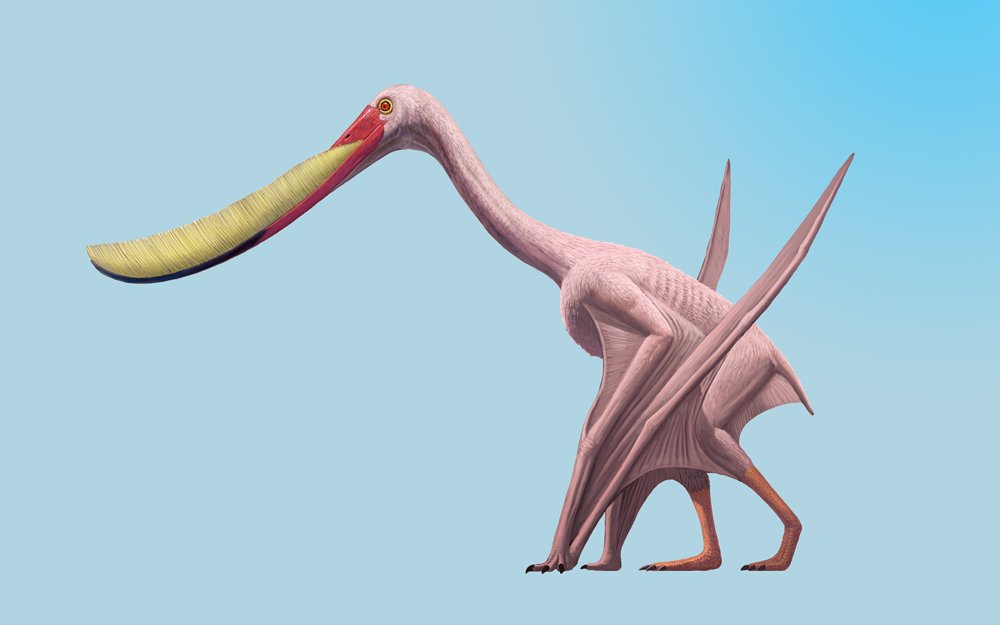
Pterodaustro guinazui represents one of the most bizarre and specialized pterosaurs known to science, a filter-feeding reptile that soared through the skies of Early Cretaceous South America. Living approximately 110 to 100 million years ago, this creature occupied a unique ecological niche, remarkably convergent with modern flamingos. Its fossils, primarily found in Argentina, provide an exceptionally detailed window into the diversity of pterosaur lifestyles and adaptations, making it a cornerstone for understanding the evolution of this extinct group of flying reptiles.
Pterodaustro was a medium-sized pterosaur with an estimated wingspan of around 2.5 meters (about 8.2 feet) and a body length of approximately 132 centimeters, much of which was comprised of its long neck and head. Its most striking and diagnostic feature was its highly specialized dentition. The lower jaw, or mandible, was exceptionally long, curved gently upwards, and packed with an astonishing array of over one thousand bristle-like, needle-thin teeth, each up to 3 centimeters long and 0.2-0.3 millimeters in diameter. These teeth formed a dense, sieve-like comb, perfectly adapted for straining small organisms from water. In stark contrast, the upper jaw was much shorter and contained only small, peg-like teeth, which likely served to crush the small prey captured by the lower jaw's filter. The skull itself was elongated, measuring about 29 centimeters, with a very long, pointed rostrum. Its skeleton was lightly built, typical for a flying animal, with hollow bones pneumatized by air sacs connected to the respiratory system. Soft tissue impressions associated with some fossils indicate it had a furry pycnofiber covering, similar to other pterosaurs, which would have provided insulation. Its hindlimbs were relatively long and robust, suggesting it was a competent walker on the ground, perhaps wading in shallow waters like a modern shorebird.
The unique anatomy of Pterodaustro provides clear and compelling evidence for its paleobiology as a specialized filter-feeder. The dental sieve in its lower jaw was an incredibly efficient tool for capturing tiny prey, such as small crustaceans, plankton, and possibly algae, from the shallow, saline lakes it inhabited. Scientists believe it fed by wading into the water, dipping its lower jaw, and sweeping its head from side to side, trapping food particles in its dental bristles while expelling water. The small, robust teeth in the upper jaw would then mash this collected food into a paste before swallowing. This feeding method is a stunning example of convergent evolution, closely mirroring that of modern flamingos. Further evidence for this diet comes from the potential presence of carotenoid pigments, derived from crustaceans, which may have imparted a pinkish hue to its feathers or skin, though this remains speculative. Locomotion would have been a mix of powered flight and terrestrial movement. Its large wings suggest it was a capable flyer, likely using flight to travel between feeding grounds. On land, its well-developed hindlimbs and splayed feet would have allowed it to walk and wade effectively on soft, muddy substrates. Fossil evidence from bone beds containing individuals of all ages, from eggs to adults, strongly suggests Pterodaustro was a gregarious, colonial nesting animal, forming large rookeries on the shores of its lacustrine habitat, another parallel with flamingos.
Pterodaustro lived in a world defined by the vast, shallow, saline, and hypersaline lakes that characterized the Lagarcito Formation in what is now central Argentina. The climate during the Albian stage of the Early Cretaceous was warm and semi-arid, leading to the formation of these extensive, ephemeral bodies of water. The ecosystem was relatively low in diversity but rich in the specific resources Pterodaustro was adapted to exploit. The water would have teemed with small crustaceans like conchostracans and other invertebrates, forming the base of a specialized food web. Pterodaustro was likely the dominant aerial predator and primary consumer of these small organisms, occupying a niche that left it with few direct competitors. Potential predators could have included terrestrial theropod dinosaurs that roamed the lake margins, such as abelisaurids, or larger crocodylomorphs that may have inhabited the less saline parts of the aquatic system. The fossil record of the Lagarcito Formation is dominated by Pterodaustro, indicating it was an incredibly abundant animal in this specific environment, a testament to its successful adaptation to this challenging, high-salinity habitat. The flora would have consisted of drought-resistant plants like conifers and ferns along the lake edges, providing cover for nesting sites.
The discovery history of Pterodaustro begins in the mid-1960s in the San Luis Province of Argentina. The paleontologist José Bonaparte, a leading figure in South American paleontology, led expeditions to a site known as Loma del Pterodaustro ('Pterodaustro Hill'). In 1969, Bonaparte formally described the new genus and species, Pterodaustro guinazui. The generic name translates to 'southern wing' (from Greek pteron 'wing' and Latin auster 'south wind'), while the specific name honors the geologist Román Guiñazú. The holotype specimen, PVL 3860, consisted of a partial skull and other skeletal elements. However, the Loma del Pterodaustro site would prove to be one of the world's most significant pterosaur fossil localities. Over the subsequent decades, hundreds of specimens were unearthed, creating an unparalleled collection that represents the entire life cycle of the animal. This includes exquisitely preserved eggs, some containing fossilized embryos, hatchlings, juveniles, and fully grown adults. This remarkable fossil assemblage, one of the largest known for any pterosaur, has allowed for detailed studies of its ontogeny (growth and development), a rarity for these delicate flying reptiles. The exceptional preservation is attributed to the fine-grained sediments and anoxic, high-salinity conditions of the ancient lakebed, which minimized scavenging and decay.
Pterodaustro holds immense evolutionary significance as a prime example of extreme dietary specialization within the Pterosauria. It belongs to the family Ctenochasmatidae, a group of pterosaurs known for their elongated snouts and numerous, fine teeth, suggesting a trend towards filter-feeding or feeding on small prey. Pterodaustro represents the pinnacle of this evolutionary trajectory, possessing the most derived and specialized filter-feeding apparatus of any known pterosaur. Its existence demonstrates that pterosaurs were not just generalized aerial piscivores but evolved to fill a wide variety of ecological niches, paralleling the diversity seen in modern birds. As a member of the Pterodactyloidea, it showcases the success of this advanced group of short-tailed pterosaurs during the Cretaceous. The detailed fossil record of Pterodaustro, especially the embryonic material, has provided crucial insights into pterosaur development. For instance, studies of its embryos show that hatchlings were likely precocial, able to walk and feed themselves shortly after hatching (a condition known as 'flaplings'), a significant finding that informs our understanding of pterosaur reproductive strategies and parental care across the entire order. Its unique anatomy challenges earlier, simpler views of pterosaur ecology and highlights the remarkable adaptive radiation these animals underwent during their 150-million-year reign.
While the fundamental aspects of Pterodaustro's biology are well-established, some scientific debates continue. One area of discussion revolves around the precise mechanics of its filter-feeding. While the general principle is accepted, the exact role of the tongue and the hyoid apparatus in manipulating food and water within the oral cavity is still being investigated. Another point of interest is its metabolism and thermoregulation. As an active flyer, it was almost certainly warm-blooded (endothermic), but the metabolic rate required to sustain its lifestyle is a subject of ongoing modeling and research. The discovery of soft, shell-less eggs, similar to those of modern lizards, sparked a major revision in our understanding of pterosaur reproduction, shifting the consensus away from hard-shelled, bird-like eggs. This finding suggests that pterosaurs may have buried their eggs in moist soil to prevent desiccation, a more reptilian reproductive strategy than previously assumed. The debate now centers on how widespread this trait was among other pterosaur groups. Furthermore, the exact phylogenetic placement of Pterodaustro within the Ctenochasmatidae is periodically refined as new related species are discovered and analyzed, helping to clarify the evolutionary steps that led to its extreme specialization.
The fossil record of Pterodaustro is both geographically restricted and locally abundant. The vast majority of specimens, numbering over 750, have been recovered from the Lagarcito Formation in the San Luis Province of Argentina. This single locality, Loma del Pterodaustro, is a lagerstätte—a site of exceptional fossil preservation. Fossils are found in fine-grained limestone and mudstone layers that represent the bottom of an ancient saline lake. The quality of preservation is often exceptional, with many specimens being articulated and three-dimensionally preserved, rather than crushed flat. The record includes not only complete and partial skeletons but also rare soft tissue impressions, gastroliths (stomach stones), and, most importantly, eggs with embryos. This provides a complete ontogenetic series, from unhatched embryo to mature adult, which is unique among pterosaurs and rare for any extinct vertebrate. This wealth of material has made Pterodaustro one of the best-understood pterosaurs, providing a foundational data set for studies on pterosaur growth, reproduction, and population structure. A few fragmentary remains attributed to the genus have also been reported from the Santa Ana Formation in Chile, suggesting a slightly wider geographic distribution within the Andean region of South America during the Early Cretaceous.
Despite its bizarre appearance and scientific importance, Pterodaustro has a relatively modest cultural impact compared to giants like Pteranodon or Quetzalcoatlus. However, it is a staple in paleontological museums and exhibitions that aim to showcase the diversity of prehistoric life. Its flamingo-like lifestyle makes it an excellent tool for science communication, illustrating concepts like convergent evolution and specialized feeding niches in an accessible way. Reconstructions and skeletal mounts are featured in major institutions, including the Argentine Museum of Natural Sciences in Buenos Aires. It has appeared in various dinosaur books, documentaries, and encyclopedias, often highlighted as the 'flamingo pterosaur'. While it may not be a household name, for those with a deeper interest in paleontology, Pterodaustro is celebrated as a perfect example of how strange and wonderful evolution can be, a testament to the incredible adaptability of life in the Mesozoic Era.
Classification
Time Period
Discovery
Location
Argentina
Formation
Lagarcito Formation
Frequently Asked Questions
What is Pterodaustro?
Pterodaustro guinazui represents one of the most bizarre and specialized pterosaurs known to science, a filter-feeding reptile that soared through the skies of Early Cretaceous South America. Living approximately 110 to 100 million years ago, this creature occupied a unique ecological niche, remarka...
When did Pterodaustro live?
Pterodaustro lived during the cretaceous period of the mesozoic era approximately 110-100 million years ago.
Where was Pterodaustro discovered?
Fossils of Pterodaustro were discovered in Argentina in the Lagarcito Formation.
What did Pterodaustro eat?
Pterodaustro was a filter-feeder. It lived in lacustrine, semi-aquatic, aerial habitats.
What type of fossil is Pterodaustro?
Pterodaustro is preserved as a body fossil. The preservation quality is exceptional.
Related Specimens
From the mesozoic era · body fossils