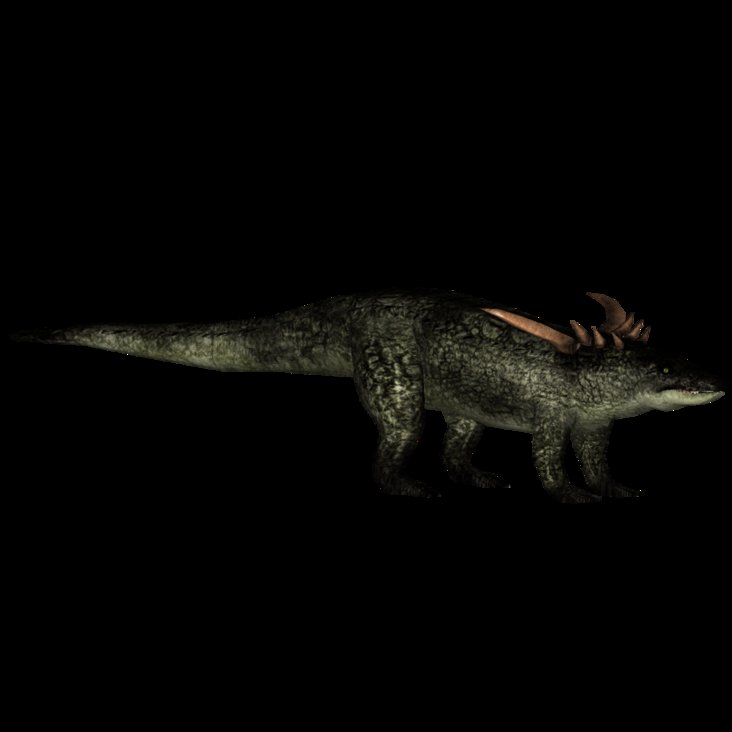
Desmatosuchus
Desmatosuchus spurensis
Image: Image sourced via web search (Fair use / Educational)
About Desmatosuchus
Desmatosuchus was a large, heavily armored archosaur belonging to the order Aetosauria, which thrived during the Late Triassic period, approximately 228 to 210 million years ago. Roaming the floodplains and river valleys of what is now the southwestern United States, this remarkable creature represents one of the most successful and widespread groups of early herbivorous reptiles in the Mesozoic era. As a prominent member of the Late Triassic terrestrial ecosystem, Desmatosuchus holds immense significance in the field of paleontology because it provides crucial insights into the early evolutionary divergence of archosaurs, specifically the pseudosuchian lineage that eventually led to modern crocodilians. Its extensive fossil record, characterized by highly distinctive bony armor plates known as osteoderms, has allowed scientists to reconstruct the complex predator-prey dynamics and ecological structures of a world that existed long before the dominance of large dinosaurs. By studying Desmatosuchus, researchers can better understand the remarkable morphological adaptations that early terrestrial herbivores developed to survive in an environment fraught with formidable apex predators.
In terms of physical appearance, Desmatosuchus was a truly imposing animal, measuring between 4.5 and 6 meters in length and weighing an estimated 250 to 300 kilograms. It possessed a robust, barrel-shaped body supported by four sturdy, relatively short legs, giving it a low-slung, quadrupedal stance reminiscent of modern crocodilians but fully adapted for a terrestrial lifestyle. The most striking and distinctive feature of Desmatosuchus was its elaborate carapace of armor. The animal's back, tail, and underbelly were covered in a complex mosaic of interlocking bony plates called osteoderms. Along its flanks, these osteoderms evolved into massive, backward-curving spikes, with the largest pair located over the shoulders reaching lengths of up to 45 centimeters. These formidable shoulder spikes likely served a dual purpose: acting as a potent physical deterrent against the massive jaws of contemporary predators and functioning as visual display structures for intraspecific communication or mating rituals. The skull of Desmatosuchus was relatively small compared to its massive body, featuring a distinctive, shovel-like or pig-like snout that was upturned at the tip. Its jaws were lined with small, peg-like teeth that were weak and unsuited for processing tough vegetation, suggesting a specialized method of feeding. The postcranial skeleton reveals a rigid spinal column, heavily reinforced by the overlying armor, which would have restricted lateral flexibility but provided exceptional protection. When compared to modern animals, Desmatosuchus might superficially resemble a heavily armored armadillo or a terrestrial crocodile, though its closest ecological analogues in later eras would be the heavily armored ankylosaurid dinosaurs of the Cretaceous period.
The paleobiology of Desmatosuchus paints a picture of a specialized, slow-moving herbivore perfectly adapted to its environment. Its diet primarily consisted of soft vegetation, ferns, horsetails, and possibly the fleshy roots and tubers of cycads and other Late Triassic flora. The unique, shovel-like structure of its snout strongly suggests that Desmatosuchus employed a rooting or grubbing feeding strategy, using its head to dig into the soft soil of riverbanks and floodplains to unearth nutritious subterranean plant parts, much like a modern wild boar. Because its teeth were relatively weak and lacked the grinding surfaces seen in later herbivorous dinosaurs, it is highly probable that Desmatosuchus swallowed its food whole or in large chunks, relying on a muscular gizzard containing swallowed stones, or gastroliths, to mechanically break down the plant matter in its digestive tract. Locomotion in Desmatosuchus was undoubtedly slow and deliberate. Its short, sprawling to semi-erect limbs and heavy armor precluded any rapid movement or running. Instead of fleeing from danger, it would have relied entirely on its formidable armor and intimidating shoulder spikes to survive encounters with predators. Socially, the frequent discovery of multiple aetosaur specimens in close proximity at various fossil sites suggests that Desmatosuchus may have been a gregarious animal, possibly moving in small herds or loose aggregations for mutual protection and foraging efficiency. Growth patterns inferred from the bone histology of its osteoderms indicate a relatively slow, reptilian metabolic rate, consistent with an ectothermic or cold-blooded physiology, though some researchers argue for a slightly elevated metabolism compared to modern squamates, given the active nature of the archosaur lineage.
The ecological context of the Late Triassic period provided a dynamic and challenging environment for Desmatosuchus. During this time, the Earth's landmasses were amalgamated into the supercontinent of Pangaea, resulting in a climate that was generally warm and characterized by strong seasonal monsoons and vast, semi-arid interiors. Desmatosuchus inhabited the lush, well-watered riparian zones and floodplains that cut through these drier regions, environments that supported dense galleries of conifers, cycads, seed ferns, and giant horsetails. The food web of this ecosystem was complex and highly competitive. Desmatosuchus shared its habitat with a diverse array of extraordinary creatures, including large, semi-aquatic phytosaurs that dominated the waterways, heavily armored dicynodonts like Placerias, and the very first, relatively small theropod dinosaurs such as Coelophysis. However, the primary existential threat to Desmatosuchus came from the apex predators of the Triassic: the massive, bipedal or semi-bipedal rauisuchians, most notably Postosuchus. Postosuchus was a fearsome carnivore equipped with massive jaws and serrated teeth capable of crushing bone. The evolutionary arms race between the heavily armored Desmatosuchus and the powerful Postosuchus is a classic example of predator-prey coevolution. The massive shoulder spikes and impenetrable dorsal carapace of Desmatosuchus were direct evolutionary responses to the crushing bite force and top-down hunting strategy of these giant rauisuchians, ensuring that only the most desperate or skilled predators would attempt an attack on a fully grown adult.
The discovery history of Desmatosuchus is deeply intertwined with the golden age of American paleontology in the early 20th century. The first significant fossils of this remarkable animal were discovered by the renowned paleontologist Ermine Cowles Case in 1920. Case, working on behalf of the University of Michigan, was conducting extensive field expeditions in the rugged, badland terrains of Crosby County, Texas, exploring the fossil-rich sedimentary deposits of the Dockum Group. It was here that he unearthed a remarkably complete and articulated skeleton, including the skull, the majority of the vertebral column, and, crucially, the spectacular array of armor plates and shoulder spikes in their natural life positions. Case formally described and named the type species, Desmatosuchus spurensis, later that same year. The generic name, Desmatosuchus, translates to 'link crocodile,' reflecting Case's initial, somewhat erroneous belief that the animal represented an evolutionary transitional form between early reptiles and later crocodilians. The specific epithet, spurensis, honors the town of Spur, Texas, located near the discovery site. Since Case's initial discovery, numerous other specimens have been found across the American Southwest, particularly in the Chinle Formation of Arizona and New Mexico. One of the most famous and well-preserved specimens is housed at the University of Michigan Museum of Paleontology, serving as the holotype and the basis for many of the skeletal reconstructions seen in museums worldwide. These subsequent discoveries have continually refined our understanding of its anatomy, allowing paleontologists to piece together a highly accurate picture of this bizarre Triassic reptile.
In terms of evolutionary significance, Desmatosuchus occupies a crucial position within the broader tree of life. It belongs to the clade Pseudosuchia, the 'crocodile-line' archosaurs, which diverged from the 'bird-line' archosaurs (Avemetatarsalia, which includes dinosaurs and pterosaurs) during the Early to Middle Triassic. Within Pseudosuchia, Desmatosuchus is a highly derived member of the Aetosauria, a specialized order that represents one of the very first times in Earth's history that archosaurs successfully adapted to a strictly herbivorous diet. The evolutionary trajectory of Desmatosuchus and its kin demonstrates the incredible morphological plasticity of the early archosaur body plan. Furthermore, Desmatosuchus is a textbook example of convergent evolution. Millions of years before the first ankylosaurid dinosaurs evolved their famous bony armor and tail clubs, aetosaurs like Desmatosuchus had already 'invented' the concept of the heavily armored, low-browsing terrestrial tank. The similarities in their wide bodies, short limbs, and extensive osteoderm coverage highlight how similar environmental pressures—namely, the need to defend against large, terrestrial predators while feeding on low-lying vegetation—can drive unrelated groups of animals to evolve strikingly similar body plans. Although the aetosaurs, including Desmatosuchus, ultimately went extinct at the end of the Triassic period, leaving no direct modern descendants, their fossilized remains provide an invaluable window into the early diversification of the archosaur lineage that eventually gave rise to the modern crocodilians we see today.
Despite being known for over a century, Desmatosuchus remains the subject of several ongoing scientific debates and controversies. One of the primary areas of contention involves its exact dietary habits. While the consensus strongly supports herbivory, some paleontologists have pointed to the pig-like snout and weak teeth as potential evidence for an omnivorous or even insectivorous diet, suggesting that Desmatosuchus might have rooted for grubs, social insects, or small invertebrates alongside plant matter. Another significant debate centers around the taxonomy and classification of various Desmatosuchus species. Over the decades, several species have been proposed, such as Desmatosuchus haplocerus and Desmatosuchus smalli, based on variations in the shape and size of the osteoderms and shoulder spikes. However, some researchers argue that these differences might merely represent sexual dimorphism, ontogenetic (growth-related) changes, or individual variation within a single, widespread species, leading to ongoing revisions of the genus. Additionally, the exact biomechanical function of the massive shoulder spikes is still debated. While defense is the most obvious function, the extreme size and specific orientation of the spikes in some specimens have led to hypotheses that they were primarily used for intraspecific combat, such as males wrestling or shoving each other during the mating season, much like the horns of modern ungulates.
The fossil record of Desmatosuchus is exceptionally rich compared to many other Triassic terrestrial vertebrates, primarily due to the highly durable nature of its bony armor. Fossils are predominantly found in the Upper Triassic terrestrial strata of the southwestern United States, most notably within the Chinle Formation, which spans across Arizona, New Mexico, Utah, and Colorado, as well as the Dockum Group in Texas. While fully articulated skeletons are relatively rare and prized by paleontologists, isolated osteoderms are incredibly common. Because the armor plates of Desmatosuchus are so distinctive and easily identifiable, they serve as excellent index fossils, helping geologists and paleontologists date and correlate different rock layers across the American Southwest. The preservation quality of these fossils ranges from fair to excellent, with many osteoderms preserving intricate details of the bone surface, including the pits and grooves that once housed blood vessels and anchored a tough, keratinous sheath in life. Famous fossil sites, such as the Petrified Forest National Park in Arizona and the Post Quarry in Texas, have yielded hundreds of Desmatosuchus fragments, providing a robust dataset that allows scientists to study population dynamics, growth rates, and morphological variation across different geographic regions and time periods within the Late Triassic.
The cultural impact of Desmatosuchus, while perhaps not as massive as that of popular dinosaurs like Tyrannosaurus rex or Triceratops, is nonetheless significant within the realm of paleontology and natural history education. Its bizarre, dragon-like appearance, complete with massive shoulder spikes and heavy armor, makes it a favorite subject for paleoartists and a striking addition to museum displays. Notable, dramatic reconstructions of Desmatosuchus can be seen at the University of Michigan Museum of Natural History, the American Museum of Natural History, and the visitor centers of Petrified Forest National Park. It frequently appears in documentaries and books focusing on the Triassic period, often depicted in tense standoffs with the apex predator Postosuchus, effectively illustrating the harsh realities and evolutionary arms races of the Mesozoic era. For educators, Desmatosuchus serves as a perfect tool to teach concepts of convergent evolution, predator-prey dynamics, and the incredible diversity of life that existed before the age of the dinosaurs.
Classification
Time Period
Discovery
Location
Texas, United States
Formation
Dockum Group
Frequently Asked Questions
What is Desmatosuchus?
Desmatosuchus was a large, heavily armored archosaur belonging to the order Aetosauria, which thrived during the Late Triassic period, approximately 228 to 210 million years ago. Roaming the floodplains and river valleys of what is now the southwestern United States, this remarkable creature represe...
When did Desmatosuchus live?
Desmatosuchus lived during the triassic period of the mesozoic era approximately 228-210 million years ago.
Where was Desmatosuchus discovered?
Fossils of Desmatosuchus were discovered in Texas, United States in the Dockum Group.
What did Desmatosuchus eat?
Desmatosuchus was a herbivore. It lived in terrestrial habitats.
What type of fossil is Desmatosuchus?
Desmatosuchus is preserved as a body fossil. The preservation quality is good.
Related Specimens
From the mesozoic era · body fossils
-tooth/7fb56d2cf543.png)