Sarcosuchus
Sarcosuchus imperator
Image: Image sourced via web search (Fair use / Educational)
About Sarcosuchus
Sarcosuchus imperator, often nicknamed 'SuperCroc', was a colossal crocodylomorph that inhabited the river systems of what is now Africa during the Early Cretaceous period, approximately 112 million years ago. As one of the largest crocodile-line archosaurs to have ever lived, its immense size and predatory prowess make it a subject of significant paleontological interest, offering a window into the unique ecosystems of Cretaceous Africa. Its discovery has fundamentally shaped our understanding of the upper limits of crocodilian body size and the diversity of life in its ancient world.
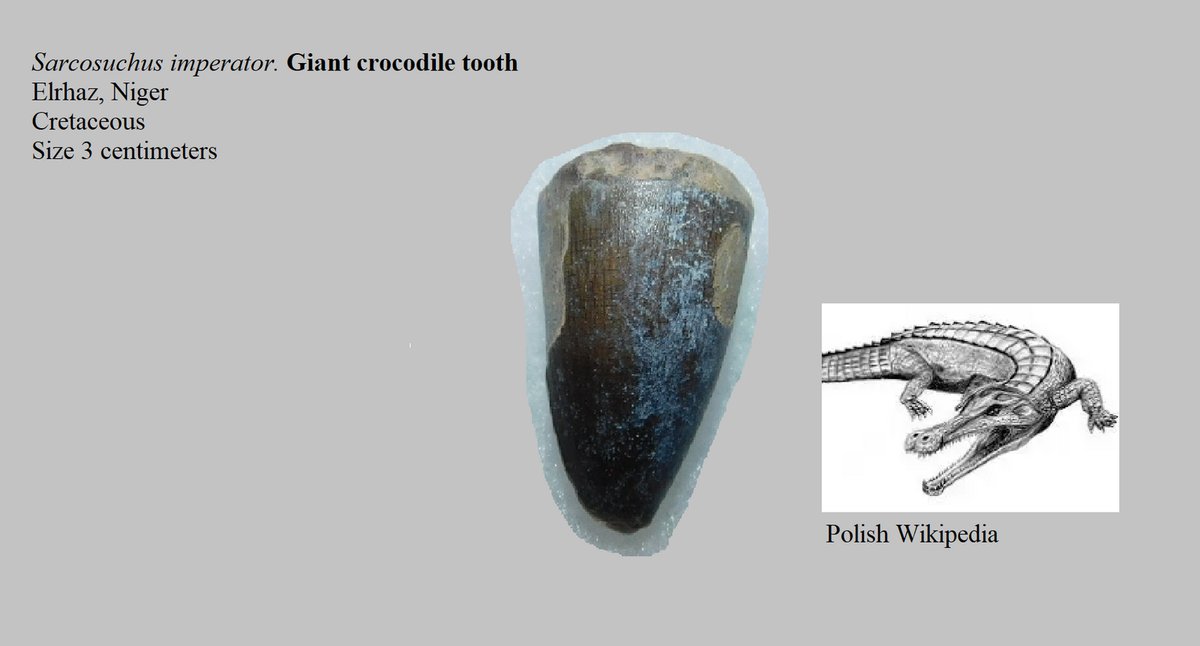
The physical attributes of Sarcosuchus were truly formidable, far exceeding those of any modern crocodilian. Conservative estimates place its total body length between 9 and 9.5 meters (30-31 feet), with some earlier, more liberal estimates suggesting lengths up to 12 meters (40 feet). Its weight is estimated to have been between 4 to 8 metric tons (4.4 to 8.8 short tons), making it a true heavyweight. The skull alone was a massive structure, measuring up to 1.6 meters (5.2 feet) in length. A key distinguishing feature was its long, relatively narrow snout, which comprised about 75% of the skull's total length, armed with over 100 robust, conical teeth. Unlike modern crocodiles, its upper jaw was longer than the lower, creating a significant overbite. The eyes were positioned dorsally, allowing it to remain submerged while scanning the water's surface for prey. Another unique feature was the large, bony bulla at the end of its snout, a hollow expansion of the nasal bones whose function remains a topic of debate, possibly related to vocalization or olfaction. Its body was covered in a thick armor of osteoderms, or bony scutes, with some on its back measuring over 30 cm across, forming a protective, interlocking shield.
The paleobiology of Sarcosuchus reflects its status as an apex predator within its freshwater habitat. Its powerful jaws, though not as broad as those of the later Deinosuchus, were capable of generating immense bite forces, suitable for ambushing and overpowering large prey. The structure of its teeth—conical and stout rather than blade-like—suggests a diet of large fish and turtles, whose remains are abundant in the same geological formations. However, its sheer size indicates it was likely a generalist predator, capable of taking down terrestrial prey that ventured too close to the water's edge, including various dinosaurs. Isotopic analysis of its osteoderms supports a diet primarily of large fish. Like modern crocodilians, Sarcosuchus was a semi-aquatic ambush predator, spending much of its time in the water, waiting for prey. Studies of its osteoderms reveal growth rings, similar to tree rings, which indicate that it had a prolonged growth period, taking approximately 50 to 60 years to reach its maximum size. This slow, extended growth pattern is different from the faster growth rates seen in many dinosaurs of the same era, suggesting a more reptilian, ectothermic or gigantothermic metabolism.
Sarcosuchus lived in a world vastly different from today's. During the Early Cretaceous, North Africa was a lush, tropical region characterized by vast, meandering river systems, floodplains, and deltas. The climate was warm and humid, supporting a rich and diverse ecosystem. Sarcosuchus was the undisputed apex predator of these aquatic environments. It shared its world with a variety of other large animals, creating a dynamic and dangerous food web. The rivers teemed with giant coelacanths and lungfish, which likely formed a staple of its diet. On land, the fauna was equally impressive. Herbivorous dinosaurs such as the long-necked Nigersaurus and the iguanodontian Lurdusaurus would have been potential prey, especially when they came to the rivers to drink. Sarcosuchus also coexisted with other large predators, including the spinosaurid theropod Suchomimus, a large, fish-eating dinosaur with a crocodile-like snout. This raises fascinating questions about niche partitioning and competition between these two giant aquatic predators. It is plausible that Sarcosuchus dominated the deeper channels while Suchomimus patrolled the shallower waters, or that they targeted different prey, thus minimizing direct conflict in this predator-rich environment.
The history of Sarcosuchus's discovery began in the mid-20th century. The French paleontologist Albert-Félix de Lapparent first reported fragmentary remains, including teeth and scutes, from the Sahara Desert in the 1940s and 1950s. Based on these initial finds, another French paleontologist, France de Broin, along with Philippe Taquet, formally named the genus Sarcosuchus in 1966, with the type species being Sarcosuchus imperator, meaning 'flesh crocodile emperor'. However, a complete understanding of the animal remained elusive until a major expedition in 1997 and 2000 led by paleontologist Paul Sereno from the University of Chicago. Sereno's team unearthed several new, far more complete specimens in the Elrhaz Formation of Niger. The most significant of these finds was an almost complete skull, along with vertebrae, limb bones, and osteoderms, which together constituted about half of the animal's skeleton. This wealth of new material allowed for the first reliable reconstructions of the entire animal, revealing its true, colossal scale and unique anatomical features. It was this discovery that brought Sarcosuchus to global attention, earning it the popular moniker 'SuperCroc' and cementing its place in the public imagination as a prehistoric giant.
In the grand tree of life, Sarcosuchus is not a direct ancestor of modern crocodiles. It belongs to a broader group called Crocodylomorpha, but it lies on a side branch known as Pholidosauridae, which went extinct long before the end of the Cretaceous. Its evolutionary significance lies in demonstrating the incredible adaptive radiation and morphological diversity of crocodylomorphs during the Mesozoic Era. It represents a pinnacle of evolution for its particular lineage, showcasing how this group could evolve to fill the apex predator niche in freshwater ecosystems on a scale rivaling that of large theropod dinosaurs. The existence of giants like Sarcosuchus and the later Deinosuchus in North America shows that gigantism in crocodilians was not an isolated phenomenon but a recurring evolutionary trend under favorable environmental conditions. Its anatomy, particularly the elongated snout (longirostry), is an example of convergent evolution, as similar snout shapes have evolved independently in other crocodylomorphs and even in spinosaurid dinosaurs like Suchomimus, likely as an adaptation for hunting fish in aquatic environments.
Despite the significant discoveries made by Paul Sereno's team, some scientific debates surrounding Sarcosuchus persist. The exact function of the large, hollow bulla at the tip of its snout is still a matter of speculation. While hypotheses range from a resonating chamber for vocalizations to an enhanced olfactory organ for detecting scents over long distances, no consensus has been reached without soft tissue evidence. Furthermore, the upper limits of its size and weight are still debated, with different researchers arriving at slightly different figures based on various reconstruction methods and comparisons with modern relatives. The precise nature of its interaction with contemporary predators like Suchomimus is also a topic of ongoing discussion, focusing on whether they were direct competitors or occupied distinct ecological niches, a question that can only be further illuminated by future fossil discoveries and more detailed isotopic studies.
The fossil record of Sarcosuchus is primarily concentrated in North and Central Africa. The most important and complete specimens have been recovered from the Elrhaz Formation in Niger, a site renowned for its rich Early Cretaceous vertebrate fauna. Fossils attributed to the genus, possibly a second species (S. hartti), have also been found in the Ilhas Formation of Brazil, suggesting a wider distribution across the supercontinent of Gondwana before Africa and South America fully separated. To date, several partial skeletons and numerous isolated elements have been discovered, but a fully complete, articulated skeleton remains elusive. The preservation quality is generally good, with the robust skull bones and thick osteoderms being the most commonly preserved parts. These fossils provide a solid basis for understanding its anatomy, though much of the post-cranial skeleton has been reconstructed based on these partial remains and comparisons with related pholidosaurs.
Sarcosuchus has made a significant cultural impact since the announcement of Paul Sereno's discoveries in the early 2000s. Its immense size and fearsome appearance have captured the public's imagination, earning it the memorable nickname 'SuperCroc'. It has been featured prominently in television documentaries, including a National Geographic special dedicated to its discovery, as well as in video games and books about prehistoric life. Major museums, such as the University of Chicago and the Children's Museum of Indianapolis, feature impressive life-sized reconstructions and fossil displays of Sarcosuchus, serving as powerful educational tools that illustrate the scale and diversity of life in the Mesozoic Era and highlight the ongoing process of paleontological discovery.
Classification
Time Period
Discovery
Location
Niger, Africa
Formation
Elrhaz Formation
Frequently Asked Questions
What is Sarcosuchus?
Sarcosuchus imperator, often nicknamed 'SuperCroc', was a colossal crocodylomorph that inhabited the river systems of what is now Africa during the Early Cretaceous period, approximately 112 million years ago. As one of the largest crocodile-line archosaurs to have ever lived, its immense size and p...
When did Sarcosuchus live?
Sarcosuchus lived during the cretaceous period of the mesozoic era approximately 112-110 million years ago.
Where was Sarcosuchus discovered?
Fossils of Sarcosuchus were discovered in Niger, Africa in the Elrhaz Formation.
What did Sarcosuchus eat?
Sarcosuchus was a carnivore. It lived in freshwater, semi-aquatic habitats.
What type of fossil is Sarcosuchus?
Sarcosuchus is preserved as a body fossil. The preservation quality is good.
Related Specimens
From the mesozoic era · body fossils