Placerias
Placerias hesternus
Image: Image sourced via web search (Fair use / Educational)
About Placerias
Placerias hesternus was a massive, herbivorous dicynodont synapsid that lived during the Late Triassic period, approximately 230 to 220 million years ago, primarily in what is now the southwestern United States. As one of the last and largest of the dicynodonts, a highly successful group of mammal-like reptiles that flourished long before the absolute dominance of dinosaurs, Placerias holds a crucial and fascinating place in paleontological history. Its abundant fossil remains provide an invaluable window into the terrestrial ecosystems of the Late Triassic, illustrating the complex and dynamic transition from synapsid-dominated faunas of the Permian and Early Triassic to the archosaur-dominated worlds of the Jurassic and Cretaceous. The existence of Placerias demonstrates the incredible resilience of the synapsid lineage following the devastating Permian-Triassic extinction event, while its eventual disappearance marks the end of a major chapter in the evolutionary history of life on Earth. Understanding Placerias is essential for comprehending the ecological foundations upon which the age of dinosaurs was built.
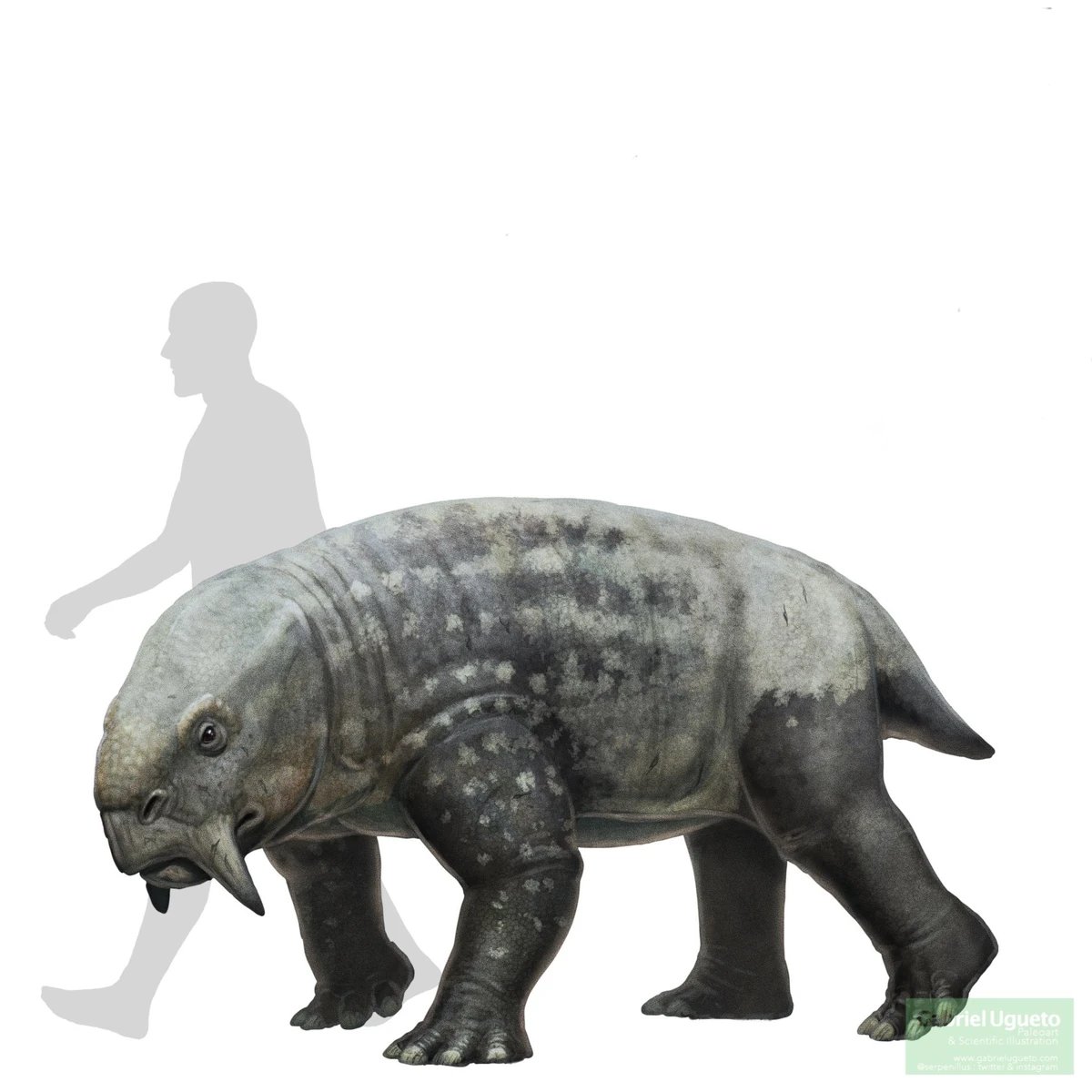
Placerias was a heavily built, robust animal, frequently compared in size, shape, and ecological role to a modern hippopotamus, though the two are only distantly related through the deep synapsid family tree. Adult individuals were truly massive for their time, capable of reaching lengths of up to 3.5 meters (approximately 11.5 feet) and standing over a meter tall at the shoulder. Weight estimates for fully grown adults range between 1,000 and 2,000 kilograms, making them some of the largest terrestrial herbivores of the Late Triassic landscape. The most distinctive feature of Placerias was its enormous, barrel-shaped torso, which housed a massive digestive tract necessary for fermenting large quantities of tough, fibrous plant material. This immense bulk was supported by four stout, powerful legs that positioned the animal in a sprawling to semi-erect stance. Its skull was highly specialized and immediately recognizable, featuring a robust, turtle-like keratinous beak used for cropping vegetation. Unlike many earlier dicynodonts, Placerias lacked true teeth, with the notable exception of two prominent, downward-pointing tusks in the upper jaw. Interestingly, these tusks were actually bony extensions of the maxilla bone itself rather than true canine teeth, making them a unique adaptation among its relatives. The neck was short, thick, and heavily muscled to support the massive head, while the tail was relatively short and stubby. Soft tissue inferences, based on its phylogenetic position as a derived synapsid, suggest it likely had thick, leathery, glandular skin, possibly equipped with sparse hair or vibrissae (whiskers) around the snout. The powerful musculature of the forelimbs and neck strongly indicates it was well-adapted for digging, rooting, or tearing at tough vegetation, utilizing its beak and bony tusks as formidable foraging tools.
As a dedicated megaherbivore, Placerias possessed a highly specialized feeding apparatus perfectly designed to process the tough, low-nutrient plant material characteristic of the Late Triassic flora. Its sharp beak and incredibly powerful jaw muscles allowed it to shear through thick cycads, ferns, seed ferns, and horsetails with remarkable efficiency. The prominent maxillary tusks were likely multi-purpose tools; they were almost certainly used for rooting in the soil to unearth nutritious tubers, roots, and rhizomes, but they also likely played a significant role in intraspecific combat and social display, much like the tusks of modern walruses or the horns of extant bovids. Locomotion in Placerias was relatively slow and ponderous. Its sprawling limb posture suggests it was not built for sustained speed or agility, but rather for stability, power, and energy conservation while foraging. Socially, the sheer concentration of Placerias fossils found in single, localized bonebeds strongly implies that these animals exhibited herd behavior. Living and traveling in large groups would have provided significant defensive advantages against the formidable apex predators of its time, relying on collective bulk and numbers rather than speed for protection. Growth patterns inferred from bone histology indicate a relatively rapid initial growth phase during juvenility, followed by a distinct plateau as the animal reached sexual maturity, a life history trait common in many large, long-lived herbivores. Its metabolism remains a subject of intense scientific interest; it likely possessed a transitional physiology, exhibiting endothermic (warm-blooded) traits more advanced than typical reptiles, allowing for sustained activity and rapid growth, but perhaps not as fully developed or precisely regulated as the metabolism of modern mammals.
During the Late Triassic, the Earth's landmasses were united into the colossal supercontinent of Pangea. The environment inhabited by Placerias in what is now the American Southwest was characterized by a strongly seasonal, megamonsoonal climate, experiencing intense, distinct wet and dry periods. The landscape was dominated by vast, sweeping floodplains, complex meandering river systems, and dense riparian forests composed of early conifers, cycads, and giant ferns. Placerias occupied a foundational ecological role in this environment as a primary megaherbivore, actively shaping the vegetation structure through its intensive browsing, trampling, and rooting behaviors. It shared its habitat with a bizarre and diverse array of early archosaurs, including heavily armored, herbivorous aetosaurs like Desmatosuchus, and large, crocodile-like phytosaurs that lurked in the rivers and lakes. The primary predators of Placerias were likely massive, terrestrial rauisuchians, such as the fearsome Postosuchus. These apex predators were heavily armed and capable of taking down even a fully grown dicynodont through ambush tactics. The intense evolutionary pressure exerted by these formidable carnivores likely reinforced the herding behavior and massive body size of Placerias as primary defense mechanisms. This period was a time of immense ecological turnover and instability, witnessing the gradual decline of the ancient synapsid lineages and the concurrent, rapid rise of the early dinosaurs. Dinosaurs of this era, such as the theropod Coelophysis, were generally small, bipedal, and agile, occupying very different ecological niches than the massive, lumbering Placerias, highlighting a world in the midst of a profound biological changing of the guard.
The discovery of Placerias is intimately tied to the rich, pioneering paleontological heritage of the American Southwest. The genus was first formally described by the eminent paleontologist Frederic Augustus Lucas in 1904, based on highly fragmentary remains discovered in the Chinle Formation of Arizona. The generic name Placerias roughly translates to 'broad body,' a highly fitting moniker for this robust, wide-stanced animal. However, the most significant and transformative breakthrough in our understanding of Placerias occurred several decades later, in the 1930s, with the discovery of the now-famous 'Placerias Quarry' near St. Johns, Arizona. Extensive excavations led by paleontologists Charles Camp and Samuel Welles of the University of California, Berkeley, uncovered a massive, chaotic bonebed containing the disarticulated remains of dozens of Placerias individuals. This extraordinary site yielded thousands of individual bones, representing animals of various ages, sizes, and developmental stages, and provided the comprehensive skeletal data necessary to finally and accurately reconstruct the entire animal. The quarry is widely believed by taphonomists to represent a mass death assemblage, possibly caused by a severe, prolonged drought that forced a large herd to congregate around a rapidly shrinking water source, where they ultimately perished from dehydration or starvation. The meticulous, groundbreaking work of Camp and Welles established Placerias as one of the best-known and most thoroughly documented Triassic vertebrates, cementing its status as a classic, textbook example of Late Triassic fauna.
Placerias holds a profound and poignant evolutionary significance as one of the terminal members of the Dicynodontia, a highly successful, globally distributed, and incredibly diverse clade of non-mammalian synapsids that dominated terrestrial herbivore niches from the Middle Permian straight through the Triassic. As a derived member of the family Stahleckeriidae, Placerias represents the absolute culmination of dicynodont evolution in terms of sheer size, bulk, and highly specialized feeding adaptations. Its existence and abundance during the Late Triassic highlight the remarkable resilience of the synapsid lineage, which managed to survive and re-diversify following the catastrophic Permian-Triassic extinction event, the most severe mass extinction in Earth's history. However, Placerias also represents the definitive end of an era. Shortly after its time, the dicynodonts vanished entirely from the fossil record, ultimately outcompeted and replaced by the rapidly diversifying archosaurs, particularly the emerging herbivorous dinosaurs. Studying Placerias provides critical, irreplaceable insights into the anatomical, biomechanical, and physiological transitions that occurred within the broader synapsid lineage—the very group that eventually, millions of years later, gave rise to true mammals. While Placerias left no direct modern descendants, its complex skeletal morphology, particularly the advanced structure of its jaw articulation, secondary palate, and middle ear bones, offers invaluable clues regarding the stepwise, evolutionary acquisition of mammalian traits. It serves as a powerful reminder of the dynamic, often ruthless nature of evolutionary history, where once-dominant, highly successful lineages can be entirely supplanted by newly emerging groups.
Despite the incredible wealth of fossil material available, Placerias remains the subject of several ongoing scientific debates and active research. One primary area of contention involves the exact biomechanical function of its prominent maxillary tusks. While traditionally viewed and depicted as robust tools for rooting up tough vegetation in hard soil, some recent biomechanical and finite element analysis studies suggest the bone structure may not have been strong enough to withstand the immense stresses of continuous digging. This has led to alternative hypotheses proposing that the tusks were primarily utilized for social display, species recognition, or intraspecific combat among rival males. Another ongoing debate centers on its precise metabolic rate and thermoregulatory capabilities. While bone histology clearly indicates relatively rapid, sustained growth, the exact degree of endothermy achieved by large Late Triassic dicynodonts like Placerias is notoriously difficult to quantify. Furthermore, the precise taxonomic relationships and phylogenetic placement within the family Stahleckeriidae are frequently revised as new, related dicynodont discoveries are made globally, particularly in South America and Africa, prompting paleontologists to continually reassess the complex biogeographical distribution and evolutionary radiation of these massive herbivores across the supercontinent of Pangea.
The fossil record of Placerias is exceptionally robust and detailed, primarily due to the highly localized abundance of remains found within the Chinle Formation of Arizona. The legendary Placerias Quarry alone has yielded the remains of at least forty distinct individuals, making it one of the most concentrated, species-specific deposits of a single vertebrate taxon from the entire Late Triassic period. The preservation quality at this specific site is generally considered good to excellent, though the bones are typically found disarticulated, jumbled, and often show signs of pre-burial scavenging by archosaurs or weathering from the elements. Skulls, robust limb bones, pelvic girdles, and vertebrae are commonly preserved, allowing for highly accurate, three-dimensional skeletal reconstructions. Beyond the borders of Arizona, fragmentary remains tentatively attributed to Placerias or closely related, unnamed taxa have been reported from other Late Triassic formations across North America, such as the Pekin Formation in North Carolina and the Popo Agie Formation in Wyoming, suggesting a relatively broad, continent-wide geographic distribution. The sheer volume and quality of material from the Placerias Quarry continues to provide an incredibly rich dataset for modern morphometric, histological, and taphonomic studies.
Placerias has achieved notable and enduring recognition in popular culture, most famously appearing in the groundbreaking, Emmy Award-winning 1999 BBC documentary series 'Walking with Dinosaurs.' Its memorable depiction as a peaceful, herd-dwelling herbivore tragically preyed upon by the terrifying Postosuchus introduced this remarkable, bizarre synapsid to a massive global audience. Skeletal mounts, detailed casts, and highly accurate life-sized models of Placerias are prominently displayed in several major natural history museums worldwide, including the American Museum of Natural History in New York and the University of California Museum of Paleontology. These captivating exhibits play a crucial educational role, vividly illustrating the bizarre, fascinating, and often overlooked diversity of life that existed long before the dinosaurs achieved their true, undisputed dominance over the Earth.
Classification
Time Period
Discovery
Location
Arizona, United States
Formation
Chinle Formation
Frequently Asked Questions
What is Placerias?
Placerias hesternus was a massive, herbivorous dicynodont synapsid that lived during the Late Triassic period, approximately 230 to 220 million years ago, primarily in what is now the southwestern United States. As one of the last and largest of the dicynodonts, a highly successful group of mammal-l...
When did Placerias live?
Placerias lived during the triassic period of the mesozoic era approximately 230-220 million years ago.
Where was Placerias discovered?
Fossils of Placerias were discovered in Arizona, United States in the Chinle Formation.
What did Placerias eat?
Placerias was a herbivore. It lived in terrestrial habitats.
What type of fossil is Placerias?
Placerias is preserved as a body fossil. The preservation quality is good.
Related Specimens
From the mesozoic era · body fossils
/09c845a0ecb7.png)