Pachyrhinosaurus
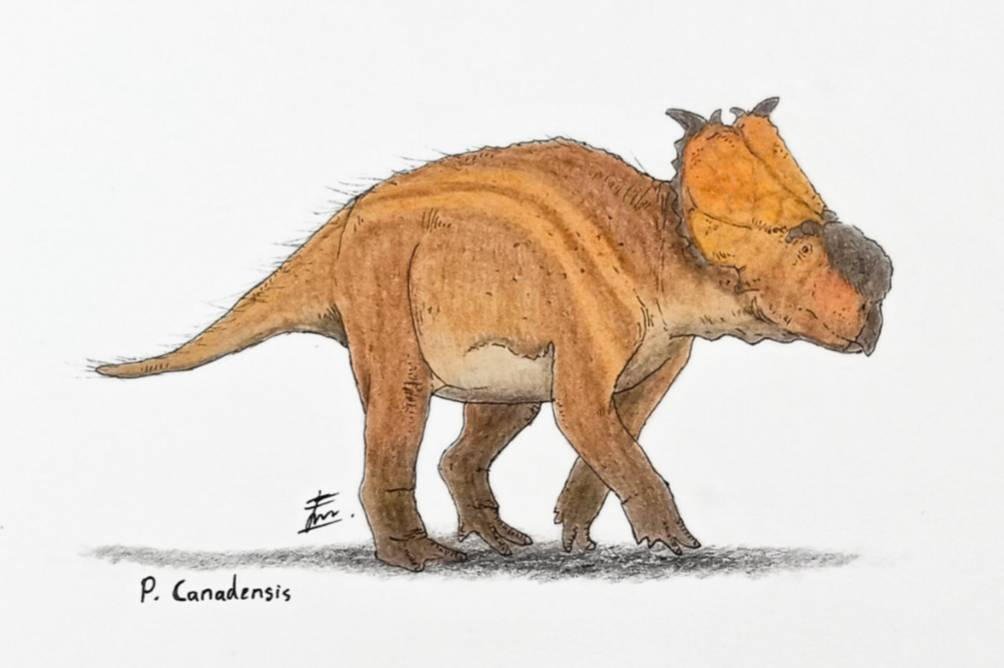
Pachyrhinosaurus canadensis
Image: Image sourced via web search (Fair use / Educational)
About Pachyrhinosaurus
Pachyrhinosaurus was a large, herbivorous ceratopsid dinosaur that inhabited North America during the Late Cretaceous Period, approximately 73 to 69 million years ago. Its name, meaning 'thick-nosed lizard,' refers to its most distinctive feature: a massive, flattened bony boss on its snout instead of the prominent nasal horn seen in relatives like Triceratops. This unique dinosaur is significant for revealing the remarkable diversity of cranial ornamentation within the Ceratopsidae and for providing key insights into the social behavior and paleoecology of high-latitude dinosaur communities.
Pachyrhinosaurus was a robust and powerfully built quadruped, reaching lengths of 5.5 to 8 meters (18 to 26 feet) and weighing an estimated 3 to 4 metric tons. For comparison, it was roughly the size of a large white rhinoceros but significantly heavier. Its body was barrel-chested, supported by sturdy, pillar-like limbs, with a short, thick tail. The most striking features were on its massive skull, which could exceed 1.5 meters in length. Instead of a sharp nasal horn, it possessed a large, roughened bony structure called a boss. A smaller boss was also present over the eyes. The exact function of these bosses is debated, but they may have been used for intraspecific combat, such as head-pushing or flank-butting contests, similar to modern muskoxen, or for species recognition. The surface texture of the boss suggests it was covered by a thick keratinous sheath in life, which would have made it even more formidable. Projecting from its large, solid frill were several curved horns, or epoccipitals. In Pachyrhinosaurus canadensis, two prominent, backward-curving horns grew from the top center of the frill. Its mouth was equipped with a sharp, toothless beak for cropping tough vegetation and complex dental batteries of hundreds of stacked, self-sharpening teeth in the cheeks for efficient grinding.
The paleobiology of Pachyrhinosaurus is illuminated by extensive fossil evidence, particularly from large bonebeds. These mass-death assemblages, containing the remains of hundreds of individuals of various ages, strongly suggest that Pachyrhinosaurus was a gregarious animal that lived in large herds. This social structure would have offered protection against large predators and facilitated migration. Analysis of bone histology indicates a relatively rapid growth rate, reaching maturity in about 15 years. Its powerful beak and dental batteries were well-suited for processing fibrous plant material, such as ferns, cycads, and conifers, which were abundant in its environment. Locomotion was quadrupedal and likely relatively slow, built for strength and endurance rather than speed. The elaborate cranial structures, including the bosses and frill horns, were almost certainly involved in social signaling, helping individuals recognize species, sex, and social status, as well as engaging in ritualized combat for mates or territory. Its metabolism was likely mesothermic, possessing an elevated metabolic rate compared to modern reptiles but not as high as that of birds or mammals, allowing it to sustain its large body size and active lifestyle in a temperate to cool climate.
Pachyrhinosaurus lived in a dynamic and diverse ecosystem on the western coastal plain of the Western Interior Seaway, a vast inland sea that divided North America. During the Late Campanian and Early Maastrichtian stages, this region, known as Laramidia, experienced a temperate to cool climate with distinct seasons, including long, dark winters at the higher latitudes where some species, like P. perotorum, lived. The environment consisted of lush floodplains, forests, and swamps, dominated by conifers, ferns, and early flowering plants. Pachyrhinosaurus shared this habitat with a rich fauna. Herbivores included other ceratopsids like Anchiceratops, hadrosaurids (duck-billed dinosaurs) such as Edmontosaurus, and armored ankylosaurs like Euoplocephalus. The primary predators that would have hunted Pachyrhinosaurus, especially the young, old, or sick, were large tyrannosaurids. In the southern part of its range, this would have been Albertosaurus and Gorgosaurus, while in the far north, the smaller but formidable Nanuqsaurus was the apex predator. Pachyrhinosaurus occupied a niche as a large, bulk-feeding herbivore, playing a crucial role in the food web by consuming vast quantities of low-growing vegetation and, in turn, serving as a food source for the top carnivores.
The discovery history of Pachyrhinosaurus began in the mid-1940s. Charles M. Sternberg, son of the famous fossil hunter Charles H. Sternberg, led expeditions for the National Museum of Canada (now the Canadian Museum of Nature) into the rich fossil beds of Alberta. Between 1945 and 1946, his team collected several incomplete skulls from the Horseshoe Canyon Formation along the Red Deer River. In 1950, Sternberg formally described and named the genus and type species, Pachyrhinosaurus canadensis, based on these initial finds, including the holotype specimen NMC 8867 and paratype NMC 8866. For decades, the genus was known from only a handful of partial skulls. This changed dramatically with the discovery of several massive bonebeds. The most significant of these is the Pipestone Creek bonebed near Grande Prairie, Alberta, discovered in 1974 by a local science teacher named Al Lakusta. Excavations, primarily led by Philip J. Currie and his team from the Royal Tyrrell Museum of Palaeontology starting in the 1980s, have since unearthed thousands of bones representing dozens of individuals, making it one of the densest dinosaur bonebeds in the world. This site provided a wealth of information about the animal's anatomy, growth series, and social behavior, solidifying its status as a herding animal.
Pachyrhinosaurus is a member of the Ceratopsidae family, specifically within the Centrosaurinae subfamily. It is the namesake of the tribe Pachyrhinosaurini, which also includes its close relative, Achelousaurus. This group is characterized by the replacement of nasal and brow horns with large, rugose bosses. The evolutionary trajectory from centrosaurines with prominent horns (like Centrosaurus and Styracosaurus) to those with bosses (like Achelousaurus and Pachyrhinosaurus) represents a significant trend in ceratopsid evolution. This transition, known as the 'Pachyrhinosaurin-lineage,' demonstrates anagenesis—the gradual evolution of a species over time. Achelousaurus, with its nasal boss and two large brow horns, is seen as a potential transitional form between earlier horned species and the fully bossed Pachyrhinosaurus. This lineage provides a compelling case study of macroevolutionary change within a single dinosaur group over a few million years, driven likely by shifts in sexual selection and species recognition signals. As a highly derived centrosaurine, Pachyrhinosaurus showcases the peak of this particular evolutionary experiment in cranial ornamentation before the subfamily's decline and the rise of the chasmosaurines like Triceratops just before the end-Cretaceous extinction.
Despite the wealth of fossil material, several scientific debates surround Pachyrhinosaurus. The precise function of the massive nasal boss remains a key point of discussion. While the dominant hypothesis favors its use in intraspecific combat, such as head-pushing or shoving, some researchers have proposed it could have been a display structure, a base for a massive keratinous horn of a shape not preserved in the fossil record, or even involved in sound resonance. Another area of debate concerns the number of valid species. For years, only P. canadensis was recognized. However, in 2008, Philip J. Currie, Wendy L. Sloboda, and Eva B. Koppelhus described a second species, P. lakustai, from the Pipestone Creek bonebed, distinguished by its unique frill ornamentation. In 2012, Anthony R. Fiorillo and Ronald S. Tykoski named a third species, P. perotorum, from the Prince Creek Formation in Alaska, which possessed a more shelf-like nasal boss. The validity and relationship between these three species are still actively researched, with some suggesting they may represent a single, chronologically evolving lineage rather than distinct, co-existing species.
The fossil record of Pachyrhinosaurus is geographically concentrated in northwestern North America, specifically in Alberta, Canada, and the North Slope of Alaska, USA. Fossils of P. canadensis are found in the Horseshoe Canyon and St. Mary River Formations of Alberta. The remarkably rich Pipestone Creek bonebed, which contains the remains of P. lakustai, is located in Alberta's Wapiti Formation. This site alone has yielded thousands of bones from individuals ranging from juveniles to adults, providing an unparalleled snapshot of a herd's population structure. Fossils of P. perotorum come from the Prince Creek Formation in Alaska, representing one of the northernmost dinosaur discoveries and offering crucial data on polar dinosaur ecosystems. The preservation quality is generally good, especially in the bonebeds, where complete disarticulated skeletons are common. Skulls and frills, being the most robust parts of the skeleton, are the most frequently preserved and studied elements.
Pachyrhinosaurus has gained significant public recognition, partly due to its unusual appearance and its role as a polar dinosaur. It was the featured protagonist in the 2013 animated film 'Walking with Dinosaurs 3D,' which brought the genus to a global audience. This portrayal, along with its inclusion in numerous documentaries, books, and video games, has cemented its place in popular culture. Major museums, including the Royal Tyrrell Museum of Palaeontology in Drumheller, Alberta, and the Canadian Museum of Nature in Ottawa, feature impressive displays of Pachyrhinosaurus skeletons and skulls, often showcasing the dramatic scale of the bonebed discoveries. Its unique, hornless face makes it a memorable and educationally important example of the incredible diversity that existed within the well-known horned dinosaurs.
Classification
Time Period
Discovery
Location
Alberta, Canada
Formation
Horseshoe Canyon Formation, St. Mary River Formation, Wapiti Formation
Frequently Asked Questions
What is Pachyrhinosaurus?
Pachyrhinosaurus was a large, herbivorous ceratopsid dinosaur that inhabited North America during the Late Cretaceous Period, approximately 73 to 69 million years ago. Its name, meaning 'thick-nosed lizard,' refers to its most distinctive feature: a massive, flattened bony boss on its snout instead ...
When did Pachyrhinosaurus live?
Pachyrhinosaurus lived during the cretaceous period of the mesozoic era approximately 73-69 million years ago.
Where was Pachyrhinosaurus discovered?
Fossils of Pachyrhinosaurus were discovered in Alberta, Canada in the Horseshoe Canyon Formation, St. Mary River Formation, Wapiti Formation.
What did Pachyrhinosaurus eat?
Pachyrhinosaurus was a herbivore. It lived in terrestrial habitats.
What type of fossil is Pachyrhinosaurus?
Pachyrhinosaurus is preserved as a body fossil. The preservation quality is good.
Related Specimens
From the mesozoic era · body fossils