Tropeognathus
Tropeognathus mesembrinus
Image: Image sourced via web search (Fair use / Educational)
About Tropeognathus
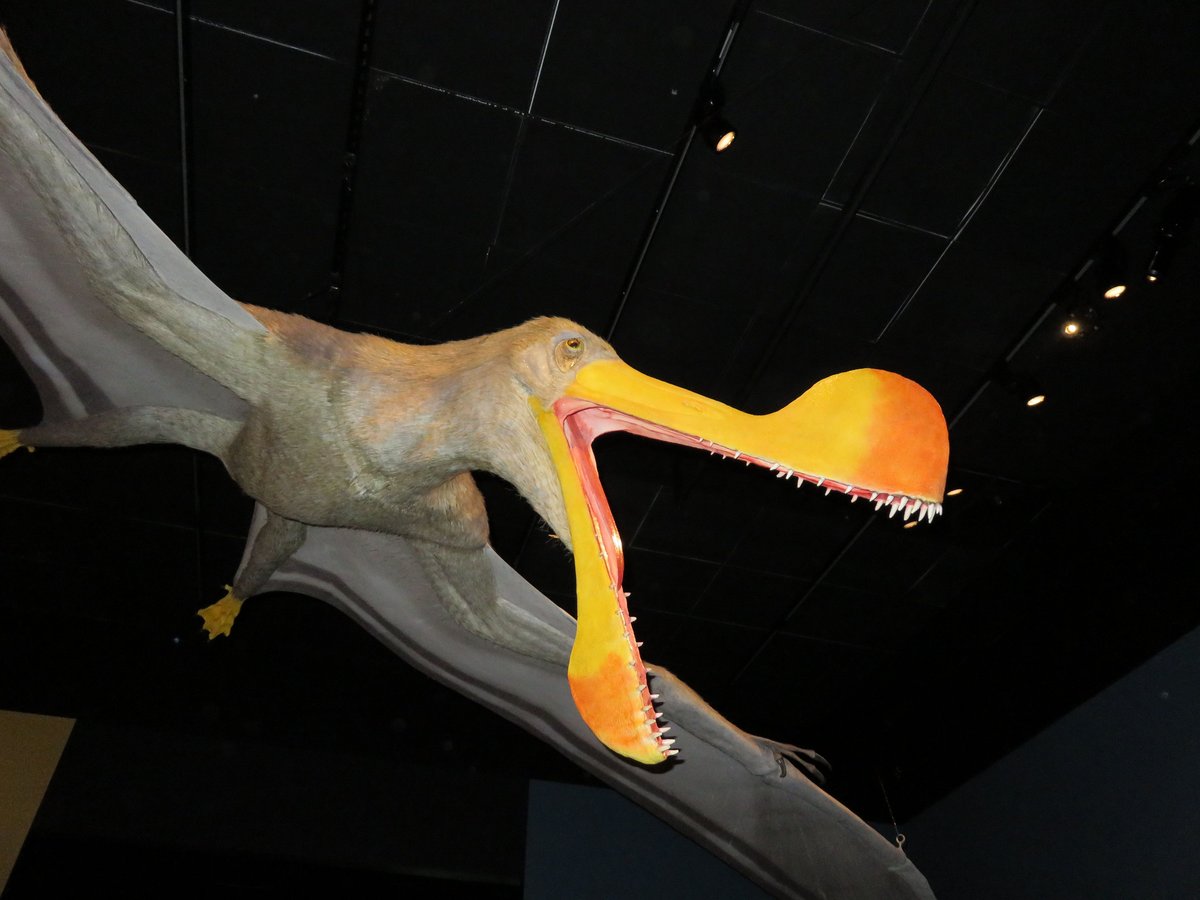
Tropeognathus mesembrinus was a large, formidable pterosaur that dominated the skies of the Early Cretaceous period, approximately 112 to 100 million years ago. Native to what is now the Araripe Basin in northeastern Brazil, this magnificent flying reptile is one of the most iconic and well-studied members of the Anhangueridae family. Its name, which translates to 'keel jaw from the south,' perfectly encapsulates its most striking anatomical feature: the prominent, rounded crests located at the tips of both its upper and lower jaws. As a key apex aerial predator of its time, Tropeognathus holds immense significance in the field of paleontology, providing crucial insights into the evolutionary adaptations, flight mechanics, and ecological roles of large-bodied ornithocheiroid pterosaurs during the Mesozoic era. The exceptional three-dimensional preservation of its fossils has allowed scientists to reconstruct its anatomy and paleobiology with a level of detail rarely achievable for fragile flying reptiles, making it a cornerstone taxon for understanding pterosaur diversity in the Southern Hemisphere. The physical description of Tropeognathus reveals an animal exquisitely adapted for a life on the wing and specialized feeding. While its body length was roughly 150 to 200 centimeters, its most awe-inspiring dimension was its wingspan, which is estimated to have reached up to 8.2 meters (nearly 27 feet) in the largest known individuals. This makes Tropeognathus one of the largest pterosaurs of the Early Cretaceous, rivaling the size of a small modern airplane. Despite its massive wingspan, its body was incredibly lightweight, with weight estimates generally ranging between 30 and 50 kilograms. This low mass was achieved through a highly pneumatized skeleton, where the bones were hollow, extremely thin-walled, and filled with air sacs connected to the respiratory system. The skull of Tropeognathus was elongated, robust, and equipped with the aforementioned sagittal crests on the premaxilla and mandibular symphysis. These keel-like structures were semi-circular and likely covered in a keratinous sheath in life, which may have extended their size even further. The jaws were lined with robust, conical teeth that interlocked when the mouth was closed, with the longest teeth positioned near the front of the snout, perfectly designed for grasping slippery prey. Soft tissue inferences, drawn from related taxa and the exceptional preservation of the Santana Group, suggest the body was covered in pycnofibers—hair-like filaments that provided insulation and indicate a warm-blooded metabolism. Compared to modern animals, Tropeognathus would have dwarfed the largest living flying bird, the wandering albatross, possessing a wingspan more than twice as wide and a skull alone that measured over a meter in length. The paleobiology of Tropeognathus paints a picture of a highly specialized, dynamic predator. Its dentition and jaw structure strongly indicate a piscivorous (fish-eating) diet. For decades, the prominent jaw crests led some paleontologists to hypothesize that Tropeognathus was a skim-feeder, flying low over the water and dragging its lower jaw through the surface to snatch fish, much like modern skimmers. However, recent biomechanical studies have largely debunked this idea, showing that the immense drag created by water resistance would have snapped the pterosaur's neck. Instead, it is now widely believed that Tropeognathus was a plunge-diver or surface-snatcher, using its keen eyesight to spot fish from above before swooping down to grab them with its interlocking teeth. The crests may have served a hydrodynamic function, stabilizing the jaws as they briefly entered the water, or they could have been used for display and species recognition. In terms of locomotion, Tropeognathus was a master of dynamic soaring. Its long, narrow wings were perfectly shaped for riding thermal currents and oceanic updrafts, allowing it to travel vast distances with minimal energy expenditure. On land, like other pterosaurs, it was a quadruped, walking on its hind legs and the folded wrists of its wings. Growth patterns inferred from bone histology suggest that Tropeognathus grew rapidly in its early years, reaching adult size relatively quickly, a trait consistent with an endothermic (warm-blooded) metabolism necessary to sustain active, powered flight. The ecological context of Tropeognathus is deeply tied to the unique environment of the Early Cretaceous Araripe Basin. During the Aptian and Albian stages, this region of Brazil was characterized by a massive, shallow inland sea or a series of interconnected coastal lagoons, created as the supercontinent Gondwana continued to rift apart, separating South America from Africa. The climate was warm, arid to semi-arid, and subject to periodic monsoonal rains. This nutrient-rich aquatic environment supported an explosive diversity of life. The waters teemed with a vast array of fish, including primitive bony fish, coelacanths, and early sharks, providing an abundant food source for Tropeognathus. The skies were crowded with other pterosaurs, making this one of the most diverse pterosaur communities known to science. Tropeognathus shared its airspace with related anhanguerids like Anhanguera and Cearadactylus, as well as the bizarre, large-crested tapejarids like Tapejara and Tupandactylus, which likely occupied different ecological niches, perhaps feeding on fruits or seeds. On the land surrounding these waters, dinosaurs roamed, including the spinosaurid Irritator and the theropod Santanaraptor. In this complex food web, Tropeognathus was an apex aerial predator, though juveniles and sick individuals may have fallen prey to large crocodilians, predatory dinosaurs, or even larger marine reptiles when resting on the water's surface. The discovery history of Tropeognathus is intertwined with the complex and often controversial world of commercial fossil collecting in Brazil. The genus was first described and named in 1987 by the eminent German paleontologist Peter Wellnhofer. The holotype specimen, designated BSP 1987 I 46, consists of a beautifully preserved, nearly complete skull and lower jaw. This specimen was acquired by the Bayerische Staatssammlung für Paläontologie und historische Geologie in Munich, Germany, having been purchased from commercial fossil dealers who excavated it from the Romualdo Formation of the Santana Group in the Araripe Basin. The circumstances of its discovery highlight a long-standing issue in Brazilian paleontology: many of the region's most spectacular fossils were historically collected by local miners and sold internationally, often without precise stratigraphic data. The name Tropeognathus mesembrinus was chosen by Wellnhofer to reflect the animal's distinctive anatomy and southern origins. Over the years, additional specimens have been discovered, including a massive, partially articulated skeleton described in 2013 by Alexander Kellner and colleagues. This specimen, MN 6594-V, housed at the Museu Nacional in Rio de Janeiro, represents the largest pterosaur ever found in Gondwana, confirming the immense size this genus could achieve and providing invaluable data on its postcranial skeleton. The evolutionary significance of Tropeognathus lies in its position within the complex family tree of the Pterodactyloidea. It belongs to the clade Ornithocheiroidea, a highly successful group of advanced pterosaurs that radiated globally during the Early to mid-Cretaceous. More specifically, it is a member of the Anhangueridae, a family characterized by their elongated snouts, specialized dentition for catching fish, and often, the presence of premaxillary and mandibular crests. Tropeognathus represents a peak in the evolutionary adaptation of pterosaurs to marine environments before the rise of the toothless Pteranodontidae and Azhdarchidae in the Late Cretaceous. Its anatomy demonstrates transitional features in the evolution of flight efficiency, showing highly derived wing structures optimized for oceanic soaring. The global distribution of related taxa, with close relatives found in Europe, Asia, and North America, underscores the incredible mobility of these animals and their ability to cross vast oceanic barriers. Studying Tropeognathus helps paleontologists map the biogeography of the Early Cretaceous world, illustrating how the opening of the South Atlantic Ocean influenced the evolution and dispersal of marine-adapted flying reptiles. Scientific debates surrounding Tropeognathus have been vigorous, particularly regarding its taxonomy and classification. For many years, there was intense disagreement over whether Tropeognathus was a valid genus or merely a species of the European genus Ornithocheirus or Coloborhynchus. Some researchers argued that the differences in crest shape and tooth arrangement were merely variations due to age, sex, or individual differences within a single, widely distributed genus. This led to a period where Tropeognathus mesembrinus was frequently referred to as Ornithocheirus mesembrinus or Coloborhynchus mesembrinus in scientific literature. However, more recent and comprehensive phylogenetic analyses have largely vindicated Wellnhofer's original assessment, reaffirming Tropeognathus as a distinct and valid genus based on unique features of its palate and crest morphology. Another ongoing debate involves the exact function of its massive crests. While the skim-feeding hypothesis has been largely discarded due to biomechanical constraints, researchers still debate whether the crests were primarily for hydrodynamic stabilization during plunge-diving, or if their primary role was in sexual dimorphism and visual display, similar to the casques of modern hornbills. The fossil record of Tropeognathus is geographically restricted to the Araripe Basin in northeastern Brazil, specifically within the Romualdo Formation, which dates to the Aptian-Albian stages of the Early Cretaceous. While the number of known specimens is relatively small—comprising a handful of skulls, partial skeletons, and isolated bones—the quality of preservation is nothing short of exceptional. The fossils are typically found encased in calcareous concretions (nodules). When these nodules are carefully prepared, often using acid baths to dissolve the surrounding rock, they reveal bones preserved in perfect three dimensions, uncrushed by the weight of overlying sediments. This 3D preservation is incredibly rare for pterosaurs, whose fragile, hollow bones are usually flattened into two-dimensional silhouettes in other fossil deposits worldwide. The Romualdo Formation is world-renowned for this taphonomic window, which has not only preserved the delicate osteology of Tropeognathus but has also, in related specimens, preserved traces of soft tissues, blood vessels, and even the internal structure of the inner ear, providing unparalleled data for biomechanical and neurological studies. The cultural impact of Tropeognathus is surprisingly vast, largely due to a case of mistaken identity in popular media. The animal achieved global fame when it was featured as the central protagonist in the acclaimed 1999 BBC documentary series 'Walking with Dinosaurs.' In the episode 'Giant of the Skies,' the massive pterosaur is referred to as 'Ornithocheirus.' However, the physical reconstruction, the distinctive keeled jaws, and the immense size depicted in the show were actually based directly on the fossils of Tropeognathus mesembrinus from Brazil. The documentary exaggerated its size slightly, giving it a 12-meter wingspan, but it successfully captured the public's imagination, introducing millions to the majesty of giant Cretaceous pterosaurs. Today, Tropeognathus remains a subject of public fascination and educational importance. Casts of its spectacular skull and skeletal reconstructions are displayed in major museums around the world, including the Bayerische Staatssammlung in Munich and the Museu Nacional in Brazil. It serves as a powerful ambassador for paleontology, illustrating the bizarre and magnificent forms life can take, and highlighting the importance of protecting the rich fossil heritage of South America.
Classification
Time Period
Discovery
Location
Brazil
Formation
Romualdo Formation
Frequently Asked Questions
What is Tropeognathus?
Tropeognathus mesembrinus was a large, formidable pterosaur that dominated the skies of the Early Cretaceous period, approximately 112 to 100 million years ago. Native to what is now the Araripe Basin in northeastern Brazil, this magnificent flying reptile is one of the most iconic and well-studied ...
When did Tropeognathus live?
Tropeognathus lived during the cretaceous period of the mesozoic era approximately 112-100 million years ago.
Where was Tropeognathus discovered?
Fossils of Tropeognathus were discovered in Brazil in the Romualdo Formation.
What did Tropeognathus eat?
Tropeognathus was a carnivore. It lived in aerial habitats.
What type of fossil is Tropeognathus?
Tropeognathus is preserved as a body fossil. The preservation quality is excellent.
Related Specimens
From the mesozoic era · body fossils