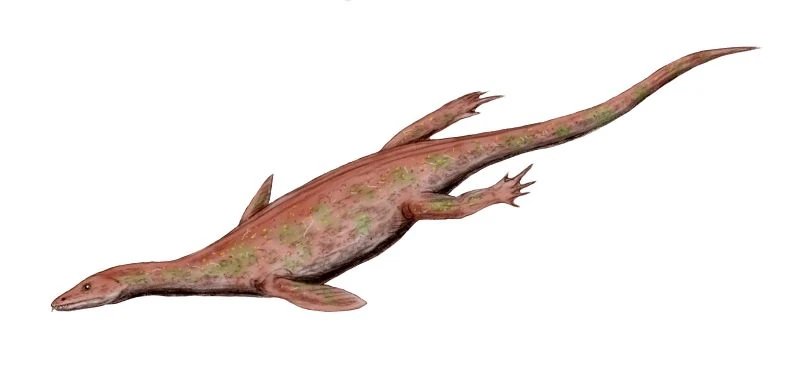
Lariosaurus
Lariosaurus balsami
Image: Image sourced via web search (Fair use / Educational)
About Lariosaurus
Lariosaurus was a genus of nothosaur, a group of semi-aquatic marine reptiles that thrived during the Middle Triassic period, approximately 245 to 235 million years ago. Its exquisitely preserved fossils, primarily from the ancient Tethys Sea deposits of Europe, offer a crucial window into the early diversification of marine reptiles following the Permian-Triassic extinction event. As a small to medium-sized predator, Lariosaurus is significant for understanding the anatomy, lifestyle, and evolutionary relationships of the nothosaurs, which are considered close relatives of the later, more fully aquatic plesiosaurs.
Lariosaurus was a relatively small marine reptile, with most adult specimens of the type species, Lariosaurus balsami, measuring between 60 and 130 centimeters (approximately 2 to 4.3 feet) in total length. Its body plan was characteristic of nothosaurs: a long, flexible neck and tail, a streamlined torso, and four paddle-like limbs. The skull was elongated and flattened, with a long snout filled with numerous sharp, conical, outward-pointing teeth, an adaptation for capturing slippery prey like fish and cephalopods. The nostrils were positioned high on the snout, allowing it to breathe while mostly submerged. A key distinctive feature of Lariosaurus, particularly in some species, was its pachyostotic (thickened and dense) ribs, which would have acted as ballast, helping the animal control its buoyancy and remain submerged. The limbs were not fully transformed into flippers like those of later plesiosaurs; they retained distinct digits, suggesting they were still functional for movement on land, perhaps for basking or nesting, similar to modern seals. The front limbs were typically more robust and paddle-like than the hind limbs, which were smaller and more webbed-foot-like, indicating the forelimbs were the primary source of propulsion in water.
As a carnivore, the paleobiology of Lariosaurus was centered around hunting in the shallow coastal waters of the Tethys Sea. Its dentition, with interlocking needle-like teeth, was perfectly suited for piscivory, enabling it to snatch small fish, squid-like belemnites, and possibly crustaceans from the water column. The long, flexible neck would have allowed it to strike quickly at prey from a distance, similar to a modern cormorant or snake-necked turtle. Locomotion was likely achieved through a combination of limb paddling and lateral undulation of its long body and tail. The more powerful front limbs probably provided the main propulsive thrust, while the hind limbs and tail assisted in steering and stabilization. Evidence from bone histology suggests Lariosaurus had a relatively fast growth rate for a reptile, reaching sexual maturity within a few years. One of the most remarkable fossils of Lariosaurus provides direct evidence of its reproductive strategy: a specimen of L. valceresii was found containing a developing embryo, indicating that at least some species of Lariosaurus were viviparous, giving birth to live young in the water. This adaptation would have freed them from the need to return to land to lay eggs, a significant step towards a fully marine lifestyle.
Lariosaurus lived in the warm, shallow subtropical seas that formed the western Tethys Ocean during the Anisian and Ladinian stages of the Middle Triassic. This marine environment was part of a vast carbonate platform system, dotted with deeper basins and volcanic islands, located in what is now modern-day Europe, particularly Italy, Switzerland, Spain, and Germany. The climate was generally hot and arid. The ecosystem was rich and diverse, representing a period of significant evolutionary recovery and radiation after the end-Permian mass extinction. Lariosaurus shared its habitat with a wide array of other marine life. It was a mid-level predator in the food web, preying on abundant fish such as Saurichthys and Peltopleurus. However, it was also prey for larger marine reptiles. Its contemporaries included other nothosaurs like Nothosaurus and Ceresiosaurus, the bizarre, long-necked protorosaur Tanystropheus, and early ichthyosaurs like Mixosaurus. The apex predators of this environment were likely large ichthyosaurs such as Cymbospondylus or massive placodonts like Cyamodus, which specialized in crushing shellfish. The presence of such a diverse fauna highlights the complex ecological structure of these Triassic marine ecosystems where Lariosaurus successfully carved out its niche.
The discovery history of Lariosaurus dates back to the early 19th century, making it one of the first nothosaurs to be scientifically described. The type species, Lariosaurus balsami, was named by the Italian naturalist Giuseppe Balsamo-Crivelli in 1839. The fossils were discovered in the black shales near Perledo, on the shores of Lake Como (anciently known as Lacus Larius, from which the genus name is derived) in Lombardy, Italy. These initial discoveries were part of a wave of paleontological exploration in Europe during that period. The holotype specimen, now housed at the Natural History Museum of Milan, was a well-preserved, articulated skeleton that clearly established its reptilian and aquatic nature. Over the subsequent decades, numerous additional specimens have been unearthed from the famous UNESCO World Heritage site of Monte San Giorgio, a fossil-rich area on the border of Italy and Switzerland. These exceptionally preserved fossils, from formations like the Grenzbitumenzone and Meride Limestone, have provided paleontologists with a wealth of anatomical information. Key specimens, such as the gravid female discovered in the 1990s, have been instrumental in reshaping our understanding of nothosaur reproductive biology and their transition to a marine existence.
Lariosaurus holds a crucial position in the evolutionary history of marine reptiles. It belongs to the Nothosauroidea, a suborder within the larger clade Sauropterygia. The sauropterygians represent one of the most successful and long-lived radiations of marine reptiles, and nothosaurs like Lariosaurus are considered to be the ancestral stock from which the more famous and fully aquatic plesiosaurs (including long-necked plesiosaurs and short-necked pliosaurs) evolved. Lariosaurus exhibits many of the transitional features expected in such an ancestor. Its limbs, for example, are intermediate between the terrestrial legs of its land-dwelling ancestors and the hydrofoil-like flippers of the Jurassic plesiosaurs. Similarly, its reliance on both limb-based paddling and body undulation for swimming represents a less specialized form of locomotion. The discovery of viviparity in Lariosaurus provides a key piece of evidence for how this lineage severed its ties to the land for reproduction, a critical step that enabled the subsequent global success and diversification of the plesiosaurs in the Mesozoic oceans. It serves as a textbook example of stepwise adaptation to a new environment, illustrating how a group of terrestrial reptiles gradually conquered the marine realm.
Despite being known for over 180 years, Lariosaurus is still the subject of scientific debate, primarily concerning its taxonomy and the number of valid species within the genus. Over the years, several species have been named based on fossils from Italy, Switzerland, Spain, and even China, but the validity of some of these is contested. For instance, some researchers have argued that species like L. valceresii or L. buzzii may represent different growth stages or sexual dimorphs of L. balsami rather than distinct species. The classification of the family Lariosauridae itself has been a point of discussion, with some paleontologists considering it a distinct family while others lump it within the broader Nothosauridae. Recent discoveries of nothosaur-like reptiles in China have complicated the picture, suggesting a more complex and geographically widespread evolutionary history for the group than previously thought. These ongoing studies and re-evaluations of existing fossil material continue to refine our understanding of nothosaur diversity and their evolutionary relationships.
The fossil record of Lariosaurus is concentrated in the Middle Triassic marine deposits of Europe. The most significant and best-preserved fossils come from the Monte San Giorgio locality on the Swiss-Italian border. The unique depositional environment of this ancient basin—an anoxic (oxygen-poor) seafloor—led to the exceptional preservation of articulated skeletons, often with soft tissue impressions like skin outlines and even stomach contents. Dozens of specimens are known, ranging from juveniles to adults, making it one of the better-represented nothosaurs in the fossil record. Important finds have also been made in the Muschelkalk deposits of Germany and Spain. The quality of these fossils is often excellent, allowing for detailed anatomical studies of the skull, limbs, and vertebral column. The completeness of these skeletons, particularly from Monte San Giorgio, has been vital for reconstructing the paleobiology and evolutionary placement of Lariosaurus and its relatives.
Lariosaurus is not a household name like Tyrannosaurus or Triceratops, but it holds a significant place in paleontological circles and museum collections. Its fossils, particularly the beautifully articulated skeletons from Monte San Giorgio, are prized exhibits in natural history museums across Europe, including the Civic Museum of Natural History in Milan and the Paleontological Museum of Zurich. The creature is sometimes featured in documentaries and books about the Triassic period or the evolution of marine reptiles, where it serves as a key example of a transitional form. Its local significance is celebrated in the region around Lake Como, Italy, where its name is a point of regional pride, linking the area's natural history to its ancient Roman name.
Classification
Time Period
Discovery
Location
Northern Italy
Formation
Grenzbitumenzone (Besano Formation) and Meride Limestone
Frequently Asked Questions
What is Lariosaurus?
Lariosaurus was a genus of nothosaur, a group of semi-aquatic marine reptiles that thrived during the Middle Triassic period, approximately 245 to 235 million years ago. Its exquisitely preserved fossils, primarily from the ancient Tethys Sea deposits of Europe, offer a crucial window into the early...
When did Lariosaurus live?
Lariosaurus lived during the triassic period of the mesozoic era approximately 245-235 million years ago.
Where was Lariosaurus discovered?
Fossils of Lariosaurus were discovered in Northern Italy in the Grenzbitumenzone (Besano Formation) and Meride Limestone.
What did Lariosaurus eat?
Lariosaurus was a carnivore. It lived in marine habitats.
What type of fossil is Lariosaurus?
Lariosaurus is preserved as a body fossil. The preservation quality is excellent.
Related Specimens
From the mesozoic era · body fossils