Dsungaripterus
Dsungaripterus weii
Image: Image sourced via web search (Fair use / Educational)
About Dsungaripterus
Dsungaripterus was a highly specialized genus of pterosaur that lived during the Early Cretaceous period, approximately 130 to 120 million years ago, in what is now the Xinjiang region of northwestern China. As a member of the suborder Pterodactyloidea, this remarkable flying reptile represents one of the most unique and ecologically specialized branches of the pterosaur family tree. Dsungaripterus is primarily celebrated in the paleontological community for its bizarre, highly adapted cranial anatomy, which provides some of the clearest evidence of durophagy—the eating of hard-shelled organisms—ever found in a flying reptile. Its discovery in the mid-twentieth century vastly expanded our understanding of pterosaur ecological diversity, proving that these Mesozoic aviators were not merely generalized fish-eaters or insectivores, but were capable of evolving highly specific morphological adaptations to exploit niche food sources in their environments. The organism stands as a testament to the evolutionary plasticity of the pterosaurian body plan during the Early Cretaceous, a time when flying reptiles were reaching new peaks of anatomical experimentation before the eventual dominance of birds in smaller aerial niches.
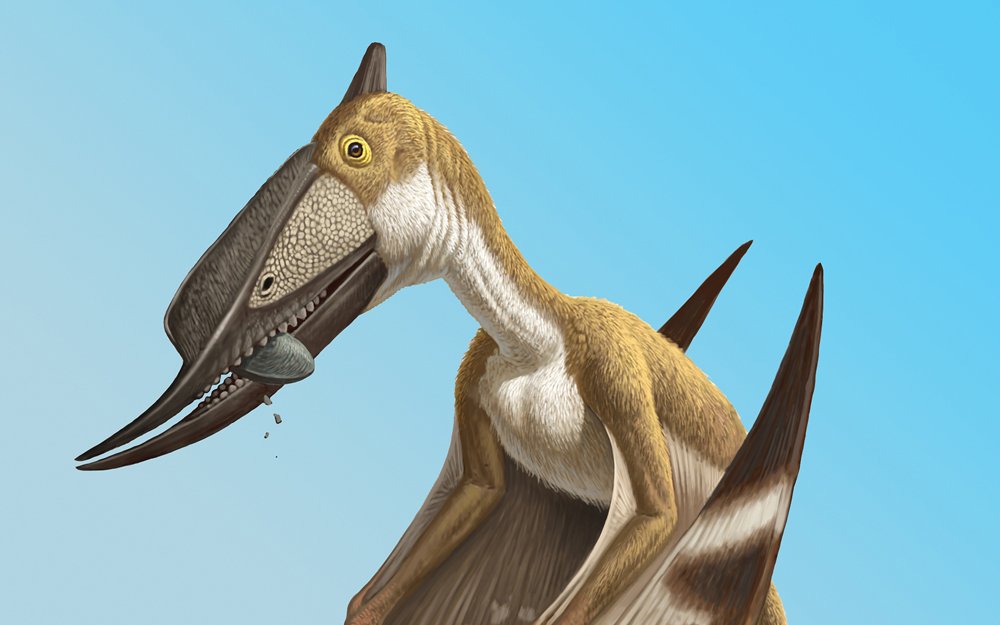
The physical description of Dsungaripterus reveals an animal that was both robust and bizarrely proportioned compared to its more delicate relatives. It possessed an estimated wingspan of approximately 3 meters (about 10 feet), making it a medium-to-large pterosaur, roughly comparable in wingspan to a modern wandering albatross, though significantly heavier and more heavily built. Unlike the paper-thin, highly pneumatized bones typical of most pterosaurs, the skeletal elements of Dsungaripterus featured unusually thick bone walls. This robust osteology suggests a heavier overall body mass, potentially weighing between 10 and 15 kilograms, which is quite substantial for a flying animal of its dimensions. The most striking feature of Dsungaripterus, however, was its skull. The snout was long, narrow, and curved distinctly upward at the tip, forming a toothless, tweezer-like beak. Behind this toothless premaxillary region, the jaws were lined with flat, bulbous, peg-like teeth that were deeply anchored into robust jawbones. Furthermore, the skull was adorned with a low, bony crest that ran along the midline of the snout, beginning just behind the nasal opening and extending backward toward the eyes. Another smaller crest projected from the back of the skull. Soft tissue inferences, drawn from related crested pterosaurs, suggest these bony structures may have been extended by keratinous sheaths or colorful soft tissues used for intraspecific display, species recognition, or sexual dimorphism. The postcranial skeleton was equally robust, with strong forelimbs and hindlimbs that indicate it was a highly capable quadrupedal walker when on the ground.
The paleobiology of Dsungaripterus is intimately tied to its extraordinary cranial anatomy, which points definitively to a durophagous diet. Paleontologists theorize that Dsungaripterus utilized a highly specialized feeding strategy: it likely used its pointed, upward-curving, toothless beak to probe into mud, sand, or shallow water to pry up hard-shelled prey such as bivalves, snails, crabs, and other crustaceans. Once the prey was extracted from the substrate, it would be moved to the back of the jaws, where the flat, bulbous teeth and powerful jaw muscles acted like a nutcracker to crush the shells, allowing the pterosaur to consume the soft tissues within. This feeding mechanism is remarkably similar to that of modern oystercatchers, albeit scaled up and utilizing teeth rather than a purely keratinous bill. Locomotion in Dsungaripterus is also a subject of great interest. The unusually thick walls of its limb bones suggest that it spent a significant amount of time foraging on the ground. Trackways attributed to similar pterosaurs indicate that they were adept quadrupedal walkers, utilizing a plantigrade stance on their hind feet while supporting their front weight on specialized digits of their folded wings. While its heavy build might suggest a more labored takeoff compared to lighter pterosaurs, its robust wing bones indicate it was still a powerful and capable flyer, likely utilizing strong bursts of powered flight to travel between foraging grounds or to escape predators. Growth patterns inferred from bone histology suggest a rapid initial growth phase followed by a slowing down as the animal reached somatic maturity, a trait common among advanced pterodactyloids.
The ecological context of Dsungaripterus places it in the Junggar Basin of northwestern China during the Early Cretaceous, a region characterized by a vast system of inland freshwater lakes, meandering rivers, and expansive floodplains. The climate during this time is thought to have been semi-arid to temperate, with distinct seasonal variations in rainfall that would have caused the water levels of the lakes and rivers to fluctuate, exposing expansive muddy shorelines ideal for a probing, durophagous predator. Dsungaripterus shared this dynamic environment with a diverse array of Mesozoic fauna. The waters were teeming with fish, turtles, and early crocodiliforms, as well as the abundant bivalves and crustaceans that formed the base of the pterosaur's diet. On land, the ecosystem supported various dinosaurs, including the stegosaur Wuerhosaurus, the large carcharodontosaurid theropod Kelmayisaurus, and various early ceratopsians and ornithopods. In this food web, Dsungaripterus occupied a specialized mid-level predatory niche. While it was an apex predator of the shoreline invertebrates, it would have been vulnerable to predation by large theropods or aquatic ambush predators when foraging on the ground or wading in the shallows. The presence of Dsungaripterus in an inland freshwater environment also highlights the adaptability of pterosaurs, proving that they were not restricted to marine coastlines but were highly successful in continental freshwater ecosystems as well.
The discovery history of Dsungaripterus is a landmark in Asian paleontology. The first fossils were discovered in the Junggar Basin of the Xinjiang Uyghur Autonomous Region in northwestern China during paleontological expeditions in the early 1960s. The genus and type species, Dsungaripterus weii, were formally described and named in 1964 by the eminent Chinese paleontologist Yang Zhongjian, who is widely known in Western literature as C.C. Young. The generic name translates to "Junggar wing," referencing the basin where it was found, while the specific epithet honors C.M. Wei, a paleontologist who contributed significantly to the expeditions and the discovery of the fossils. The holotype specimen, designated IVPP V-277, consists of a partial skull and lower jaws, which immediately captivated the scientific community due to its bizarre morphology. Subsequent expeditions to the Tugulu Group formations in the Junggar Basin have yielded numerous additional specimens, including nearly complete skulls, articulated postcranial skeletons, and isolated bones from individuals of various ontogenetic stages. These discoveries have made Dsungaripterus one of the best-represented and most thoroughly understood pterosaurs from Asia. The abundance of material has allowed researchers to reconstruct its anatomy with a high degree of confidence and has provided a crucial baseline for identifying and understanding related durophagous pterosaurs discovered later in other parts of the world.
In terms of evolutionary significance, Dsungaripterus occupies a pivotal position within the Pterosauria. It is the eponymous type genus of the family Dsungaripteridae, a specialized clade of pterodactyloids that radiated during the Late Jurassic and Early Cretaceous. The discovery of Dsungaripterus demonstrated that pterosaurs were capable of evolving extreme morphological specializations to exploit specific ecological niches, challenging the earlier view of pterosaurs as a relatively homogenous group of fish-eaters. Phylogenetically, the Dsungaripteridae are placed within the larger clade Azhdarchoidea, which also includes the tapejarids and the massive azhdarchids that would come to dominate the Late Cretaceous skies. Dsungaripterus exhibits several transitional features that bridge the gap between earlier, more basal pterodactyloids and these later, highly derived forms. For instance, the reduction of teeth in the front of the jaw and the development of a prominent nasoantorbital fenestra (a large opening in the side of the skull) are trends that are taken to the extreme in later toothless azhdarchoids. By studying Dsungaripterus, paleontologists gain valuable insights into the evolutionary pressures that drove the diversification of pterosaur skull morphologies and feeding strategies, illustrating a classic example of adaptive radiation in the Mesozoic skies.
Scientific debates surrounding Dsungaripterus have primarily focused on the biomechanical implications of its unique anatomy. One major area of contention has been its flight capabilities. The unusually thick walls of its long bones represent a significant departure from the extreme skeletal pneumaticity seen in most pterosaurs. Some researchers have argued that this increased bone mass would have made flight highly energetically demanding, suggesting that Dsungaripterus may have been a reluctant flyer that spent the vast majority of its time foraging on the ground. Others counter that the robust skeleton was a necessary adaptation to withstand the biomechanical stresses of its terrestrial foraging style and that its large wing area would have easily compensated for the increased weight, allowing for strong, powered flight. Another debate centers on the exact nature of its diet. While durophagy is universally accepted, some scientists question whether it fed exclusively on aquatic invertebrates. It has been proposed that Dsungaripterus might have also consumed hard-shelled terrestrial insects, or even scavenged carcasses, using its powerful jaws to crack open bones to access marrow, much like a modern bearded vulture. These debates continue to stimulate biomechanical modeling and isotopic analyses of Dsungaripterid fossils.
The fossil record of Dsungaripterus is exceptionally rich compared to many other pterosaur genera, which are often known only from fragmentary remains. The fossils are primarily recovered from the lower beds of the Tugulu Group in the Junggar Basin of Xinjiang, China. Dozens of specimens have been collected over the decades, ranging from isolated teeth and limb bones to nearly complete, articulated skeletons. The preservation quality of these fossils is generally good to excellent. Crucially, unlike the flattened, two-dimensional pterosaur fossils famously found in the Solnhofen limestone of Germany or the Yixian Formation of China, many Dsungaripterus fossils are preserved in three dimensions within sandstone and mudstone concretions. This three-dimensional preservation has been invaluable, allowing paleontologists to accurately reconstruct the complex spatial relationships of the skull bones, the exact shape of the crushing teeth, and the biomechanical properties of the limb joints. The abundance of fossils representing different size classes has also provided rare insights into the ontogeny (growth and development) of pterosaurs, revealing how the skull crests and specialized dentition developed as the animals matured from juveniles to adults.
The cultural impact of Dsungaripterus, while perhaps not as ubiquitous as that of Pteranodon or Quetzalcoatlus, is significant among dinosaur enthusiasts and within educational contexts. Its bizarre, unmistakable skull makes it a popular subject for paleoart, where it is frequently depicted probing the mudflats of Early Cretaceous lakeshores. It has appeared in various dinosaur encyclopedias, children's books, and documentary series highlighting the diversity of Mesozoic life. Notable museum displays featuring reconstructed skeletons and life-sized models of Dsungaripterus can be found in major institutions in China, such as the Paleozoological Museum of China in Beijing, as well as in traveling exhibitions worldwide. For the public, Dsungaripterus serves as a fascinating example of evolutionary extreme, demonstrating that the prehistoric world was filled with highly specialized and bizarre creatures that challenge our modern expectations of animal morphology.
Classification
Time Period
Discovery
Location
China
Formation
Tugulu Group
Frequently Asked Questions
What is Dsungaripterus?
Dsungaripterus was a highly specialized genus of pterosaur that lived during the Early Cretaceous period, approximately 130 to 120 million years ago, in what is now the Xinjiang region of northwestern China. As a member of the suborder Pterodactyloidea, this remarkable flying reptile represents one ...
When did Dsungaripterus live?
Dsungaripterus lived during the cretaceous period of the mesozoic era approximately 130-120 million years ago.
Where was Dsungaripterus discovered?
Fossils of Dsungaripterus were discovered in China in the Tugulu Group.
What did Dsungaripterus eat?
Dsungaripterus was a carnivore. It lived in aerial habitats.
What type of fossil is Dsungaripterus?
Dsungaripterus is preserved as a body fossil. The preservation quality is good.
Related Specimens
From the mesozoic era · body fossils
/12d285016704.png)