Turrilites
Turrilites costatus
Image: Image sourced via web search (Fair use / Educational)
About Turrilites
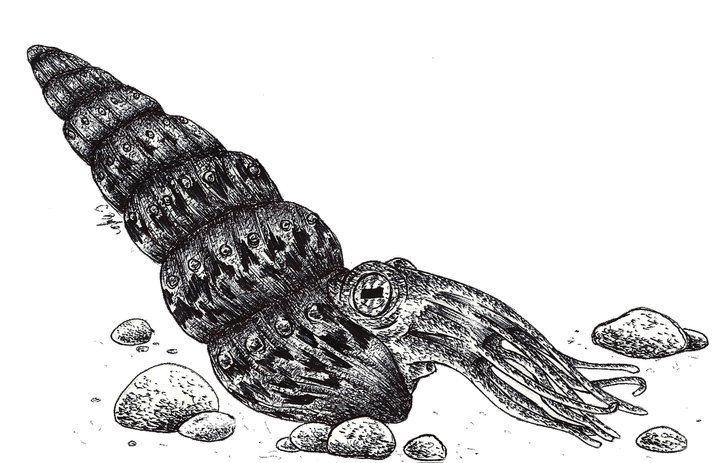
Turrilites costatus is a highly distinctive species of heteromorph ammonite that thrived during the Cenomanian stage of the Late Cretaceous period, approximately 100 to 94 million years ago. Unlike the familiar tightly coiled, planar shells of typical ammonites, Turrilites possessed a spectacular, helically coiled shell that closely resembled the shape of a modern marine gastropod or sea snail. This fascinating cephalopod was widely distributed across the shallow, warm epicontinental seas that covered much of Europe, North America, and parts of Africa during the mid-Cretaceous greenhouse climate. As an index fossil, Turrilites costatus holds immense significance in the field of paleontology and biostratigraphy, allowing geologists to precisely date and correlate marine sedimentary rocks across vast geographic distances. Its unique morphology also provides crucial insights into the evolutionary experimentation and ecological diversification of ammonoids shortly before their ultimate extinction at the end of the Mesozoic era. The physical anatomy of Turrilites costatus is immediately recognizable due to its striking, turreted shell structure. The shell is coiled in a high, three-dimensional helix, typically reaching lengths of 10 to 20 centimeters, although some exceptional specimens may have grown slightly larger. The whorls of the shell are tightly in contact with one another, forming a robust, conical spire. The surface of the shell is heavily ornamented with prominent, vertical ribs and distinct rows of rounded tubercles or nodes, which likely served both as structural reinforcement against the crushing pressure of deep water and as a deterrent against shell-crushing predators. The name 'costatus' specifically refers to these strong, rib-like features. Internally, the shell was divided into a series of complex chambers separated by intricately folded walls known as septa. The living animal occupied only the largest, final chamber at the wide end of the cone, while the empty upper chambers were connected by a thin tube called the siphuncle, which the animal used to regulate gas and fluid levels for buoyancy control. Although the soft tissues of Turrilites have never been preserved, paleontologists infer that it possessed a squid-like body with a distinct head, large, well-developed eyes for spotting prey and predators, and a ring of prehensile tentacles surrounding a sharp, parrot-like chitinous beak used for tearing flesh. In terms of paleobiology, Turrilites costatus presents a fascinating biomechanical puzzle. Because of its asymmetrical, helical shell, the animal's center of mass and center of buoyancy were offset. Hydrodynamic modeling suggests that Turrilites likely floated in the water column with its shell oriented vertically, the narrow apex pointing upward and the heavier body chamber and tentacles hanging downward. This orientation would have made rapid, horizontal swimming highly inefficient, suggesting that Turrilites was not an active, fast-moving pursuit predator. Instead, it is widely believed to have been a slow-moving or drifting pelagic organism, utilizing vertical migration within the water column to follow the daily movements of zooplankton. Its diet likely consisted of small crustaceans, larval fish, and other diminutive planktonic organisms, which it would have captured using its tentacles as it drifted through the rich, sunlit upper layers of the Cretaceous oceans. The complex septal walls may have allowed it to withstand significant hydrostatic pressure, enabling it to retreat to deeper, darker waters during the day to avoid visual predators, before rising to the surface at night to feed. The ecological context of the Cenomanian stage was one of the most dynamic periods in Earth's history. Global temperatures were exceptionally high, and there were no permanent polar ice caps. Consequently, global sea levels were at some of their highest points in geological history, flooding vast continental areas and creating expansive, shallow epicontinental seas. These warm, nutrient-rich waters were highly productive, supporting complex and diverse marine ecosystems. Turrilites costatus inhabited these vibrant marine environments alongside a plethora of other organisms. The sea floor was carpeted with bivalves, brachiopods, and echinoderms, while the water column teemed with diverse schools of bony fishes, sharks, and other ammonite species. The apex predators of these Cretaceous seas were formidable marine reptiles, including early mosasaurs, large plesiosaurs, and fast-swimming ichthyosaurs, many of which would have readily preyed upon slow-moving cephalopods like Turrilites. To survive in this dangerous environment, Turrilites relied on its heavily armored, spiky shell and its ability to vertically migrate out of the primary hunting zones of these visual predators. The discovery and taxonomic history of Turrilites costatus dates back to the early days of modern paleontology. The genus Turrilites was first formally described by the pioneering French naturalist Jean-Baptiste Lamarck in 1801, during a period of intense scientific exploration and cataloging of the natural world. Lamarck recognized the unique, snail-like coiling of these fossils but correctly identified their internal chambered structure as belonging to cephalopods rather than gastropods. The specific epithet 'costatus' was later applied to distinguish this heavily ribbed form from other members of the genus. Historically, the most abundant and beautifully preserved specimens of Turrilites costatus have been recovered from the Chalk Group formations of England and France, particularly in regions like Sussex, Kent, and the Normandy coast. These areas were the focal points of 19th-century geological mapping, and Turrilites quickly became a vital tool for the early stratigraphers who were attempting to correlate the chalk layers across the English Channel. The evolutionary significance of Turrilites costatus is profound, as it exemplifies the remarkable phenomenon of heteromorphy in ammonites. For hundreds of millions of years, the vast majority of ammonoids maintained a tightly coiled, planispiral shell shape, which was highly efficient for active swimming. However, during the Late Jurassic and particularly in the Cretaceous, various lineages of ammonites began to 'uncoil' and experiment with bizarre, asymmetrical, and open shell shapes. Turrilites represents one of the most successful of these evolutionary experiments. The transition from a flat coil to a three-dimensional helix required significant developmental and genetic changes, likely driven by a shift in ecological niche from active nektonic swimming to passive pelagic drifting. Studying Turrilites helps evolutionary biologists understand how major morphological innovations arise and how organisms adapt to exploit new environmental opportunities. Furthermore, the widespread success of the Turrilitidae family demonstrates that these seemingly 'bizarre' shapes were not evolutionary dead ends or signs of a declining lineage, as early paleontologists mistakenly believed, but rather highly successful adaptations to specific mid-Cretaceous marine environments. Despite centuries of study, Turrilites costatus remains the subject of ongoing scientific debates and investigations. The most prominent controversy revolves around its exact life orientation and mode of life. While the consensus strongly favors a vertical, head-down orientation in the water column, some researchers have proposed alternative models. A minority view suggests that Turrilites might have been a benthic, bottom-dwelling organism, dragging its shell along the sea floor like a modern hermit crab or heavy gastropod. However, the lack of significant wear or abrasion on the lower portions of most fossil shells strongly argues against a benthic lifestyle. Additionally, the exact function of the complex, frilled septal walls in heteromorphs continues to be debated. While pressure resistance is the traditional explanation, some modern paleontologists argue that the complex folding was an adaptation to increase the surface area for mantle tissue attachment, thereby improving the efficiency of liquid removal from the chambers during buoyancy regulation. The fossil record of Turrilites costatus is exceptionally rich and globally distributed, making it a textbook example of an index fossil. Specimens have been unearthed in marine sedimentary deposits across Europe, North America, South America, Asia, and Africa. They are most commonly found in chalks, marls, and fine-grained limestones, which represent the quiet, offshore marine environments where these animals lived and died. Preservation quality is generally very good, with the robust calcium carbonate shells often surviving the fossilization process intact. In many chalk deposits, the original aragonite shell material has been dissolved away, leaving behind perfect internal molds (steinkerns) that beautifully display the intricate, fern-like suture patterns where the septal walls met the outer shell. Famous fossil sites yielding Turrilites include the Grey Chalk Subgroup of the United Kingdom and the Cenomanian stratotypes in the Paris Basin. The cultural impact of Turrilites costatus, while perhaps more subtle than that of giant dinosaurs, is nonetheless significant within the realm of earth sciences and natural history education. Its striking, unusual shape makes it a popular and visually appealing display specimen in natural history museums worldwide, from the Natural History Museum in London to the Smithsonian Institution in Washington, D.C. For educators, Turrilites serves as a perfect tangible example to explain complex scientific concepts such as biostratigraphy, evolutionary adaptation, and the dynamic nature of prehistoric marine ecosystems. It challenges the public's preconceived notions of what an ammonite 'should' look like, sparking curiosity about the boundless creativity of evolutionary processes. Furthermore, for amateur fossil hunters and rockhounds exploring the Cretaceous chalk cliffs of Europe, finding a well-preserved Turrilites shell remains a highly prized and thrilling discovery, connecting modern individuals directly to the deep, ancient history of our planet's oceans.
Classification
Time Period
Discovery
Location
France and England
Formation
Chalk Group
Frequently Asked Questions
What is Turrilites?
Turrilites costatus is a highly distinctive species of heteromorph ammonite that thrived during the Cenomanian stage of the Late Cretaceous period, approximately 100 to 94 million years ago. Unlike the familiar tightly coiled, planar shells of typical ammonites, Turrilites possessed a spectacular, h...
When did Turrilites live?
Turrilites lived during the cretaceous period of the mesozoic era approximately 100-94 million years ago.
Where was Turrilites discovered?
Fossils of Turrilites were discovered in France and England in the Chalk Group.
What did Turrilites eat?
Turrilites was a carnivore. It lived in marine habitats.
What type of fossil is Turrilites?
Turrilites is preserved as a body fossil. The preservation quality is good.
Related Specimens
From the mesozoic era · body fossils