Ichthyostega
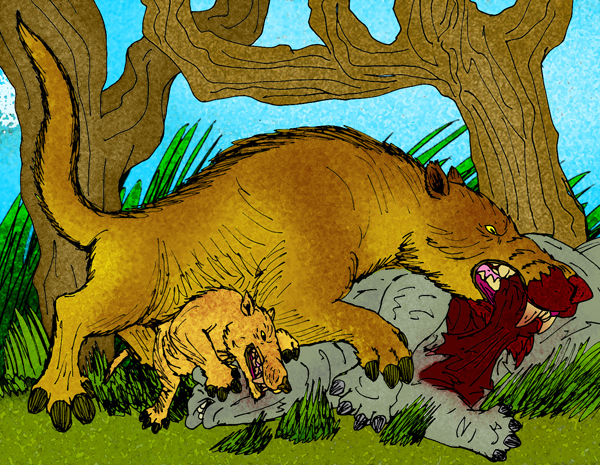
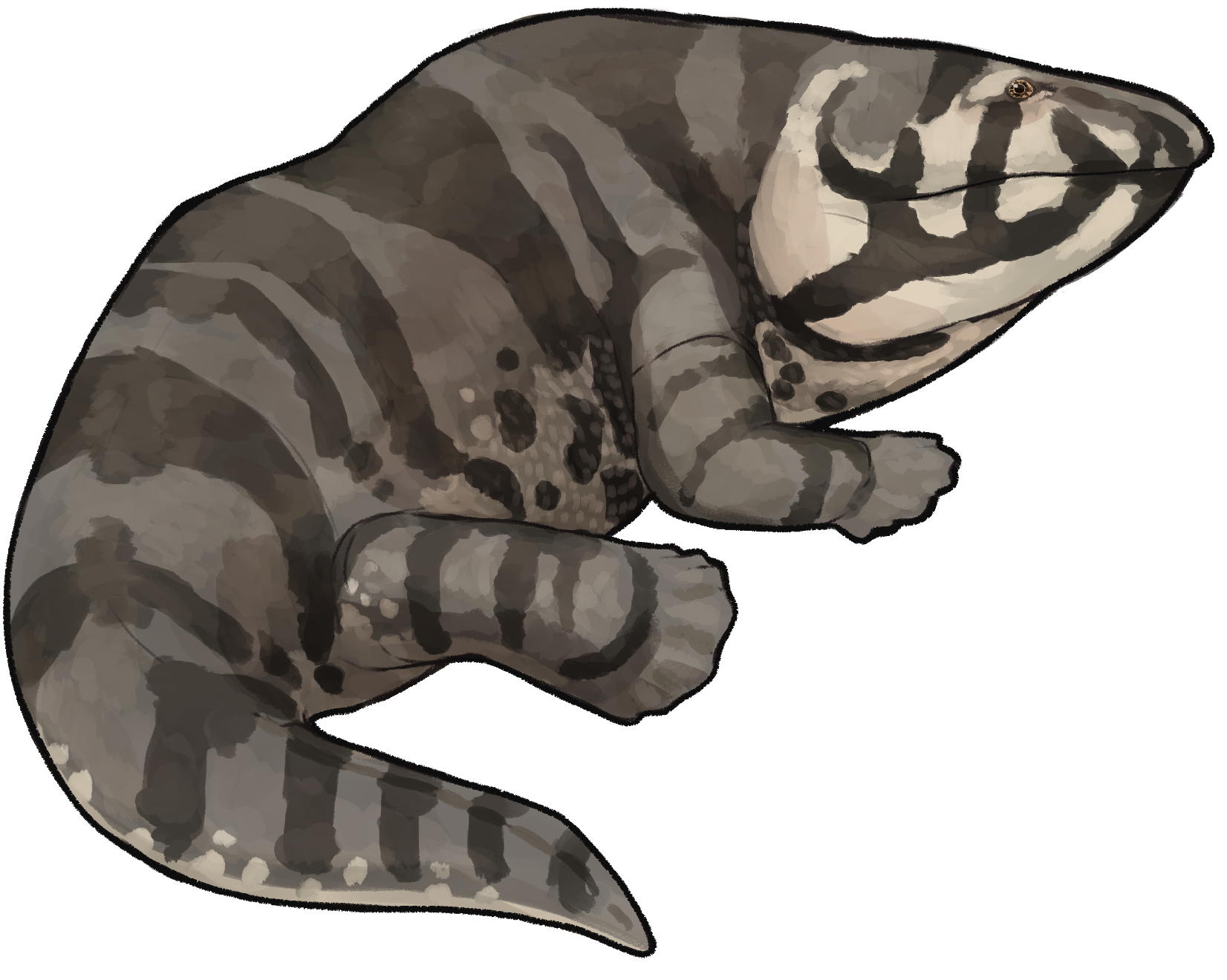
Ichthyostega stensioei
Image: File:Ichthyostega stensioei.png - Wikimedia Commons (CC BY-SA)
About Ichthyostega
Ichthyostega is a pivotal genus of early tetrapod that lived during the Late Devonian period, specifically the Famennian age approximately 372 to 365 million years ago, in what is now East Greenland. As one of the earliest known vertebrates to possess well-developed limbs with digits, it represents a critical evolutionary milestone in the profound transition from fully aquatic lobe-finned fishes to terrestrial amphibians. Its discovery in the Aina Dal Formation provided the scientific community with the first concrete, undeniable fossil evidence of four-limbed vertebrates navigating the complex ecological shift from water to land during the Paleozoic era.
Physically, Ichthyostega was a remarkably robust and heavily built animal, reaching approximately 150 centimeters in length and possessing a body mass that suggests a formidable presence in its ancient ecosystem. Its anatomy was a fascinating mosaic of primitive fish-like traits and derived amphibian-like adaptations. The skull was broad, flat, and heavily armored with dermal bone, featuring dorsally positioned eyes that would have allowed the animal to observe its surroundings while remaining mostly submerged, much like modern crocodiles. Behind the skull, it retained a distinct opercular bone, indicating the presence of internal gills for extracting oxygen from water, alongside a functional set of lungs for breathing atmospheric air. The postcranial skeleton was particularly extraordinary, characterized by an unusually massive, overlapping ribcage. These broad, flat ribs, known as costal plates, formed a rigid corset around the animal's torso, which paleontologists believe evolved to prevent the lungs from collapsing under the weight of the body when the animal ventured out of the buoyant aquatic environment. Its posterior ended in a distinctly fish-like tail, complete with bony fin rays that would have provided powerful propulsion through the water. However, the most defining feature of Ichthyostega was its limbs. It possessed powerful, paddle-like forelimbs and hindlimbs that ended in a surprising number of digits. Unlike the standard pentadactyl limb of later tetrapods, the hindlimbs of Ichthyostega featured seven distinct toes. These limbs were structurally similar to the flippers of modern seals, heavily muscled but with limited articulation, suggesting a unique mode of movement that bridged two entirely different worlds.
The paleobiology of Ichthyostega reveals an organism highly specialized for a semi-aquatic lifestyle, operating as an opportunistic carnivore in its Devonian habitat. Its robust jaws, lined with sharp, conical teeth, indicate a diet consisting primarily of fish, aquatic invertebrates, and perhaps the occasional unwary arthropod near the water's edge. Feeding likely occurred predominantly in the water, where the animal could utilize suction or rapid lunging motions to capture prey. The locomotion of Ichthyostega has been a subject of intense biomechanical study, fundamentally altering our understanding of early tetrapod movement. Despite possessing four distinct limbs, the skeletal articulation of its shoulders and pelvis indicates that it could not walk on land in the alternating, quadrupedal gait seen in modern salamanders or lizards. The forelimbs were capable of bearing weight and pulling the animal forward, but the hindlimbs were oriented more like paddles and lacked the necessary rotational ability to push the body off the ground. Consequently, when Ichthyostega did venture onto land, it likely moved by dragging its heavy body, using its forelimbs to haul itself forward in a synchronous "crutching" motion, similar to the movement of modern mudskippers or earless seals. Its sensory biology was also adapted to this transitional lifestyle. The structure of its stapes, a bone in the middle ear, was massive and integrated into the braincase in a way that suggests it was optimized for underwater hearing, detecting low-frequency vibrations in the murky water rather than airborne sounds. Bone histology studies of its fossilized remains indicate a slow, prolonged growth pattern, typical of early tetrapods, with lines of arrested growth suggesting it lived in an environment with distinct seasonal variations.
The ecological context in which Ichthyostega thrived was vastly different from the modern world. During the Late Devonian, the landmass that is now East Greenland was situated near the equator, forming part of the supercontinent Euramerica, also known as the Old Red Sandstone continent. The climate was warm, tropical, and subject to intense monsoonal seasons that created dynamic, shifting landscapes. Ichthyostega inhabited shallow, swampy freshwater basins, meandering river systems, and heavily vegetated floodplains. These environments were shaded by the first extensive forests in Earth's history, dominated by early tree-like plants such as Archaeopteris, which shed massive amounts of organic material into the water, creating complex, nutrient-rich aquatic ecosystems. In these murky waters, Ichthyostega shared its habitat with a diverse array of organisms. It co-existed with another famous early tetrapod, Acanthostega, though the two likely occupied slightly different ecological niches, with Ichthyostega perhaps spending marginally more time in shallower waters or on muddy banks. The waters were also teeming with heavily armored placoderm fishes, early ray-finned fishes, and large predatory lobe-finned fishes like Eusthenopteron. Within this vibrant food web, adult Ichthyostega occupied a position near the apex, utilizing its size and amphibious capabilities to exploit resources both in the water and along the immediate shoreline, navigating an ecosystem that was experiencing a rapid diversification of life.
The discovery history of Ichthyostega is a fascinating chapter in the annals of paleontology, beginning in the rugged, icy terrain of East Greenland. The first fossils were unearthed in 1932 during a Danish geological expedition led by the prominent geologist Lauge Koch. The specimens were found in the Aina Dal Formation, a geological sequence of red and green siltstones and sandstones that perfectly preserved the remains of Devonian life. The task of describing these groundbreaking fossils fell to the brilliant young Swedish paleontologist Gunnar Säve-Söderbergh, who officially named the type species Ichthyostega stensioei in 1932. The genus name translates to "fish roof," a nod to the fish-like dermal bones of its skull, while the specific epithet honored the renowned Swedish paleontologist Erik Stensiö. Following Säve-Söderbergh's tragic early death, the mantle of researching Ichthyostega was taken up by his colleague Erik Jarvik. Jarvik dedicated decades of his life to meticulously preparing and studying the Greenland specimens, producing detailed anatomical monographs that served as the definitive interpretation of the animal for over half a century. Jarvik's painstaking work involved physically grinding down fossil specimens millimeter by millimeter to understand their internal three-dimensional structure, a destructive but necessary technique at the time. The expeditions to East Greenland continued sporadically over the decades, yielding more material and cementing the region as the most important site in the world for understanding the Devonian tetrapod transition.
The evolutionary significance of Ichthyostega cannot be overstated; it fundamentally anchors our understanding of the vertebrate conquest of the continents. In the grand tree of life, Ichthyostega is classified as a stem tetrapod, occupying a crucial phylogenetic position between highly derived lobe-finned fishes, such as Panderichthys and Tiktaalik, and the true crown-group tetrapods that would eventually give rise to modern amphibians, reptiles, birds, and mammals. It perfectly illustrates the concept of mosaic evolution, where different parts of an organism evolve at different rates. While its limbs and digits were highly advanced, signaling a clear departure from its piscine ancestors, its skull, tail, and respiratory systems remained deeply tied to an aquatic heritage. For decades, Ichthyostega stood alone as the sole representative of Devonian tetrapods, bridging a massive morphological gap and proving that the basic tetrapod body plan evolved long before animals became fully terrestrial. The presence of digits in Ichthyostega and its contemporaries revolutionized evolutionary biology by demonstrating that legs and toes originally evolved in water, likely for navigating through dense aquatic vegetation or gripping submerged debris, rather than as an adaptation for walking on land. This paradigm shift overturned the long-held assumption that limbs evolved specifically for terrestrial locomotion, showing instead that terrestrial walking was a secondary exaptation of structures that evolved for aquatic survival.
Despite its long history of study, Ichthyostega remains the subject of vigorous scientific debates and modern re-evaluations. For many years, Erik Jarvik's reconstruction of Ichthyostega depicted it as a relatively capable terrestrial walker, often illustrated standing tall on all four legs. However, this view was heavily challenged in the late 20th and early 21st centuries by paleontologists such as Jennifer Clack and Per Ahlberg. Utilizing newly discovered specimens and advanced biomechanical modeling, they demonstrated that the limb joints of Ichthyostega lacked the necessary range of motion for a conventional walking gait, leading to the current consensus of the "crutching" seal-like movement. Another major debate centered around its digits. Jarvik originally reconstructed the hindlimb with five toes, adhering to the assumption that pentadactyly was the ancestral state for all tetrapods. It was only later, through careful re-examination of the fossils by Clack and Ahlberg, that the presence of seven digits was confirmed, proving that early tetrapods were polydactylous and that the five-digit limb was a later evolutionary stabilization. Furthermore, the exact function of its massive ear bone, the stapes, continues to generate discussion, with some researchers arguing it was used for underwater audition, while others suggest it played a structural role in supporting the braincase during the mechanical stresses of terrestrial excursions.
The fossil record of Ichthyostega is relatively robust for an animal of its antiquity, though it is geographically restricted almost entirely to the Late Devonian deposits of East Greenland, specifically the Aina Dal and Britta Dal Formations. Over the decades, paleontological expeditions have recovered hundreds of specimens, ranging from isolated bones to partially articulated skeletons. The preservation quality is often exceptional, with the fossils encased in hard, iron-rich sandstones that protected the delicate bone structures over hundreds of millions of years. However, this hard matrix also makes fossil preparation notoriously difficult. In recent years, the advent of high-resolution micro-computed tomography (CT scanning) has allowed scientists to peer inside the rock without destroying the fossils, revealing previously hidden details of the braincase, inner ear, and limb articulations. Famous sites like Mount Celsius have yielded the majority of these crucial specimens, providing a localized but deeply detailed window into the population dynamics and anatomical variations of this early tetrapod.
The cultural impact of Ichthyostega extends far beyond the confines of academic paleontology. It has achieved an iconic status in popular science, frequently serving as the ultimate symbol of the evolutionary transition from water to land. It is a staple in biology and geology textbooks worldwide, illustrating the tangible reality of transitional fossils and the predictive power of evolutionary theory. Museum displays across the globe, most notably at the Natural History Museum in London and the Zoological Museum in Copenhagen, feature prominent reconstructions of Ichthyostega, capturing the imagination of the public. Through countless documentaries and educational programs, Ichthyostega continues to educate generations about the deep history of life on Earth, standing as a monumental testament to the moment our distant ancestors first hauled themselves onto the muddy shores of a primordial world.
Classification
Time Period
Discovery
Location
East Greenland
Formation
Aina Dal Formation
Frequently Asked Questions
What is Ichthyostega?
Ichthyostega is a pivotal genus of early tetrapod that lived during the Late Devonian period, specifically the Famennian age approximately 372 to 365 million years ago, in what is now East Greenland. As one of the earliest known vertebrates to possess well-developed limbs with digits, it represents ...
When did Ichthyostega live?
Ichthyostega lived during the devonian period of the paleozoic era approximately 372-365 million years ago.
Where was Ichthyostega discovered?
Fossils of Ichthyostega were discovered in East Greenland in the Aina Dal Formation.
What did Ichthyostega eat?
Ichthyostega was a carnivore. It lived in semi-aquatic habitats.
What type of fossil is Ichthyostega?
Ichthyostega is preserved as a body fossil. The preservation quality is good.
Related Specimens
From the paleozoic era · body fossils