Insect in amber
Diptera indet.
About Insect in amber
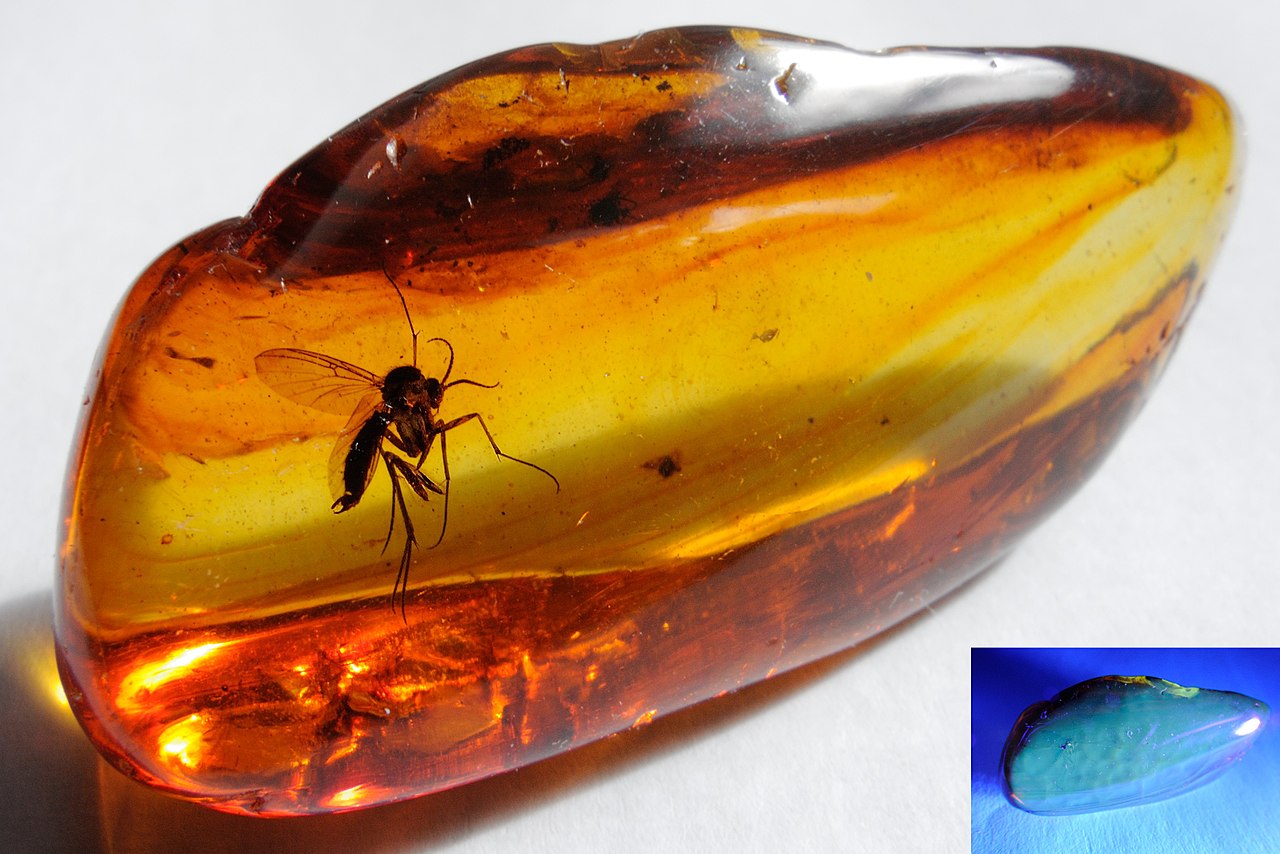
This specimen, an indeterminate dipteran insect encased in amber, represents a remarkable window into the ecosystems of the Paleogene Period, approximately 40 to 50 million years ago. Preserved with extraordinary fidelity, this tiny organism, likely a gnat or small fly, offers invaluable data on the evolution, behavior, and environment of ancient forest biomes. Its existence as a fossil inclusion provides a three-dimensional snapshot of life during the Eocene Epoch, a time of significant climatic and biological transition.
The physical characteristics of this indeterminate dipteran are preserved in exquisite detail, a hallmark of amber entombment. Although its precise dimensions are unrecorded, it is clearly a diminutive insect, likely measuring only a few millimeters in length, consistent with many families of small flies and gnats such as Mycetophilidae (fungus gnats) or Sciaridae (dark-winged fungus gnats). Its body is divided into the three classic insect segments: a head, thorax, and abdomen. The head bears a pair of relatively large compound eyes, suggesting a well-developed visual sense crucial for navigating a complex forest understory. A pair of delicate, segmented antennae are clearly visible, their structure hinting at a sophisticated chemosensory system used for detecting food sources, mates, or environmental cues. The thorax, the locomotive center of the insect, supports a single pair of membranous wings, the defining characteristic of the Order Diptera. The venation patterns on these wings, though microscopic, are often key to taxonomic identification. Six slender, jointed legs are also attached to the thorax, each terminating in tiny claws (tarsi) that would have allowed it to grip surfaces like bark, leaves, or fungi. The abdomen appears segmented and relatively simple, housing the digestive and reproductive organs. Compared to modern flies, its overall body plan is highly conserved, demonstrating the long-term success of the dipteran bauplan. The key difference lies not in its fundamental anatomy but in the specific combination of features that would place it within a now-extinct lineage or as an early member of a modern family.
The paleobiology of this small fly can be inferred from its morphology and the known habits of its modern relatives. Given its size and likely classification among the Nematocera (the suborder including gnats and midges), its diet was probably specialized and non-predatory. A fungivorous lifestyle is a strong possibility; many small Eocene flies, particularly fungus gnats, laid their eggs in bracket fungi or decaying wood, with the larvae consuming the fungal mycelia. Alternatively, it may have been a detritivore, with larvae feeding on decomposing leaf litter on the forest floor, playing a vital role in nutrient cycling. Adult flies of this type often adopt a different diet, primarily feeding on nectar, honeydew, or other sugary plant exudates, making them incidental pollinators. Its delicate wings suggest it was a capable but not necessarily powerful flier, likely engaging in short, fluttering flights within the humid, shaded lower levels of the forest, rather than long-distance aerial travel. Its behavior would have been driven by the search for food, moisture, and mates. The very act of its preservation, trapped in sticky tree resin, suggests a life lived in close proximity to resin-producing trees, a common behavior for insects seeking shelter, food, or oviposition sites on or near tree bark.
This insect inhabited a world vastly different from our own, living within the lush, warm-temperate to subtropical forests that dominated the Baltic region during the Eocene Epoch, approximately 40 to 50 million years ago. This period was characterized by a warm, humid "greenhouse" climate with minimal polar ice, allowing dense forests to thrive at high latitudes. The specific habitat was likely a mixed coniferous-broadleaf forest, rich in resin-producing trees such as pines (Pinus) and relatives of the modern Sciadopityaceae (umbrella pine), the source of the famous Baltic amber. This dipteran shared its environment with a staggering diversity of other organisms, many of which are also found preserved in amber. Its co-inhabitants included numerous other insects like ants, beetles, and barklice, as well as a rich variety of arachnids, including pseudoscorpions, spiders, and mites. It would have occupied a low trophic level in the forest food web, serving as a primary consumer of fungi or detritus. In turn, it would have been prey for a host of predators, including spiders whose webs are often found preserved in amber, predatory insects like assassin bugs, and potentially small vertebrates such as lizards or early insectivorous birds that foraged in the forest canopy and understory.
The discovery history of this specific specimen is not documented, a common situation for many pieces of Baltic amber that have been mined and traded for centuries. It is designated "Diptera indet.," meaning it is an indeterminate specimen belonging to the Order Diptera, lacking a formal species name or detailed provenance. It was likely recovered from one of the extensive amber deposits along the coast of the Baltic Sea, possibly from the Samland Peninsula near Kaliningrad, Russia, which has been the world's primary source of high-quality Eocene amber since antiquity. These deposits, known as "blue earth," are sedimentary layers of glauconitic sand and clay that contain vast quantities of raw amber washed out of their original forest soils. For centuries, such pieces were collected by "amber fishers" after storms or mined commercially. This particular specimen would have been identified as scientifically significant by a collector or researcher, who recognized the clarity of the inclusion. It likely passed through the hands of dealers before entering a private or institutional collection, where it was polished to enhance the visibility of the insect. Its scientific value lies not in a singular, famous discovery event, but as a representative example of the countless organisms that contribute to our collective understanding of the Baltic amber forest paleoecosystem.
From an evolutionary perspective, this fossil fly is a testament to the ancient origins and diversification of the Order Diptera. By the Eocene, flies had already become a highly successful and diverse group, having originated in the Mesozoic Era. This specimen represents a point in their evolutionary history when many modern families were becoming established. While its indeterminate status prevents a precise placement on the phylogenetic tree, it almost certainly belongs to the suborder Nematocera, characterized by their long, multi-segmented antennae. It serves as an anatomical data point, showcasing the morphology of a fly that lived roughly 20 million years after the Cretaceous-Paleogene extinction event. It lacks the dramatic transitional features of a major evolutionary leap, but instead provides crucial evidence for the stasis and subtle refinement of the dipteran body plan over tens of millions of years. By comparing its features—such as wing venation, antennal structure, and leg morphology—with both older Cretaceous fossils and modern species, paleontologists can trace the evolutionary pathways of specific lineages, helping to calibrate molecular clocks and understand the tempo and mode of insect evolution in response to the rise of flowering plants and modern forest ecosystems.
The primary scientific debate surrounding a specimen like this is one of taxonomic identity. Without destructive analysis or exceptionally high-resolution imaging, placing an "indet." specimen into a specific family, let alone a genus or species, can be contentious. Experts might disagree on the interpretation of subtle features like wing vein patterns or the number of antennal segments, leading to different potential classifications. For example, one researcher might argue for an affinity with Mycetophilidae based on tibial spurs, while another might suggest Sciaridae based on eye bridge structure. Another area of debate involves behavioral interpretation. While entrapment in resin is direct evidence of its presence on a tree, the exact reason—whether it was foraging, resting, mating, or accidentally blown onto the sticky surface—remains a matter of inference and speculation. Recent revisions in dipteran phylogeny, often driven by molecular data from living species, constantly reshape the evolutionary tree, requiring paleontologists to reassess where fossils like this one fit into the broader picture of fly evolution.
The fossil record of insects from the Eocene is dominated by lagerstätten, or sites of exceptional preservation, with amber deposits being the most famous. The Baltic amber deposits are the most extensive in the world, having produced millions of specimens, including tens of thousands of scientifically described dipterans. This vast sample size provides an unparalleled look at the diversity and disparity of an ancient insect fauna. The quality of preservation is often pristine, capturing not just the external morphology but sometimes even microscopic details like setae (bristles), pigmentation patterns, and occasionally internal tissues or gut contents. While the Baltic region is the most prolific source, other Eocene amber deposits, such as Rovno amber from Ukraine, also yield similar fossils, allowing for geographic comparisons of forest ecosystems. This specific specimen, though of unknown origin, is representative of the high-quality fossils that have made these sites cornerstones of invertebrate paleontology, providing a record of life that is unmatched in its detail and completeness for terrestrial arthropods.
Though scientifically classified as an indeterminate specimen, this insect in amber has a significant cultural and educational impact. It serves as a powerful visual icon of deep time, elegantly illustrating the concept of fossilization in a way that is both beautiful and easily understood by the public. Such fossils are prized exhibits in natural history museums worldwide, from the American Museum of Natural History in New York to the Museum für Naturkunde in Berlin, where they captivate audiences and often serve as a gateway to deeper interest in paleontology and evolution. The imagery of an insect trapped in amber was famously popularized in the novel and film "Jurassic Park," cementing its place in the public imagination as a vessel of ancient life and, fictionally, of prehistoric DNA. For educators, it is a perfect tool for teaching about evolution, paleoecology, and the processes of fossilization, offering a tangible connection to a world that existed millions of years before humans.
Time Period
Discovery
Location
Unknown (likely Baltic region)
Formation
Unknown
Frequently Asked Questions
What is Insect in amber?
This specimen, an indeterminate dipteran insect encased in amber, represents a remarkable window into the ecosystems of the Paleogene Period, approximately 40 to 50 million years ago. Preserved with extraordinary fidelity, this tiny organism, likely a gnat or small fly, offers invaluable data on the...
When did Insect in amber live?
Insect in amber lived during the paleogene period of the cenozoic era approximately 40-50 million years ago.
Where was Insect in amber discovered?
Fossils of Insect in amber were discovered in Unknown (likely Baltic region) in the Unknown.
What did Insect in amber eat?
Insect in amber was a likely fungivore, detritivore, or nectar feeder (common for small flies/gnats). It lived in terrestrial (forest environment) habitats.
What type of fossil is Insect in amber?
Insect in amber is preserved as a body fossil. The preservation quality is excellent.
Related Specimens
From the cenozoic era · body fossils