Mesohippus
Mesohippus bairdii
Image: Image sourced via web search (Fair use / Educational)
About Mesohippus
Mesohippus, whose name translates to "middle horse," represents a pivotal chapter in the long and well-documented evolutionary history of the horse family, Equidae. This small, three-toed mammal inhabited the plains and woodlands of North America during the Middle to Late Eocene and Early Oligocene epochs, approximately 40 to 30 million years ago. As a transitional form between the earliest fox-sized horses like Hyracotherium and later, more modern-looking equids, Mesohippus provides paleontologists with invaluable insights into the anatomical and ecological shifts that ultimately led to the single-toed, grazing horses of today. Its abundant and well-preserved fossils have made it a cornerstone for understanding mammalian adaptation to changing Cenozoic environments.
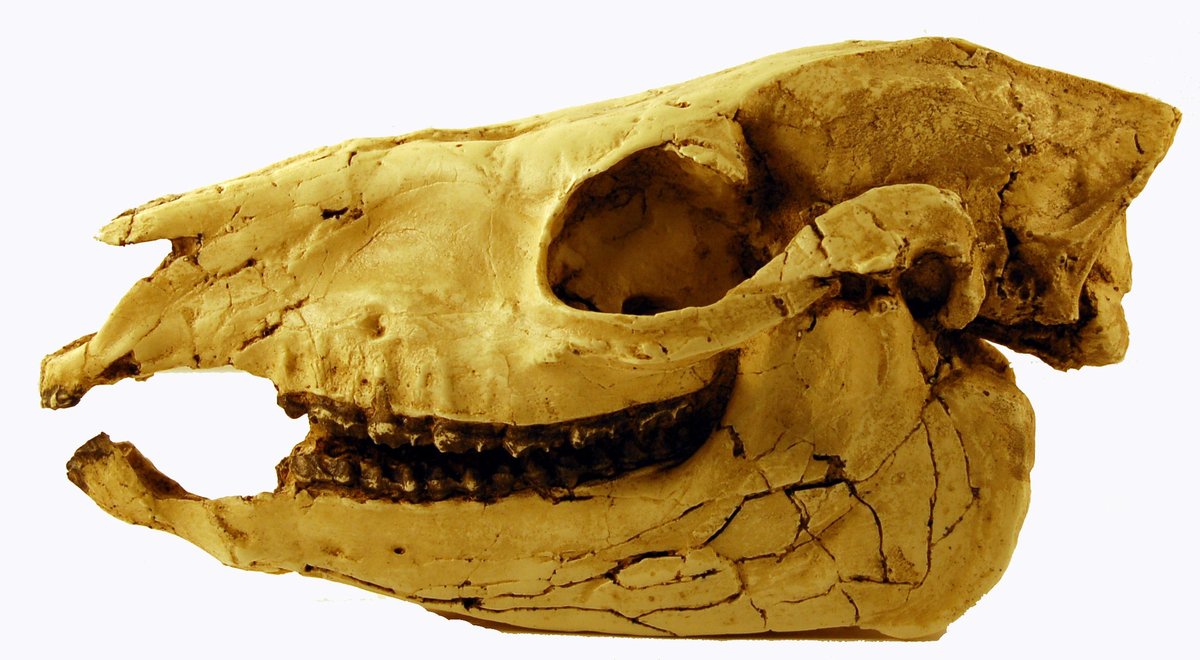
In terms of physical appearance, Mesohippus was a significant departure from its smaller ancestors, though it would still be dwarfed by modern horses. An average adult, such as a member of the species Mesohippus bairdii, stood approximately 60 centimeters (about 24 inches or 6 hands) high at the shoulder, comparable in size to a modern greyhound or a large goat. Its body length was around 120 centimeters (4 feet), and weight estimates typically range from 25 to 35 kilograms (55 to 77 pounds). The skull was longer and more horse-like than that of its predecessors, with a more pronounced facial region and eyes set further back, providing a wider field of vision. A key skeletal development was in its dentition; Mesohippus possessed a full set of low-crowned (brachydont) molars and premolars, with six grinding teeth in each jaw, a feature that marked an improvement for processing tougher plant material. Most notably, its limbs underwent a crucial transformation. While earlier equids had four toes on the front feet and three on the hind, Mesohippus stood on three toes on all four feet. The central toe was significantly larger and bore the majority of the animal's weight, while the two side toes were smaller and likely only made contact with the ground on soft terrain. This three-toed (tridactyl) stance was a critical step towards the single-toed (monodactyl) condition of modern horses, representing an adaptation for more efficient, faster running.
The paleobiology of Mesohippus reflects its adaptation to a changing world. Its low-crowned teeth indicate it was primarily a browser, feeding on soft leaves, young shoots, fruits, and other tender vegetation found in woodlands and along riverbanks, rather than the tough, abrasive grasses that would later dominate the plains. The shift from the four-toed Hyracotherium to the three-toed Mesohippus signifies a major change in locomotion. The elongated legs and the emphasis on the central digit suggest an increased capacity for speed and endurance, allowing it to cover more ground and more effectively evade predators. This cursorial (running-adapted) lifestyle was likely a response to the expansion of more open habitats. While direct evidence of social behavior is scarce, the abundance of fossils in certain localities suggests that Mesohippus may have lived in small herds, a behavior common in modern herbivores for mutual protection and foraging efficiency. This herding behavior would have been a crucial defense mechanism against the formidable predators of its time. Its metabolism was likely similar to that of other active, medium-sized mammals, requiring a consistent intake of vegetation to fuel its more mobile existence compared to its smaller, forest-dwelling ancestors.
Mesohippus lived during a period of significant global climate change, specifically the transition from the warm, humid Eocene to the cooler, drier Oligocene. This climatic shift caused the dense, subtropical forests that once covered much of North America to recede, giving way to more open woodlands, savannas, and grasslands. Mesohippus was perfectly poised to exploit these new environments. Its habitat consisted of these transitional landscapes, where it could browse on leafy vegetation while also benefiting from the open spaces for running. It shared this world with a diverse array of other mammals. Its food web position was that of a primary consumer, a herbivore preyed upon by a host of predators. These included large creodonts like Hyaenodon, nimravids (false saber-toothed cats) such as Hoplophoneus, and entelodonts, the fearsome, pig-like omnivores often called "hell pigs." The evolutionary pressure from these efficient hunters undoubtedly drove the development of Mesohippus's speed and potential herding instincts. Other herbivores in its ecosystem included early rhinos, tapirs, oreodonts (a diverse group of extinct cud-chewing mammals), and early camels, creating a complex and competitive community of plant-eaters.
The discovery history of Mesohippus is deeply intertwined with the "Bone Wars" of the late 19th century, the famous and often bitter rivalry between paleontologists Othniel Charles Marsh and Edward Drinker Cope. The genus was first named and described by Marsh in 1875, based on fossils collected from the rich Oligocene deposits of the American West. The type species, Mesohippus bairdii, was actually named earlier by Joseph Leidy in 1850, though he initially classified it under the genus Palaeotherium. Leidy, a preeminent American paleontologist, did foundational work in the White River Badlands of Nebraska and South Dakota, where Mesohippus fossils are exceptionally common. However, it was Marsh who recognized its distinct characteristics and its crucial intermediate position in the evolutionary line of horses he was meticulously assembling. Marsh's collections for the Yale Peabody Museum, gathered by his teams of fossil hunters, included numerous complete and partial skeletons of Mesohippus, which became a central pillar in his influential 1879 publication tracing the evolution of the horse. These specimens, many of which remain key references today, provided the first clear, tangible evidence of a major transitional stage in equine evolution, solidifying the theory of evolution with a powerful fossil example.
Mesohippus holds immense evolutionary significance as a classic example of a transitional fossil. It beautifully illustrates the gradual, mosaic nature of evolution, bridging the gap between the small, dog-like Eocene horses and the larger, more specialized Miocene equids like Merychippus. Its anatomy showcases several key evolutionary trends in the horse lineage. First is the reduction in the number of toes, a clear adaptation for cursorial locomotion on firmer ground. Second is the change in dentition; while still a browser, the development of a continuous crest on its molars (lophs) was a precursor to the complex, high-crowned teeth needed for grazing on abrasive grasses. Third is the increase in overall body size and the lengthening of the face and limbs. Mesohippus demonstrates that these changes did not all occur at once but were staggered over millions of years. It sits comfortably within the family Equidae, representing a successful radiation of browsing horses before the major shift to grazing occurred later in the Miocene. Its lineage is believed to have given rise to the next major stage in horse evolution, the genus Miohippus, which was slightly larger and showed further dental adaptations, coexisting with Mesohippus for several million years.
Despite its well-established place in equine evolution, some scientific debates concerning Mesohippus persist. One area of discussion revolves around the exact relationship between Mesohippus and the slightly later genus Miohippus. For a long time, the two were seen as a simple, linear progression. However, the fossil record shows they coexisted for at least four million years, suggesting a more complex, branching evolutionary pattern where Miohippus may have evolved from a specific Mesohippus population while other Mesohippus species continued to thrive. This has led to a re-evaluation of the once-linear depiction of horse evolution, favoring a more bush-like model of diversification and extinction. Furthermore, the classification of various species within the Mesohippus genus itself is subject to ongoing revision as new specimens are found and existing ones are re-analyzed with modern techniques. Distinguishing between species based on subtle variations in size and dental morphology can be challenging, leading to debates about whether certain fossils represent distinct species or simply individual or regional variation within a single, widespread species like M. bairdii.
The fossil record of Mesohippus is remarkably rich and extensive, making it one of the best-represented fossil mammals from the Cenozoic of North America. Fossils are found in great abundance throughout the Great Plains of the United States and parts of Canada. The primary source is the White River Formation (and its equivalents) in South Dakota, Nebraska, Wyoming, and Colorado. These badlands deposits, formed from ancient volcanic ash and river sediments, are renowned for their exceptional preservation. Complete and articulated skeletons of Mesohippus are relatively common, providing paleontologists with a comprehensive understanding of its anatomy. Skulls, jaws, and isolated teeth are particularly numerous. This abundance has allowed for detailed studies of population structure, growth series, and individual variation. Famous fossil sites like Toadstool Geologic Park in Nebraska and Badlands National Park in South Dakota have yielded thousands of Mesohippus specimens, making it a staple of North American paleontology.
Due to its importance as a key transitional fossil, Mesohippus has had a significant cultural and educational impact. It is a star exhibit in nearly every major natural history museum that features a display on the evolution of the horse. The iconic, linear chart of horse evolution, though now considered an oversimplification, almost always features Mesohippus as a critical intermediate step between the tiny Hyracotherium and the modern Equus. This has cemented its place in the public consciousness as a textbook example of evolution in action. Notable displays featuring complete Mesohippus skeletons can be seen at the American Museum of Natural History in New York, the Field Museum in Chicago, and the Yale Peabody Museum, showcasing the wealth of fossils that helped build our understanding of life's history.
Classification
Time Period
Discovery
Location
North America (specifically, the White River Badlands of South Dakota and Nebraska, USA)
Formation
White River Formation
Frequently Asked Questions
What is Mesohippus?
Mesohippus, whose name translates to "middle horse," represents a pivotal chapter in the long and well-documented evolutionary history of the horse family, Equidae. This small, three-toed mammal inhabited the plains and woodlands of North America during the Middle to Late Eocene and Early Oligocene ...
When did Mesohippus live?
Mesohippus lived during the paleogene period of the cenozoic era approximately 40-30 million years ago.
Where was Mesohippus discovered?
Fossils of Mesohippus were discovered in North America (specifically, the White River Badlands of South Dakota and Nebraska, USA) in the White River Formation.
What did Mesohippus eat?
Mesohippus was a herbivore. It lived in terrestrial habitats.
What type of fossil is Mesohippus?
Mesohippus is preserved as a body fossil. The preservation quality is excellent.
Related Specimens
From the cenozoic era · body fossils