Temnodontosaurus
Temnodontosaurus platyodon
Image: Image sourced via web search (Fair use / Educational)
About Temnodontosaurus
Temnodontosaurus was a genus of large-bodied ichthyosaur, a highly successful group of marine reptiles that superficially resembled modern dolphins and tuna. Thriving during the Early Jurassic period, approximately 198 to 185 million years ago, its fossils are primarily found in the marine deposits of Europe, particularly the United Kingdom and Germany. As one of the earliest giant ichthyosaurs, Temnodontosaurus represents a pivotal apex predator in post-Triassic marine ecosystems, offering crucial insights into the rapid diversification and ecological dominance of ichthyosaurs following the end-Triassic extinction event.
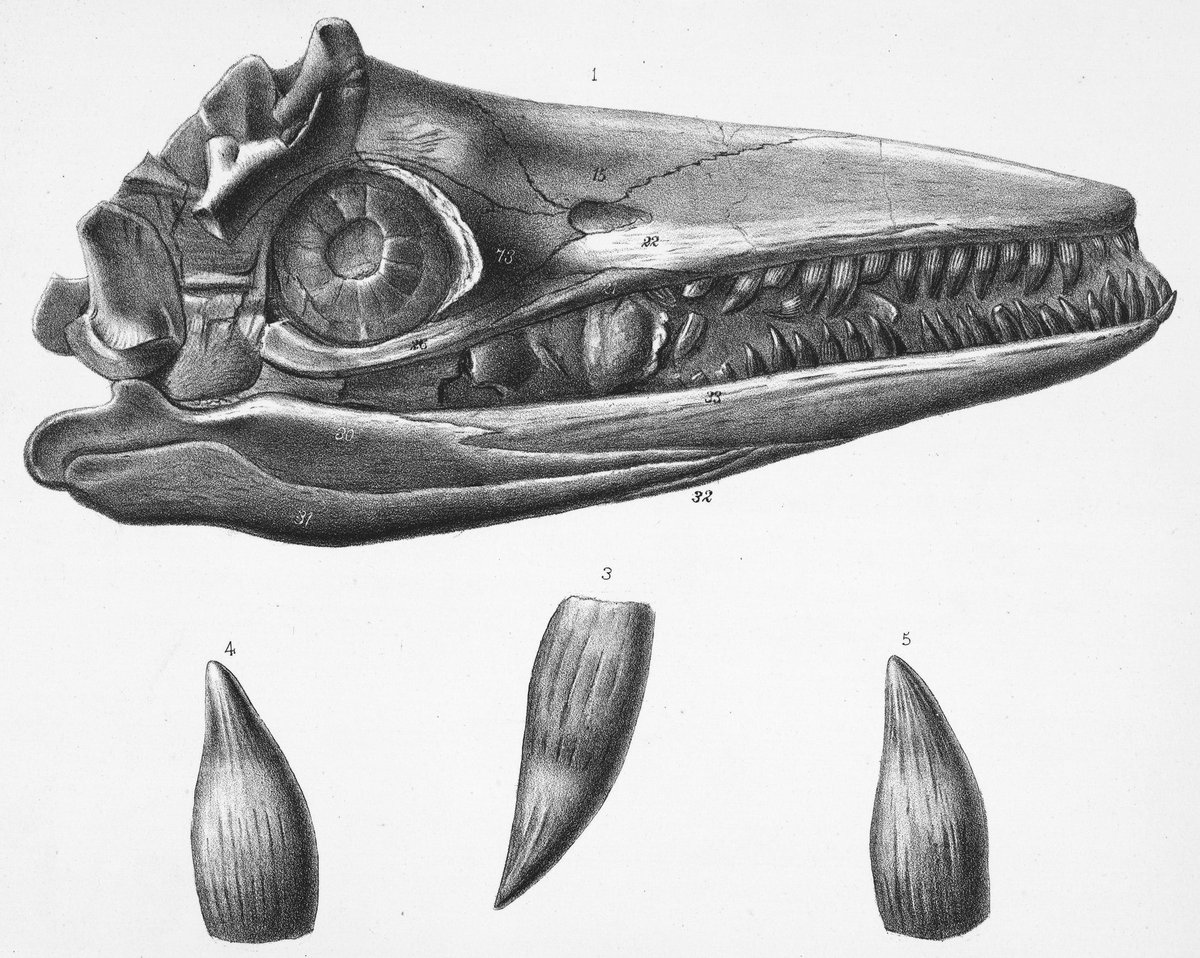
Temnodontosaurus was a formidable marine reptile, with some species reaching lengths comparable to modern orcas. The type species, Temnodontosaurus platyodon, typically measured between 9 and 12 meters (30 to 40 feet) in length, with some estimates suggesting maximum sizes approaching 15 meters. Its body was streamlined and fusiform, an ideal shape for efficient movement through water, much like today's pelagic predators. The most striking feature of Temnodontosaurus was its exceptionally large eyes, which, in some specimens, measured over 20 centimeters (8 inches) in diameter, making them among the largest eyes of any known animal, relative to body size. These massive orbits were supported by a ring of sclerotic bones, which helped the eyeball maintain its shape under immense water pressure in deep, low-light conditions. The skull was long and robust, housing a formidable array of large, conical teeth set in continuous grooves rather than individual sockets, a condition known as thecodonty. The teeth were pointed and sturdy, well-suited for grasping and processing large prey. Its vertebral column was composed of disc-like vertebrae, providing a combination of strength and flexibility. It possessed four powerful, paddle-like flippers for steering and stability, and a large, crescent-shaped caudal fin, or tail fluke, which provided the primary thrust for propulsion, similar in function to that of a shark.
The paleobiology of Temnodontosaurus paints a picture of a highly capable and active apex predator. Its massive eyes, adapted for low-light vision, strongly suggest it was a deep-diving hunter, capable of pursuing prey in the darker, mesopelagic zones of the ocean, potentially hundreds of meters below the surface. The robust teeth and powerful jaws indicate a diet consisting of large and challenging prey. Stomach contents from some specimens have confirmed this, revealing the remains of other marine reptiles, including smaller ichthyosaurs, as well as large fish and cephalopods like belemnites and ammonites. This evidence firmly places Temnodontosaurus at the top of the food chain. Its hunting strategy was likely one of active pursuit and ambush. Using its powerful tail for rapid acceleration, it could have launched swift attacks on its prey from below. Locomotion was thunniform, meaning it was propelled primarily by the side-to-side movement of its tail fluke, while its flippers were used for maneuvering and stabilization at high speeds. There is little direct evidence for social behavior, but like many large marine predators today, it may have been a solitary hunter or lived in small, transient groups. Its metabolism was likely elevated compared to typical reptiles, a trait common among active ichthyosaurs, allowing it to sustain the high energy demands of its predatory lifestyle in cool Jurassic seas.
Temnodontosaurus inhabited the epicontinental seas that covered much of Europe during the Early Jurassic. This period, following the end-Triassic mass extinction, was characterized by a warm, greenhouse climate and rising sea levels, which created extensive shallow marine environments teeming with life. The specific ecosystem it dominated is well-documented in the rock layers of the Lias Group in England and the Posidonia Shale in Germany. These were productive marine settings with a complex food web. Temnodontosaurus shared these waters with a diverse array of fauna, including other ichthyosaur genera like Ichthyosaurus and Stenopterygius, long-necked plesiosaurs such as Plesiosaurus, and the formidable pliosaur Rhomaleosaurus. The seas were also filled with various species of ammonites, belemnites, and large fish like Dapedium and Lepidotes, all of which formed part of its diet. As the apex predator, Temnodontosaurus would have played a crucial role in regulating the populations of these other animals. It likely faced little competition from other predators of its size, solidifying its position at the pinnacle of the marine food web. Its existence highlights the rapid recovery and radiation of marine reptile megafauna in the wake of a major extinction event, quickly establishing new and complex ecological hierarchies.
The discovery history of Temnodontosaurus is deeply intertwined with the birth of paleontology as a scientific discipline. The first significant fossils were unearthed in the early 19th century from the coastal cliffs of Lyme Regis in Dorset, England, a region now known as the Jurassic Coast. These discoveries were made by the pioneering fossil collector Mary Anning and her family. In 1811, Mary's brother Joseph Anning found a large skull, and over the next year, Mary excavated the rest of the associated skeleton. Initially, the creature was thought to be a type of crocodile or fish. The specimen was purchased by the collector Henry Hoste Henley, who brought it to the attention of the scientific community in London. In 1814, the anatomist Sir Everard Home described it, but it was his assistant, Charles Konig, who first informally named it Ichthyosaurus platyodon in 1821. The genus name Temnodontosaurus, meaning 'cutting-tooth lizard,' was later coined by Richard Lydekker in 1889 to distinguish this large, robust-toothed form from the more gracile Ichthyosaurus. The original specimen found by the Annings remains one of the most important historical fossils, representing one of the first complete skeletons of a large prehistoric reptile to be scientifically described and playing a key role in challenging pre-evolutionary ideas about the history of life on Earth.
Temnodontosaurus holds significant evolutionary importance as it represents an early peak in ichthyosaur gigantism and ecological dominance. Ichthyosaurs as a group are a classic example of convergent evolution, having evolved a body plan remarkably similar to that of fish and dolphins despite being reptiles. Temnodontosaurus, appearing relatively early in the Jurassic, demonstrates that this group rapidly evolved large body sizes and specialized predatory adaptations after the Triassic period. It belongs to the parvorder Neoichthyosauria, a group that includes the majority of post-Triassic ichthyosaurs. Within this group, it is the namesake of the family Temnodontosauridae. Its anatomy, particularly its combination of a relatively primitive vertebral column with a highly derived, tuna-like tail, provides valuable information about the stepwise evolution of high-performance swimming in these animals. The genus showcases the diversity within Early Jurassic ichthyosaurs, occupying a distinct ecological niche as a macropredator of other large vertebrates, a role that would later be filled by pliosaurs in the Middle and Late Jurassic. It is not a direct ancestor to any modern animals, as the entire ichthyosaur lineage went extinct in the Late Cretaceous, but it stands as a testament to the remarkable ability of reptiles to adapt to and dominate marine environments.
Despite being one of the first ichthyosaurs discovered, Temnodontosaurus has been the subject of ongoing scientific debate, particularly concerning its taxonomy. For many years, the number of valid species within the genus was contentious, with numerous species being named based on fragmentary material. A major revision by paleontologist Michael Maisch in the early 2000s helped to clarify the genus, synonymizing many previously named species and recognizing a smaller, more clearly defined set, including T. platyodon, T. trigonodon, and T. eurycephalus. Another area of discussion revolves around its precise feeding ecology. While its role as an apex predator is well-established, the degree to which it specialized on certain prey types is still being investigated. The discovery of different tooth morphologies among species—some with robust, cutting teeth and others with more slender, piercing teeth—suggests niche partitioning, with different species potentially targeting different prey. For example, the broad, triangular teeth of T. eurycephalus may have been adapted for dismembering very large prey, a hypothesis that continues to be explored through biomechanical studies and analysis of fossil gut contents.
The fossil record of Temnodontosaurus is quite robust, particularly for an Early Jurassic reptile. Its remains are most famously found along the Jurassic Coast of Dorset, England, especially in the Blue Lias and Charmouth Mudstone formations. These sites have yielded numerous well-preserved and often articulated skeletons, some of which are nearly complete. Germany is another key locality, with exceptional specimens having been recovered from the Posidonia Shale near Holzmaden. The anoxic conditions at the bottom of the Posidonia sea led to remarkable preservation, often including soft tissue outlines of the body shape, skin, and even stomach contents. Fossils have also been reported from other parts of Europe, including France and Luxembourg, indicating a wide distribution across the shallow seas of the continent. While skulls and vertebral columns are the most commonly found elements, the discovery of complete skeletons has provided a comprehensive understanding of its anatomy. These high-quality fossils make Temnodontosaurus one of the best-understood of all the large marine reptiles of its time.
Temnodontosaurus has had a notable, if somewhat understated, cultural impact. As one of the first major fossil reptiles discovered by Mary Anning, it played a foundational role in the public's burgeoning fascination with prehistoric life in the 19th century. Its dramatic fossils helped establish the concept of extinction and a 'lost world' of giant reptiles. Today, impressive skeletons of Temnodontosaurus are prominently displayed in major museums around the world, including the Natural History Museum in London, which houses some of Anning's original finds. While it may not be as famous as Tyrannosaurus or Triceratops, it is a staple in exhibits on marine life of the Mesozoic. Its immense size and particularly its giant eyes often capture the imagination of museum visitors, serving as a powerful educational tool to illustrate the scale and diversity of life in ancient oceans.
Classification
Time Period
Discovery
Location
United Kingdom
Formation
Lias Group (specifically Blue Lias and Charmouth Mudstone Formations)
Frequently Asked Questions
What is Temnodontosaurus?
Temnodontosaurus was a genus of large-bodied ichthyosaur, a highly successful group of marine reptiles that superficially resembled modern dolphins and tuna. Thriving during the Early Jurassic period, approximately 198 to 185 million years ago, its fossils are primarily found in the marine deposits ...
When did Temnodontosaurus live?
Temnodontosaurus lived during the jurassic period of the mesozoic era approximately 198-185 million years ago.
Where was Temnodontosaurus discovered?
Fossils of Temnodontosaurus were discovered in United Kingdom in the Lias Group (specifically Blue Lias and Charmouth Mudstone Formations).
What did Temnodontosaurus eat?
Temnodontosaurus was a carnivore. It lived in marine, pelagic habitats.
What type of fossil is Temnodontosaurus?
Temnodontosaurus is preserved as a body fossil. The preservation quality is excellent.
Related Specimens
From the mesozoic era · body fossils