Hyracotherium
Hyracotherium leporinum
Image: File:Hyracotherium leporinum.jpg - Wikimedia Commons (CC BY-SA)
About Hyracotherium
Hyracotherium is a genus of small, early perissodactyl, or odd-toed ungulate, that inhabited the subtropical forests of Europe during the Eocene epoch, approximately 56 to 48 million years ago. Often popularly referred to as the 'dawn horse,' this diminutive mammal is a pivotal figure in the study of early Cenozoic life, offering profound insights into the initial radiation of mammals following the Cretaceous-Paleogene extinction event. While historically positioned as the direct ancestor of the modern horse, its true evolutionary relationships are far more complex, with the type species, *Hyracotherium leporinum*, now understood to be an early member of the Palaeotheriidae, an extinct family more closely related to horses than to rhinos or tapirs, but not on the direct ancestral line.
A detailed examination of its physical characteristics reveals an animal markedly different from its modern relatives. *Hyracotherium leporinum* was a small creature, comparable in size to a fox or a small dog, measuring approximately 60 centimeters (24 inches) in length and standing only about 20 centimeters (8 inches) high at the shoulder. Its estimated weight was a mere 5 to 10 kilograms (11 to 22 pounds). The overall body plan was gracile, featuring a distinctly arched back, reminiscent of a modern duiker, and a relatively long tail. The skull was short and low, lacking the elongated snout of later equids, and housed a comparatively small brain. Its dentition was that of a typical primitive mammal, with a full complement of 44 low-crowned (brachydont) teeth, including small canines. These teeth were adapted for crushing and grinding soft vegetation rather than the abrasive grasses that would later dominate terrestrial ecosystems. Perhaps its most defining anatomical feature was its limb structure. The forelimbs possessed four functional toes, while the hind limbs had three, with a vestigial first toe sometimes present. Each toe terminated not in a broad, single hoof, but in a small, hoof-like nail, with the weight of the animal supported by a fleshy pad behind the toes, similar to the foot of a modern tapir. This multi-toed, pad-footed arrangement underscores its adaptation to a life spent navigating soft, uneven forest floors.
The paleobiology of *Hyracotherium* can be inferred from its skeletal anatomy and the paleoenvironmental context of its fossil discoveries. Its brachydont teeth, with their simple cusps and crests, are clear indicators of a browsing herbivorous diet. It likely fed selectively on soft, succulent leaves, young shoots, ferns, and fruits found close to the ground in the forest understory. This dietary strategy, known as folivory and frugivory, required less specialized dental adaptations compared to the high-crowned (hypsodont) teeth needed for grazing on tough, silica-rich grasses, which had not yet become widespread. Its locomotion was suited for its habitat; the flexible, arched back and multi-toed feet suggest a running style more akin to a bounding or scampering gait than the sustained, efficient trot of a modern horse. This agility would have been crucial for maneuvering through dense vegetation and evading predators. As a small mammal in a world newly populated by mammalian carnivores like creodonts, *Hyracotherium* likely relied on camouflage and quick, darting movements for survival. It was probably a solitary animal or lived in small, inconspicuous groups, foraging quietly within its forested territory. Its relatively small brain size suggests a life governed more by instinct than complex social behaviors.
*Hyracotherium leporinum* lived during the Ypresian age of the early Eocene, a time characterized by the Paleocene-Eocene Thermal Maximum (PETM), one of the most rapid and extreme global warming events in geological history. The climate was exceptionally warm and humid, with subtropical or tropical conditions extending into high-latitude regions like England. The environment preserved in the London Clay Formation, where its fossils are found, was a warm, shallow sea bordered by lush, dense coastal forests and swamplands, similar to modern mangrove swamps or the bayous of the southeastern United States. This ecosystem supported a rich and diverse fauna. *Hyracotherium* shared its terrestrial habitat with other early mammals, including the large pantodont *Coryphodon*, the primate *Plesiadapis*, and various creodont predators. The surrounding waters teemed with sharks, bony fish, and marine reptiles, while the skies were home to some of the earliest known songbirds. As a primary consumer, *Hyracotherium* occupied a crucial position in the food web, converting plant matter into a food source for the era's emerging carnivorous mammals. Its existence highlights the rapid diversification of life forms filling the ecological niches left vacant by the dinosaurs.
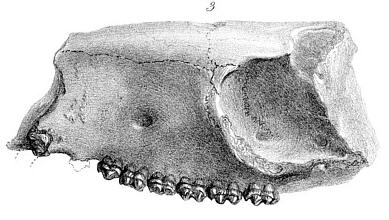
The discovery and scientific history of *Hyracotherium* are intertwined with the very foundations of paleontology and evolutionary theory. The first fossils were unearthed in 1839 from the London Clay deposits at Studd Hill near Herne Bay, Kent, England. These remains, consisting of a partial skull and other fragments, were studied by the eminent British anatomist Sir Richard Owen. In 1841, Owen formally described the specimen, naming it *Hyracotherium leporinum*. The generic name, meaning "hyrax-like beast," was chosen due to the perceived similarity of its cheek teeth to those of the modern rock hyrax, while the specific name *leporinum* means "hare-like," referencing its small size. At the time, Owen did not recognize any connection to horses. Decades later, in 1876, American paleontologist Othniel Charles Marsh, working with a more complete series of fossils from North America, described a similar animal he named *Eohippus* ("dawn horse") and famously arranged it as the first stage in his now-iconic evolutionary sequence of the horse. It was later recognized that Marsh's *Eohippus* was so similar to Owen's *Hyracotherium* that, by the rules of taxonomic priority, the older name *Hyracotherium* should apply to both. For much of the 20th century, the two names were used synonymously, with *Hyracotherium* being the scientifically accepted term for the earliest horse ancestor.
This animal's evolutionary significance has been a subject of continuous refinement. For over a century, *Hyracotherium* (often illustrated using the more complete North American *Eohippus* fossils) was presented as the archetypal basal equid, the starting point of a linear, progressive evolution towards the modern horse, *Equus*. This classic model showed a gradual increase in size, reduction of toes, and deepening of teeth over 50 million years. However, modern phylogenetic analyses have revealed a more complex, branching evolutionary bush rather than a simple ladder. The type species, *Hyracotherium leporinum* from Europe, is now considered to be a member of the Palaeotheriidae, an extinct family that represents a side-branch of perissodactyl evolution. While palaeotheres are closely related to equids, they are not their direct ancestors. The North American species once assigned to *Hyracotherium*, such as *"Hyracotherium"* *vasacciense*, are now placed in separate genera like *Sifrhippus* and are considered true basal members of the family Equidae. Therefore, while *Hyracotherium* itself is not the direct ancestor of the horse, it remains a crucial specimen representing the ancestral morphotype of early perissodactyls, showcasing the primitive traits from which the distinct lineages of horses, rhinos, and tapirs would later diverge.
The taxonomic placement of *Hyracotherium* has been one of the most persistent scientific debates in vertebrate paleontology. The central issue revolved around its status as a "wastebasket taxon"—a genus into which numerous species of small, primitive Eocene perissodactyls from both North America and Eurasia were placed. This lumping obscured the true diversity and evolutionary relationships of these early animals. Beginning in the late 20th century and accelerating with cladistic methods, paleontologists like David Froehlich began to systematically revise the genus. This research led to the conclusion that the European type species, *H. leporinum*, was distinct from the North American forms. Consequently, many North American species were reassigned to other genera, including *Eohippus* (which was resurrected for some species), *Sifrhippus*, *Minippus*, and *Arenahippus*. This taxonomic split clarifies that the true dawn horses (Equidae) originated in North America, while *Hyracotherium* proper represents an early European offshoot of the perissodactyl family tree, the palaeotheres. This revision underscores the dynamic nature of scientific classification as new evidence and analytical methods become available.
The fossil record of *Hyracotherium leporinum* is primarily confined to the London Clay Formation of southeastern England, a Lagerstätte renowned for its exceptional preservation of Eocene flora and fauna. The holotype specimen described by Richard Owen is housed at the Natural History Museum in London. While fossils of *H. leporinum* are relatively rare compared to its North American counterparts, the specimens that have been found are often well-preserved, providing detailed anatomical information. The London Clay's marine depositional environment means that terrestrial animal remains like *Hyracotherium* are typically found as isolated bones or partial skeletons that were washed out to sea from the nearby coastal forests. In contrast, the fossils of the related North American "dawn horses" are far more abundant, particularly in the Willwood Formation of the Bighorn Basin, Wyoming, where thousands of specimens, including nearly complete skeletons, have been collected. This wealth of North American material was instrumental in building the classic horse evolution narrative, even though the original name-bearer, *Hyracotherium*, is a much rarer European taxon.
Despite its complex and revised scientific identity, the image of *Hyracotherium* as the "dawn horse" has had a lasting cultural impact. It remains a staple of museum exhibits on evolution worldwide, often featured at the beginning of displays illustrating the history of the horse. Its diminutive size and multi-toed feet provide a powerful and easily understandable visual contrast to the large, single-hoofed modern horse, making it an effective educational tool for demonstrating macroevolutionary change over geological time. It has appeared in numerous textbooks, documentaries, and popular science books as a classic example of a transitional form, securing its place in the public consciousness as a key player in the grand story of life on Earth.
Classification
Time Period
Discovery
Location
London Clay Formation, Kent, England
Formation
London Clay Formation
Frequently Asked Questions
What is Hyracotherium?
Hyracotherium is a genus of small, early perissodactyl, or odd-toed ungulate, that inhabited the subtropical forests of Europe during the Eocene epoch, approximately 56 to 48 million years ago. Often popularly referred to as the 'dawn horse,' this diminutive mammal is a pivotal figure in the study o...
When did Hyracotherium live?
Hyracotherium lived during the paleogene period of the cenozoic era approximately 56-48 million years ago.
Where was Hyracotherium discovered?
Fossils of Hyracotherium were discovered in London Clay Formation, Kent, England in the London Clay Formation.
What did Hyracotherium eat?
Hyracotherium was a herbivore. It lived in terrestrial habitats.
What type of fossil is Hyracotherium?
Hyracotherium is preserved as a body fossil. The preservation quality is good.
Related Specimens
From the cenozoic era · body fossils