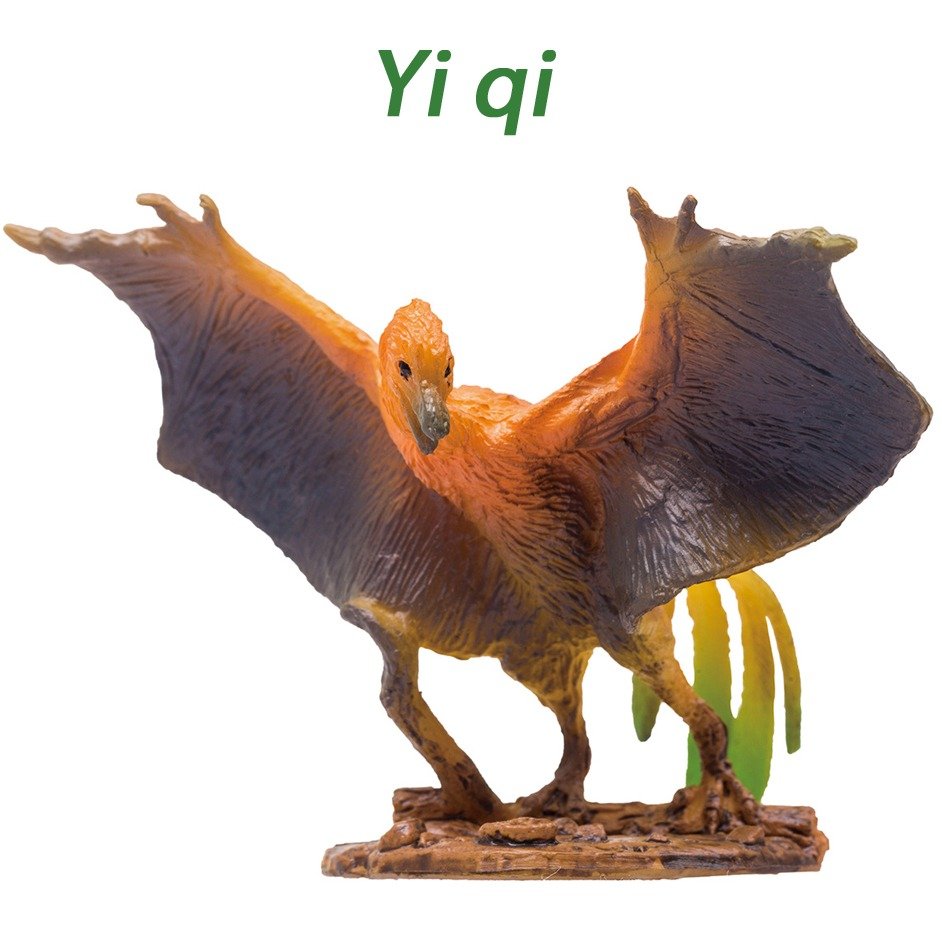
Yi qi
Image: Image sourced via web search (Fair use / Educational)
About Yi qi
Yi qi is a remarkably unusual species of scansoriopterygid dinosaur that lived during the Middle to Late Jurassic period, approximately 163 to 159 million years ago, in what is now Hebei Province, China. This extraordinary creature has profoundly altered our understanding of dinosaur evolution and the origins of flight, representing a unique evolutionary experiment in aerial locomotion. Unlike the feathered wings of early birds and their closest dromaeosaurid relatives, Yi qi possessed membranous wings supported by a highly specialized, elongated wrist bone, a feature entirely unprecedented among dinosaurs. Its discovery provided the first definitive evidence that some non-avian dinosaurs evolved bat-like or pterosaur-like wings, highlighting the incredible morphological diversity and evolutionary experimentation that occurred near the base of the avian family tree. As one of the most bizarre and unexpected fossil discoveries of the twenty-first century, Yi qi serves as a crucial reminder that the pathway to powered flight in dinosaurs was not a single, linear progression, but rather a complex radiation of diverse anatomical strategies.
In terms of its physical dimensions, Yi qi was a relatively small animal, roughly the size of a modern pigeon. Its estimated body length was approximately 38 centimeters, with a wingspan reaching about 60 centimeters, and it likely weighed around 380 grams. The most astonishing anatomical feature of Yi qi is the presence of a long, rod-like bone extending from its wrist, known as the styliform element. This bone is not found in any other known group of dinosaurs, though a similar structure evolved independently in modern flying squirrels and extinct pterosaurs to support a patagium, or gliding membrane. Fossil evidence clearly preserves patches of this membranous tissue between the styliform bone and the elongated fingers, confirming its function as an aerodynamic surface. In addition to these leathery wings, Yi qi was covered in a dense coat of feathers. However, unlike the complex, asymmetrical pennaceous feathers seen in Microraptor or Archaeopteryx, the feathers of Yi qi were relatively simple, stiff, and filamentous, resembling the bristles of a paintbrush. These feathers were concentrated around the head, neck, and body, likely serving primarily for thermoregulation rather than aerodynamics. Microscopic analysis of fossilized melanosomes—pigment-bearing organelles—indicates that the animal had a predominantly black or dark grey plumage, with potentially yellowish-brown hues on its head and neck, providing a striking visual reconstruction of this Jurassic oddity.
The paleobiology of Yi qi suggests a highly specialized, arboreal lifestyle, uniquely adapted to navigating the dense forest canopies of Jurassic China. Its dentition, characterized by small, peg-like teeth angled slightly forward at the tip of the snout, strongly indicates an insectivorous or perhaps omnivorous diet. It likely foraged among the branches, using its elongated fingers to probe for insects, grubs, and small vertebrates hidden beneath the bark or within the foliage. The most intensely studied aspect of its biology is its mode of locomotion. Biomechanical analyses and aerodynamic modeling have concluded that Yi qi was incapable of sustained, powered flight. Its skeletal musculature, particularly the lack of a prominent keeled sternum for the attachment of massive flight muscles, and the structural limitations of its membranous wings, suggest it was primarily a glider. Much like modern flying squirrels or colugos, Yi qi would have climbed high into the trees using its sharp, curved claws, and then launched itself into the air, extending its arms and the styliform bone to deploy its patagium. This gliding capability would have been an efficient means of traveling between trees to forage, escape predators, or survey its territory. Its social behavior remains speculative, but given the complex visual displays seen in many feathered dinosaurs, the contrasting colors of its plumage might have played a role in intraspecific communication or mating rituals. Growth patterns inferred from related scansoriopterygids suggest a relatively rapid maturation process, typical of small, active theropods.
During the Middle to Late Jurassic, the environment of the Tiaojishan Formation, where Yi qi lived, was a lush, temperate to subtropical forest ecosystem dominated by conifers, ginkgoes, cycads, and ferns. The climate was generally warm and humid, characterized by seasonal variations and periodic volcanic activity, which ultimately contributed to the exceptional preservation of the region's fossils. This dense, multi-tiered forest canopy provided the perfect habitat for an arboreal glider like Yi qi. The ecosystem was incredibly diverse, hosting a wide array of co-existing species. Yi qi shared its habitat with early mammals like Castorocauda and Volaticotherium, the latter being another gliding animal, indicating intense competition for aerial and arboreal niches. The skies and upper canopies were also navigated by various pterosaurs, such as Darwinopterus, and early avialans like Anchiornis. On the forest floor, larger herbivorous dinosaurs and predatory theropods roamed, making the trees a necessary refuge for small animals. In this complex food web, Yi qi occupied the role of a mid-level consumer, preying on abundant insects and perhaps small lizards or mammals, while simultaneously serving as potential prey for larger arboreal predators, climbing theropods, or low-flying pterosaurs. This dynamic environment drove the evolutionary innovations seen in Yi qi, pushing it to exploit the aerodynamic possibilities of its unique anatomy to survive in a highly competitive, three-dimensional landscape.
The discovery history of Yi qi is a fascinating tale that underscores the importance of amateur fossil hunters and the rich paleontological heritage of China. The holotype specimen, designated STM 31-2, was discovered by a local farmer named Wang Jianrong in a quarry near Mutoudeng in Qinglong County, Hebei Province. Wang subsequently sold the fossil to the Shandong Tianyu Museum of Nature in 2007. For several years, the specimen remained unstudied until it caught the attention of Xu Xing, one of China's most prolific and renowned paleontologists. Xu and his team began a meticulous examination of the fossil, initially puzzled by the strange, rod-like bone extending from the wrist. It was only after extensive preparation and the identification of the preserved soft tissue membrane that the true nature of the animal was revealed. The formal description of the species was published in the journal Nature in 2015 by Xu Xing, Zheng Xiaoting, Corwin Sullivan, and their colleagues. They named the dinosaur Yi qi, which translates from Mandarin as strange wing. This name is notable not only for its descriptive accuracy but also for being the shortest generic and specific name in the entirety of dinosaur taxonomy. The discovery of STM 31-2 was a watershed moment, providing the first undeniable proof of membranous wings in a dinosaur and instantly making Yi qi one of the most famous and heavily scrutinized fossils of the decade.
The evolutionary significance of Yi qi cannot be overstated, as it fundamentally disrupts the traditional narrative of how flight evolved in dinosaurs. Taxonomically, Yi qi belongs to the Scansoriopterygidae, a bizarre and enigmatic family of small, feathered theropods closely related to the ancestors of modern birds. Before the discovery of Yi qi, it was generally assumed that the evolution of flight in dinosaurs was exclusively tied to the development of pennaceous feathers, culminating in the avian wing. Yi qi demonstrates that the Paraves—the clade containing birds and their closest relatives—underwent a period of intense evolutionary experimentation with different aerodynamic structures. The membranous wing of Yi qi represents a striking example of convergent evolution, where a dinosaur independently evolved a flight apparatus similar to those of entirely different lineages, namely bats and pterosaurs. This suggests that the selective pressures for aerial locomotion in the Jurassic forests were so strong that they drove multiple, distinct anatomical solutions. Furthermore, the existence of Yi qi indicates that the path to avian flight was not a solitary success story but rather one of several competing aerodynamic models. Ultimately, the feathered wing proved more successful and adaptable, leading to the survival and radiation of birds, while the membranous wings of scansoriopterygids like Yi qi represent an evolutionary dead end, a fascinating but ultimately extinct branch on the tree of life.
Despite the exceptional preservation of the holotype, Yi qi has been the subject of intense scientific debate since its description. The primary controversy revolves around its flight capabilities and the exact configuration of its wings. While most researchers agree that Yi qi was a glider, the exact shape and attachment points of the patagium remain contested. Some aerodynamic models suggest a broad wing attached to the torso and legs, similar to a flying squirrel, while others propose a narrower wing more akin to a bat. The orientation of the styliform bone is also debated; whether it pointed forward, outward, or backward significantly alters the calculated lift and drag coefficients of the animal. Additionally, some paleontologists initially questioned the interpretation of the styliform element, suggesting it might be a displaced rib or a different carpal bone, though subsequent discoveries of related scansoriopterygids like Ambopteryx longibrachium, which also possesses a styliform bone and membranous wings, have largely vindicated the original interpretation. The exact phylogenetic placement of Scansoriopterygidae within Paraves also continues to be refined, with ongoing debates about their exact relationship to early birds like Archaeopteryx and dromaeosaurs like Microraptor.
The fossil record for Yi qi is currently extremely limited, consisting entirely of a single holotype specimen, STM 31-2. This specimen is housed at the Shandong Tianyu Museum of Nature in Pingyi, China. Despite being known from only one individual, the quality of preservation is nothing short of exceptional. The fossil is articulated and compressed on a slab and counter-slab of shale from the Tiaojishan Formation. It preserves not only the majority of the skeleton, including the delicate skull, elongated fingers, and the unique styliform bone, but also extensive soft tissue. This includes the carbonized remains of the filamentous feathers covering the body and the crucial patches of the leathery patagium between the fingers and the styliform element. Most remarkably, the preservation is detailed enough to retain melanosomes, allowing scientists to reconstruct the animal's coloration. The Tiaojishan Formation, where Yi qi was found, is renowned globally as a Konservat-Lagerstätte, a fossil site yielding exceptionally preserved remains. This formation has provided a crucial window into the Middle-Late Jurassic ecosystems of Asia, yielding numerous other significant fossils, including early mammals, pterosaurs, and other feathered dinosaurs, making it one of the most important paleontological sites in the world for understanding the origins of flight.
The cultural impact of Yi qi has been significant, capturing the imagination of both the public and the scientific community. Its bizarre, dragon-like appearance—combining a dinosaurian body with bat-like wings—made it an instant media sensation upon its announcement in 2015. It has been featured extensively in science documentaries, popular science magazines, and paleoart, where it is often depicted gliding through misty Jurassic forests. The dinosaur holds the unique distinction of having the shortest scientific name of any dinosaur, consisting of just four letters, which has made it a popular trivia fact. Beyond its novelty, Yi qi serves as a powerful educational tool in museums and classrooms, illustrating concepts of convergent evolution, the complexity of the fossil record, and the fact that the history of life is full of unexpected and bizarre adaptations that challenge our preconceived notions of how animals evolved.
Classification
Time Period
Discovery
Location
Hebei Province, China
Formation
Tiaojishan Formation
Frequently Asked Questions
What is Yi qi?
Yi qi is a remarkably unusual species of scansoriopterygid dinosaur that lived during the Middle to Late Jurassic period, approximately 163 to 159 million years ago, in what is now Hebei Province, China. This extraordinary creature has profoundly altered our understanding of dinosaur evolution and t...
When did Yi qi live?
Yi qi lived during the jurassic period of the mesozoic era approximately 163-159 million years ago.
Where was Yi qi discovered?
Fossils of Yi qi were discovered in Hebei Province, China in the Tiaojishan Formation.
What did Yi qi eat?
Yi qi was a carnivore. It lived in arboreal habitats.
What type of fossil is Yi qi?
Yi qi is preserved as a body fossil. The preservation quality is exceptional.
Related Specimens
From the mesozoic era · body fossils