Quinkana
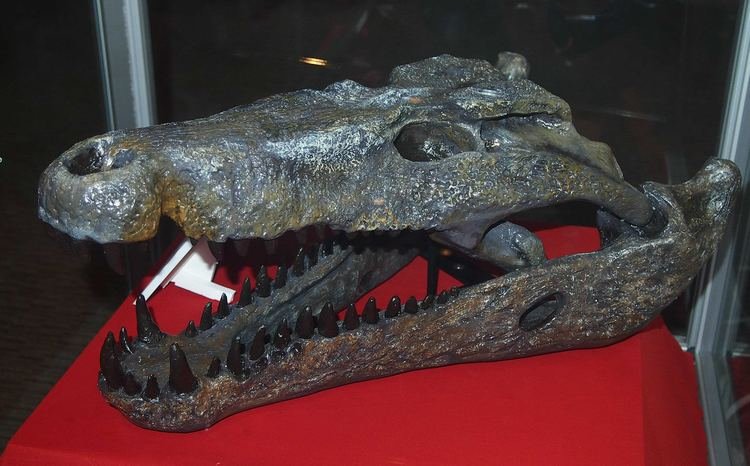
Quinkana fortirostrum
Image: Image sourced via web search (Fair use / Educational)
About Quinkana
Quinkana was a genus of large, terrestrial crocodyliform that roamed Australia from the late Oligocene to the late Pleistocene, representing a unique lineage of land-based predators in an ecosystem dominated by marsupials. As a member of the extinct Mekosuchinae subfamily, it was one of the last and largest of a diverse group of Australasian crocodylians. Its existence highlights a period when reptiles, not mammals, occupied the apex predator niche in many of Australia's terrestrial environments, challenging the conventional narrative of mammalian dominance during the Cenozoic.
Quinkana was a formidable predator, distinguished by a suite of adaptations for a fully terrestrial lifestyle, a stark contrast to its semi-aquatic relatives. The largest species, such as Quinkana fortirostrum, are estimated to have reached lengths of 5 to 7 meters (approximately 16 to 23 feet), making them comparable in size to a large saltwater crocodile, but with a more gracile build. Weight estimates vary, but likely ranged from 200 to 500 kilograms. The most striking feature of Quinkana was its skull, which was deep, narrow, and laterally compressed, unlike the broad, flattened snouts of modern crocodiles. This morphology supported powerful jaw-closing muscles. Its teeth were another key adaptation; they were ziphodont, meaning they were recurved, laterally compressed, and serrated like steak knives. This dentition is convergent with that of theropod dinosaurs and is highly effective for slicing through flesh, indicating a diet of large terrestrial prey. The postcranial skeleton of Quinkana showed significant modifications for life on land. Its limbs were longer and positioned more directly beneath the body than in semi-aquatic crocodilians, facilitating a more efficient, upright gait. This posture would have allowed for greater speed and agility while pursuing prey over open ground, a mode of locomotion often referred to as a 'gallop' or 'bound' in paleontological literature.
As an apex terrestrial predator, Quinkana's paleobiology was centered on hunting large vertebrates. Its ziphodont teeth were ill-suited for the crushing and holding tactics of modern crocodiles, which employ a 'death roll' in water. Instead, Quinkana likely behaved more like a Komodo dragon or a large predatory cat, using ambush tactics or short, powerful bursts of speed to surprise its prey. It would have inflicted deep, slicing wounds with its serrated teeth, causing massive blood loss and shock, and then waited for the animal to weaken before moving in to feed. Its prey would have included the megafauna of Pleistocene Australia, such as the giant wombat-like Diprotodon, large kangaroos like Procoptodon, and giant flightless birds. The structure of its limbs suggests it was capable of moving quickly over land, but it was probably not a sustained pursuit predator. Instead, it would have relied on its size, power, and specialized dentition to overwhelm prey. There is no direct evidence for social behavior, but like many large predators, it may have been a solitary hunter, defending a specific territory. Growth patterns are inferred from other crocodylians, suggesting a slow but steady growth to its immense adult size, with metabolism likely being ectothermic but with some capacity for elevated activity levels during hunts.
Quinkana lived in a version of Australia that was progressively drying out through the Neogene and Quaternary periods. Its habitat ranged from the lush rainforests of the Miocene, as evidenced by fossils from Riversleigh, to the more open woodlands, savannas, and sclerophyll forests of the Pliocene and Pleistocene. The climate was becoming more arid and seasonal, driving the expansion of grasslands and shaping the evolution of the continent's unique fauna. In this ecosystem, Quinkana occupied the niche of the top terrestrial predator, a role filled by large placental mammals on other continents. It co-existed with a remarkable array of megafauna, including the aforementioned Diprotodon, the giant short-faced kangaroo Procoptodon, the 'marsupial lion' Thylacoleo carnifex, and the giant monitor lizard Varanus priscus (megalania). Quinkana would have competed directly with Thylacoleo and Varanus priscus for resources, creating a complex predator guild. Its primary prey were the large herbivorous marsupials that browsed and grazed across the landscape. The extinction of Quinkana around 40,000 years ago coincides with the broader Quaternary extinction event in Australia, which saw the disappearance of most animals weighing over 100 kilograms. This event is linked to a combination of increasing aridity and the arrival of the first humans, whose hunting practices and use of fire may have drastically altered the ecosystem, leading to the collapse of the megafauna food web upon which Quinkana depended.
The discovery history of Quinkana began in the mid-20th century, but the genus was formally named and described by paleontologist Ralph Molnar in 1981. The name 'Quinkana' is derived from the 'Quinkans', supernatural spirits depicted in the rock art of the Aboriginal people of Cape York Peninsula, Queensland, where some of the first fossils were found. The type species, Quinkana fortirostrum, was described based on skull fragments discovered in the Bluff Downs Local Fauna in northern Queensland. The most significant fossil locality for understanding the diversity and evolution of Quinkana is the Riversleigh Fossil Site, a UNESCO World Heritage Site in northwestern Queensland. Discoveries at Riversleigh have yielded numerous specimens from multiple species spanning millions of years, from the Oligocene to the Miocene, providing a detailed record of their evolutionary history. Another important site is the Tea Tree Cave in northern New South Wales, where Pleistocene-era fossils were found. Unlike dinosaurs with popular nicknames, individual Quinkana specimens are not typically given specific names, but the collective fossil material from sites like Riversleigh has been crucial in reconstructing the anatomy and lifestyle of this unique predator.
Quinkana's evolutionary significance lies in its membership within the Mekosuchinae, a diverse and now-extinct subfamily of crocodylians that were endemic to Australia and the southwestern Pacific. This group radiated into a wide variety of ecological niches, including terrestrial, semi-aquatic, and possibly even arboreal forms, showcasing a level of ecological diversity not seen in modern crocodylians. Quinkana represents the pinnacle of the terrestrial adaptation within this lineage. Its evolution demonstrates that crocodylians were not evolutionary dead-ends confined to waterways but were capable of producing highly successful land-based apex predators that could compete with and even supplant mammals. The ziphodont dentition of Quinkana is a remarkable example of convergent evolution, independently evolving a tooth form almost identical to that of theropod dinosaurs and some early synapsids. This highlights how similar ecological pressures can produce similar anatomical solutions in vastly different lineages. The extinction of Quinkana and the rest of the mekosuchines marked the end of this unique evolutionary experiment, leaving only the semi-aquatic saltwater and freshwater crocodiles in Australia today.
While the general understanding of Quinkana as a terrestrial predator is well-established, some scientific debates persist. The primary area of discussion revolves around its exact locomotion and hunting capabilities. While its limb posture was clearly more upright than that of modern crocodiles, the degree of its cursoriality (ability to run) is debated. Some researchers propose it was capable of a fast, bounding gallop, while others suggest it was more of an ambulatory walker, relying on ambush rather than speed. The exact timeline and cause of its extinction also remain a topic of active research. The relative importance of climate change versus human impact (the 'blitz' versus 'grill' hypotheses) in the demise of Australian megafauna, including Quinkana, is a central question in Quaternary paleontology. Furthermore, the taxonomy within the genus is subject to revision as new fossils are discovered. The relationships between the various named species (Q. fortirostrum, Q. babarra, Q. timara, Q. meboldi) and their precise evolutionary pathway through the Cenozoic are continually being refined based on new finds from sites like Riversleigh.
The fossil record of Quinkana is exclusively Australian. Fossils have been found primarily in Queensland, with significant sites including the Riversleigh World Heritage Area, Bluff Downs, and various caves in the Cape York Peninsula. Discoveries have also been made in northern New South Wales. The fossil record consists mostly of disarticulated remains, with teeth being the most commonly found elements due to their durability. Skulls and jaw fragments are also relatively common and are crucial for identifying the genus due to their distinctive ziphodont teeth and deep snout morphology. Complete or even partially articulated skeletons are exceptionally rare, which makes reconstructing the animal's full postcranial anatomy and locomotion challenging. Despite this, the abundance of fragmentary material from well-dated deposits has allowed paleontologists to build a robust understanding of the genus's long history, diversity, and eventual extinction across the Australian continent.
Quinkana has not achieved the same level of mainstream cultural impact as dinosaurs or the saber-toothed cat, but it holds a significant place in Australian paleontology and natural history. It is a popular feature in Australian museums, with institutions like the Queensland Museum and the Australian Museum in Sydney often displaying fossil material and life-sized reconstructions. These exhibits highlight the unique evolutionary story of Australia's extinct megafauna. Quinkana occasionally appears in documentaries about prehistoric life, particularly those focusing on Australia's past, where it is often depicted as the continent's answer to the tyrannosaur. Its role as a top land predator that was not a mammal serves as an important educational tool, challenging public perceptions of Cenozoic ecosystems and showcasing the incredible diversity of reptilian evolution.
Classification
Time Period
Discovery
Location
Australia
Formation
Bluff Downs Local Fauna, Riversleigh Fossil Site, Tea Tree Cave
Frequently Asked Questions
What is Quinkana?
Quinkana was a genus of large, terrestrial crocodyliform that roamed Australia from the late Oligocene to the late Pleistocene, representing a unique lineage of land-based predators in an ecosystem dominated by marsupials. As a member of the extinct Mekosuchinae subfamily, it was one of the last and...
When did Quinkana live?
Quinkana lived during the neogene to quaternary period of the cenozoic era approximately 24-0.04 million years ago.
Where was Quinkana discovered?
Fossils of Quinkana were discovered in Australia in the Bluff Downs Local Fauna, Riversleigh Fossil Site, Tea Tree Cave.
What did Quinkana eat?
Quinkana was a carnivore. It lived in terrestrial habitats.
What type of fossil is Quinkana?
Quinkana is preserved as a body fossil. The preservation quality is good.
Related Specimens
From the cenozoic era · body fossils