Gastornis
Gastornis giganteus
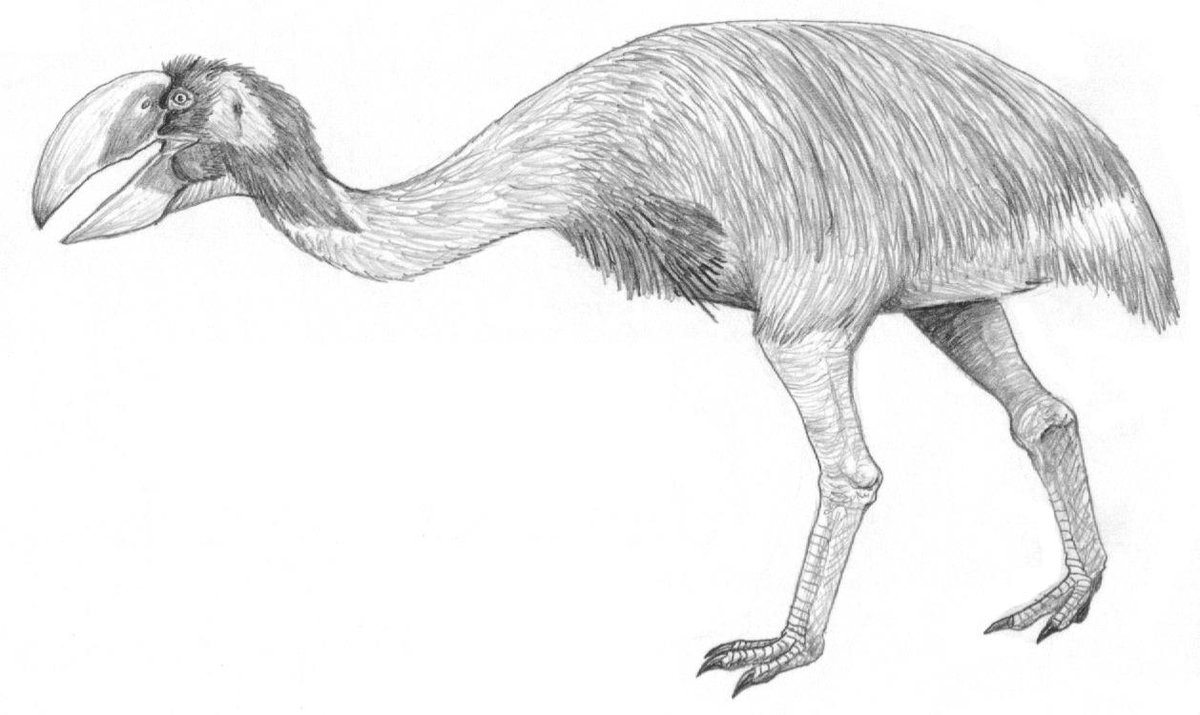
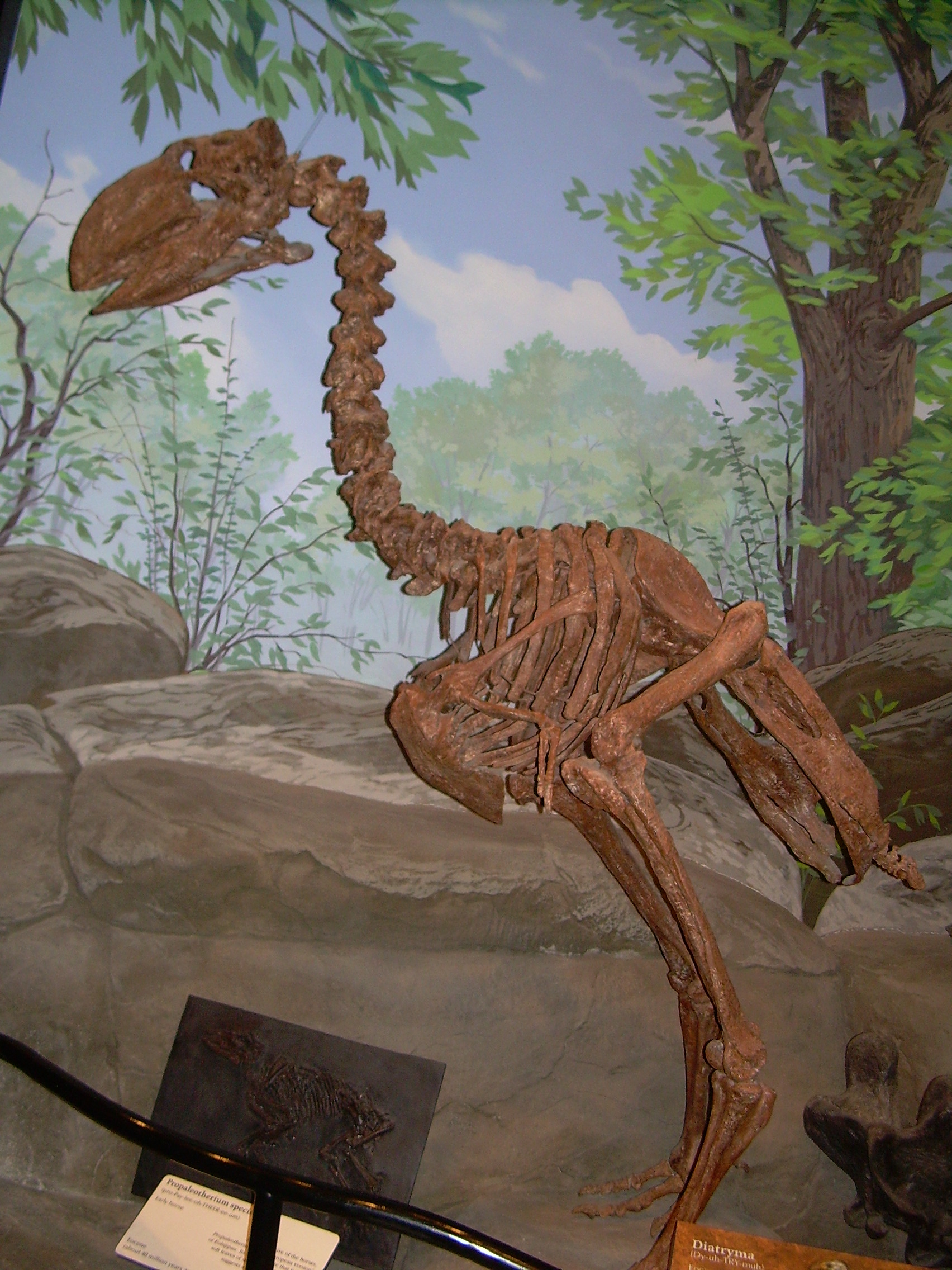
Image: Category:Gastornis gigantea - Wikimedia Commons (CC BY-SA)
About Gastornis
Gastornis giganteus represents one of the most striking examples of avian megafauna to evolve in the wake of the Cretaceous-Paleogene extinction event. This genus of large, flightless birds inhabited the dense, subtropical forests of the Northern Hemisphere during the Paleocene and Eocene epochs, approximately 56 to 45 million years ago. Initially conceived as a fearsome apex predator, a so-called 'terror bird' of the early Cenozoic, modern scientific consensus has dramatically reinterpreted Gastornis as a large terrestrial herbivore, fundamentally altering our understanding of its ecological role and the dynamics of post-dinosaur ecosystems.
Standing approximately 2 meters (6.6 feet) tall at the head, Gastornis was an imposing and powerfully built bird, with an estimated body mass ranging from 100 to 175 kilograms (220 to 385 pounds), comparable to a modern ostrich but with a much more robust and stocky build. Its most distinctive feature was its enormous skull, which could measure up to 45 centimeters (18 inches) in length. The beak was exceptionally deep, laterally compressed, and possessed a slightly hooked tip, a feature that historically fueled the predator hypothesis. Unlike the slender skulls of modern ratites, the skull of Gastornis was heavily reinforced with fused bones, suggesting it was adapted to withstand significant mechanical stress. The neck was thick and muscular, supported by 13 large cervical vertebrae, connecting the massive head to a broad, barrel-chested torso. Its wings were vestigial, reduced to tiny, non-functional appendages akin to the nubs found on some moa species, indicating a complete and long-established commitment to a terrestrial existence. In stark contrast, its legs were massive and pillar-like, with thick tarsometatarsi and broad, four-toed feet that supported its considerable weight. These legs were clearly designed for walking and bearing weight within forest undergrowth, rather than for the high-speed pursuit associated with predatory birds or modern ratites of open plains.
The paleobiology of Gastornis has been a subject of intense scientific investigation and revision. For over a century, its massive, hooked beak was interpreted as a tool for dismembering prey, leading to its popular depiction as a hunter of small, early mammals like Eohippus. However, this view has been largely overturned by a convergence of evidence. Biomechanical studies of its jaw musculature, led by researchers like Lawrence Witmer, revealed that while the bite force was powerful, the skull was not well-adapted for struggling with prey or tearing flesh. Instead, the jaw's structure was more consistent with a crushing or shearing action, ideal for processing tough plant matter. This hypothesis was significantly bolstered by geochemical analysis. Calcium isotope studies conducted by Delphine Angst and her colleagues on fossilized Gastornis bones showed isotopic ratios consistent with a diet of plants, which absorb calcium differently than animals. Furthermore, the absence of raptorial talons on its broad, sturdy feet undermines the predator hypothesis, as it lacked the primary grasping and killing tools of predatory birds. Its locomotion was likely a steady, deliberate walk through the forest floor, where it used its formidable beak to crack open large, hard-shelled nuts and seeds, or to shear tough, fibrous vegetation. Inferred behavior suggests it was a diurnal forager, possibly living in small groups or pairs, with its large size providing a defense against the few potential predators of its time.
Gastornis lived during a period of profound global warmth known as the Paleocene-Eocene Thermal Maximum (PETM), when subtropical and tropical forests extended far into the higher latitudes. The environment of the Willwood Formation in Wyoming, where many North American specimens are found, was a warm, humid, and densely forested floodplain crisscrossed by rivers and swamps. This lush ecosystem supported a diverse array of flora and fauna. Gastornis shared its habitat with an emerging cast of mammalian herbivores, including the small, multi-toed ancestor of the horse, Eohippus (now Hyracotherium), and early primates like Cantius. Potential predators were present but generally smaller than the giant bird; these included early creodonts like Oxyaena and the mesonychid Pachyaena. In this context, Gastornis occupied the niche of a large, ground-dwelling primary consumer, a role left vacant by the extinction of the large herbivorous dinosaurs. Its position in the food web was that of a high-volume forager, processing plant material that smaller mammals could not. Its size would have made it a formidable presence, likely deterring most predators and allowing it to dominate the forest floor's herbivorous guild.
The history of Gastornis begins in Europe with the discovery of the type species, Gastornis parisiensis, in the Geiseltal deposits near Paris, France, in 1855. These initial remains were described by Gaston Planté and later named in his honor by paleontologist Alphonse Milne-Edwards. Across the Atlantic, the North American counterpart was discovered decades later. In 1876, the renowned American paleontologist Edward Drinker Cope unearthed a partial skeleton in the Wasatch Formation of New Mexico. Believing it to be a distinct genus, he named it Diatryma gigantea, a name that would become widely recognized for over a century. For many years, the European and North American forms were considered separate but related genera. However, as more complete skeletons were found, including a nearly complete specimen from the Willwood Formation in Wyoming's Bighorn Basin in the early 20th century, paleontologists began to note the striking similarities. By the late 20th century, a comprehensive review by researchers like Larry Martin demonstrated that the anatomical differences were insufficient to warrant separate generic status. Following the principle of priority in scientific nomenclature, the older European name, Gastornis, was officially adopted for all species, with the North American form being reclassified as Gastornis giganteus.
The evolutionary significance of Gastornis lies in its status as one of the first major evolutionary experiments in avian gigantism following the demise of the non-avian dinosaurs. It belongs to the extinct order Gastornithiformes, a group whose precise placement within the avian family tree has been debated. For a time, they were thought to be related to cranes and rails (Gruiformes), but more recent phylogenetic analyses place them within the Anseriformes, the group that includes modern ducks, geese, and swans. This makes Gastornis a very early, highly specialized offshoot of the waterfowl lineage that adapted to a fully terrestrial, herbivorous lifestyle. It demonstrates the remarkable evolutionary plasticity of birds and their ability to rapidly radiate into and dominate ecological niches previously occupied by dinosaurs. Gastornis was not a "living fossil" or a holdover from the Mesozoic, but a thoroughly Cenozoic creation, showcasing how life rebounded and diversified in a world without giant reptiles. Its existence underscores a critical period of ecological restructuring when birds, for a brief geological moment, became the largest land animals in many ecosystems.
The most prominent scientific debate surrounding Gastornis has been the century-long controversy over its diet. The "killer bird" hypothesis, popularized by paleontologists like William Diller Matthew and Walter Granger in the early 20th century, was based almost entirely on the superficial resemblance of its beak to that of predatory birds. This interpretation became deeply entrenched in both scientific literature and popular culture. The shift towards an herbivorous model began in the latter half of the 20th century, with anatomical arguments pointing to the lack of raptorial features. The debate was largely settled in the 21st century with the advent of new analytical techniques. The biomechanical and isotopic evidence presented by researchers like Angst, Ericson, and Witmer provided strong, direct evidence for herbivory, leading to a widespread scientific consensus. A secondary, less contentious debate involves its taxonomy; while the synonymy of Diatryma with Gastornis is now accepted, the exact number of valid species within the genus and its precise relationship to other early Cenozoic birds, like the South American terror birds (Phorusrhacids), remain areas of active research.
The fossil record of Gastornis, while not abundant, is geographically widespread across the Northern Hemisphere, with key specimens found in western Europe (France, Germany, United Kingdom) and western North America (Wyoming, New Mexico, Colorado). The North American fossils, primarily attributed to Gastornis giganteus, are most famously recovered from the Willwood and Wasatch Formations of the Bighorn and Powder River Basins. While complete, articulated skeletons are exceptionally rare, numerous partial skeletons, isolated bones, and skull fragments have been collected. The quality of preservation is often excellent, allowing for detailed anatomical and geochemical studies. One of the most important North American specimens is the nearly complete skeleton housed at the American Museum of Natural History, which formed the basis for many early reconstructions. Fossilized footprints, assigned to the ichnogenus Rivavipes, have also been discovered in Washington state and are believed to have been made by Gastornis, providing direct evidence of its locomotion and foot structure.
Despite the scientific reclassification of its diet, the dramatic image of Gastornis as a "terror bird" has left a lasting cultural impact. For decades, museum displays, including the iconic one at the American Museum of Natural History, depicted it menacingly standing over a cowering Eohippus. This powerful imagery cemented its place in popular culture through books, documentaries like "Walking with Beasts," and films, where it is almost invariably portrayed as a ferocious predator. Although this depiction is now known to be inaccurate, it has made Gastornis one of the most recognizable prehistoric birds after Archaeopteryx. Its story serves as a powerful educational tool, illustrating the dynamic nature of scientific inquiry and how new evidence can fundamentally reshape our understanding of the deep past.
Classification
Time Period
Discovery
Location
North America (Wyoming and New Mexico)
Formation
Willwood Formation
Frequently Asked Questions
What is Gastornis?
Gastornis giganteus represents one of the most striking examples of avian megafauna to evolve in the wake of the Cretaceous-Paleogene extinction event. This genus of large, flightless birds inhabited the dense, subtropical forests of the Northern Hemisphere during the Paleocene and Eocene epochs, ap...
When did Gastornis live?
Gastornis lived during the paleogene period of the cenozoic era approximately 56-45 million years ago.
Where was Gastornis discovered?
Fossils of Gastornis were discovered in North America (Wyoming and New Mexico) in the Willwood Formation.
What did Gastornis eat?
Gastornis was a herbivore. It lived in terrestrial habitats.
What type of fossil is Gastornis?
Gastornis is preserved as a permineralized fossil. The preservation quality is good.
Related Specimens
From the cenozoic era · permineralized fossils