Inoceramus
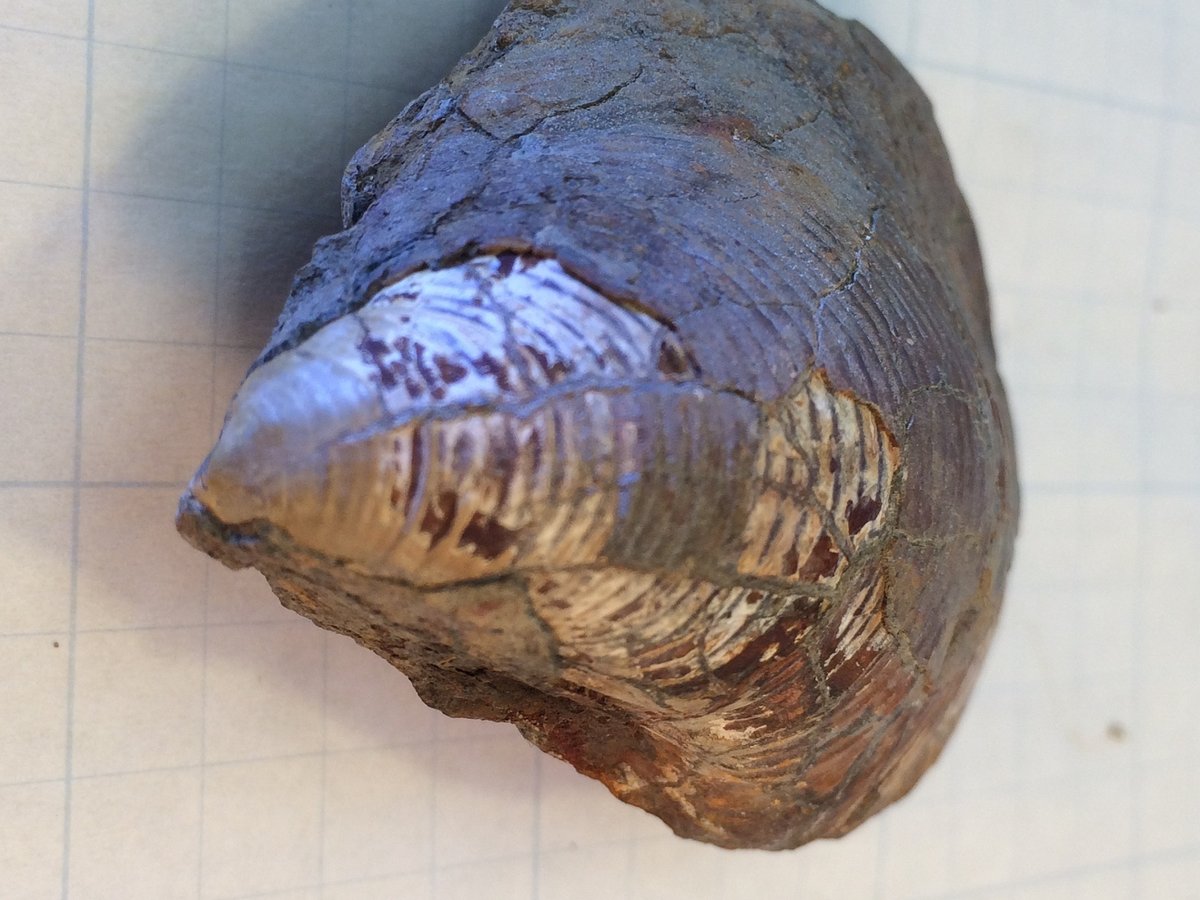
Inoceramus labiatus
Image: Image sourced via web search (Fair use / Educational)
About Inoceramus
Inoceramus is a genus of extinct marine bivalve mollusks that flourished globally during the Cretaceous Period, approximately 100 to 66 million years ago. These giant relatives of modern oysters and clams are renowned for their enormous size and widespread distribution, making them one of the most important index fossils for dating Cretaceous marine sedimentary rocks. Their fossilized shells, often found in vast beds, provide critical insights into the paleoecology of ancient oceans, particularly the Western Interior Seaway of North America.
The physical characteristics of Inoceramus are striking, primarily due to their potential for gigantism. While many species, such as the type species Inoceramus cuvieri, were moderately sized at 10-30 centimeters in diameter, some species like Inoceramus (Platyceramus) platinus could achieve truly colossal dimensions, with shells reaching up to 3 meters (nearly 10 feet) in diameter. This makes them among the largest bivalves ever to have lived, dwarfing even the largest modern giant clams. The shells were typically inequivalve, meaning the two valves were not symmetrical, and often had a thin, flattened, or gently curved profile. The shell's exterior was characterized by distinctive, concentric, rib-like undulations or growth lines, which are a key identifying feature. The shell itself was composed of a unique prismatic calcite structure, with large, vertically oriented crystals. This microstructure made the shells relatively fragile post-mortem, which is why complete, articulated specimens are less common than fragmented shell pieces. The inner layer was nacreous, or mother-of-pearl, and exceptionally well-preserved fossils can still exhibit this iridescent sheen. Due to their immense size, it is estimated that a large individual could have weighed over 50 kilograms, including the soft tissues.
As a bivalve, Inoceramus was a sessile, benthic organism, living on or partially buried in the soft, muddy seafloor of epicontinental seas. Its paleobiology was that of a classic filter-feeder, using its gills to strain plankton and organic detritus from the water column. Its enormous size suggests a highly efficient feeding mechanism and a rich supply of nutrients in the Cretaceous oceans. The broad, flat shape of many Inoceramus species is interpreted as an adaptation to living on soft, anoxic or dysoxic (low-oxygen) substrates, a condition known as the 'snowshoe' strategy. By distributing its weight over a large surface area, the animal avoided sinking into the fine sediment. This adaptation was crucial for survival in the deep, poorly-circulated waters of basins like the Western Interior Seaway. Growth patterns, visible in the concentric rings on their shells, indicate that they grew relatively quickly. Isotopic analysis of their shells has been instrumental in reconstructing Cretaceous ocean temperatures, revealing information about climate fluctuations and seasonality. Some Inoceramus shells are found with epibionts like smaller oysters or barnacles attached, indicating they provided a hard substrate for other life on an otherwise soft seafloor. It is believed they were largely solitary, though they often formed dense accumulations or 'pavements' after death.
The ecological context of Inoceramus was the warm, high-sea-level world of the Late Cretaceous. They were a dominant component of the benthic fauna in the Western Interior Seaway, a vast inland sea that split North America in two, as well as the Tethys Ocean and other global marine environments. The seafloor they inhabited was often a low-oxygen environment, inhospitable to many other organisms, allowing Inoceramus to thrive with little competition. The water column above teemed with life, including massive marine reptiles like mosasaurs and plesiosaurs, which may have been occasional predators, crushing the shells to get at the soft body within. Ammonites, another key Cretaceous index fossil, were abundant in these seas, as were various species of fish, sharks like Squalicorax, and early seabirds such as Hesperornis. The plankton-rich waters that fed Inoceramus were fueled by high global temperatures and active oceanic circulation patterns. The eventual extinction of Inoceramus at the end of the Cretaceous, along with the dinosaurs and ammonites, was part of the catastrophic Cretaceous-Paleogene (K-Pg) mass extinction event, which radically altered marine ecosystems worldwide.
The discovery history of Inoceramus dates back to the early days of paleontology. The genus was first named by British naturalist James Sowerby in 1814. The name 'Inoceramus' derives from Greek roots meaning 'fiber' or 'sinew' (inos) and 'pottery' or 'earthen vessel' (keramos), likely referencing the fibrous appearance of the weathered shell's prismatic layer. Fossils were among the first to be systematically collected and described from the Cretaceous chalk deposits of England and continental Europe. In North America, paleontologists like F.B. Meek and F.V. Hayden, exploring the American West in the mid-19th century, documented vast beds of Inoceramus shells in formations like the Niobrara and Pierre Shale. One of the most famous specimens is a massive slab housed at the Sternberg Museum of Natural History in Kansas, showcasing an enormous Inoceramus (Platyceramus) platinus shell that is over 2 meters in diameter. These discoveries were fundamental in establishing the stratigraphy of the American West and correlating rock layers across continents, cementing the genus's role as a premier biostratigraphic tool for geologists.
Inoceramus holds significant evolutionary importance within the Mollusca. As members of the Pterioida order, they are related to modern pearl oysters and pen shells. Their evolutionary history represents a remarkable case of adaptive radiation and specialization for life in the unique environments of the Mesozoic. The development of their specialized prismatic shell structure and their adaptation to dysoxic seafloor conditions showcase an evolutionary pathway distinct from many other bivalve lineages. Their global distribution and rapid speciation throughout the Cretaceous make them an ideal subject for studying evolutionary rates and biogeographic patterns. The extinction of the entire Inoceramidae family at the K-Pg boundary marks a major turning point in the history of marine benthic ecosystems. Their ecological niche as giant, low-oxygen tolerant filter-feeders was left vacant, and it was not until millions of years later that other bivalve groups began to diversify and fill similar roles, though none ever reclaimed the same gigantic proportions.
Despite being a well-established genus, Inoceramus is not without its scientific debates. The primary area of contention is its taxonomy. The genus has historically been a 'wastebasket taxon,' with hundreds of species assigned to it over the past two centuries. Modern paleontological revisions, using more rigorous cladistic analysis, have suggested that the genus is paraphyletic, meaning it does not contain all descendants of a single common ancestor. Consequently, many former Inoceramus species have been reassigned to new or different genera, such as Platyceramus for the giant, flat-shelled forms. There is also ongoing research into the precise reasons for their gigantism. Hypotheses range from metabolic adaptations to low-oxygen environments (the 'respiratory hypothesis') to the stability and nutrient richness of the Cretaceous seas. Isotopic studies continue to refine our understanding of their paleoecology, sometimes challenging older interpretations of water depth and temperature.
The fossil record of Inoceramus is exceptionally rich and geographically widespread. Their fossils are found in Cretaceous marine sediments on every continent, including Antarctica. They are particularly abundant in the chalk formations of Europe and the shales and limestones of the North American Western Interior Seaway. Famous fossil sites include the English Chalk, the Niobrara Formation of Kansas and Nebraska, and the Pierre Shale of the Dakotas. The fossils typically consist of the calcite shells, which preserve well. Because the two valves were held together by a ligament that decayed after death, fossils are often found as single, disarticulated valves. However, vast 'pavements' or beds containing thousands of shells are common, indicating mass mortality events or areas of high population density. The unique prismatic calcite layer often breaks down into small, prism-shaped fragments, which can form a significant component of the surrounding sedimentary rock, sometimes creating layers known as 'inoceramite'.
While not as famous as dinosaurs, Inoceramus has a notable cultural impact, particularly within the geological and paleontological communities. They are a staple of museum collections worldwide that feature Cretaceous marine life. The sheer size of specimens like those at the Sternberg Museum or the Canadian Fossil Discovery Centre makes for an impressive and educational display, effectively communicating the scale of ancient life. For fossil collectors, especially in the American Midwest, Inoceramus shells are a common and prized find. They serve as a crucial educational tool, teaching students about concepts like index fossils, biostratigraphy, and the ancient environments that once existed in the heart of modern continents. Their presence in the rock record is a tangible link to the lost world of the Cretaceous oceans.
Classification
Time Period
Discovery
Location
Europe (specifically Germany and England)
Formation
Western Interior Seaway deposits (e.g., Niobrara Formation, Greenhorn Limestone)
Frequently Asked Questions
What is Inoceramus?
Inoceramus is a genus of extinct marine bivalve mollusks that flourished globally during the Cretaceous Period, approximately 100 to 66 million years ago. These giant relatives of modern oysters and clams are renowned for their enormous size and widespread distribution, making them one of the most i...
When did Inoceramus live?
Inoceramus lived during the cretaceous period of the mesozoic era approximately 100-66 million years ago.
Where was Inoceramus discovered?
Fossils of Inoceramus were discovered in Europe (specifically Germany and England) in the Western Interior Seaway deposits (e.g., Niobrara Formation, Greenhorn Limestone).
What did Inoceramus eat?
Inoceramus was a filter-feeder. It lived in marine, deep-sea, benthic habitats.
What type of fossil is Inoceramus?
Inoceramus is preserved as a body fossil. The preservation quality is good.
Related Specimens
From the mesozoic era · body fossils