Hybodus
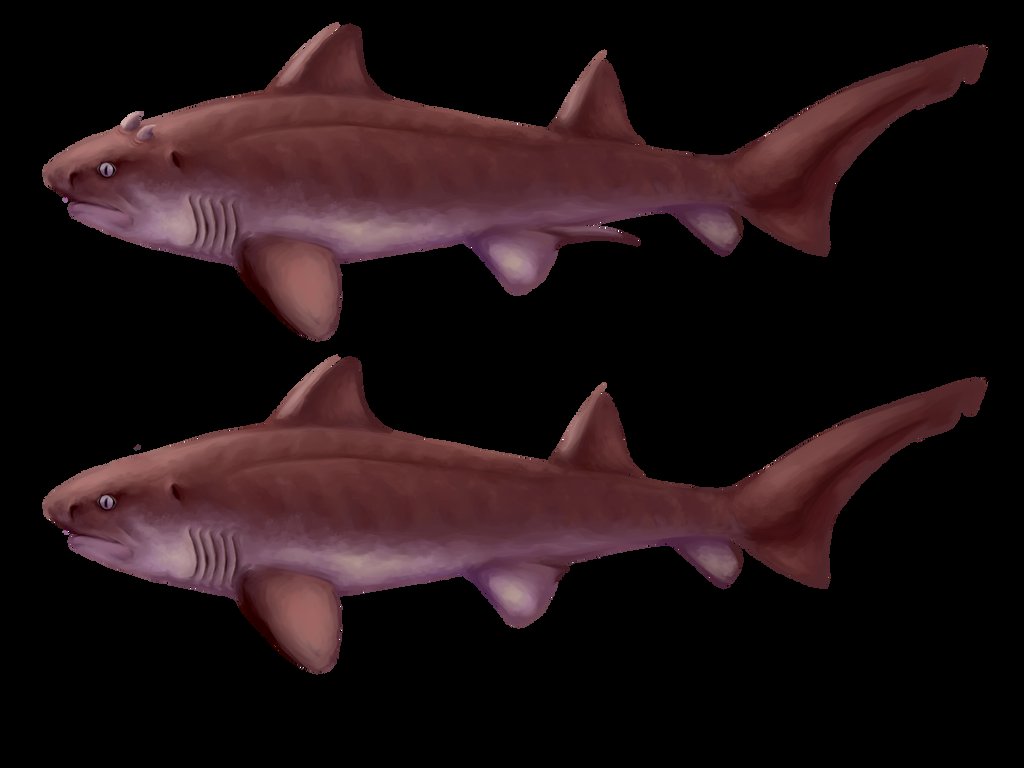
Hybodus hauffianus
Image: Image sourced via web search (Fair use / Educational)
About Hybodus
Hybodus was a highly successful and widespread genus of shark that thrived in the oceans of the Mesozoic Era, particularly during the Jurassic Period. First appearing in the Permian and surviving until the Late Cretaceous, this long-lived genus represents a crucial branch in the evolutionary story of sharks, showcasing a suite of adaptations that allowed it to flourish for over 150 million years. Its fossils, found globally, provide paleontologists with a detailed window into the marine ecosystems of the age of dinosaurs, revealing a versatile predator that occupied a significant niche before the rise of modern shark lineages. The species Hybodus hauffianus, known from exceptionally preserved fossils in Germany, is a key representative that illuminates the anatomy and biology of this important group.
Hybodus was a moderately sized shark, with most species, including H. hauffianus, reaching an average length of approximately 2 meters (6.5 feet), comparable to a modern Caribbean reef shark. Its body plan was classically shark-like and streamlined, suggesting it was an active and agile swimmer. One of its most distinctive features was the presence of two dorsal fins, each preceded by a prominent, sharp, and often ornamented spine. These fin spines, which are commonly found as fossils, likely served a defensive purpose, making the shark a more difficult meal for larger marine reptiles like pliosaurs. Another key characteristic was its unique dentition, known as heterodonty. Hybodus possessed two distinct types of teeth in its jaws: sharp, pointed teeth at the front for seizing and tearing soft-bodied prey like fish and squid, and flattened, molar-like crushing teeth at the back for breaking the shells of hard-bodied prey such as crustaceans, ammonites, and bivalves. Furthermore, male specimens of Hybodus are distinguished by a pair of prominent, hook-like cephalic claspers on their head, just behind the eyes. These structures, absent in females, are thought to have been used to grasp the female's pectoral fin during mating, a feature not seen in modern sharks and representing a unique reproductive adaptation among the Hybodontiformes.
Hybodus was an opportunistic and versatile carnivore, a conclusion strongly supported by its heterodont dentition. Its feeding strategy was not specialized but rather adapted to a wide variety of available food sources. The sharp anterior teeth were ideal for capturing slippery, fast-moving prey, while the robust posterior teeth allowed it to exploit the abundant shelled invertebrates on the seafloor. This dietary flexibility was likely a key factor in its long-term evolutionary success, enabling it to thrive in diverse marine environments and adapt to changing prey availability. Stomach contents from exceptionally preserved fossils have confirmed this varied diet, containing remains of fish, belemnites (squid-like cephalopods), and crustaceans. In terms of locomotion, its streamlined body, powerful tail, and well-developed fins indicate it was a capable swimmer, though perhaps not as fast as the swiftest modern sharks like the mako. It likely employed a cruising swimming style, patrolling shallow coastal waters, reefs, and epicontinental seas in search of food. The presence of cephalic claspers on males suggests complex mating behaviors, possibly involving elaborate courtship rituals before copulation, where the male would secure the female to facilitate the internal fertilization common to all sharks.
During the Jurassic Period, Hybodus inhabited a world very different from our own. It swam in the warm, shallow waters of epicontinental seas like the Tethys Ocean, which covered much of modern-day Europe. The climate was generally warmer and more humid, with higher sea levels creating vast marine ecosystems teeming with life. Hybodus was a mid-level predator, an integral part of a complex food web. It shared its environment with a diverse array of marine creatures, including other fish like the large predatory Leedsichthys, various species of ammonites and belemnites which it preyed upon, and numerous marine reptiles. It had to be wary of larger predators that occupied the apex positions in the ecosystem. These included formidable pliosaurs such as Liopleurodon and ichthyosaurs like Ophthalmosaurus. The defensive fin spines of Hybodus may have evolved specifically as a deterrent against such powerful adversaries. Its role as a generalist predator meant it helped regulate the populations of smaller fish and invertebrates, contributing to the overall stability and health of the Jurassic marine environment. Its widespread distribution across the globe indicates its ability to adapt to various local conditions within these ancient seas.
The genus Hybodus was first described by the Swiss-American naturalist Louis Agassiz in his monumental work "Recherches sur les Poissons Fossiles" (Research on Fossil Fishes), published between 1833 and 1843. Agassiz, a pioneer in paleoichthyology, established the genus based on isolated fossil teeth and fin spines, which were relatively common finds in Mesozoic marine deposits across Europe. The name "Hybodus" translates to "humped tooth," referring to the prominent central cusp of its teeth. One of the most significant species, Hybodus hauffianus, was named in honor of the Hauff family, who were instrumental in the excavation and preparation of fossils from the Posidonia Shale of Holzmaden, Germany. The Holzmaden lagerstätte has yielded some of the most complete and exquisitely preserved Hybodus specimens in the world. These fossils, such as those housed in the Hauff Museum, are not just skeletons but often include carbonized impressions of skin, muscle tissue, and even internal organs, providing unparalleled insights into the shark's anatomy and biology. These remarkable finds transformed the understanding of Hybodus from an animal known only from teeth and spines into a well-understood organism with a detailed physical appearance and known dietary habits.
Hybodus belongs to the order Hybodontiformes, an extinct group of sharks that represents a crucial evolutionary link between the primitive Paleozoic sharks and the modern sharks (Neoselachii) that dominate today's oceans. Hybodonts were the dominant group of sharks throughout the Mesozoic Era. They showcase a mosaic of ancestral and derived traits. While they retained some primitive features like a terminal mouth (positioned at the front of the snout, rather than underslung like in many modern sharks) and two spined dorsal fins, they also displayed advanced characteristics such as more complex fin structures and the specialized heterodont dentition. This combination of features highlights their transitional nature. They were more advanced than the ancient xenacanths of the Paleozoic but were eventually outcompeted and replaced by the more adaptable and efficient neoselachians, which include the ancestors of great whites, hammerheads, and reef sharks, following the Cretaceous-Paleogene extinction event. Studying Hybodus and its relatives is therefore essential for understanding the major evolutionary radiations and extinctions that shaped the 450-million-year history of sharks, providing a clear picture of what a successful, non-modern shark looked like and how it functioned within its ecosystem.
While the general anatomy and lifestyle of Hybodus are well-established, some scientific debates persist. The precise function of the cephalic claspers on the heads of males remains a topic of discussion. While their role in mating is widely accepted, the exact mechanics of how they were used to grip the female without causing injury is still being investigated. Furthermore, the taxonomy within the genus Hybodus itself has been subject to revision. Historically, Hybodus became a "wastebasket taxon," where many isolated Mesozoic shark teeth and spines of uncertain affinity were assigned. Modern paleontological practice, employing more rigorous comparative anatomy, has led to the re-evaluation of many of these species, with some being assigned to new genera. This ongoing taxonomic cleanup is refining our understanding of hybodont diversity and their evolutionary relationships. Recent discoveries of new hybodont species from different parts of the world continue to add complexity to their family tree, challenging previous assumptions about their distribution and diversification patterns throughout the Mesozoic.
The fossil record of Hybodus is extensive and geographically widespread, reflecting its success and longevity. Fossils attributed to the genus have been found on every continent, including Antarctica, in marine deposits dating from the Permian to the Late Cretaceous. The most common fossils are isolated teeth and dorsal fin spines, which are durable and preserve well. However, complete or near-complete articulated skeletons are much rarer but provide the most valuable scientific information. The most famous and important fossil sites for Hybodus are the Jurassic lagerstätten of Europe, particularly the Posidonia Shale near Holzmaden in Germany and the Solnhofen Limestone, also in Germany. These sites are renowned for their exceptional preservation, which captures soft tissue outlines and stomach contents, offering a holistic view of the animal. Other significant finds have been made in the Jurassic marine clays of England and throughout North America, providing a robust dataset for studying the genus's global presence and ecological role over millions of years.
Hybodus has made a notable impact on popular culture as a quintessential prehistoric shark. It is frequently featured in documentaries about Mesozoic marine life, such as the BBC's "Walking with Dinosaurs" special "Sea Monsters," where it was depicted as a common mid-sized predator of the Jurassic seas. Its distinctive appearance, with its head claspers and spined fins, makes it a memorable and easily recognizable creature for public audiences. Major natural history museums around the world, including the Natural History Museum in London and the Senckenberg Museum in Frankfurt, often display impressive fossils of Hybodus, showcasing the exceptional preservation from German lagerstätten. These displays serve an important educational role, illustrating the deep evolutionary history of sharks and highlighting that the oceans of the past were inhabited by creatures just as fascinating as the dinosaurs on land.
Classification
Time Period
Discovery
Location
Germany
Formation
Posidonia Shale
Frequently Asked Questions
What is Hybodus?
Hybodus was a highly successful and widespread genus of shark that thrived in the oceans of the Mesozoic Era, particularly during the Jurassic Period. First appearing in the Permian and surviving until the Late Cretaceous, this long-lived genus represents a crucial branch in the evolutionary story o...
When did Hybodus live?
Hybodus lived during the jurassic period of the mesozoic era approximately 200-150 million years ago.
Where was Hybodus discovered?
Fossils of Hybodus were discovered in Germany in the Posidonia Shale.
What did Hybodus eat?
Hybodus was a carnivore. It lived in marine, reef, shallow-sea habitats.
What type of fossil is Hybodus?
Hybodus is preserved as a body fossil. The preservation quality is excellent.
Related Specimens
From the mesozoic era · body fossils
/c81e708ee030.png)