Archaeocidaris
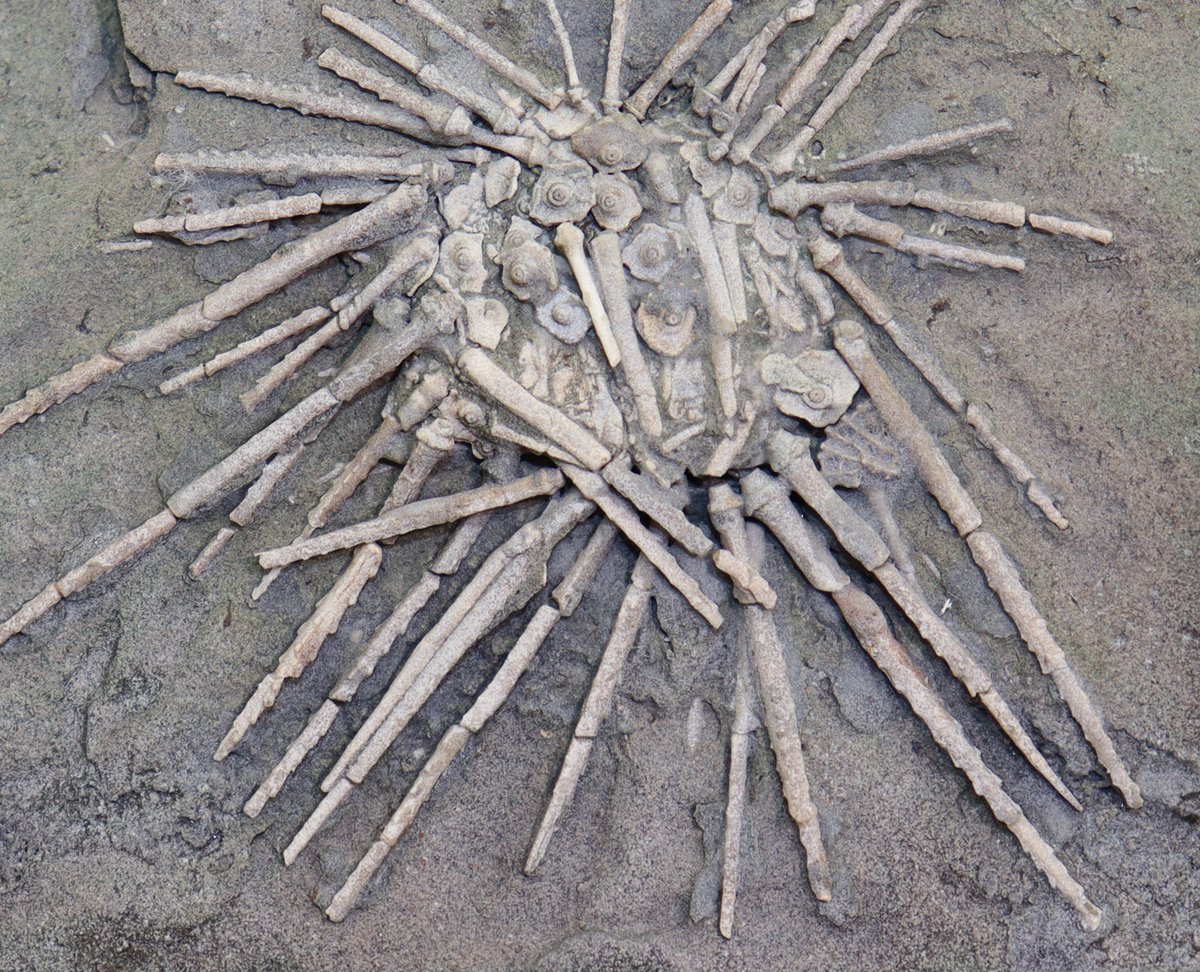
Archaeocidaris brownwoodensis
Image: Image sourced via web search (Fair use / Educational)
About Archaeocidaris
Archaeocidaris brownwoodensis is an extinct species of primitive sea urchin that inhabited the shallow, warm epicontinental seas of the Carboniferous period, approximately 325 to 300 million years ago. Discovered primarily in the rich fossiliferous deposits of Texas, this remarkable echinoderm represents a crucial transitional phase in the evolutionary history of sea urchins. Its significance in paleontology lies in its unique anatomical structure, which bridges the gap between the earliest, heavily armored echinoderms of the Paleozoic and the more familiar, rigid-tested sea urchins that populate modern oceans. By studying Archaeocidaris, paleontologists gain invaluable insights into the adaptive strategies and morphological innovations that allowed echinoids to survive the devastating mass extinctions that punctuated Earth's history.
The physical anatomy of Archaeocidaris brownwoodensis presents a fascinating contrast to extant sea urchins. The central body, or test, typically measured between 5 and 10 centimeters in diameter, though the sprawling spines would have made the living animal appear significantly larger, perhaps reaching up to 20 centimeters across. Unlike modern sea urchins, which possess a rigid, fused test composed of tightly interlocking calcareous plates, Archaeocidaris featured a flexible test. The interambulacral plates were imbricating, meaning they overlapped one another like the shingles on a roof or the scales of a fish. This flexibility allowed the test to expand and contract, potentially aiding in respiration or locomotion, but it also made the organism highly susceptible to post-mortem disarticulation. The most visually striking feature of Archaeocidaris was its formidable array of primary spines. These spines were exceptionally long, robust, and heavily ornamented with tiny, forward-pointing thorns or serrations. Each primary spine was attached to a prominent, perforated tubercle on the test via a ball-and-socket joint, granting the urchin a wide range of motion for defense and movement. Surrounding the base of these massive primary spines were smaller, secondary spines that formed a dense, protective underbrush. At the oral pole of the test, Archaeocidaris possessed a complex chewing apparatus known as Aristotle's lantern, composed of five powerful, constantly growing jaws tipped with hard teeth, optimized for scraping and crushing.
In terms of paleobiology, Archaeocidaris brownwoodensis was a benthic organism, spending its life navigating the muddy and carbonate-rich substrates of the Carboniferous seafloor. Based on the robust structure of its Aristotle's lantern, it is widely classified as an omnivorous grazer and detritivore. It likely fed by scraping algae, encrusting organisms, and microbial mats from rocks and shells, while also scavenging decaying organic matter and occasionally consuming small, slow-moving invertebrates. The heavily calcified teeth were capable of breaking down tough materials, allowing the urchin to exploit a wide variety of food sources in its environment. Locomotion was achieved through a coordinated effort of its water vascular system and its muscular spines. Hundreds of tiny, fluid-filled tube feet extended through pores in the ambulacral plates, providing suction and sensory input, while the large primary spines acted as stilts or levers to push the animal across the uneven ocean floor. This dual system of movement allowed Archaeocidaris to traverse both soft muds and hard reef structures with relative ease. Socially, while echinoids are not known for complex interactions, it is highly probable that Archaeocidaris formed dense aggregations in areas of abundant food or during spawning events, similar to modern sea urchins. Reproduction was undoubtedly achieved through broadcast spawning, releasing millions of eggs and sperm into the water column, where the resulting planktonic larvae would drift for weeks before settling onto the substrate and metamorphosing into juvenile urchins. Growth was continuous, with the calcareous plates and spines adding new material in concentric rings, a process that required a steady intake of calcium carbonate from the surrounding seawater.
The ecological context of Archaeocidaris brownwoodensis is rooted in the dynamic and biologically diverse marine environments of the late Paleozoic era. During the Carboniferous period, much of what is now North America was submerged beneath shallow, tropical epicontinental seas. The climate was generally warm and humid, supporting massive coastal coal swamps on land and vibrant, reef-like ecosystems in the water. The seafloor was dominated by extensive meadows of crinoids, whose towering, flower-like bodies created a complex, three-dimensional habitat. Archaeocidaris navigated through the dense holdfasts and stems of these crinoids, alongside a rich community of brachiopods, bryozoans, rugose corals, and early bivalves. In this bustling ecosystem, Archaeocidaris occupied a critical position in the food web as a primary consumer and detritivore, helping to recycle nutrients and control the growth of algal mats. However, it was also a target for a growing array of specialized predators. The Carboniferous seas were patrolled by formidable hunters, including large nautiloid cephalopods, early ammonoids, and a diverse radiation of chondrichthyans. Some of these early sharks, such as the shell-crushing bradyodonts, possessed flattened, pavement-like teeth specifically adapted for breaking open the hard shells of invertebrates. The long, serrated spines of Archaeocidaris served as a crucial evolutionary defense mechanism against these durophagous predators, making the urchin a difficult and painful meal to consume.
The discovery history of Archaeocidaris brownwoodensis is intimately tied to the rich paleontological heritage of Texas. The species derives its specific epithet, brownwoodensis, from the city of Brownwood in Brown County, Texas, a region renowned for its exceptional Pennsylvanian-age fossil deposits. The first significant specimens were unearthed in the mid-20th century by geologists and amateur fossil hunters exploring the outcrops of the Winchell Formation and surrounding strata. These geological formations, composed of alternating layers of limestone and shale, represent the cyclical rise and fall of sea levels during the Carboniferous. The formal description and naming of the species were undertaken by invertebrate paleontologists who recognized the distinct morphological characteristics of its spines and plates compared to other Archaeocidaris species found in Europe and the midwestern United States. One of the most famous localities for finding this species is the Brownwood Spillway, an artificial excavation created for flood control that inadvertently exposed highly fossiliferous layers of ancient seafloor. Here, collectors have found thousands of isolated spines and plates, though complete tests remain an exceedingly rare prize. The meticulous work of researchers in cataloging these fragmented remains has been instrumental in reconstructing the anatomy and life history of this ancient echinoid, turning a collection of scattered parts into a coherent picture of a living, breathing organism.
The evolutionary significance of Archaeocidaris cannot be overstated, as it occupies a pivotal position near the base of the echinoid family tree. It belongs to the subclass Perischoechinoidea, a paraphyletic grouping of primitive sea urchins that flourished during the Paleozoic. Archaeocidaris is considered a stem-group representative of the Cidaroida, the order that includes modern pencil urchins. By studying Archaeocidaris, scientists can trace the evolutionary trajectory from the flexible, multi-plated tests of early Paleozoic echinoids to the rigid, twenty-columned tests that characterize almost all post-Paleozoic sea urchins. The overlapping, imbricating plates of Archaeocidaris represent an ancestral condition that provided flexibility but perhaps lacked the structural integrity needed to withstand the increasingly powerful crushing jaws of Mesozoic predators. The transition to a rigid test, which occurred in later echinoid lineages, was a major evolutionary innovation that allowed sea urchins to survive the Permian-Triassic mass extinction, an event that wiped out the vast majority of Paleozoic echinoderms, including the last of the flexible-tested archaeocidarids. Furthermore, the complex structure of the primary spines and the advanced articulation of the tubercles in Archaeocidaris demonstrate that many of the sophisticated defensive and locomotory adaptations seen in modern sea urchins were already well-established over 300 million years ago.
Despite decades of study, Archaeocidaris remains the subject of several ongoing scientific debates. One of the primary areas of contention involves its exact taxonomic placement and its relationship to the surviving cidaroid lineages. While it is generally accepted as a close relative or direct ancestor of modern cidaroids, the precise phylogenetic branching points are obscured by the fragmentary nature of the fossil record. Some researchers argue that the morphological diversity seen within the genus Archaeocidaris suggests it may actually represent a polyphyletic grouping, a wastebasket taxon into which many superficially similar Paleozoic urchins have been placed. Another debate centers on the functional morphology of its flexible test. While some paleontologists hypothesize that the flexibility aided in respiration by allowing the internal coelomic cavity to expand and contract, others suggest it was primarily an adaptation for squeezing into crevices or absorbing the impact of predatory attacks without shattering. Recent advances in high-resolution 3D scanning and biomechanical modeling are beginning to shed new light on these questions, allowing scientists to simulate the movement and structural limits of the imbricating plates, though a consensus has yet to be fully reached.
The fossil record of Archaeocidaris brownwoodensis is both abundant and frustratingly incomplete. Because the overlapping plates of its test were held together in life by connective tissue rather than being rigidly fused, the animal almost always fell apart shortly after death. As the soft tissues decayed, ocean currents and scavengers quickly scattered the individual plates, spines, and elements of the Aristotle's lantern across the seafloor. Consequently, the vast majority of Archaeocidaris fossils consist of isolated, disarticulated components. The large, robust primary spines are particularly common and are frequently found preserved in the limestones and shales of the Texas Pennsylvanian deposits. Complete or even partially articulated tests are considered exceptionally rare and are usually the result of rapid burial events, such as underwater mudslides or storm deposits, which entombed the urchin before it could disarticulate. When such specimens are found, they offer a priceless window into the spatial arrangement of the skeletal elements. The preservation quality of the individual calcitic plates and spines is often excellent, retaining microscopic details of the muscle attachment scars and the intricate serrations on the spines, which are crucial for species-level identification.
While perhaps not as globally recognized as dinosaurs or trilobites, Archaeocidaris holds a special place in the cultural landscape of regional paleontology, particularly in Texas. The distinctive, thorny spines are a favorite find among amateur rockhounds and fossil collectors, often serving as a gateway fossil that sparks a lifelong interest in Earth's history. Specimens of Archaeocidaris brownwoodensis are prominently featured in local and university museums across the American Southwest, where they are used to educate the public about the ancient marine environments that once covered the region. The striking appearance of a fully reconstructed Archaeocidaris, with its bristling array of fearsome spines, frequently captures the imagination of museum visitors, illustrating the bizarre and alien nature of Paleozoic life and highlighting the deep, enduring legacy of evolutionary adaptation.
Classification
Time Period
Discovery
Location
Texas, United States
Formation
Winchell Formation
Frequently Asked Questions
What is Archaeocidaris?
Archaeocidaris brownwoodensis is an extinct species of primitive sea urchin that inhabited the shallow, warm epicontinental seas of the Carboniferous period, approximately 325 to 300 million years ago. Discovered primarily in the rich fossiliferous deposits of Texas, this remarkable echinoderm repre...
When did Archaeocidaris live?
Archaeocidaris lived during the carboniferous period of the paleozoic era approximately 325-300 million years ago.
Where was Archaeocidaris discovered?
Fossils of Archaeocidaris were discovered in Texas, United States in the Winchell Formation.
What did Archaeocidaris eat?
Archaeocidaris was a omnivore. It lived in marine habitats.
What type of fossil is Archaeocidaris?
Archaeocidaris is preserved as a body fossil. The preservation quality is good.
Related Specimens
From the paleozoic era · body fossils