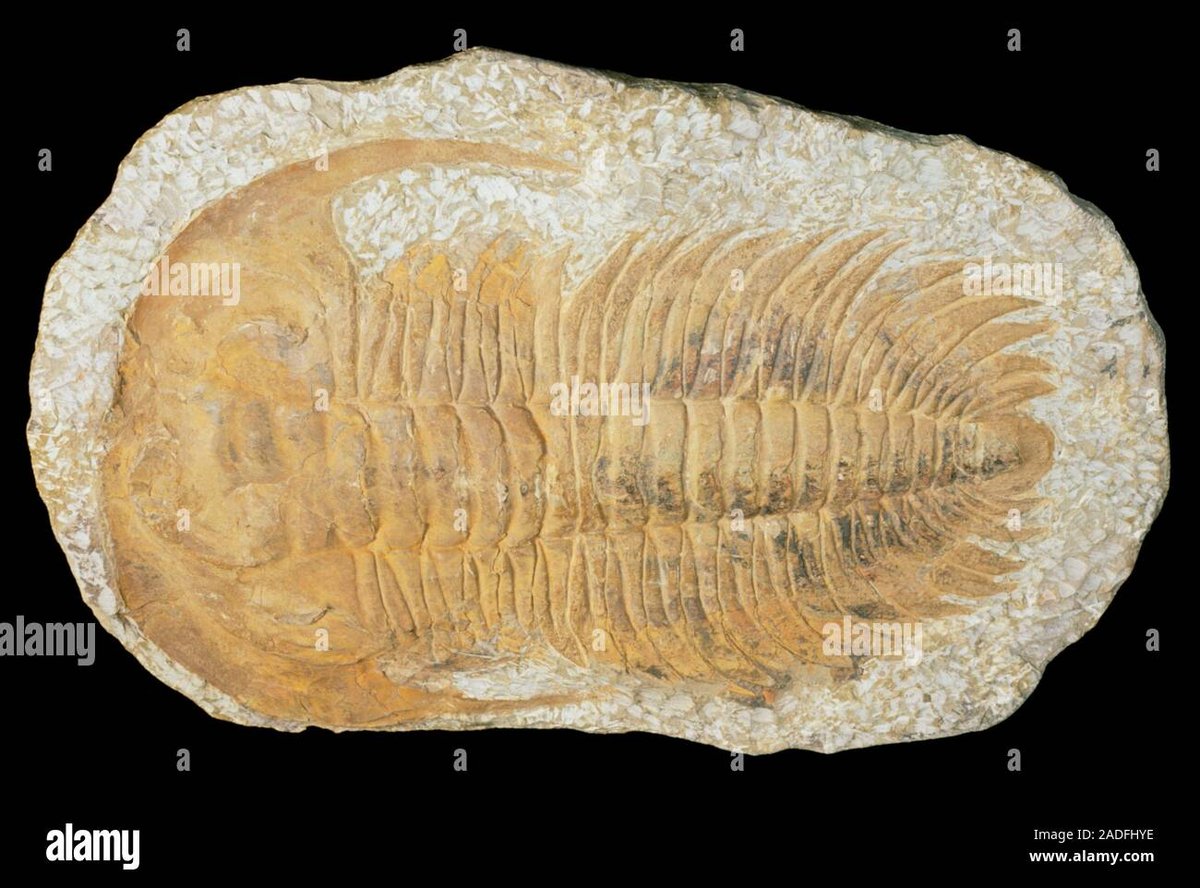
Paradoxides
Paradoxides davidis
Image: Image sourced via web search (Fair use / Educational)
About Paradoxides
Paradoxides davidis is an iconic species of trilobite, an extinct group of marine arthropods, that flourished during the Middle Cambrian Period, approximately 510 to 497 million years ago. As one of the largest known trilobites, its widespread and well-preserved fossils have made it a crucial index fossil for dating Cambrian strata and a key subject for understanding the explosive diversification of life known as the Cambrian Explosion. Its impressive size and distinctive features offer a profound glimpse into the complex ecosystems that emerged in Earth's ancient oceans over half a billion years ago.
Paradoxides davidis was a giant among its contemporaries, reaching impressive lengths of up to 45 centimeters (about 18 inches), with some less substantiated reports suggesting even larger individuals. This size is comparable to a modern dinner plate or a large horseshoe crab, making it one of the largest arthropods of the entire Paleozoic Era. Its body was dorsoventrally flattened, a typical trilobite characteristic, and was divided into three main sections, or tagmata: the cephalon (head), the segmented thorax, and the pygidium (tail). The cephalon was large and semicircular, dominated by prominent, crescent-shaped holochroal eyes composed of numerous calcite lenses. A key diagnostic feature of the genus Paradoxides is the large, forward-expanding glabella (the central raised lobe of the cephalon), which often bore faint furrows. Long, elegant genal spines extended backward from the corners of the cephalon, sometimes reaching as far back as the pygidium, likely serving a defensive or hydrodynamic function. The thorax was long and flexible, composed of 16 to 21 articulating segments, each bearing a pair of pleurae (lateral lobes) that terminated in sharp, backward-curving spines. The pygidium was notably small and fan-shaped relative to the large cephalon and thorax, a characteristic of the Redlichiida order. Like other trilobites, its dorsal exoskeleton was made of calcite, but no soft tissues have been preserved, so inferences about its limbs, gills, and antennae are based on exceptionally preserved relatives like Olenoides. It is presumed to have had numerous pairs of biramous (two-branched) limbs beneath its thorax, used for both walking and respiration.
Based on its morphology and the sedimentary environments where its fossils are found, the paleobiology of Paradoxides davidis is interpreted as that of a benthic (bottom-dwelling) organism. It likely inhabited the soft, muddy substrates of shallow to mid-depth continental shelf environments. Its flattened body shape and widely spaced legs would have been well-suited for crawling across the seafloor. The large eyes, positioned high on the cephalon, provided a wide field of view, suggesting it was an active creature, aware of its surroundings, perhaps to spot potential food or predators. Its diet is a subject of some debate. The absence of robust, crushing mouthparts suggests it was not an active predator of hard-shelled organisms. Instead, it is widely believed to have been a detritivore or a scavenger, feeding on organic debris, microbial mats, or the carcasses of other animals on the seabed. It may have used its numerous legs to stir up sediment, filtering out edible particles. Growth occurred through molting (ecdysis), where the trilobite shed its exoskeleton to increase in size. The distinct suture lines on the cephalon facilitated this process, allowing the facial plates to separate so the animal could emerge. The abundance of shed exoskeletons (exuviae) in the fossil record provides strong evidence for this growth pattern.
Paradoxides davidis lived in the oceans of the microcontinent Avalonia during the Middle Cambrian. At this time, Earth's geography was vastly different; most continental landmasses were clustered in the Southern Hemisphere, forming parts of the supercontinent Gondwana. Avalonia was a separate entity, located at temperate southern latitudes. The climate was generally warmer than today, with no significant polar ice caps, leading to high sea levels that flooded continental margins, creating extensive shallow epicontinental seas. These seas were the cradle of the Cambrian Explosion, teeming with a newly diverse array of life. Paradoxides shared its environment with other trilobites (such as Conocoryphe), primitive mollusks, sponges, brachiopods, and enigmatic organisms like Wiwaxia. As a large organism, an adult Paradoxides may have been an apex scavenger or detritivore in its local food web. However, it was not without threats. The top predator of the Cambrian seas was Anomalocaris, a large, swimming arthropod relative that could have preyed upon even large trilobites, potentially by flipping them over to attack their vulnerable underside. The prominent spines on Paradoxides likely served as a formidable defense against such attacks, making it a difficult and dangerous meal.
The discovery and history of Paradoxides davidis are deeply intertwined with the foundational years of geology and paleontology in the 19th century. The species was formally named by the British geologist John William Salter in 1863. However, the fossils themselves were known to quarrymen and local collectors in Wales for decades prior. The specific name, 'davidis', honors Thomas Davies, a mineralogist at the British Museum who recognized the significance of specimens being found. The type locality for the species is in the Menevian Beds of St Davids, Pembrokeshire, Wales. These discoveries were pivotal in the work of early geologists like Adam Sedgwick, who established the Cambrian System based on the rock layers in Wales. Paradoxides became a quintessential 'guide' or 'index' fossil for the Middle Cambrian because its fossils are abundant, geographically widespread (across Avalonia), and confined to a specific, narrow time interval. One of the most significant specimens is the 'Holotype' specimen, designated by Salter, which is housed in the collections of the Natural History Museum, London. This and other remarkably complete specimens from classic localities in Wales and Newfoundland helped define not just a species, but an entire geological age, demonstrating the power of fossils in unraveling Earth's history.
Paradoxides holds immense evolutionary significance as a prominent member of the Order Redlichiida, one of the earliest and most primitive groups of trilobites. The Redlichiids are considered basal to most later trilobite lineages, showcasing a suite of ancestral characteristics such as a large number of thoracic segments, a small pygidium, and prominent genal spines. The evolutionary success of Paradoxides and its relatives highlights the rapid adaptation and diversification of arthropods during the Cambrian Explosion. They represent a successful early experiment in arthropod body plans, achieving large size and ecological dominance long before other groups like crustaceans or insects. While trilobites as a whole have no direct living descendants, their closest modern relatives are the chelicerates, a group that includes horseshoe crabs, spiders, and scorpions. Studying the anatomy of Paradoxides, particularly its segmented body and jointed exoskeleton, provides crucial insights into the foundational bauplan from which the staggering diversity of all subsequent arthropods evolved. Its existence underscores the evolutionary principle of adaptive radiation, where a lineage rapidly diversifies to fill a wide array of ecological niches in a new environment—in this case, the newly complex Cambrian seafloor.
While the classification of Paradoxides davidis at the species and genus level is well-established, scientific debates continue regarding its precise lifestyle and the broader taxonomy of its family, the Paradoxididae. One area of discussion revolves around its feeding habits. While scavenging or detritivory is the consensus, some researchers have proposed that it might have been a specialized predator of soft-bodied worms or other infaunal organisms, using its legs to dig them from the sediment. Another debate concerns the function of its large, expanding glabella. Some paleontologists suggest it may have housed a large stomach or digestive glands, necessary to process low-nutrient sediment for food. Others propose it could have been related to sensory organs or even brood pouches for its young, though there is no direct evidence for the latter. Recent cladistic analyses have also refined the relationships within the Paradoxididae family, sometimes leading to reassignments of species among closely related genera. These ongoing studies, often employing new statistical and imaging techniques, continue to refine our understanding of this ancient arthropod's life and times.
The fossil record of Paradoxides davidis is robust and geographically widespread, though its distribution is constrained to the geological terrane of Avalonia. This means its fossils are famously found in specific locations that were once part of this microcontinent: South Wales (UK), the English Midlands, Eastern Newfoundland (Canada), and parts of Massachusetts (USA). The Manuels River Hibernia Interpretation Centre in Newfoundland is a world-renowned site where thousands of Paradoxides specimens, including some of the largest ever found, have been recovered from the Chamberlain's Brook Formation. Preservation quality is often good to excellent, with the durable calcite exoskeletons preserving fine details of the dorsal shield. Fossils are typically found as disarticulated parts—cephalons, thoracic segments, pygidia—as well as complete, articulated specimens, often representing individuals buried suddenly by sediment flows. The abundance of molted exuviae also contributes significantly to the fossil record, providing a more complete picture of the trilobite's life cycle than is available for many other extinct animals.
Due to its impressive size and classic 'trilobite' appearance, Paradoxides has a notable cultural impact, particularly within paleontological and geological circles. It is frequently featured in textbooks and museum exhibits as the quintessential example of a Cambrian organism and an index fossil. Major museums like the Natural History Museum in London, the Sedgwick Museum of Earth Sciences in Cambridge, and the Canadian Museum of Nature in Ottawa hold significant and often beautifully displayed specimens of Paradoxides davidis. Its discovery in Newfoundland is a point of regional pride, celebrated at the Manuels River site, which has been developed for both scientific research and public education. For the public, Paradoxides represents the strangeness and grandeur of early life, a tangible link to the dawn of the animal kingdom that continues to inspire awe and curiosity about Earth's deep past.
Classification
Time Period
Discovery
Location
Wales, United Kingdom
Formation
Menevian Group (specifically, the Menevian Beds)
Frequently Asked Questions
What is Paradoxides?
Paradoxides davidis is an iconic species of trilobite, an extinct group of marine arthropods, that flourished during the Middle Cambrian Period, approximately 510 to 497 million years ago. As one of the largest known trilobites, its widespread and well-preserved fossils have made it a crucial index ...
When did Paradoxides live?
Paradoxides lived during the cambrian period of the paleozoic era approximately 510-497 million years ago.
Where was Paradoxides discovered?
Fossils of Paradoxides were discovered in Wales, United Kingdom in the Menevian Group (specifically, the Menevian Beds).
What did Paradoxides eat?
Paradoxides was a detritivore or scavenger. It lived in marine, benthic habitats.
What type of fossil is Paradoxides?
Paradoxides is preserved as a body fossil. The preservation quality is good.
Related Specimens
From the paleozoic era · body fossils
/09c845a0ecb7.png)