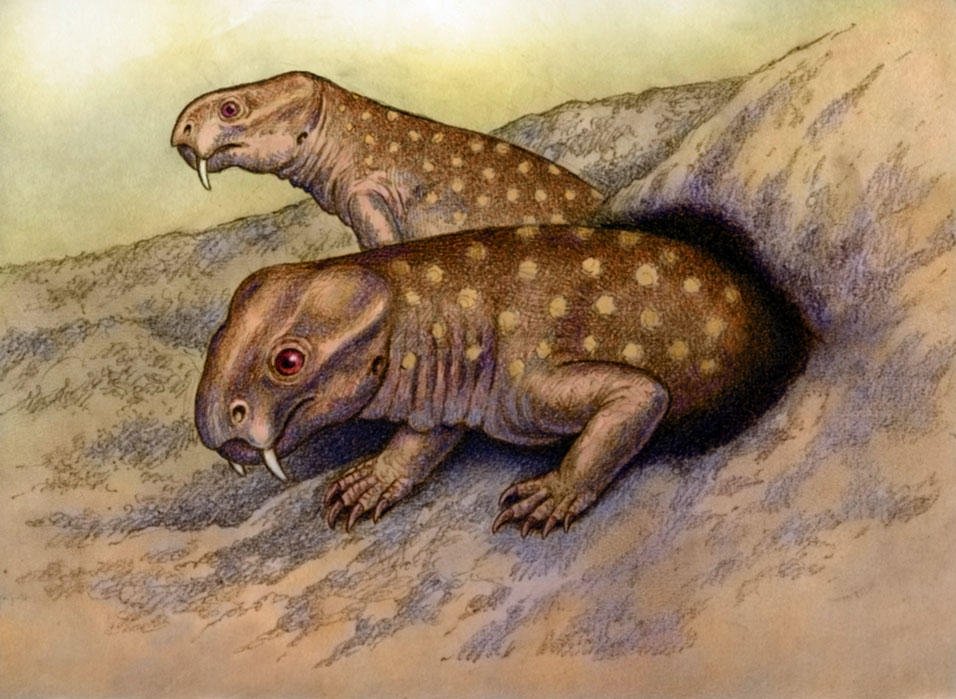
Diictodon
Diictodon feliceps
Image: Image sourced via web search (Fair use / Educational)
About Diictodon
Diictodon was a small, successful, and remarkably abundant herbivorous synapsid that thrived during the Late Permian period, approximately 260 to 252 million years ago. As a member of the dicynodonts, a group of tusked, mammal-like reptiles, it inhabited the vast, semi-arid floodplains of the supercontinent Pangaea, with its fossils being particularly numerous in what is now South Africa's Karoo Basin. Its unparalleled success, evidenced by its sheer numbers in the fossil record, makes Diictodon a crucial organism for understanding terrestrial ecosystems just before the catastrophic Permian-Triassic extinction event, the greatest mass extinction in Earth's history.
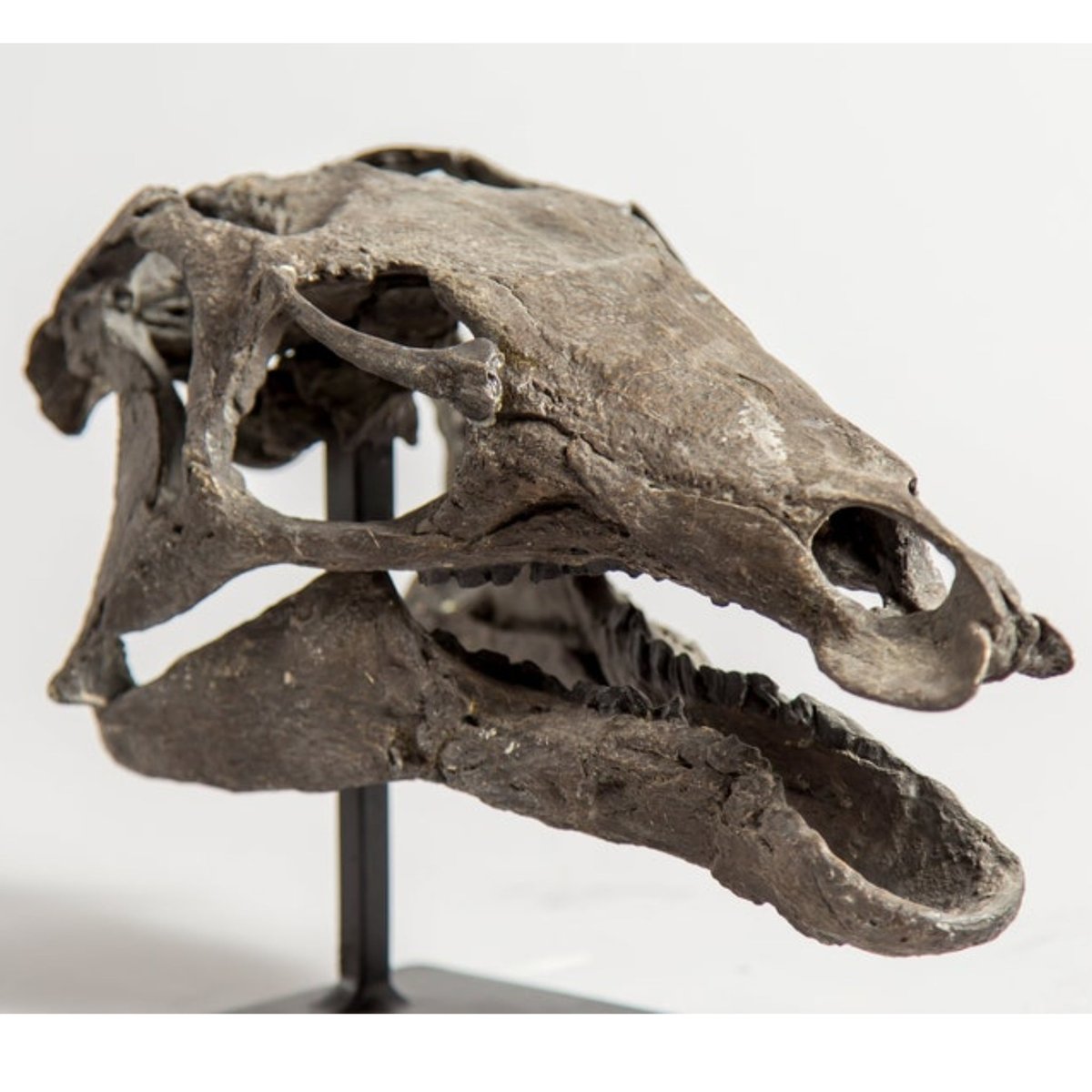
Diictodon was a diminutive creature, typically measuring about 45 centimeters (18 inches) in length, comparable in size to a modern prairie dog or a small badger. Its body was stout and barrel-shaped, supported by short, sprawling limbs that positioned it low to the ground. The skull was highly specialized and one of its most distinctive features. It was disproportionately large for its body, with a short, broad snout that terminated in a horny, turtle-like beak used for shearing tough plant material. The most prominent cranial feature was a pair of tusks, present in both males and females, though typically larger in males, suggesting a role in sexual display or defense in addition to feeding. These ever-growing tusks, which projected downwards from the upper jaw, were the only teeth Diictodon possessed, a hallmark of the dicynodont group. Its large eye sockets suggest it had good vision, and the structure of its inner ear indicates it could likely detect low-frequency sounds and ground vibrations, a useful adaptation for a burrowing animal. The skeleton was robust, with a strong pectoral girdle and powerful forelimbs equipped with five-fingered hands, well-suited for digging. Its overall build reflects a fossorial, or burrowing, lifestyle, a key to its survival and ecological success.
The paleobiology of Diictodon is exceptionally well-understood thanks to the abundance of its fossils, many of which are preserved in their burrows. It was a dedicated herbivore, using its sharp beak to crop low-growing vegetation like ferns, cycads, and horsetails, and its tusks to dig for nutritious roots and tubers. The powerful jaw muscles, anchored to a wide temporal fenestra (an opening in the skull behind the eye), would have provided a strong bite for processing fibrous plants. Diictodon is most famous for its extensive, corkscrew-shaped burrows, which could reach depths of up to 1.5 meters. These subterranean shelters would have provided protection from the harsh, semi-arid climate of the Late Permian, with its extreme temperature fluctuations, and offered a safe haven from predators like the formidable gorgonopsians. Fossil evidence of multiple individuals, including juveniles and adults, found together in these burrows strongly suggests that Diictodon was a social animal, possibly living in family groups or small colonies. This gregarious behavior, combined with its burrowing lifestyle, likely contributed significantly to its high survival rates. Its growth was relatively rapid, reaching adult size quickly, an advantageous trait in a high-predation environment.
Diictodon lived in the vast interior of the supercontinent Pangaea, an environment characterized by a semi-arid, seasonal climate. The landscape it inhabited, preserved today as the Beaufort Group of the Karoo Supergroup in South Africa, was a wide floodplain crossed by ephemeral rivers and dotted with sparse vegetation. This ecosystem supported a diverse fauna of therapsids. Diictodon occupied the niche of a small, primary consumer, feeding on the available low-lying flora. It was a crucial link in the food web, serving as a primary food source for a variety of predators. Its main threats came from large carnivorous therapsids, particularly the saber-toothed gorgonopsians like Gorgonops and Rubidgea, as well as the larger therocephalians. Diictodon's burrowing behavior was its primary defense against these apex predators. It coexisted with other herbivorous dicynodonts, such as the larger Oudenodon and the massive Aulacephalodon, suggesting a degree of niche partitioning where different species specialized in consuming different types of plants or plant parts. The sheer abundance of Diictodon indicates it was a keystone herbivore, profoundly shaping the plant communities through its grazing and digging activities and sustaining the predator populations that depended on it.
The discovery history of Diictodon is deeply intertwined with the rich paleontological exploration of South Africa's Karoo Basin. The genus was first described by the renowned British paleontologist Sir Richard Owen in 1876. Owen, a giant in the field of comparative anatomy who also coined the term 'dinosaur', based his description on fossil skulls sent to him from the Karoo. He named the type species Diictodon feliceps, with the genus name meaning 'two-weasel-tooth' in reference to its prominent tusks, and the species name 'feliceps' meaning 'cat-head', alluding to the shape of the skull. Since Owen's initial work, countless Diictodon fossils have been unearthed, making it one of the most common vertebrate fossils from the Late Permian. A particularly significant discovery was made by paleontologist Roger Smith in the 1990s, who found numerous fossils of Diictodon preserved within their helical burrows. These remarkable finds, which included skeletons of adults and juveniles together, provided unprecedented, direct evidence of the animal's fossorial and social behaviors, transforming our understanding of its life habits from speculation into observed fact. No single specimen has been given a popular nickname like 'Sue', as the animal is known from thousands of individuals rather than one iconic skeleton.
As a member of the Dicynodontia, Diictodon holds a significant place in the evolutionary history of synapsids, the group that includes modern mammals. Synapsids dominated terrestrial ecosystems during the Permian, and the dicynodonts were the most successful and diverse herbivorous clade within this group. Diictodon represents a highly specialized and successful branch of this lineage. Its anatomy showcases a mosaic of 'reptilian' and 'mammalian' traits. While it had a sprawling posture similar to reptiles, its differentiated dentition (specialized tusks and a beak), single temporal fenestra, and likely higher metabolic rate were steps on the evolutionary path towards mammals. The dicynodonts, including Diictodon, were part of the larger therapsid group, the 'mammal-like reptiles', which directly gave rise to the first true mammals in the Triassic. Although the Diictodon lineage itself did not survive the Permian-Triassic extinction, its close relatives did, and studying its biology provides critical insights into the adaptations that allowed synapsids to thrive and eventually give rise to the mammalian form. Its burrowing adaptation, in particular, is a fascinating example of convergent evolution, as many modern mammals in similar environments have adopted the same survival strategy.
Despite being a well-studied genus, Diictodon is not without its scientific debates, primarily concerning its taxonomy. Over the years, numerous species of Diictodon were named based on slight variations in skull morphology, particularly tusk size and presence. However, more recent and comprehensive studies, led by paleontologists like Christian Kammerer, have revised the genus significantly. It is now widely accepted that many of these supposed species were actually examples of individual variation, age differences, or sexual dimorphism within a single, highly variable species, Diictodon feliceps. The presence of tusks in both sexes, albeit larger in males, was a key finding that helped consolidate the taxonomy. Another area of ongoing research is the precise function of the tusks. While digging for food and defense are likely functions, their role in intraspecific combat or display, similar to the tusks of modern warthogs or elephants, is a subject of active discussion among paleontologists. The discovery of paired individuals in burrows has also fueled debate about whether they represent parent-offspring pairs, mated pairs, or simply communal denning, with each interpretation having different implications for their social structure.
The fossil record of Diictodon is nothing short of extraordinary. It is arguably the most common vertebrate fossil found in the Late Permian strata of the Karoo Basin in South Africa, which remains the primary location for its discovery. Fossils are so numerous that paleontologists sometimes use the abundance of Diictodon as a biostratigraphic marker to date rock layers. Tens of thousands of specimens are known, ranging from isolated skulls to complete, articulated skeletons. The quality of preservation is often excellent, thanks to the animals being rapidly buried in their burrows by river floods or sandstorms. This has led to the preservation of delicate structures and even entire family groups in life position, providing a unique snapshot of Permian life. These fossilized burrows, known as trace fossils, are as important as the body fossils themselves. While South Africa is the epicenter of Diictodon fossils, remains attributed to the genus or very close relatives have also been found in other parts of what was once Pangaea, including China, suggesting a widespread distribution for this highly successful animal.
In the realm of popular culture, Diictodon has not achieved the same level of fame as dinosaurs, but it holds a significant place in depictions of the Permian period. It was featured prominently in the 2005 BBC documentary 'Walking with Monsters', where it was portrayed as a plucky, burrowing survivor navigating a dangerous world dominated by gorgonopsians. This appearance helped introduce the creature to a global audience. Many natural history museums with significant Permian collections, such as the Iziko South African Museum in Cape Town and the Natural History Museum in London, feature excellent Diictodon fossils in their displays. Often, these exhibits include casts of their distinctive helical burrows, effectively illustrating their unique lifestyle. For educators and paleontologists, Diictodon serves as a perfect example of a successful pre-dinosaurian animal, showcasing the diversity of life before the age of dinosaurs and highlighting the importance of adaptation and behavior in evolutionary success.
Classification
Time Period
Discovery
Location
South Africa
Formation
Karoo Supergroup (specifically Beaufort Group)
Frequently Asked Questions
What is Diictodon?
Diictodon was a small, successful, and remarkably abundant herbivorous synapsid that thrived during the Late Permian period, approximately 260 to 252 million years ago. As a member of the dicynodonts, a group of tusked, mammal-like reptiles, it inhabited the vast, semi-arid floodplains of the superc...
When did Diictodon live?
Diictodon lived during the permian period of the paleozoic era approximately 260-252 million years ago.
Where was Diictodon discovered?
Fossils of Diictodon were discovered in South Africa in the Karoo Supergroup (specifically Beaufort Group).
What did Diictodon eat?
Diictodon was a herbivore. It lived in terrestrial habitats.
What type of fossil is Diictodon?
Diictodon is preserved as a body fossil. The preservation quality is excellent.
Related Specimens
From the paleozoic era · body fossils