Inostrancevia
Inostrancevia alexandri
Image: Image sourced via web search (Fair use / Educational)
About Inostrancevia
Inostrancevia was a genus of large, predatory therapsids known as gorgonopsians that roamed the Earth during the Late Permian period, approximately 260 to 252 million years ago. As one of the largest and most formidable carnivores of its time, it represents the apex of a lineage of 'mammal-like reptiles' that dominated terrestrial ecosystems long before the first dinosaurs. Its fossils, primarily found in what is now northern European Russia, provide a crucial window into the complex and ultimately doomed world that existed just prior to the Permian-Triassic extinction event, the most severe mass extinction in Earth's history.
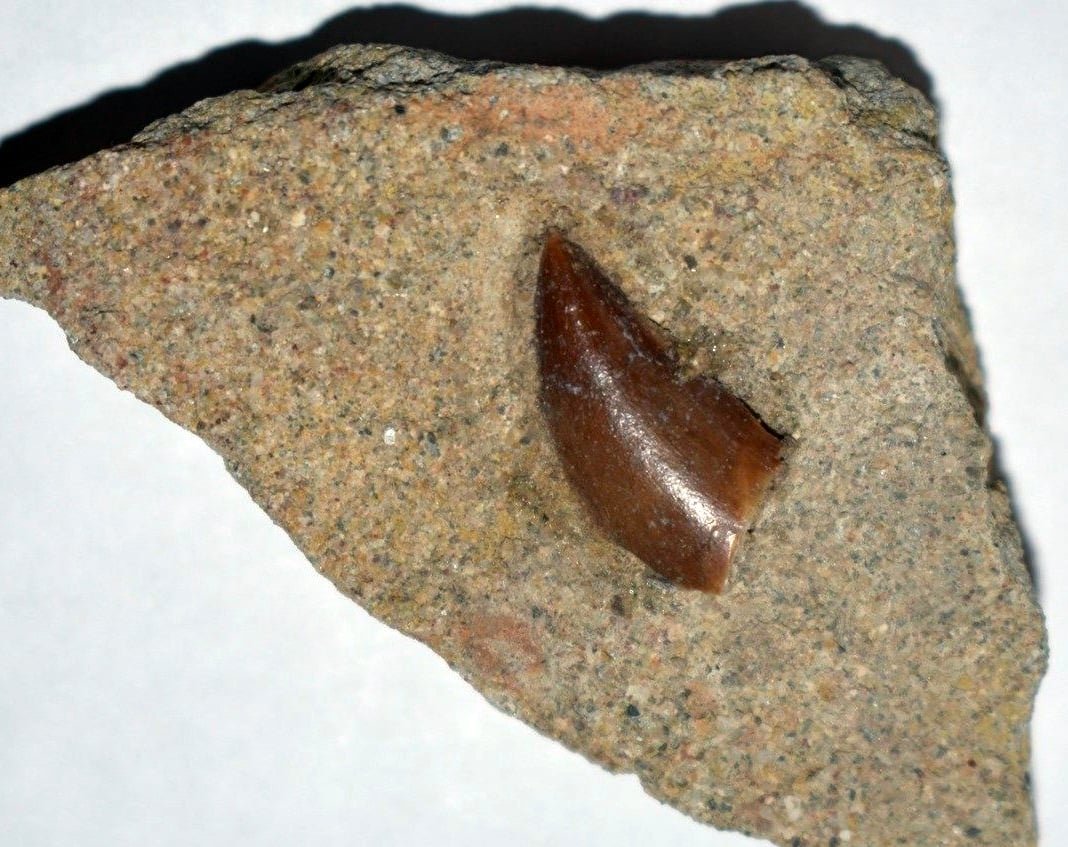
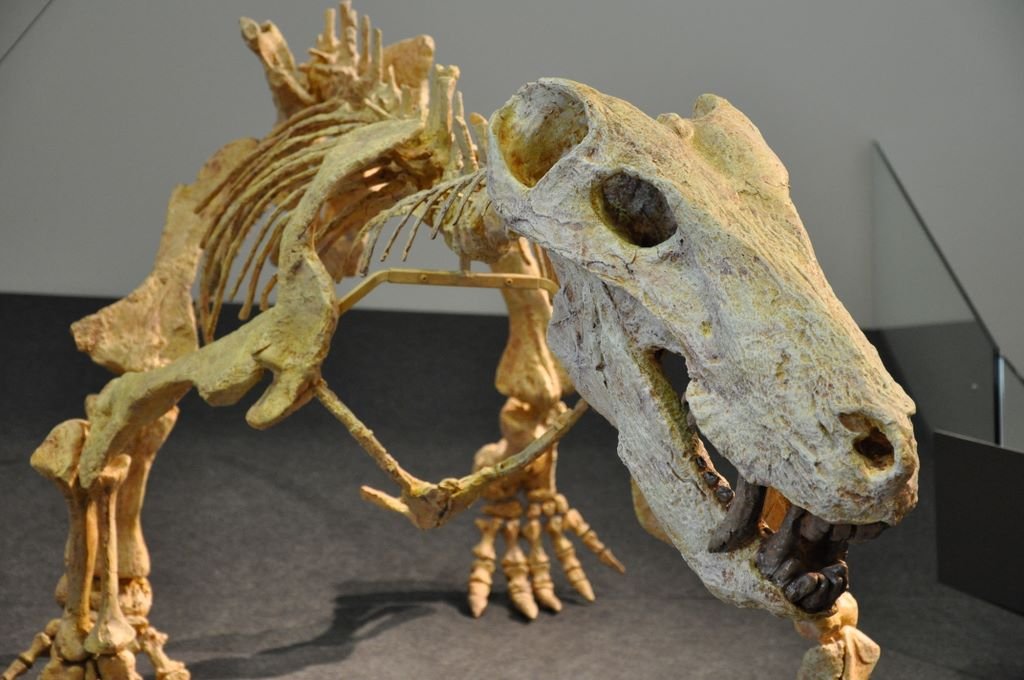
Inostrancevia was a powerfully built predator, reaching an estimated body length of up to 3.5 meters (11.5 feet) and a weight of around 300 kilograms (660 pounds), making it comparable in size to a modern Siberian tiger or a small bear. Its most striking feature was its elongated, deep skull, which could measure up to 60 centimeters (24 inches) long. This skull housed a formidable set of differentiated teeth, a hallmark of advanced synapsids. Most prominent were the enormous, saber-like canine teeth in the upper jaw, which could reach 15 centimeters (6 inches) in length. These were complemented by smaller, sharp incisors at the front for gripping and tearing, and simpler post-canine teeth along the jaw for processing flesh. The skull possessed large temporal fenestrae—openings behind the eye sockets—that anchored powerful jaw-closing muscles, indicating a devastatingly strong bite. Its skeleton was robust, with a semi-sprawling posture. The limbs were positioned more directly beneath the body than in more primitive reptiles, suggesting a more efficient and powerful gait, though it was likely not as fully erect as in later mammals or dinosaurs. This combination of size, weaponry, and improved locomotion cemented its status as a top-tier predator.
As an apex carnivore, Inostrancevia's paleobiology was centered around hunting large prey. Its saber-like canines were likely used in a similar manner to those of saber-toothed cats, employed to deliver a deep, fatal stabbing or slashing bite to the soft throat or underbelly of its victims. Analysis of its skull mechanics suggests it could open its jaws to an exceptionally wide gape, perhaps over 90 degrees, to effectively deploy these massive teeth. Its primary prey likely consisted of large herbivorous pareiasaurs like Scutosaurus and dicynodonts, which were abundant in the same ecosystems. Fossil evidence, including bite marks on Scutosaurus bones that match the dentition of gorgonopsians, supports this predator-prey relationship. Its locomotion, while more advanced than that of its pelycosaur ancestors, was probably suited for ambush predation or short, powerful bursts of speed rather than sustained pursuit. There is no direct evidence for social behavior, but like many large modern predators, it may have been a solitary hunter. Its metabolism is a subject of debate; as a therapsid, it was on the evolutionary line to mammals and may have possessed some degree of endothermy (warm-bloodedness), allowing for higher activity levels than a typical ectothermic reptile, which would have been essential for an active predatory lifestyle.
Inostrancevia lived during the Wuchiapingian and Changhsingian ages of the Late Permian, a time of significant environmental stress leading up to the great extinction. The supercontinent of Pangea dominated the globe, creating vast inland deserts and extreme continental climates with hot summers and cold winters. Inostrancevia inhabited the northern temperate regions of Pangea, in a floodplain environment characterized by a network of rivers and seasonal climate variations. This ecosystem, known from the Sokolki Assemblage in Russia, was a diverse but harsh landscape. The flora consisted of hardy plants like glossopterids and conifers. Inostrancevia sat at the very top of the food web, a position it fiercely maintained. Its main competitors were other large carnivores, such as the therocephalian Gorynychus, though Inostrancevia was the largest predator in its environment. Its primary food sources were the heavily armored, tank-like pareiasaur Scutosaurus and the large, tusked dicynodont Vivaxosaurus. The predator-prey dynamics of this ecosystem were intense, a final flourishing of the Paleozoic fauna before it was almost entirely wiped out by the cataclysmic volcanic activity of the Siberian Traps, which triggered runaway global warming and ocean anoxia, ending the Permian period and the reign of the gorgonopsians.
The discovery of Inostrancevia is credited to the Russian paleontologist Vladimir Prokhorovich Amalitsky, a visionary professor at Warsaw University who pioneered paleontological expeditions in northern Russia in the late 19th and early 20th centuries. Between 1899 and 1914, Amalitsky led excavations along the banks of the Northern Dvina River near the town of Kotlas in the Arkhangelsk Oblast. This region, known as the Sokolki locality, yielded a treasure trove of exceptionally well-preserved Late Permian fossils. Among the most spectacular finds were two nearly complete and articulated skeletons of a giant gorgonopsid. Amalitsky recognized their significance but tragically died in 1917 during the turmoil of the Russian Revolution before he could formally describe them. His work was posthumously published by his widow, Anna Amalitskaya, and the formal description was completed by paleontologist Aleksei Bystrow in the 1920s. The genus was named Inostrancevia in honor of the prominent Russian geologist Aleksandr Inostrantsev. The type species, I. alexandri, is based on one of the magnificent skeletons Amalitsky unearthed (specimen PIN 2005/1578), which remains one of the most complete gorgonopsid fossils ever found and is a centerpiece exhibit at the Paleontological Institute in Moscow.
Inostrancevia's evolutionary significance lies in its position as a highly derived member of the Gorgonopsia, a major clade within the Therapsida. Therapsids, in turn, are part of the larger group Synapsida, the lineage that ultimately gave rise to mammals. Inostrancevia therefore represents a crucial stage in the transition from early, reptile-like synapsids (like Dimetrodon) to modern mammals. It showcases a suite of advanced, mammal-like traits, including highly differentiated (heterodont) dentition with specialized incisors, canines, and post-canines; a more developed secondary palate that would have aided in breathing while eating; and a more upright limb posture for efficient movement. While not a direct ancestor of mammals (the gorgonopsian lineage was a side branch that went extinct), it exemplifies the evolutionary experimentation that was occurring within therapsids during the Permian. It demonstrates how synapsids evolved to become dominant, active, and complex terrestrial predators, filling ecological niches that would later be occupied by archosaurs (including dinosaurs) in the Mesozoic and, eventually, by predatory mammals in the Cenozoic. It is a powerful illustration of a successful evolutionary design that was cut short by a mass extinction event.
Despite its iconic status, Inostrancevia has been at the center of several scientific debates, primarily concerning its taxonomy and the number of valid species. For many years, several species were assigned to the genus, including I. latifrons and I. major, based on slight differences in skull proportions. However, more recent analyses, particularly by paleontologist Christian Kammerer in the 2010s, have suggested that these differences likely represent individual variation, sexual dimorphism, or changes during growth (ontogeny) within a single species, I. alexandri. Another area of discussion revolves around its hunting technique. While the saber-tooth stabbing model is widely accepted, the exact mechanics of the bite and the degree of jaw muscle power versus neck muscle power in delivering the fatal blow are still debated. Furthermore, a 2023 study proposed that some specimens previously assigned to Inostrancevia from South Africa actually represent a new genus, Atroxodon, suggesting that Inostrancevia itself may have been geographically restricted to Russia, challenging earlier ideas of a more widespread distribution across Pangea. This highlights the ongoing process of scientific revision as new fossils are found and new analytical techniques are applied.
The fossil record of Inostrancevia is geographically concentrated in the Arkhangelsk, Vologda, and Orenburg Oblasts of European Russia. The most famous and productive site is the Sokolki locality on the Northern Dvina River, which has yielded several remarkably complete and articulated skeletons. The preservation quality at this site is often good to excellent, with bones found in their natural life positions, providing invaluable information about the animal's anatomy and proportions. In total, a handful of partial to complete skeletons and several skulls are known, making Inostrancevia one of the best-understood of all gorgonopsians. These fossils are primarily housed at the Paleontological Institute of the Russian Academy of Sciences in Moscow and the Borissiak Paleontological Institute. The limited geographic range of confirmed fossils suggests it was an endemic predator of the northern Pangean temperate zone, though related gorgonopsids were widespread across the supercontinent. The completeness of the known specimens has made Inostrancevia a benchmark organism for studying the anatomy and evolution of the entire Gorgonopsia clade.
Inostrancevia has made a notable impact on popular culture, often appearing in documentary series about prehistoric life as the quintessential Permian apex predator. It has been featured in programs like the BBC's "Walking with Monsters" and "Primeval," where it is typically depicted as a ferocious, saber-toothed beast stalking its prey across a desolate Permian landscape. These portrayals have cemented its image in the public consciousness as one of the most formidable pre-dinosaurian carnivores. Several museums around the world feature casts or life-sized reconstructions of Inostrancevia, with the original skeletons in Moscow being the most significant display. Its dramatic appearance, with its massive saber teeth and powerful build, makes it a subject of fascination and a key educational tool for teaching about the strange and wonderful world that existed before the age of dinosaurs and the profound impact of mass extinctions on the history of life.
Classification
Time Period
Discovery
Location
Russia (Arkhangelsk Oblast)
Formation
Sokolki Assemblage of the Salarevskaya Formation
Frequently Asked Questions
What is Inostrancevia?
Inostrancevia was a genus of large, predatory therapsids known as gorgonopsians that roamed the Earth during the Late Permian period, approximately 260 to 252 million years ago. As one of the largest and most formidable carnivores of its time, it represents the apex of a lineage of 'mammal-like rept...
When did Inostrancevia live?
Inostrancevia lived during the permian period of the paleozoic era approximately 260-252 million years ago.
Where was Inostrancevia discovered?
Fossils of Inostrancevia were discovered in Russia (Arkhangelsk Oblast) in the Sokolki Assemblage of the Salarevskaya Formation.
What did Inostrancevia eat?
Inostrancevia was a carnivore. It lived in terrestrial habitats.
What type of fossil is Inostrancevia?
Inostrancevia is preserved as a body fossil. The preservation quality is good.
Related Specimens
From the paleozoic era · body fossils