Glyptodon
Glyptodon clavipes
Image: Category:Glyptodon fossils - Wikimedia Commons (CC BY-SA)
About Glyptodon
Glyptodon clavipes was a colossal, heavily armored mammal that inhabited the grasslands of South America during the Pleistocene epoch, from approximately 2.5 million to 10,000 years ago. As one of the most iconic members of the South American megafauna, this giant relative of modern armadillos played a crucial role in its ecosystem and its discovery was pivotal in the early development of evolutionary theory. Its immense size, unique defensive shell, and eventual extinction make it a subject of enduring paleontological fascination.
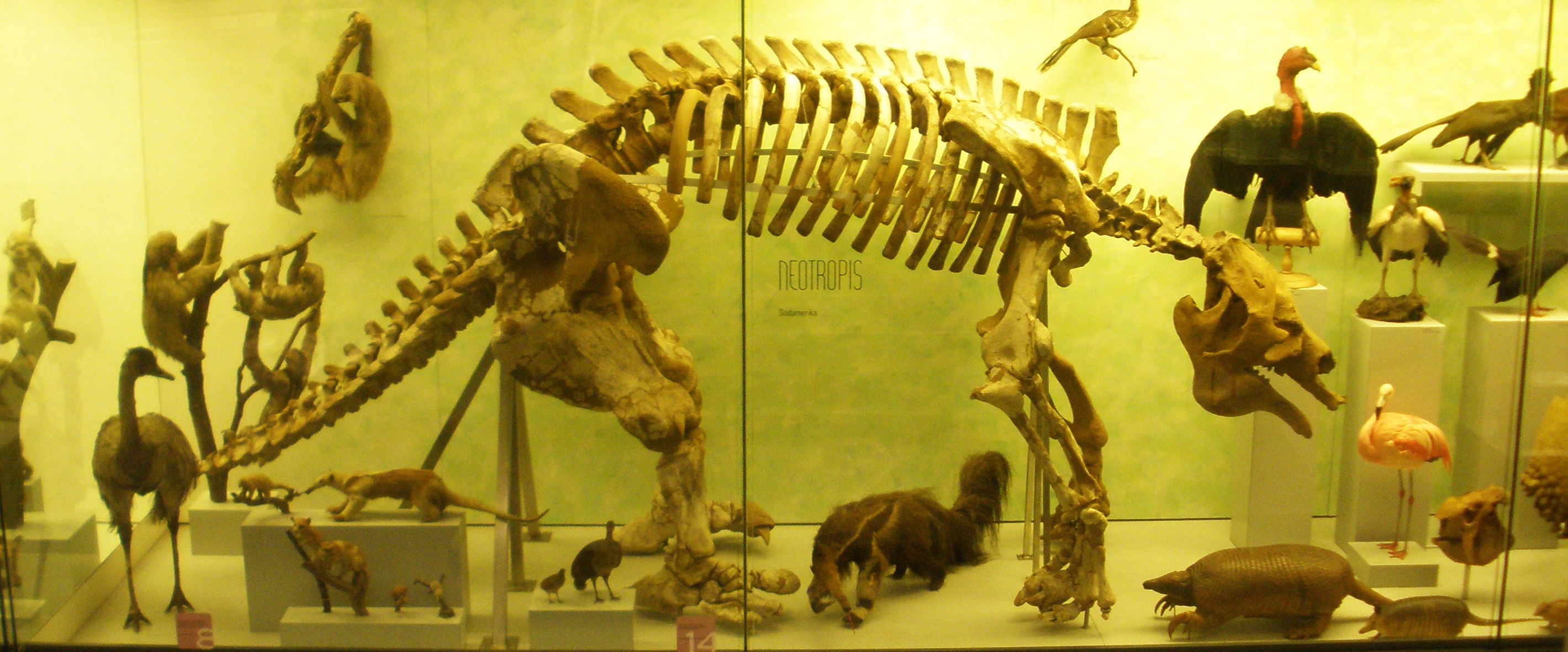
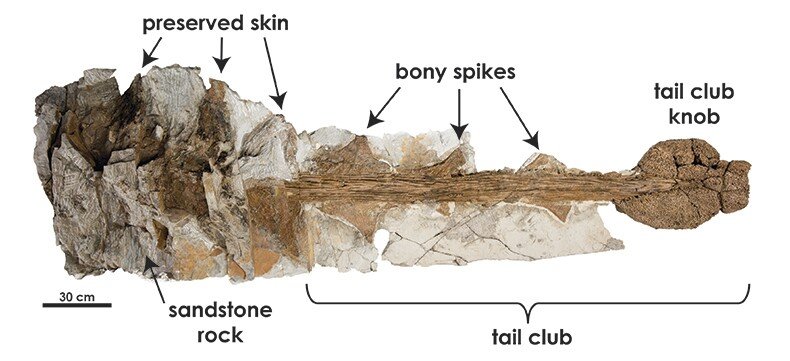
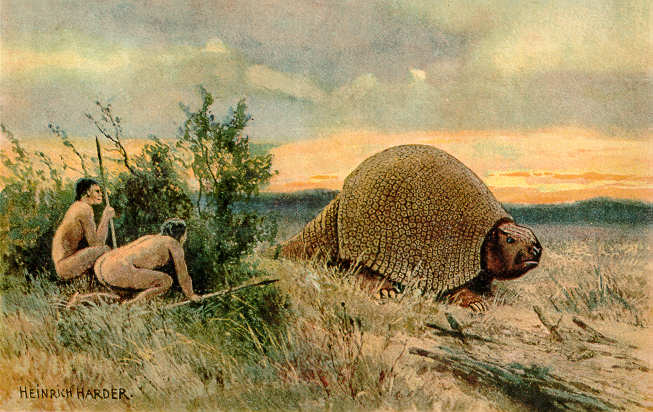
The most striking feature of Glyptodon was its enormous, rigid, dome-shaped carapace, a protective shell that has often been compared in size and shape to a modern Volkswagen Beetle. This remarkable structure, which could measure over 1.5 meters in length, was not composed of flexible bands like the shells of its living armadillo relatives. Instead, it was a solid, fused dome constructed from more than a thousand individual hexagonal bony plates called osteoderms, each intricately patterned. This shell alone could weigh over 400 kilograms, contributing significantly to the animal's total weight, which is estimated to have reached up to 2,000 kilograms (2 metric tons). The animal itself measured approximately 3.3 meters from head to tail. Beneath this impenetrable shield, Glyptodon possessed a robust skeleton with short, stout limbs designed to support its massive bulk. Its feet terminated in broad, hoof-like claws, providing a stable base for its slow, ponderous gait. The skull was deep and compact, with a shortened snout and a bony cap on its dorsal surface, offering additional protection. Its tail was also encased in a series of bony rings, culminating in a club-like structure in some related genera, though the tail of *G. clavipes* was primarily a defensive sheath without a terminal mace.
The paleobiology of Glyptodon reveals a creature exquisitely adapted to its role as a megaherbivore. Its deep jaw housed a set of continuously growing, high-crowned cheek teeth that lacked enamel, instead consisting of three layers of dentin and cementum that wore at different rates, maintaining a rough, grinding surface. This dental morphology, combined with powerful jaw musculature, indicates a diet of tough, fibrous vegetation. Isotope analysis of its fossilized remains confirms that Glyptodon was a grazer, feeding primarily on grasses and other low-lying plants abundant in the Pleistocene savannas. Its locomotion was necessarily slow and deliberate, a consequence of its immense weight and rigid body structure. Rather than relying on speed to evade predators, it would have hunkered down, retracting its limbs and head beneath the protective overhang of its carapace, rendering it virtually invulnerable to attacks from even the most formidable carnivores of its time. Biomechanical studies suggest that its limbs were pillar-like, supporting its weight with minimal muscular effort, a common adaptation in graviportal animals. Growth patterns inferred from the osteoderms suggest a relatively slow maturation rate, consistent with a life history strategy focused on defense and longevity.
Glyptodon thrived in the dynamic ecological landscape of Pleistocene South America, particularly in the vast, open grasslands and savannas of the Pampas region. During this period, the climate fluctuated between cooler, drier glacial periods and warmer, wetter interglacial periods, which directly influenced the distribution of vegetation and the composition of faunal communities. As a dominant primary consumer, Glyptodon played a significant role in shaping these ecosystems through its grazing activities, akin to modern-goliath herbivores like elephants or rhinoceroses. It shared its habitat with a spectacular array of other megafauna. Its primary predators would have included the formidable saber-toothed cat, *Smilodon populator*, and giant short-faced bears like *Arctotherium*. While adults were likely impervious to predation, juveniles may have been vulnerable. Glyptodon also coexisted with other giant herbivores, such as the ground sloths *Megatherium* and *Mylodon*, the camel-like *Macrauchenia*, and the bizarre, trunked litoptern *Toxodon*. This assemblage of large mammals created a complex food web where Glyptodon occupied the niche of a heavily defended, bulk-feeding grazer, relying on its armor rather than agility for survival in a world of giants.
The discovery history of Glyptodon is deeply intertwined with the foundational moments of paleontology and evolutionary biology. The first scientifically recognized fossils were unearthed in the early 19th century in the Luján Formation near Buenos Aires, Argentina. In 1823, a French naturalist named Auguste de Saint-Hilaire sent some osteoderms to Georges Cuvier in Paris, who initially misinterpreted them as belonging to the giant ground sloth *Megatherium*. However, it was the British naturalist and anatomist Sir Richard Owen who formally described and named the genus *Glyptodon* in 1839, a name derived from Greek meaning "carved tooth," in reference to the fluted, grooved appearance of its teeth. Owen's work was based on more complete specimens collected by Sir Woodbine Parish. Perhaps the most famous naturalist to encounter Glyptodon fossils was Charles Darwin, who, during his voyage on HMS Beagle in the 1830s, collected numerous fossil fragments from the Pampas. Darwin was struck by the resemblance of these giant armored fossils to the small, living armadillos of the same region. This observation became a cornerstone of his "law of succession of types," a key piece of evidence supporting the idea that species evolve from pre-existing, related forms within the same geographic area, a concept he would later elaborate upon in *On the Origin of Species*.
Glyptodon's place in the tree of life provides a spectacular example of evolutionary radiation and adaptation. It belongs to the superorder Xenarthra, a group of mammals largely endemic to the Americas that also includes modern sloths, anteaters, and armadillos. Within this group, Glyptodon is classified under the family Glyptodontidae, a lineage of large, heavily armored xenarthrans that diverged from the ancestors of modern armadillos tens of millions of years ago. Recent groundbreaking research using ancient DNA extracted from a fossil of the related genus *Doedicurus* has definitively confirmed that glyptodonts are not just a sister group to armadillos but are nested within the armadillo family tree itself. Specifically, they represent a subfamily, the Glyptodontinae, that is most closely related to the modern fairy armadillos (*Chlamyphorus*) and the giant armadillo (*Priodontes*). This discovery reshaped our understanding of xenarthran evolution, revealing that the immense size and rigid carapace of glyptodonts evolved from a much smaller, more flexible-shelled ancestor. The evolution of Glyptodon showcases an extreme adaptation towards defense, a successful strategy that allowed this lineage to flourish for millions of years across the Americas after the Great American Biotic Interchange.
Despite being a well-known fossil mammal, Glyptodon has been the subject of several scientific debates. For decades, the precise taxonomic relationship between glyptodonts and armadillos was contentious, with paleontologists debating whether they were a distinct, separate family or a specialized offshoot of armadillos. The aforementioned ancient DNA analysis published by Delsuc et al. in 2016 largely settled this debate, placing them firmly within the armadillo lineage. Another area of discussion revolves around the function of the tail. While some of Glyptodon's relatives, like *Doedicurus*, possessed a formidable spiked mace at the end of their tail, likely used for intraspecific combat or defense, the tail of *Glyptodon clavipes* was more simply armored with bony rings. The exact use of this less-specialized tail, whether for passive defense, display, or some other function, remains a topic of speculation. Furthermore, the precise cause of their extinction continues to be debated, with arguments weighing the relative impacts of rapid climate change at the end of the Pleistocene versus the arrival and hunting pressures of early humans, the Clovis people, in the Americas.
The fossil record of Glyptodon is exceptionally rich, particularly in the Pampas region of Argentina, Uruguay, and southern Brazil. The Luján Formation in Argentina has yielded a wealth of beautifully preserved specimens, including complete carapaces, skulls, and postcranial skeletons. These fossils are often found in fluvial deposits, suggesting the animals lived near rivers and floodplains. The preservation quality is frequently remarkable, with some carapaces found almost entirely intact, allowing for detailed study of their structure and biomechanics. The sheer number of specimens has enabled paleontologists to study population-level variations and ontogenetic changes. Famous paleontological sites like the cliffs near Mar del Plata in Argentina have provided a continuous record of Glyptodon and its contemporaries, offering a clear window into the Pleistocene ecosystem. The abundance of these fossils has made Glyptodon one of the best-understood members of the South American megafauna.
Due to its bizarre and impressive appearance, Glyptodon has had a significant cultural impact. Its massive, dome-like shell makes it an instantly recognizable and popular exhibit in natural history museums around the world, including the American Museum of Natural History in New York and the Natural History Museum in London. These imposing skeletons serve as powerful educational tools, captivating the public and illustrating the incredible diversity of extinct megafauna. Glyptodon frequently appears in popular science books, documentaries about prehistoric life, and even in fiction and video games, often depicted as a gentle, armored giant of a lost world. It stands as a powerful symbol of the unique evolutionary history of South America and a stark reminder of the profound ecological changes that occurred at the end of the last ice age.
Classification
Time Period
Discovery
Location
Pampas region, Argentina
Formation
Luján Formation
Frequently Asked Questions
What is Glyptodon?
Glyptodon clavipes was a colossal, heavily armored mammal that inhabited the grasslands of South America during the Pleistocene epoch, from approximately 2.5 million to 10,000 years ago. As one of the most iconic members of the South American megafauna, this giant relative of modern armadillos playe...
When did Glyptodon live?
Glyptodon lived during the quaternary period of the cenozoic era approximately 2.58-0.01 million years ago.
Where was Glyptodon discovered?
Fossils of Glyptodon were discovered in Pampas region, Argentina in the Luján Formation.
What did Glyptodon eat?
Glyptodon was a herbivore. It lived in terrestrial habitats.
What type of fossil is Glyptodon?
Glyptodon is preserved as a body fossil. The preservation quality is excellent.
Related Specimens
From the cenozoic era · body fossils