Mixosaurus
Mixosaurus cornalianus
Image: Image sourced via web search (Fair use / Educational)
About Mixosaurus
Mixosaurus cornalianus is an extinct species of early marine reptile belonging to the order Ichthyosauria, which thrived during the Middle Triassic period, approximately 245 to 235 million years ago. Its name, translating literally to 'mixed lizard,' perfectly encapsulates its transitional evolutionary status, bridging the anatomical gap between the more primitive, eel-like early ichthyosaurs and the highly specialized, dolphin-like forms that would dominate the later Mesozoic oceans. Primarily discovered in the exceptionally preserved fossil beds of the Monte San Giorgio region along the border of modern-day Italy and Switzerland, Mixosaurus represents one of the most abundant and well-studied marine reptiles of the Triassic. Its extensive fossil record has provided paleontologists with an unparalleled window into the early adaptation of terrestrial reptiles to a fully pelagic lifestyle, making it a cornerstone taxon for understanding the evolutionary trajectory of the ichthyosaur lineage.
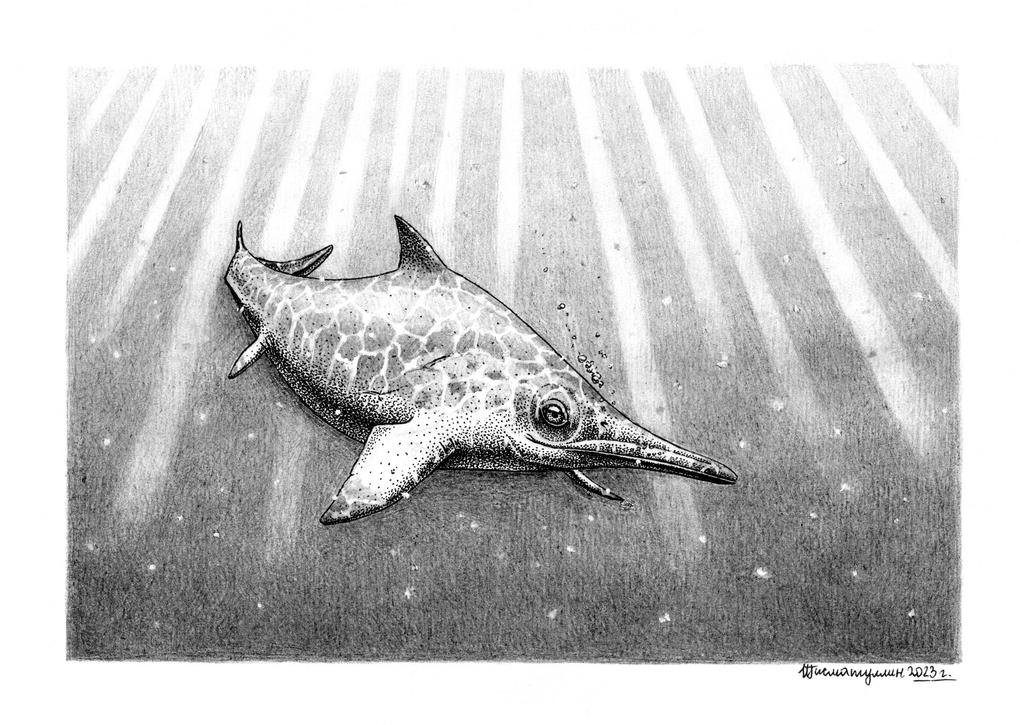
In terms of physical description, Mixosaurus cornalianus was a relatively small marine reptile, with most adult specimens measuring between 100 and 200 centimeters in total body length, roughly comparable in size to a modern harbor porpoise or a large salmon. Weight estimates suggest a living mass of approximately 10 to 20 kilograms, depending on the age and exact length of the individual. The anatomy of Mixosaurus is characterized by a fascinating mosaic of primitive and derived features. It possessed a long, streamlined body that was less rigid and less deep than the barrel-shaped torsos of later Jurassic ichthyosaurs like Ophthalmosaurus. The skull was elongated and tapering, equipped with a distinct heterodont dentition; the anterior teeth were sharp and conical for grasping slippery prey, while the posterior teeth were more robust and blunt, suited for crushing. Unlike later ichthyosaurs that possessed a pronounced, crescent-shaped dorsal fin, Mixosaurus had a much lower, longer ridge along its back, supported by specialized neural spines. Its limbs were modified into flippers, but they retained distinct, individualized digits (hyperphalangy was present, but not to the extreme degree seen in later forms), indicating a less specialized hydrofoil structure. The tail was particularly notable; it featured a slight downward bend at the posterior end, creating a primitive, asymmetrical heterocercal tail fin. This contrasts sharply with the highly symmetrical, lunate tail flukes of advanced ichthyosaurs. Soft tissue preservation in some exceptional specimens from Monte San Giorgio has revealed the outline of the body, confirming the presence of a small dorsal ridge and a distinct, albeit primitive, upper tail lobe composed entirely of soft tissue, providing crucial insights into the early stages of aquatic streamlining in this remarkable clade.
Paleobiological analyses of Mixosaurus cornalianus reveal a highly active, fully marine predator adapted to the shallow, warm waters of the Tethys Sea. Its diet, inferred from its specialized heterodont dentition and fossilized stomach contents, primarily consisted of small fish and cephalopods, such as early belemnites and ammonites. The sharp front teeth were perfectly adapted for snagging fast-moving, slippery prey, while the blunter back teeth could crush the shells of small invertebrates. Locomotion in Mixosaurus is a subject of intense biomechanical study. Because its body was more elongated and its tail less specialized than later ichthyosaurs, it likely employed a sub-carangiform swimming style. This means it generated thrust by undulating the posterior half of its body and tail, rather than relying solely on the stiff, rapid oscillation of a lunate tail fluke (thunniform locomotion) seen in later, faster-swimming ichthyosaurs. This swimming method suggests that while Mixosaurus was a capable swimmer, it was likely an ambush predator or a pursuit predator of moderately fast prey, rather than a high-speed pelagic cruiser. Social behavior is difficult to infer directly from fossils, but the sheer abundance of Mixosaurus remains in localized deposits suggests they may have congregated in large numbers, perhaps for breeding or feeding in nutrient-rich coastal waters, similar to modern schooling fish or pods of small cetaceans. Growth patterns, studied through bone histology, indicate a rapid initial growth rate, a common adaptation in marine reptiles to quickly reach a size that minimizes predation risk. Furthermore, the high growth rates and the necessity of sustaining an active, pelagic lifestyle strongly suggest that Mixosaurus, like later ichthyosaurs, possessed an elevated metabolism, likely achieving some degree of endothermy or regional heterothermy to maintain body temperature in varying water conditions.
The ecological context of the Middle Triassic world was one of recovery and evolutionary experimentation following the devastating Permian-Triassic extinction event. Mixosaurus inhabited the western margins of the Tethys Ocean, a vast equatorial sea that separated the northern supercontinent of Laurasia from the southern supercontinent of Gondwana. The specific environment represented by the Monte San Giorgio deposits was a complex system of shallow, warm, and highly productive intraplatform basins surrounded by carbonate reefs. The climate was generally warm and equable, with little evidence of polar ice caps. In this vibrant marine ecosystem, Mixosaurus occupied a mid-level position in the food web. It shared its habitat with a diverse array of marine life, including early sauropterygians like the long-necked pachypleurosaurs (e.g., Neusticosaurus) and the larger, apex predator nothosaurs (e.g., Ceresiosaurus). The waters teemed with actinopterygian (ray-finned) fishes, coelacanths, and a rich invertebrate fauna of bivalves, gastropods, and cephalopods. While Mixosaurus preyed upon the smaller fish and cephalopods, it was itself likely preyed upon by the larger nothosaurs and early, massive ichthyosaurs like Cymbospondylus, which patrolled the deeper waters adjacent to the shallow basins. The dynamic predator-prey relationships in this environment drove rapid evolutionary arms races, contributing to the increasing specialization and aquatic adaptation seen in the marine reptile lineages of the Triassic.
The discovery history of Mixosaurus is deeply intertwined with the rich paleontological heritage of the Alpine region of Europe. The genus was first erected by the eminent paleontologist George Baur in 1887, based on fragmentary remains that had been previously assigned to other genera. However, the true significance and detailed anatomy of Mixosaurus cornalianus were brought to light through extensive excavations at Monte San Giorgio, a UNESCO World Heritage site straddling the border of Switzerland and Italy. The specific epithet 'cornalianus' honors Emilio Cornalia, a prominent 19th-century Italian naturalist who contributed significantly to the early study of the region's fossils. Throughout the late 19th and entire 20th centuries, systematic quarrying of the bituminous shales of the Besano Formation yielded thousands of Mixosaurus specimens. These excavations, often led by institutions such as the University of Zurich and the Natural History Museum of Milan, uncovered articulated skeletons of breathtaking completeness. Unlike isolated bones found in many other fossil sites, the anoxic (oxygen-poor) conditions at the bottom of the Triassic intraplatform basins prevented scavenging and decay, allowing for the preservation of delicate articulated skeletons and, occasionally, the carbonized outlines of soft tissues. Key specimens, though rarely given colloquial nicknames like 'Sue' the T. rex, are meticulously cataloged in museum collections, with certain exceptionally preserved slabs serving as the holotypes and neotypes that anchor the anatomical definition of the entire Mixosauridae family.
The evolutionary significance of Mixosaurus cannot be overstated; it is the quintessential transitional fossil within the ichthyosaur lineage. Before the discovery of well-preserved early Triassic forms, the origin of ichthyosaurs was shrouded in mystery, as Jurassic forms appeared highly specialized and fully adapted to marine life, with no obvious terrestrial ancestors. Mixosaurus bridges this gap. It retains primitive features from its terrestrial ancestors, such as a relatively long zeugopodium (the lower limb bones, radius/ulna and tibia/fibula) and distinct, separated digits, while simultaneously exhibiting derived features necessary for a pelagic lifestyle, such as a streamlined skull, polydactyly (extra digits, though limited compared to later forms), and the beginnings of a tail fluke. By studying Mixosaurus, paleontologists have been able to map the step-by-step anatomical transformations that occurred as reptiles returned to the sea. It demonstrates that the evolution of the iconic, dolphin-like ichthyosaur body plan was not sudden but occurred through a gradual accumulation of adaptations over millions of years. Mixosaurus sits at the base of the Merriamosauria clade, representing a successful, globally distributed radiation of middle Triassic ichthyosaurs that set the anatomical stage for the massive, apex-predator ichthyosaurs of the Late Triassic and the highly efficient, thunniform cruisers of the Jurassic and Cretaceous periods.
Despite its abundance, Mixosaurus remains the subject of ongoing scientific debates and revisions. One major area of contention has been its exact taxonomic placement and the internal relationships of the Mixosauridae family. Over the decades, numerous species from around the globe (including North America and Asia) were assigned to the genus Mixosaurus, leading to a 'wastebasket taxon' situation. Recent rigorous cladistic analyses and re-evaluations of the fossil material have led to the splitting of the genus, with many species being reassigned to new genera like Phalarodon. The debate over its swimming mechanics also continues; while the sub-carangiform model is widely accepted, the exact degree of flexibility in its vertebral column and the hydrodynamic efficiency of its primitive tail fluke are still actively modeled using modern computational fluid dynamics. Furthermore, the interpretation of its soft tissue preservation, particularly the exact shape and function of the dorsal ridge versus a true dorsal fin, remains a topic of lively discussion among marine reptile specialists, as new imaging technologies like UV light and synchrotron scanning reveal previously unseen details in historical specimens.
The fossil record of Mixosaurus cornalianus is one of the most robust for any Triassic marine reptile. The vast majority of specimens are concentrated in the Middle Triassic (Anisian to Ladinian stages) deposits of the Besano Formation and the overlying Meride Limestone at Monte San Giorgio. The preservation quality is frequently exceptional; the anoxic bottom waters of the ancient lagoons prevented decomposition and scavenging, resulting in fully articulated skeletons pressed flat into the shale. These fossils often preserve not just the complete osteology, including delicate elements like the sclerotic rings in the eyes and the fragile bones of the palate, but also stomach contents and, crucially, soft tissue outlines. The sheer volume of specimens—numbering in the thousands across various museum collections in Europe—allows for robust statistical analyses of population dynamics, growth series (ontogeny), and morphological variation, making Mixosaurus a model organism for studying Triassic marine ecosystems.
In terms of cultural impact, while Mixosaurus may not possess the household name recognition of Tyrannosaurus rex or Triceratops, it holds a place of profound reverence within the paleontological community and among enthusiasts of marine reptiles. It is a star attraction at several major European institutions, most notably the Paleontological Museum of Munich, the Natural History Museum of Milan, and the dedicated fossil museum in Meride, Switzerland. The beautifully prepared, complete slabs of Mixosaurus are frequently used in educational exhibits to illustrate the concept of convergent evolution and the transition of life from land to sea. The public fascination with Monte San Giorgio, driven in large part by the exquisite fossils of Mixosaurus, was instrumental in the site being designated a UNESCO World Heritage site, ensuring the protection and continued scientific study of this invaluable window into the Triassic world.
Classification
Time Period
Discovery
Location
Italy and Switzerland border region
Formation
Besano Formation
Frequently Asked Questions
What is Mixosaurus?
Mixosaurus cornalianus is an extinct species of early marine reptile belonging to the order Ichthyosauria, which thrived during the Middle Triassic period, approximately 245 to 235 million years ago. Its name, translating literally to 'mixed lizard,' perfectly encapsulates its transitional evolution...
When did Mixosaurus live?
Mixosaurus lived during the triassic period of the mesozoic era approximately 245-235 million years ago.
Where was Mixosaurus discovered?
Fossils of Mixosaurus were discovered in Italy and Switzerland border region in the Besano Formation.
What did Mixosaurus eat?
Mixosaurus was a carnivore. It lived in marine habitats.
What type of fossil is Mixosaurus?
Mixosaurus is preserved as a body fossil. The preservation quality is exceptional.
Related Specimens
From the mesozoic era · body fossils